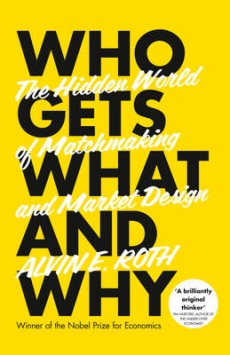
Who Gets What – And Why: The Hidden World of Matchmaking and Market Design is a book by Nobel laureate Alvin E. Roth on market design.
He begins by pointing out that not all markets are money driven. Community markets commonly are. Food for example will typically rise and fall in price depending on supply and demand. It’s relatively simple. Many markets are matching markets however. These involve much more complicated transactions.
Take the job market for example. This is not simply supply and demand. You have to both want to go work for a company, and the company has got to want you. I cannot simply turn up at Google’s offices and announce I am starting work. Nor can they demand I come work for them. We have to be matched by agreement. This is common – university applications and martial partners are good examples. These are major issues in our lives.
He then states that a free market is one that works well because of strict rules. The free market is not one where people can do whatever they want but one were the players find a safe environment in which to transact.
This is often not the case in matching markets. Take school applications for example. When I was a kid we lived next to an okay school. However, I wanted to go a better school down the road. The risk was that if I put the good school as first preference and the close school as second preference, I would fail to get into the top school because they had other priority students and fail to get into the okay school because it was over-subscribed from people who had put it as their first preference.
Typically people will instead put the okay school as their first preference to play it safe. This is bad market design because it does not allow participants to express their true preference and often not to get what they actually wanted.
Can you fix this by implementing a market that allows people to express their true preference without the risk? It turns out you can!
Roth describes a multi-round matching algorithm that makes this possible. Here is how it could work for a school system:
- Parents list their true preferences for the schools they want
- Round one starts and each school makes offers based on the students that each school wants (typically based on proximity, or perhaps test results)
- Each student tentatively accepts the the best offer according to their preference
- In round two, the school makes new offers based on the places freed up from rejected offers in the previous round
- Students can then switch their offers if they get a better one, or hold on to their existing offer
- Rounds repeat until there is a stable match for as many people as possible
I am unlikely to have done the algorithm justice. I’m not a Nobel laureate – buy the book if you want to understand it. However, the outcome is that people can list their true preferences without the risk of losing out and everyone gets the best match possible.
Let us take continue with my school problem. I list the good school first and the okay school second. Under a traditional system I could miss out on both. Under this system, it does not matter that I listed my true preferences because the okay school would make me an offer in round one, which even if I didn’t get an offer from the good school, I could still accept. In addition it works better for the schools because the multi-round system means they get the students they most desire who also want to go attend them. Everyone comes out on top so it is in both parties interest to take part.
He also discusses unravelling. This is where a market moves further and further forward. Graduate recruitment is a good example of this. If you wait until people have finished their degree to make a job offer, they have often taken another offer. So you begin making offers earlier, and then everyone does it earlier, so you move even earlier. In the end you are making offers after their first year, without any guarantee they are going to get a good degree at the end!
The university American football bowls were a good example of this. They would often make deals with teams before the year had finished. These teams would then go on to lose a few games and thus the bowls would end up with mediocre teams in the “play-offs”. Exposing limits typically does not work. That is to say “nobody makes offers until this date” participants typically ignore it or make informal deals.
A better solution is to redesign the market so that it is not in their advantage to go early and begin the process of unravelling. In the case of the bowl series, the five major bowls combined to rotate who gets the biggest championship game each year. Getting the top teams and thus far higher viewing figures makes it well worth them only getting it one in five times.
Controls on markets rarely work as well as a well designed market. Take prohibition in the US for example. It didn’t stop people drinking, it just created a black market. Organised crime got involved. This is a big problem because when prohibition ended, the criminals didn’t stop being criminals, they just did something else.
This might be a good lesson for the war on drugs. Not only it is obviously failing to control drug use and supporting organised criminal activity, but even if we decriminalised drugs, which the evidence shows is clearly a good thing, we would also have the legacy of organised crime to mop up.
A better market is also a thicker market. One where there are plenty of buyers and sellers that can be matched. There are a number of ways to do this.
Commoditisation is one. Take coffee for example. If everyone sells individual coffee you need to build up a relationship with each coffee grower to ensure their quality is high. But if you implement national standards and grading, people can buy a specific grade coffee without this information. You can even have a futures market.
Money can be a useful tool for easing congestion in a crowded market. Ticket reselling sites are a good example of this. The ticket market is broken. Gig tickets are typically sold all at one price, even though some people want to attend an event so much that they would be willing to pay a premium. Ideally this would be done at the original point-of-sale, but it isn’t, so the ticket resale market has sprung up to fix this.
Speed is also important. eBay is a good example of this. They have transitioned from an auction format which takes time and there is no guarantee you will win. Now, most transactions are Buy It Now, matching buyers and sellers instantly. Their feedback system is also an example of an evolving market. Initially people would always leave positive feedback for sellers, because otherwise the seller would retaliate. Now, only buyers can leave feedback, so they are free to be honest about bad experiences.
Filtering can also be an issue in over-crowded markets. If you are an attractive woman in online dating, you may receive more messages than you can respond to. Or for popular jobs, a company will receive more applicants than it can sort through. Roth suggests that one way in which a degree can be valuable is almost like a peacock’s tail. If you can show you can deliver on a three year project, it doesn’t matter that it might not be relevant to the job you apply for.
In summary, many markets are not just simple money-driven commodity markets. matching markets are complex and often do not work well or safely. This is a major problem because matching markets affect huge areas of our lives – education, jobs and love! Therefore it is important that we design these markets in such a way as to make them work as well as possible for all participants. Importantly, it is possible to do this with good market design.