The Moral Arc
Wednesday, September 23rd, 2015 | Books
In his 2015 book The Moral Arc, Michael Shermer sets out to explain how science and reason have guided moral values throughout history and continue to do so to this day.
The arc represents the expanding moral sphere. Historically, on an evolutionary timescale, we would have mostly been concerned with ourselves and our offspring. As time goes on, this expands to our family, to the wider community, to all humanity, and now to all conscious beings.
As Shermer correctly points out, it is going in the right direction. We live in the safest time to be alive – even if it doesn’t always feel that way! There are less wars, we are wiping out slavery, homicide rates are at an all time low, rape is outlawed in the west and torture is illegal. Violent crime goes down year on year. Traditionally many of these things were common, and even legal!
One of the reasons for this is a better understanding of the world. If you think one of the women in your village is a witch, and that she is causing your crops to fail, the rational thing to do is to burn her. It’s horrible, but it is a mistaken fact about the world, rather than people being moral. Of course the causes of the witch trials were numerous and complex, but Shermer argues that this contributing role, which can be seen throughout history has a large impact, and explains why we become more moral as we gain a better scientific understanding of how the world works.
Slavery is a good example of this. Much of the slave trade was supported by the claim that black people were not humans. Now, with out understanding of evolution and generics, this view cannot be supported by evidence, so the moral argument for slavery (and a moral argument did used to be made in favour of it!) collapses.
Another reason is increased intelligence. Shermer claims that our IQ raises approximately 3 points every decade (though IQ tests are normalised so the actual number remains consistent). This and better education allows us to conceptualise other people’s feelings more and more, and thus expand our moral sphere to today where we can consider how a factory-farmed chicken might feel.
Interestingly, some studies show that reading fiction can improve your ability to empathise. Maybe all that time is not wasted after all.
Morality is a survival technique. It allow us to act altruistically while punishing freeloaders. As humans, we survive better when we work together for common good. However, to stop people taking advantage of this, morality evolves to stop people taking advantage of this.
The book discusses expensive signalling. For example, pirates. Why would a pirate ship fly a pirate flag, telling everyone they are pirates? Surely that increases the chance of the navy spotting them and gives ships a warning when they approach? Shermer suggests the answer is that they wanted people to be scared.
Pirates are not the drunken disorganised ramble you imagine. They were very well organised, had strict rules, a chain o’ command and even constitutions! Why? It was the only way they could run a ship and turn a profit. However, by creating this false impression and being so bold as to fly a pirate flag they convinced many ships to surrender without violence. This was good for everyone as the pirates did not really want to fight – that cost lives!
Another example discussed is the nuclear bombs deployed in the Second World War. Often viewed as morality questionable decisions. However, when considered in the cool light of rationalism, probably made sense. When the Allied Forces took the first Japanese island all but 200 of the 21,000 soldiers and civilians fought to the death! Invading mainland Japan would have seen massive casualties on both sides. In fact the conventional bombing of Tokyo that would have proceeded a land invasion would have taken more lives than the nuclear bombs. Deploying the nukes waa a demonstration of our ability to choose between the lesser of two evils then.
As another interesting aside, Shermer notes that almost all businesses suffer during the war, and therefore it is not often in the oligarchy’s interest to go to war. Whether that stretches as far as Halliburton though, remains to be seen.
Increasingly today we are seeing non-violent campaigns come into play. These work even better as they are more representative of society (violent uprisings tends to be primarily composed of young males). Non-violence has a higher success rate, especially if it reaches a 3.5% share of the population, which Shermer argues is the critical mass.
The idea that we used to live more ethical, greener lives is also challenged. It is not that traditional societies felt a moral duty not to damage the environment – they just did not have the power to do it! The reason Native Americans used every part of the buffalo is that they had to to survive.
Political ideas are also challenged. Shermer quotes data showing conservatives give the most to charity even when controlled for income. Liberals on the other house treat tax as a proxy for giving. Of any social group it is the working poor that give the most.
He suggests that men are always trying to control women’s reproductive rights because they have the most to lose from it. Some studies suggest infidelity rates could be 10-20%, or even as high as 30-50%. Women can know with 100% certainly that the child they give birth is their own, whereas men have less certainty, so it is of evolutionary advantage to ensure their partners are being faithful.
The idea of teaching abstinence is also challenged – not that anyone could really think it was a good idea anyway. However, according to the Chapel Hill Study (I think that’s what the name was) showed 1/200 pregnant women reported virgin conception. Gay rights are also discussed in the politics section. Apparently New York law used to require people to weather at least three items of clothing “befitting their gender” whatever that means.
Shermer also talks about the improving moral attitude towards lab animals. In a very honest section of the book he discusses his uncomfortableness with having to gas the lab animals they were using after being told it was illegal for him to take them up to the woods and let them free. Thankfully they are no longer disposed of in this way.
He also discusses the Holocaust which has a lot of crossover with his book Denying History: Who Says the Holocaust Never Happened and Why Do They Say It? Were the soldiers just following orders? Group pressure is certainly an issue. Studies show that if two people try to convince you of a deliberately wrong answer in a test, you will probably fight your ground. However, when four people do it, you are more likely to agree with an answer you know is clearly wrong. Non-conformity is traumatic experience. However, research suggests that you have to actively go along with, thus anyone just following orders is complicit.
The book finishes with a look into the future. There is speculation as to whether nation states would be superseded by a world government (unlikely and undesirable according to those quoted) or city states. How capitalism should be reformed and how an advanced civilisation could take place with cheaper energy.
Overall, this book is a great read. It is pretty random at times. It’s trips through politics, speculation of the future and the organisation do loosely fit into the idea of describing a moral arc, but make for a very winding path. The core message is an important one: morality is a survival trait that is evolved into us and will continue to do so as we pursue a rational, naturalistic, empathetic (Humanist) view of the world.
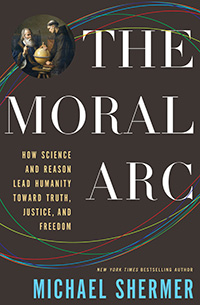
In his 2015 book The Moral Arc, Michael Shermer sets out to explain how science and reason have guided moral values throughout history and continue to do so to this day.
The arc represents the expanding moral sphere. Historically, on an evolutionary timescale, we would have mostly been concerned with ourselves and our offspring. As time goes on, this expands to our family, to the wider community, to all humanity, and now to all conscious beings.
As Shermer correctly points out, it is going in the right direction. We live in the safest time to be alive – even if it doesn’t always feel that way! There are less wars, we are wiping out slavery, homicide rates are at an all time low, rape is outlawed in the west and torture is illegal. Violent crime goes down year on year. Traditionally many of these things were common, and even legal!
One of the reasons for this is a better understanding of the world. If you think one of the women in your village is a witch, and that she is causing your crops to fail, the rational thing to do is to burn her. It’s horrible, but it is a mistaken fact about the world, rather than people being moral. Of course the causes of the witch trials were numerous and complex, but Shermer argues that this contributing role, which can be seen throughout history has a large impact, and explains why we become more moral as we gain a better scientific understanding of how the world works.
Slavery is a good example of this. Much of the slave trade was supported by the claim that black people were not humans. Now, with out understanding of evolution and generics, this view cannot be supported by evidence, so the moral argument for slavery (and a moral argument did used to be made in favour of it!) collapses.
Another reason is increased intelligence. Shermer claims that our IQ raises approximately 3 points every decade (though IQ tests are normalised so the actual number remains consistent). This and better education allows us to conceptualise other people’s feelings more and more, and thus expand our moral sphere to today where we can consider how a factory-farmed chicken might feel.
Interestingly, some studies show that reading fiction can improve your ability to empathise. Maybe all that time is not wasted after all.
Morality is a survival technique. It allow us to act altruistically while punishing freeloaders. As humans, we survive better when we work together for common good. However, to stop people taking advantage of this, morality evolves to stop people taking advantage of this.
The book discusses expensive signalling. For example, pirates. Why would a pirate ship fly a pirate flag, telling everyone they are pirates? Surely that increases the chance of the navy spotting them and gives ships a warning when they approach? Shermer suggests the answer is that they wanted people to be scared.
Pirates are not the drunken disorganised ramble you imagine. They were very well organised, had strict rules, a chain o’ command and even constitutions! Why? It was the only way they could run a ship and turn a profit. However, by creating this false impression and being so bold as to fly a pirate flag they convinced many ships to surrender without violence. This was good for everyone as the pirates did not really want to fight – that cost lives!
Another example discussed is the nuclear bombs deployed in the Second World War. Often viewed as morality questionable decisions. However, when considered in the cool light of rationalism, probably made sense. When the Allied Forces took the first Japanese island all but 200 of the 21,000 soldiers and civilians fought to the death! Invading mainland Japan would have seen massive casualties on both sides. In fact the conventional bombing of Tokyo that would have proceeded a land invasion would have taken more lives than the nuclear bombs. Deploying the nukes waa a demonstration of our ability to choose between the lesser of two evils then.
As another interesting aside, Shermer notes that almost all businesses suffer during the war, and therefore it is not often in the oligarchy’s interest to go to war. Whether that stretches as far as Halliburton though, remains to be seen.
Increasingly today we are seeing non-violent campaigns come into play. These work even better as they are more representative of society (violent uprisings tends to be primarily composed of young males). Non-violence has a higher success rate, especially if it reaches a 3.5% share of the population, which Shermer argues is the critical mass.
The idea that we used to live more ethical, greener lives is also challenged. It is not that traditional societies felt a moral duty not to damage the environment – they just did not have the power to do it! The reason Native Americans used every part of the buffalo is that they had to to survive.
Political ideas are also challenged. Shermer quotes data showing conservatives give the most to charity even when controlled for income. Liberals on the other house treat tax as a proxy for giving. Of any social group it is the working poor that give the most.
He suggests that men are always trying to control women’s reproductive rights because they have the most to lose from it. Some studies suggest infidelity rates could be 10-20%, or even as high as 30-50%. Women can know with 100% certainly that the child they give birth is their own, whereas men have less certainty, so it is of evolutionary advantage to ensure their partners are being faithful.
The idea of teaching abstinence is also challenged – not that anyone could really think it was a good idea anyway. However, according to the Chapel Hill Study (I think that’s what the name was) showed 1/200 pregnant women reported virgin conception. Gay rights are also discussed in the politics section. Apparently New York law used to require people to weather at least three items of clothing “befitting their gender” whatever that means.
Shermer also talks about the improving moral attitude towards lab animals. In a very honest section of the book he discusses his uncomfortableness with having to gas the lab animals they were using after being told it was illegal for him to take them up to the woods and let them free. Thankfully they are no longer disposed of in this way.
He also discusses the Holocaust which has a lot of crossover with his book Denying History: Who Says the Holocaust Never Happened and Why Do They Say It? Were the soldiers just following orders? Group pressure is certainly an issue. Studies show that if two people try to convince you of a deliberately wrong answer in a test, you will probably fight your ground. However, when four people do it, you are more likely to agree with an answer you know is clearly wrong. Non-conformity is traumatic experience. However, research suggests that you have to actively go along with, thus anyone just following orders is complicit.
The book finishes with a look into the future. There is speculation as to whether nation states would be superseded by a world government (unlikely and undesirable according to those quoted) or city states. How capitalism should be reformed and how an advanced civilisation could take place with cheaper energy.
Overall, this book is a great read. It is pretty random at times. It’s trips through politics, speculation of the future and the organisation do loosely fit into the idea of describing a moral arc, but make for a very winding path. The core message is an important one: morality is a survival trait that is evolved into us and will continue to do so as we pursue a rational, naturalistic, empathetic (Humanist) view of the world.