Posts Tagged ‘psychology’

The Happiness Hypothesis

Saturday, January 9th, 2016 | Books

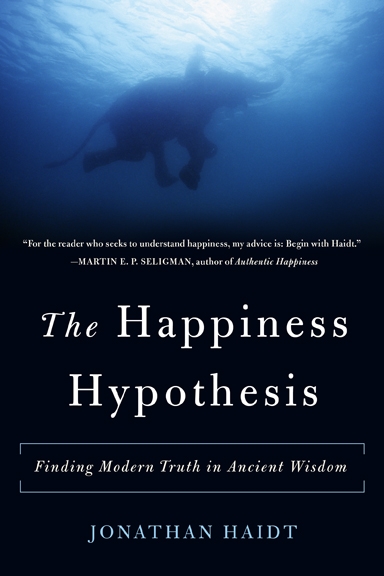
The Happiness Hypothesis: Finding Modern Truth in Ancient Wisdom is a book by Jonathan Haidt. In it Haidt, a psychologist, looks at the ideas of happiness developed by Eastern religions, and puts them in a context of modern science in an attempt to develop an evidence-based happiness hypothesis.

He uses the analogy of an elephant and a rider. The rider is the higher-level rational part of your mind, the elephant is the rest. The rider can decide the think happy thoughts, eat healthily, exercise regularly and not spend all one’s time eating cake. It can even tell the elephant. But unless you actually train the elephant, the elephant is going to do what it wants.

Haidt starts off my demonstrating just how little control over our lives we really have. For example people who are named Dennis are more likely to become dentists. You are also more likely to marry someone with a similar sounding name to you. He gives his own personal example: he (John) is married to Jane. I did a quick scan of my friends and family and the rule does not work so well, but statistically it does seem to hold. It’s kind of horrible when you think about it. Are we pawns to environmental biases to quite such an extent? It would seem so.

Haidt points out that if you try hard to not think about negative thoughts, you end up thinking about them more. This has interesting implications for anxiety. Actively trying to avoid negative thoughts for example could actually reinforce them. I also identified strongly with his example of feeling the urge to shout random things at dinner parties just because I know I shouldn’t.

Another example of Haidt being a soulmate was his discussion of vegetarianism. He, like myself, is a vegetarian. He believes that killing animals for food is wrong. But, like me also, he can’t quite seem to actually cut meat out of his diet.

He talks about the negativity bias. We are programmed to reactive to negative things more strongly than positive. This is because if we miss a meal, we will probably find some more. If we miss a predator, we we will probably be eaten. This is not be confused with the positivity bias that Kahneman demonstrates we also have.

Haidt argues in favour of gossip. He suggests it is an important social tool for maintaining fairness. If someone is cheating the system, morality only works when people know about the transgressor. Whether that justifies the deep invasion of people’s personal lives that is often associated with gossip is another matter, but gossip as concept serves a useful evolutionary purpose.

We all have a base level of happiness, and we tend to return to it. This is probably had news for someone like me that seems to have a low level of happiness. Winning the lottery is not going to fix that. However, on the flip side, getting a terrible debilitating disease is unlikely to decrease it in the long term either. We get used to the situation and our base levels return to normal. Material possessions will only bring very short-lived happiness. Spend the money on experiences instead, and for maximum affect ensure you do it with the people you love.

Some things we do not adjust to though. For example noise levels, traffic and commuting are always bad. It is worth eliminating noise from your life were possible, especially traffic noise. As I learnt in Happiness By Design, commuting really is the worst thing you can do with your time. Given that, and that money does not make you happy because you adjust, taking a pay cut to live closer work is a smart move that will increase your happiness.

Critically, social connections correlate with happiness more than almost anything else. This backs up something I can come to realise and begun preaching over the past few years. Moving away from your friends and family to a different city, for career advancement, is a bad move. Yes you get more money. However, as discussed, this does not make you happy. What does make you happy is friends and family and these you lose when you move cities.

Unless your job is literally your entire life’s passion, take a lower-paid job in a city where your friends and family live, with a short commute. Don’t worry if it’s not your perfect job, it’s not your life.

Too many choices are bad. You want some choice, but above half a dozen it actually decreases your happiness because you expect a better match than you get and the probably that you selected an imperfect match increases. If you, like myself, have had the experience of walking into a shoe store, seeing 200 different trainers, and not liking any of them, you will know what I mean. If there were five styles of trainer, it would actually be a lot easier.

In his conclusion he says that the ancient wisdom and modern science often converge and both are needed, to some extent, to achieve true happiness. Happiness does come from within (to the extent that you cannot buy it) but the only way to achive it is through behaviour changes, and these can only be achived by re-training your elephant, not merely deciding as a rider.

The-Happiness-Hypothesis

Why Smart People Make Big Money Mistakes

Tuesday, January 5th, 2016 | Books

Why Smart People Make Big Money Mistakes – And How to Correct Them: Lessons From The New Science Of Behavioral Economics is a book with an obserdly long title. It’s written by Gary Belsky and Thomas Gilovich.

I first assumed that it was going to be about why professional investors do stupid things. I was incorrect, much to my advantage. It was about us, all of us. We are the smart people making the big money mistakes.

A lot of the content I already knew from reading A Random Walk and Thinking, Fast and Slow, but it was all a valuable reminder. Especially as I am still making many of the mistakes! Though as the book concludes, as fallible humans we are probably going to continually make them. It’s a fun book to read as you get scenarios and have to try and guess the right answer. Just like QI, you quickly learn to avoid the obvious answers.

Mental accounting is a classic example. A pound is a pound. Yet so often we sub-divide our money into different funds that are more or less valuable. I was in this exact scenario as I was reading it.

I had recently received some compensation for a car accident. I was thinking about buying a stand mixer with it. It’s bonus money, right? At the end of each month, I do a spreadsheet of all my bank balances and debts to see how much money I had on. In this case, I had even put a debit in to cancel out the effects of the extra money in my bank account, so that I could keep that money in a separate mental account.

But this is nonsense! I have that money, and it is just as valuable as any other money. If I can justify buying a stand mixer, I can justify it from my savings as much as from ‘found’ money as it is often called. If I can’t, then I shouldn’t be buying it. So I took the advice from the book – I removed the entry on my spreadsheet and I sent the money to my savings account. If I can justify taking it out, I can buy the stand mixer. If not, the money stays in my savings. Either way, all money has the same value.

The best way to avoid this issue is to put found money into your savings account, count it as part of your total savings for a while, then see if you still want to make the purchase.

Another example I fall pray to is using big purchases to hide additional extras. When I was going to buy my first desktop computer, I thought about buying a tablet to go with it. In the shadow of the cost of the computer, it wasn’t that much money. Luckily, my dad talked me out of it. I could have bought one later, but I never did because I could not really justify the cost on its own.

Contrast this with when I bought a piano. They offered to sell me a stool with it. It was a small cost in compassion to buying a piano. But did I really need it? I decided the sensible thing to do was wait and see if I really needed it, and could justify the purchase on its own. Six months later and I am still just using a dining chair, and it works fine. Better even, because a stool would get in the way.

Sunk cost fallacy is the idea that once you have spent the money it is gone, but people do not often actually believe this. The classic example is paying for a cinema ticket, or entry to a nightclub, getting bored, and then staying anyway to “get your money’s worth”. Of course, in reality, the money is gone and you are just wasting another valuable commodity, your time, by staying there bored.

This in itself doesn’t cost you money of course. However, other examples do. Take, for example, selling a house. People will often refuse to sell a house for more than they bought it for. Why? The buying price is irrelevant. If you need to sell your house, you should do so for the highest price you can get, rather than holding on to it because of an irrational psychological anchor. Yet, we’re all human, and I am sure I would try and hang on too, even though the rational part of my brain would be calling myself an idiot.

The book also talks about the ideal number of choices. Quoting the famous jam study. If you give people six choices, they are more likely to buy than if you give them 24. I mentioned this a few days ago in my review of the Happiness Hypothesis. It is worth noting that six and 24 were just the values that were picked for the experiment: it does not conclude that exactly six choices is the optimal number.

Insurance is an area that I am getting better at. I never took out extended warrenties and phone insurance anyway, but Daniel Kahneman has long since convinced me that I am correct not to do so. Insurance is a money making product, so if you could afford to replace it, you should not have insurance. I would be very annoyed if I smashed my £600 iPhone tomorrow and had to buy a new one. However, I could buy a new one, and the money I have saved over the past decade of owning a phone, not paying for insurance, and not smashing it, would still leave me in heavy profit.

A sneakier example is insurance excess though. On top of the £150 mandatory excess on my car insurance policy, I have an optional £250. Sometimes I think I should get rid of this. However, as the book points out, that would be a bad move. I can afford the £400 excess I would have to pay if my car was in an accident, so it makes sense to take advantage of the reduction in premiums because most years I will not claim on my insurance. In my case, this is pretty academic anyway, as my insurance company doesn’t think my car is worth anything.

In short, this is a very useful book. It references a lot of Kahneman and Tversky, which is useful for the everyday money mistakes we make. It also talks a lot about retirement planning and stock market investing, which is less relevant to some people, but still useful to most.

why-smart-people-make-big-money-mistakes

Thinking about New Year’s resolutions? Read this first

Thursday, December 31st, 2015 | Success & Productivity

marathon

At this time of year, people often make New Year’s resolutions. Really, by definition, it is the only time you can do it.

I have never been very good at them. Not because I never stick to them, but because one of my few talents seems to be having some resolve. So when I decide to do something over the Christmas holidays, be it learning guitar or changing my diet, I just get on and do it without waiting for New Year to actually arrive.

Many other people fall into a different group. The one that devices to work on a weakness or eliminate a vice, and typically fail to stick to it. A study by Richard Wiseman suggested that 88% of people fail to keep them. If this is you, you could try again this year. However, as the old phrase goes, ‘the definition of insanity is doing the same thing and expecting different results.’

However, in The Happiness Hypothesis, a book I will be writing about in early January, Jonathan Haidt makes another suggestion. Work on your strengths. This probably should not be a novel suggestion, but thanks to society’s focus on self-improvement and being a well-rounded person, we tend to focus on our weaknesses so much that our strengths get overlooked.

This is something I have pondered for a while with Toastmasters. I am not very good at Table Topics. But, modesty aside, I am good at prepared speaking. I’ve already been to the UK & Ireland finals once. I could spend my time improving my Table Topics, and become an okay Table Topics speaker. However, do I need to be good at Table Topics? Spending time on my prepared speeches with the aim of going to the world finals seems a much more exciting prospect.

My own petty concerns aside, should Wayne Rooney work on his tennis, or John Grisham focus on advanced maths? Probably not. You don’t actually have to be good at everything; having one awesome skill may well be far more useful.

Utility aside though, there is a far more important reason that you should work on your strengths. That is that you are more likely to stick to it. Achieving your goals actually gives you very little reward or happiness. Yes it’s good, but probably not as good as you think it will be, and probably wears off quite quickly. To lead a truly fulfilling life, you have to enjoy the journey.

A weakness is probably a weakness because you do not enjoy it. Whether it is stopping drinking, starting exercises, or tackling your fear of public speaking, you are probably going to find that journey quite unpleasant. I am not saying do not tackle it, but do not be surprised if you soon find yourself giving up on it.

In contrast, if you make a resolution to do something you already love doing, taking it to the next level, you are far more likely to stick at it. This is important if you attach any esteem to following through on your New Year’s resolutions. So if you are planning to make them, do yourself a favour this year and pick a strength to work on.

Dataclysm

Saturday, December 19th, 2015 | Books

Christian Rudder is a founder and head of data trends at the dating site OkCupid. For years he ran the blog OkTrends which looked at what data you could mine from their site. This book is a continuation of this work as well as bringing in other data sets, mostly to talk about human sexuality.

The full title is Dataclysm: Who We Are (When We Think No One’s Looking).

The anonymised data of OkCupid in aggregate provide some surprising facts, and some expected ones. Take gender differences, for example. Women rate men of a similar age to themselves as the most attract. Up until 30 women will rate men a year or two older than them as the most attractive; after 30 they find men a year or two younger than them most attractive. A drop off starts at 40. That is a good innings though. Compare this to the way men rate women. They rate 21 year olds the most attractive and it goes down hill from there.

He looks at the use of English on Twitter. Many people suppose the internet is degrading the quality of language used. Not so. The average length of a word used on Twitter is actually longer than that in professional publications, and historically. It turns out that when you limit people to 140 characters, they write concisely using a wide lexicon.

He quotes Steve Jobs: “people don’t know what they want until you show it to them”. This always reminds me of the Henry Ford quote “if I had asked my customers what they wanted, they would have said a faster horse”. Whether Ford actually said that is unknown, but it makes a good point. When asking for feedback you really need to find out what they think the problem is that you want to solve, rather than asking them what they think the solution is. In Ford’s case a faster way to get from A to B and in Job’s case an easier way to play and listen to music.

Back on OkCupid, it turns out that everyone is a racist. Rudder breaks the data down into how four groups: white, asian, latino, black, rate each other’s photos. It turns out that people generally rate their own race as the most attractive, but the real drop off is for black women by any other group, who consistently rate them lower. This has geographic differences however. There is a big gap in the US for example, while almost no gap in the UK.

He also looks at the differences between the heterosexual and LGBT communities. Is sexuality a spectrum, for example. Only 19% self-identifying bisexuals regularly message both males and females. This could imply a number of things. It could be that there is a spectrum and many bisexuals fall at either end of it. It could also be that some gay people identify as bisexual for cultural or social reasons. Especially given it correlates with their state’s tolerance of homosexuality. The answer is probably a number of different factors.

Rudder also mentions that Justine Sacco, the woman who made the “hope I don’t get aids” tweet, worked for OkCupid’s parent company. Sacco was discussed in Jon Ronson’s book So You’ve been Publicly Shamed. The hashtag #HasJustineLandedYet is a classic example of how quickly things can travel world the world these days.

In summary, it’s not too clear what Dataclysm was actually about. It seemed to be mostly “here is some interesting data about people”. From that respect, it was genuinely interesting. It also had a lot of crossover with A Billion Wicked Thoughts in using anonymous internet data, a source that has only come around in the last few decades, to reveal fascinating insights into human thoughts and behaviour.

dataclysm

50 Psychology Ideas You Really Need to Know

Saturday, November 7th, 2015 | Books

Part of the “50 Ideas You Really Need to Know” series apparently, this book by Adrian Furnham breaks down into 50 4-page sections giving a quick introduction to various concepts in psychology.

It is not available on eBook format, so I had to get the print.

It was pretty rubbish. I was sold on the title really need, but that is not the case. It contained a lot of stuff on abnormal psychology and concepts that were irrelevant to me. I do not need to know that stuff; I need to know about psychological biases that affect my everyday life – the kind of stuff Kahneman writes about. So when I took a quick look at it and saw “Gambler’s Fallacy” I thought it would be a good revision book. It was not.

The stuff that was in there was interesting, but I knew most of it.

There was some useful knowledge, or at least reminders in there though. Happiness tends to return to the base level regardless of what happens. Good to know if you are worried something awful will happen and leave you less happy than you are now.

In general, the summations of a topic were excellent. IQ for example strongly matches up with what Ritchie says in his recent book Intelligence: All That Matters. There is also an interesting discussion regarding the Flynn effect – do we get worse at problem-solving as we age, or are we simply comparing people to younger generations, who are constantly gaining IQ?

It also rubbishes multiple intelligences (which do not exist), though the “condensed idea” which is a one-line summary for each section says there may be multiple intelligences. I assume this was summing up the idea that it then rubbished, but it was rather confusing.

Furnham does not shy away from controversy either. One section discusses the differences in standard deviation and average IQ of both gender and racial groups. It’s all evidence-based of course, but can often be a taboo subject nonetheless.

Other points that perked my interest was that everybody dreams. Even if you don’t think you do, it means you just don’t remember them – they almost certainly do happen. Also, group brainstorming can be less productive than working individually because people are embarrassed to put their ideas forward or like to free-ride along.

Ultimately, I do not think I would recommend this book, because the material in it is just not useful enough.

50-ideas-psychology

Compelling People

Saturday, October 24th, 2015 | Books

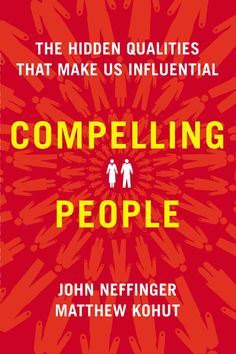
Compelling People: The Hidden Qualities That Make Us Influential is a book by John Neffinger and Matthew Kohut. It looks at what makes particular people, such as state leaders, the persuasive and charismatic people they are.

It claims to draw on the latest scientific evidence, though there do not seem to be any inline citations and the authors are writers and coaches rather than academics. That does not mean there is no good stuff in here – it is just difficult to know.

They put forward the idea that a charismatic person is one who projects strength and warmth. Strength is the ability to get stuff done and warmth is the ability to share someone’s feelings. The top leaders are able to do both.

Stereotypes play a role. Men are seen as stronger whereas women are seen as warmer. Luckily though, character is more important than physical characteristics, so you can soon overwrite these biases.

Lots of little clues project strength. Having your hands in fists or out flat. Vocally, be direct, sure of yourself, and avoid being too polite. In men, a low voice is strong and attractive. You can use method activating to set the tone of the conversation. For example, when I am reviewing restaurant food, I like pretend I am Paul Hollywood, and it makes it a lot easier to say blunt and honest things.

You can apply these things in your prep. Lets say for example that you are about to give a speech. As you prepare to go on stage, ensure you stand tall and smile. This will carry through into the presentation.

Another kind of strength is sated strength. This is when you’re so strong you don’t need to show it. Picture Steve Jobs for example, spread out of a couch, not giving a shit about what anyone thinks because he is the head of Apple. This is a world away from the sharp-suited kind of strength, but rather displays strength in a warm and casual way. It can backfire though – think Mark Zuckerberg turning up at his investor meetings in a hoodie and trainers. People began to question his leadership.

Similarly, different things project warmth. Tilting your head to the side. If you have a local accent, that can help project genuineness. Warmth is very easy to lose so be careful. To maintain trust ensure you do not lean away, cross your arms or touch your face.

Clothing can be a mine field too. Generally smart black clothing presents strength and casual white clothing projects warmth. However, clothing also affects how you feel, so if you want to feel confident and strong, a suit may not be the best play if you feel uncomfortable in it.

Smiling is important. You have to do it right. There is a big difference between a fake smile and a Duchenne smile, which involves using your whole face. Smiling makes other people smile, which makes them feel happy.

They also touch on a few areas that are controversial, public-speaking wise. They recommend using the magic ball hand position (put your hands as if you are cradling a ball around your belly button). I often get told off for this at Toastmasters. Similarly, we discourage the use of filler words. Neffinger and Kohut point out that they have their place as it signals to the audience you are not done.

When it is time to apply the persuasion, you need to identify with your audience and emphasise with them. The trick is to get yourself inside an imaginary circle with them, and get the opposition on the outside. Obama is very good at this when talking about gun control. He acknowledges that people have the right to bare arms (a nod to the opposition) before pointing out that responsible gun owners support him in some controls (get everyone inside the circle) and it is just the NRA that want everyone carrying automatic weapons (push the opposition outside).

The old saying “ask for money, get advice; ask for advice, get money” is also relevant. By deferring to people and making them feel important and knowledgeable, you are more likely to win their support. In contrast, once you begin having an argument with someone, persuasion ends.

Two topics the book ends with are both nice examples. The first is “it is a leader’s responsibly to define reality”. This came across strongly in Walter Isaacson’s biograpbhy of Steve Jobs. Jobs redefined the industry by insisting it would be that way. Of course you can argue that people like Dennis Ritchie were doing actually useful things while Jobs was churning out over-priced junk. But Mac, iTunes and the iPhone have shaped our society.

On a more local example, the entire committee laughed when I said were going to put on a week-long event in a marquee for Atheist Society despite having only been running for a few months. But just six weeks later we did it. Reality is malleable when you have the determination to see it through.

Finally, the most important message of the book is “be worth of being looked up to”. If you want to be someone people think is a caring, determined, hard-working leader then the best way to achieve that is to be a caring, determined, hard-working leader. The rest is just dressing.

compelling-people

Intelligence: All That Matters

Thursday, September 24th, 2015 | Books

In Intelligence: All That Matters, Stuart Richie presents a a succinct overview of intelligence research and where we are today.

I first met Stuart when we travelled up to Edinburgh for a national conference on how we could organise student humanist societies better. That is showing my age because he is now a fellow at the University of Edinburgh. Over the years he has spent much time trashing anti-intelligence articles and I have often thought “he should probably stop moaning and write a book about it”. Now he has, and although I’m bitter about not receiving a signed copy, it is a good read.

It comes across with a relaxed, somewhat “man down the pub” style. Though I should add that as most of my friends now have PhDs, the man down the pub is a very-well educated individual who just happens to be in a casual environment. Not someone who spouts nonsense without citing the relevant reference papers.

Richie challenges a lot of the new ideas that have come out in recent decades. Are there different kinds of intelligence for example? No, there is just one. There is no such thing as musical intelligence or football intelligence, there is just regular intelligence. There is some conciliation to emotional intelligence, but it should be noted that it does not correlate with success factors the way proper IQ does.

Intelligence also correlates with itself. If you do well in one area of an IQ test, you are likely to do well in the all. You can game it by practicing, to an extent, but who really has time to do that when you are mostly cheating yourself? Also, it will only affect certain areas of the test, which will be brought down by the rest.

IQ correlates with everything. Good health, good mental health, high earnings, education, liberalism and atheism all correlate. This surprised me as I had believed that high IQ correlated with poor mental health. Indeed, I have always comforted myself that I worry too much because I am clever, not because I am an idiot. Thanks for that. IQ correlates with leadership and creatively as well, though far more loosely than other traits.

There only seems to be one drawback of high IQ – it also correlates with short-sightedness. It is not understood why, though it may be because high IQ children read more. Just to be safe I am going to ban my kids from reading. If I have read Steven Pinker correctly, which I almost certainly have not, they will be fine anyway.

As we age our intelligence drops off a little. Bad news for me already being past my mid-twenties. This is seen in certain areas though. Crystallised intelligence (Wikipedia defines this as “the ability to use skills, knowledge, and experience”) continues to rise while fluid intelligence (problem-solving) gradually drops off. Leading an active lifestyle can help maintain this.

50% of IQ can be accounted for genetically. It is polygenic, that is to say, no one gene accounts for it – there is no smart gene. The rest is environmental, though this is not really understood as, to reference Pinker again, parenting does not account for it. We are also seeing intelligence increasing at approximately three points per decade. This is known as the Flynn effect, but it is not obvious because IQ tests are regularly normalised.

This fits in neatly with what Michael Shermer writes in The Moral Arc about the expanding moral sphere being due to our increased intelligence, education and understanding of the world. Indeed Shermer also discusses the Flynn effect.

Unfortunately, there is no much you can do to increase your IQ. Any product telling you that it can is unlikely to be making an evidence-based claim. The one proven factor that does work, however, is education. A study in Norway when they extended mandatory schooling by two years, IQ went up. As they introduced it region by region, it was as close to a control as you can get, so suggests there is a causative link there.

The final section of the book looks at some of the implications and political debates surrounding intelligence research. Overall there are no differences in IQ between genders. Neither is smarter than the other. However, a 2014 paper by Miller and Halpern, looking at data from the Scottish government, suggests that males have a wider standard deviation (bell curve). This would explain why there are more men in higher academia and winning Nobel prizes, and also why there are more men of low intelligence (and as a consequence living on the streets, on Death Row, etc). Males are more likely to be at one extreme or the other.

In summary, IQ is important because there is only one kind of intelligence and IQ tests measure it pretty accurately. This correlates with health, wealth and happiness so is a worth topic for research.

Intelligence-all-that-matters

As a bonus, Stuart appeared on my podcast in November 2008. It was a live conference podcast involving a dozen guests and intelligence is not discussed (or apparent) at any point during the show. However, for those who were at the conference, it is a reminiscent listen.

Psych out

Sunday, July 19th, 2015 | Science

Last week we had dinner with Gijsbert who pointed me to the new version of his PsyToolkit. This is a piece of software for building psychological experiments, though more relevant to us civilians are the tests and scales available on the website

There are now over 60 on them, so myself and Elina spent Saturday night filling them all out. Of course how much you can take from them is questionable. However, they are all academically published scales.

I came up with some interesting results:

  • I am not a psychopath – which was the result I was hoping for
  • I am only slightly dissatified with my life – win
  • I’m only minimally depressed
  • I have high self-esteem – probably thanks to me being so great
  • I’m not narcissistic – pretty surprised at that!
  • I am highly sceptical of adverts
  • I have high general anxiety
  • I do not have internet addiction – apparently
  • I am a perfectionist – did not expect that!

Of course I am now basically going to do nothing with this information. However, it was fun to do the tests.

I also suggested he added the Edinburgh Postnatal Depression Scale (EPDS) which he prompted did. Pleasingly, my score dropped from 11 to 9 this week, meaning I am no longer postnatally depressed!

The Psychopath Test

Tuesday, July 14th, 2015 | Books

Jon Ronson is a journalist who writes books the same way Louis Theroux makes documentaries. He goes and interviews odd people and pokes them gently but persistently until interesting stories fall out.

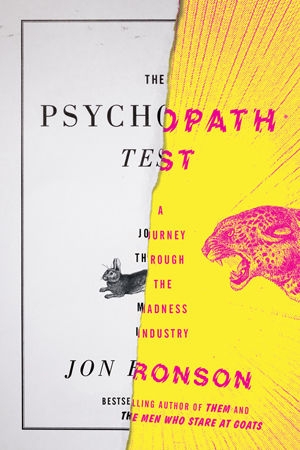
In his book The Psychopath Test: A Journey Through the Madness Industry he looks at what psychopathy is, how it is diagnosed (there is a checklist), what can be done about it (very little) and where you might find psychopaths. The answer to the last question is apparently prisons and CEOs.

He starts off by narcissistically whining about his own problems and anxieties. I find this annoying at first as he sounds too similar to myself for comfort, but gradually come round to it as the book goes on. He is very much a character in the story. Given a preference, I think I would opt-out of that, but it doesn’t ruin the book.

If you ever worry that you are a psychopath, then good news, that probably means you are not one. Psychopaths typically do not suffer from anxiety. However, if you want to double check, you could use the PCL-R, a checklist developed by Robert Hare.

Ronson also provides advice for psychopaths looking to avoid the media spotlight – be as boring as possible because then no journalist will want to write about you. Statically, that should be useful to just under 1% of my visitors…

The-Psychopath-Test

Nudge

Sunday, March 29th, 2015 | Books

Nudge: Improving Decisions About Health, Wealth and Happiness is a 2008 book by Richard H. Thaler and Cass R. Sunstein. It looks at choice architecture (that is to say how you present people with choices) and advocates libertarian paternalism in public policy, and beyond.

Libertarian paternalism is the idea that we should let people do what they want, but nudge them in the right direction. The current phasing in of enrolment in private pension schemes is a great example of this. People can opt-out if they wish, but if they no nothing, then a sensible default course is chosen for them, in this case to have a pension.

Another good example of this is organ donation. Should you have an opt-in or opt-out system? Both are libertarian by nature in that they let people choose what they want to do. However, most people do not bother to choose, regardless of whether the default is to donate their organs or not. I’ve blogged about this before.

It begins with a revision lesson on Thinking, Fast and Slow. Anchoring is a real problem for example. You will tend to fill your plate at dinner time, so if you want to eat less and lose weight – use smaller plates.

The book notes that people are human, rather than “econs”. Econs being a term of perfectly rational beings. So there is often a struggle between the planner and the doer in you. Your planner will set the alarm for 7am, but when it comes down to it, you just hit the snooze button.

For this reason, Elina now has an app on her phone that donates to charity every time she hits snooze. As it happens she never hits snooze anyway, but if she did, studies have shown that this small financial incentive would be likely to have a powerful effect.

Once you accept people are not econs, things make a lot more sense. I love credit cards. There are loads of advantages to them. However, I pay the full balance of every month. If you know you do not have enough self-control to do that, seemingly irrational actions like avoiding having one suddenly makes a lot more sense.

There is also the problem that the free market does not always function correctly. It works well for soft drinks. We all drink them regularly, so can tell what is a good product, easily compare them, and choose the best ones. But how about mortgage advisors? We may not see the effects for decades, and we only buy one or two throughout our lifetime so the opportunity for learning is not there. The same is true for healthcare decisions. Also, as we are not expects, that adds an extra layer of difficulty to making sensible decisions.

Because we are human, and have these struggles, the book suggests we should nudge people into doing the most sensible thing, while ultimately giving them the choice to change it if they so wish. Hence an opt-out system for organ donation. By default, people will donate the organs, and the overwhelming majority will leave it at this, while still allowing people to change this if they want to be a completely morally bankrupt dick.

Some of the nudges you can use are incredibly trivial and effective. One of the most amusing being that if you put a fake fly in a urinal, men will aim at it. In fact, they aim so well that it reduces inaccuracy by around 80%.

There are some related topics the book touches on. Stimulus-response compatibility for example. People expect things to be certain way. For example, if you put a handle on a push door, people will pull it. Even if you write pull on it. You could argue it is still there fault, but the human brain is geared up to pull things with handles. Just design a better door.

There are a number of social factors that influence people’s actions too. Priming for example. If you ask people what to do before they do it, they are more likely to actually do it. Though as Matt Cutts notes, if you go out and tell people your goals, that actually makes you less likely to complete them.

People often tend to follow others too – if you tell people the percentage of people that are compliant with their tax returns (which is very high), people are more likely to be honest. This fits with what Michael Shermer argues in that people will only follow society’s rules if they see everyone else is following them too.

Company stock options for employees. These are a terrible idea. I invest in the stock market, but I try to diversify my risk as much as possible. Not only do I use index funds that invest in a broad range of companies, but I invest in a diverse range of these – UK, North America, Europe and the developing world. Yet with company stock options, you don’t just have all your savings in one market – you have them in one company! That is super risky, and if the company goes bust, you lose both your savings and your job. Of course many companies offer incentives to invest, but according to the book, these are only worth 50% of their share price when evaluated – so the incentive better be good or you would be better investing it in the wider stock market.

Thinking, Fast and Slow convinced me that taking our extended warranties and phone insurance was never worth it. I never did anyway, but I always wondered whether I should. Nudge points out this applies to a whole host of other things too: insurance when posting items, a smaller excess on your car insurance or damage waiver on your rental car. They offer these policies because they make money, so if you can stomach the short term loses, avoiding them brings long-term gains.

The book concludes with some ideas for society to consider. One is the privatisation of marriage. They argue that the state could get out of the marriage business and leave it to churches, humanists, etc or even your local diving club to do marriages. They could then be as discriminatory or weird as they wanted. However, they would confer no recognition or benefits from the state. Similarly, the state could recognise civil unions, which were independent of marriage, but allow the state to recognise your relationship.

They also address concerns about the misuse of nudging. Of course, this already happens – the supermarkets do not select which products are at eye level at random. However, the book suggests that a good guideline would be that all nudges should be made public. Auto-enrolment in pensions, for example, is no secret, and has an opt-out, so it is difficult to argue it is anything but beneficial. Employing such a strategy means that the least well-informed people in society are protected while offering the most well informed as much choice as they would like.

Nudge