Archive for the ‘Books’ Category

Great Expectations

Thursday, March 26th, 2015 | Books

Great Expectations is one of Charles Dickens’ longest novels and tells the story of Pip as he grows up and becomes a man. It is narrated in the first person and has a good balance of happy endings, and death.

It’s only the second Dickens novel I have read. However, I have seen a lot of the films, especially ones with Muppets in, and as any literary buff knows, that is just as good as reading the book. Thus my only comparison is A Tale of Two Cities. I found this one more engaging as a novel overall; it held my interest better. However, some of the most memorable section of Two Cities outshines Great Expectations for its gritty realism and vivid descriptions.

great-expectations

Potatoes Not Prozac

Saturday, March 21st, 2015 | Books

Someone recommended the book Potatoes Not Prozac by Kathleen DesMaisons saying that it had really helped them. It describes itself as a food programme to help with depression, though what it actually turns out to be about is a guide for people who are “sugar sensitive”.

Sugar sensitivity is something that Dr MesMaisons has made up. Or discovered if you were being generous. There is nothing on Wikipedia about it. There is a stub article about sugar addiction, a topic still under research before we have any real understanding of it. However the book justifies its existence using the following phrase.

“a solution too important to wait for the approval of scientific authorities”

From there it turns to a classic self-help book that is big on claims and small on scientific references. The text is regularly interlaced with quotes from people telling the reader how good the programme is and how it has changed their lives. As long as you follow the programme to the letter of course.

It’s the classic heartwarming story – an underdog doctor without the backing of the scientific community dares to go it alone because she has seen it work for hundreds of people. She has developed a simple programme that offers quick results without pharmaceutical. It’s all our dreams come true. In fact, it’s so simple that 9 of the 256 pages can be devoted to a copy and paste of an internet chat in which people on the programme describe how they felt before and after it.

Helpfully there are also lots of references to the Radiant Recovery programme that MesMaisons runs, including which of the products you might want to buy. But who am I to say that George’s Shake® isn’t as delicious as claimed? Maybe it is. With sugar sensitivity being linked to alcoholism, there are also some references to Alcoholics Anonymous. Another programme that can boast of having no evidence of efficacy.

The programme starts by encouraging you to eat breakfast and have some protein in it. One of the example meals is a sausage. Of co,urse eating processed meat every day will literally take years off your life (the scientific authorities have had time to approve that), but if it improves your quality of life, that is a trade off you might feel is worth making.

There is probably some good stuff in here. Eating sensible meals three times a day in some kind of routine is going to provide your life some structure and normality. The rest remains an unknown though. Perhaps it will eventually be scientifically proven. However, as it is I cannot see the evidence nor it is packaged in a way that I can describe any other way than yet another cultish self-help book.

Potatoes not prozac

Memoirs of a Geisha

Friday, March 20th, 2015 | Books

I read Memoirs of a Geisha as a kind of back-up career plan, in case things go sour with the whole programming thing.

I identified strongly with Chiyo. Sure, she lived on the otherwise of the world, came from a small fishing village, worked as a geisha, lived through World War II and spent her life dreaming of a certain man, and I didn’t do any of those things. However, on a deeper level, we’ve both faced the universal struggle of keeping our hair in place.

I had a vague idea of what a geisha was, but it was interesting to get more of an insight into their lives, even if it was a fictional story. I was also a little surprised how recent such practices as selling off your daughter were still used.

Importantly, it had a happy ending, which are the best endings.

MemoirsOfAGeisha

The Blank Slate

Thursday, March 19th, 2015 | Books

If the claims made in this book are true, it is probably the most important, the most surprising, and the most controversial book I have ever read.

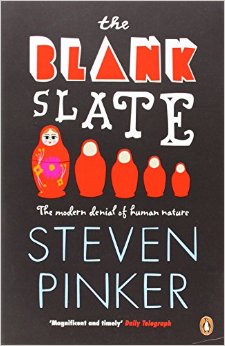
The Blank Slate: The Modern Denial of Human Nature is a 2002 book by Steven Pinker. It challenges three modern ideas of human nature. These are:

  • The blank blank slate – the idea that the human mind has no innate traits
  • The nobel savage – the idea that humans are inherently good and it is society that turns them bad
  • The ghost in the machine – the idea that we each have a soul that is separate from our biological brain

Pinker argues that the brain is predisposed to certain beliefs and practices, that it is inherently violent and needs society to quell this. The “soul” refers to the Cartesian model of consciousness that Dan Dennett tackled in his book Consciousness Explained.

It’s a big book and for me to do the arguments it puts forward justice in one blog post would be absolutely impossible. In part, because I probably do not have my head round all of them. However, I have discussed some of the most interesting and most controversial points below.

Why is it that Europe flourished while Africa did not? It could of course be luck. However, one explanation that helps explain it is that cultural practices are probably easier to share across Europe and Asia than they are across Africa. Methods of agriculture for example can be shared across a wide thin continent because being at the same longitudes, they have similar clients. Whereas Africa, being a thin tall continent, has different climates at different longitudes, so agricultural practices need to be developed again and again.

Pinker argues that the slate cannot be blank, because blank slates cannot do anything. Take the computer for example. We have to programme it to do anything useful. Something must be innate. This is probably why artificial intelligence research has been unable to replicate human intelligence with a generalised artificial neural network – these networks can learn anything, but the human brain is actually a series of specialised sub-systems.

The problem with this from a neuroscience point of view, is how the brain takes shape. Our genome contains about 750 megabytes of data. This is no where near enough to specify such complex systems. However, we know that all input affects the brain (otherwise we would have no memory) and that the body uses feedback circuits to shape themselves – joints for example grow to fit each other. There is nothing supernatural about the brain, so it seems sensible to assume it works the same way.

That is not to say that the brain is fixed. Indeed, from what we have seen above, it is clear that it is not. Areas of the brain can be re-purposed – musicians have an expanded cortex that controls finger movement and dead people re-use their auditory cortex for processing sign language. However, this does not mean the brain is plastic to be moulded into any shape any more than a joint’s ability to fit together implies it could also be your liver. We can sometimes re-purpose things, but they do have a purpose.

The blank slate is thus destroyed. However, it is not as easy to let go as all that because it is a scary thing to do. We have linked the blank state to our system of morality. Everyone is equal because our brains are equal, and if we let that idea slide that could open up the door for thinking people are not equal. Godwin know’s where that leads.

Pinker rebukes this idea though. He points out that differences in race are smaller than differences in individuals. Two races may have slightly different standard deviations, but they will mostly overlap. Secondly, the idea of the blank slate is actually more dangerous. If we accept the blank slate, we accept the idea that people could be conditioned enjoy or accept slavery. The hatcheries of Brave New World would work today.

Thankfully, the slate isn’t blank, and humans will not submit to this. Orwell’s Big Brother does not control human nature. It is hard-wired into us.

How about the nobel savage. Are humans inherently good and corrupted by society? Pinker argues not. The evidence shows that pre-state societies were in fact the most violent and murderous. Pre-states had a homicide rate of 10-60% (that is to say 10-60% died of being murdered, rather than natural causes). Even in America, a country stereotyped for everyone shooting each other, has a homicide rate of 1.5%.

He discusses altruism, and breaks it down into two kinds. The first is nepotistic. he look after our family more than other people. This is because they share our genes, and so we are biologically wired to protect them. This seems a big doom and gloom – was Thatcher right about there being no such thing as society? Maybe, but this does not prove it in my opinion. You’re right, I am going to look after my kids first of all, because they share half of my genes. However, I share a lot of genes with the rest of the human race, and many with other living creatures too. So I would suggest nepotistic altruism could have an effect on how we treat everyone, though to a much weaker level.

Secondly, reciprocal altruism. This is the concept of “you scratch my back, I’ll scratch yours”. This is probably the key to how society works. The selfish gene produces the altruistic organism because we work better when cooperating. However, this only works in a structured and regulated society.

In The Believing Brain, Michael Shermer discusses why he is right-wing, or at least supports some authoritarian in a state. He points out that people are only altruistic, and people only follow the law if they can see that justice is being done to those who do not.

Pinker argues the same thing. He points out that communes never work because people will inherently do a little as possible if not being monitored and have a psychological tendency to overestimate the share of work they have done, so even if they are being honest with themselves, they may well have not done enough. This, combined with humans being hard-wired to care more about their own offspring than others, seems to be an excellent explanation of the ultimate failure of kibbutzim.

This has implications for things like judicial sentencing. I have previously believed that rehabilitation is the most important, possibly the only important, consideration when sentencing someone. However, under the model of the ignoble savage, there is nothing “fix” and deterrence becomes the most important consideration.

How about differences in gender? Now Pinker is on thin ice, politically. He starts by talking about sexual reproduction and suggests that males seek quantity whereas females seek quality. He puts this down to our evolutionary background. Men have very little investment in a child – they just need to provide some seed, so in order to maximise spreading their genes they should attempt to have as many mates as possible. A child is a much bigger investment for a female, however, as they have to grow it and care for it once it is born, so they are more interested in picking a high-quality mate that will produce a health child and hopefully stick around to look after this.

This does not justify the social attitude that men who sleep with lots of partners are “players” while women who sleep with lots of parters are “sluts”. However, it does suggest that there is an evolutionary basis for why we might be pre-disposed to think this, rather than it being another evil of “the patriarchy”.

He then goes on to argue that men and women are clearly different, and their brains are not interchangeable. The fact that traditionally women stay at home and look after children while men do not is not a social construct. It happens throughout the animal kingdom with the overwhelming majority of mammal species working the same way.

This has significant impact for the gender pay gap for example. For some reason, we have been unable to solve it, even though it is illegal to pay one gender more. It’s not easy to see why this is. Under the model of the blank slate, we blame the patriarchy, and stereotype threat, and spend a huge amount of money trying to get girls to do STEM, even though research suggests this is not justified.

However, if we accept the non-blank slate model, we can then begin to really tackle these problems, because we can actually tackle the correct problem. However, the current political climate of not even being able to suggest such ideas without being written off as a racist means that most evidence-based solutions for the problem are automatically written off.

Again, it is critical to stress that none of these biological explanations justify the current situation. It is not okay to discriminate against someone because of gender or race. However, the only way we can tackle these issues are to accept that these problems are evolutionary based and that we have biased we need to correct against!

The view that we are noble savages and that society has created racism and sexism is not the case. These things are wired into us and it is society that fixes them. Until we accept that these are natural biases that we need to use society to counteract, we will struggle to make progress.

If this isn’t getting your blood pumping yet, Pinker then goes on to discuss rape. Again, I will stress that I cannot do justice to an entire book in one blog post, so I would recommend you read it yourself to ensure that your understanding of my understanding of what Pinker is arguing actually matches what Pinker has written.

He argues that rape could be “natural”. That doesn’t mean it is good of course – arsenic, cancer and being eaten by a bear are all natural. However, it does seem to have been a feature of pre-state society and takes place in much of the animal kingdom too. Mallard ducks regularly engage in gang rape for example, and many species have bits of their bodies design specifically to restrain the female when mating. He then makes an extended case for the idea that rape genuinely is about sex, rather than being about power or violence.

I do not want to go too deep into this because with it being such a sensitive subject, so again I would not want to do injustice to Pinker’s writing. The last thing I will add on the topic however, is that Pinker points out that civilisation reduces violence against women. Two driving factors behind controlling rape are punishment (in our case being incarcerated) and ostracisation (being thrown our of society). Both of these things require society.

Finally, just when you think your beliefs have been rocked enough, Pinker goes on to discuss parenting. If I was being flippant, I would suggest that he says it “doesn’t matter”. However, like everything else in the book, once he has destroyed the belief you used to have, he then goes on to explain why it should still matter.

He argues that home environments do not matter. For example, if you take identical twins and split them up at birth, they turn out the same even though they were raised in different households. Whereas if you take adoptive siblings, raised in the same household, they are as different as if you picked people at random.

Immediately, I had two issues with this line of reasoning. The first is that “good” parents produce “good” children and “bad” parents produce “bad” children. I am not really sure what terms to use with regards to “good” and “bad”, they are certainly not the best, but I am drawing a blank as to what the best term would be. By this I mean smart, well-educated, care about their children, etc. However, this argument does not hold up, because it could equally be genetic. Of course high IQ parents produce high IQ children, we do not need a non-genetic reason to accept that.

The other issue I would take with it is that clearly genes do not account for all of the variation in a child. However, Pinker argues that this variation actually comes from a child’s peer group, rather than their parents. Children select their peer group, which is why differences show up in individual children, but do not show up across the twin and adopted sibling studies, which would suggest parenting and home life played a role.

If he is right, parenting just became a whole lot easier. For example, all that stuff you are doing to stimulate their brain, is completely pointless.

Of course, that doesn’t mean that you do not need to be good parents. Firstly, mistreating your children can seriously damage them. Secondly, there is a plain and simple moral imperative to be nice to them. Thirdly, you still want to build a relationship with your children. After all, they will (hopefully) be looking after you when you are older. However, it does mean that you can spend your time enjoying your time with your kids, rather than worrying about shaping them into the person you want them to be.

This is a massive claim of course, and one that even if I accept, and don’t think I really do at this point, I am not sure I could bring myself to follow through on it because the risk of being wrong are high.

Summary

Where does this leave us? Well, if it is all true, and the critics have not been able to do much to dismantle it, it means I need to re-consider my philosophy. The idea that people are inherently good just isn’t true. We are reciprocally altruistic which only works in a society that is fair and just. Of course I want to live in a society that is fair and just anyway, but this suggests that we need a partially authoritarian society to do this, rather than aiming for a utopian dream where everyone is just honest.

As for raising my children, this is a claim I am not sure I can accept. Even if I could accept it, would I really follow through on not trying to stimulate them and shape them into the people I want them to be? Probably not, because the risks of being wrong are large, and if the theory turns out to be right, they will turn out the same anyway. It is like walking eyes-open into another of Pascal’s Wagers, but I’m not sure I can help it.

If anyone else has read it, I would be fascinated to hear what you think of it.

The Blank Slate

Talent is Overrated

Sunday, March 15th, 2015 | Books

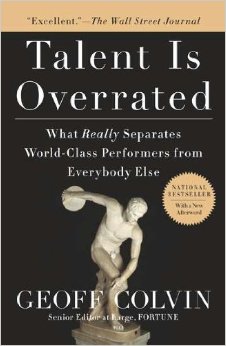
Talent is Overrated: What Really Separates World-Class Performers from Everybody Else is a book by Geoff Colvin.

I read it after I was recommended it by a friend. He is a member of my Toastmasters club and is a lovely and funny guy. But several of his talks have irked the sceptic in me. In one unlucky incident, for example, he gave a talk on neuro-linguistic programming, a field that has now been completed debunked. Unfortunately for him, I was his formal evaluator that way, and was quite outspoken in my evaluation speech!

In another speech he spoke about Malcolm Gladwell’s 10,000 hour rule, which again is probably nonsense. I challenged him on it and he recommended I read “Talent is Overrated”. So, after that extended backstory, here I am having read it with my usual attempt to keep an open, yet appropriately-sceptical mind.

The central theme of the book is that you do not need “talent” to be good at something, you just need lots of time. It challenges the idea that there is a correlation between IQ and success. Research does not support these suggestions.

However, it does make an important point about the quality of practice. It says it is very important, and it is. One of the biggest criticism’s about Gladwell’s 10,000 hours is that he largely ignores quality of practice whereas Colvin stresses it is the most important thing.

The second half of the book turns into a management handbook for motivating your staff. This makes a good point that staff are your most valuable asset. However, some of it felt a little confused. For example it claims you need to have a long-term plan and talks about Panasonic’s 500 year plan. Then it talks about having to reinvent your business model every 3-4 years. How do we reconcile long term plans with the increasingly uncertain future?

The book finishes off by going back to the original topic of why are highly successful people so successful. It discusses age-related degrading of talents and suggests that while we do degrade as we get older, if we continue to push our skills they tend not to degrade much at all (but the rest of our bodies will). I’m not sure on the research on this, though I might just choose to believe it because it sounds pleasing. Ah the bliss of ignorance.

It also puts forward the idea that if you want to be truly amazing at something you need to start really young. This is probably a controversial point, that is probably true. Thus entirely justifying living out your dreams through your kids…

Talent is overrated

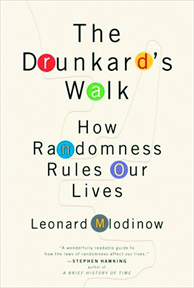
The Drunkard’s Walk

Wednesday, March 11th, 2015 | Books

The Drunkard’s Walk: How Randomness Rules Our Lives is a book about randomness and probability by Leonard Mlodinow.

It is well researched and written. He talks about a lot of the other research cited by similar books, and basically anything that references Daniel Kahneman is probably on the right track. Why Kahneman? Possibly because his research is the best. Or possibly because Kahneman’s work reached the critical mass to make it more popular than anyone else. I would seemed to have missed the point of the book if I didn’t accept that as a possibility.

Mlodinow talks a lot about luck, and how much that is a part of the most successful people. It is a massive part. I often describe it as “the one thing Malcolm Gladwell got right”. See my review of Outliers.

I was already familiar with most of the content of the book, but it was good to have a reminder. Take these points for example:

  • We judge more specific scenarios more likely than general ones. The classic example is a character description of a feminist. We judge “she is a feminist and a bank teller” to be more likely than “she is a bank teller” even though B is contained in A so must be at least as likely.
  • The two daughters problem. If a family has two children and one of them is a daughter, what is the probability that they will have two daughters. It might seem like a half, but the answer is actually a third. This is because there are four possibilities (boy boy, boy girl, girl boy, girl girl) and we only eliminate one (boy boy) by saying they have one daughter.
  • The two daughters with a name problem. What are the probabilities of a family of two children having two girls if they have a girl named Florida? The answer is a half, not a third. This is because families with two daughters have two chances to have one named Florida.

The answers to these questions are often not obvious at first. It took me a bit of time to get my head round them. But that is the point. Humans do not have an innate understanding of probability, we’re actually pretty bad at it a lot of the time.

Then some of it is downright confusing. Take for example the gambler’s fallacy and regression towards the mean.

In the gambler’s fallacy, people think that if black has come up ten times in a row on a roulette wheel, red must be due. Of course it isn’t. The odds are still 50/50. At the same time, if you have just had a really good of ten bets, the odds are that your next run of ten bets will be less good because of regression towards the mean. Holding these two concepts in your head simultaneous and knowing which to apply in each situation becomes incredibly confusing.

There are some other great examples in the book too.

DNA testing is often described as almost perfect. The changes of DNA being confused are incredibly small. Whereas the chances of a witness being wrong are quite high. For more details read The Invisible Gorilla by Christopher Chabris and Daniel Simons.

They correctly point out that faced with witness testimony vs DNA evidence, the DNA evidence is far more likely to be accurate. However, the odds are not millions to one that it will be wrong. Sure, the test itself is that good. But the chance of human error in the lab might be 1%. Thus it will still only be accurate 99% of the time.

Alcohol was another interesting topic. I’ve written several times before about how humans cannot tell the difference between cheap and expensive wine. Mlodinow quotes even more studies. In one, they labelled two bottles as $90 and $10 and subjects judged the expensive wine to be better. They were the same wine in two bottles. In a second cited experiment, food colouring was added to white wine and subjects were then served the same wine in “white” and “red” forms, claiming they could identify the differences.

Something also struck close to home was similar tests on vodka. Mlodinow points out that vodka is naturally without character, so most of it is marketing. Indeed, in a blind taste test, critics could not tell the difference between expensive brands such as Grey Goose and Ketel One and cheap brands – ultimately rating Smirnoff as the best.

I have done a taste test between Smirnoff, Absolut and Grey Goose and there was a clear difference. However, it was not blind and this study suggests that if I did it blind, I could not tell the difference (which I suspect is the case). It’s a good reminder of the power of expectation.

Mlodinow concludes the book by talking more about luck and how successful people are mainly just lucky. That is not to say that they do not tip the balance in their favour by being talented as well, but if you look at someone like Bill Gates, he himself admits he has been lucky to get where he is.

There is an important message to take away from this though. Because it is not innate, and there is a luck element, that gives us control. If we can control how many coin flips we take – in the form of how many times we try, be it in business, learning a new skill, whatever it is – the more chance we have for it to come up heads.

the drunkards walk

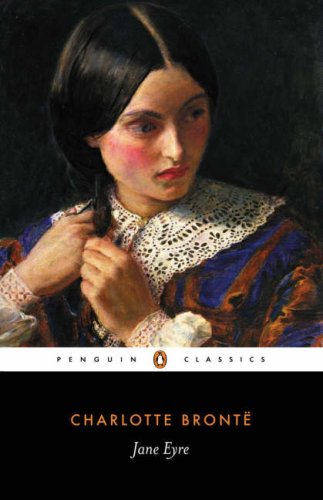
Jane Eyre

Sunday, March 8th, 2015 | Books

Written by Charlotte Bronte, Jane Eyre makes up and important part of the Bronte sisters work. With Emily Bronte having written Wuthering Heights, these two novels represent the best work of the two sisters. It is only a shame there wasn’t a third Bronte sister to write another great novel. But there wasn’t.

I decided to go for the abridged version. I just couldn’t face the 500-or-so pages of the unabridged version. Of course you lose a lot of the detail that way, but I found it made for a more pleasurable experience for a book that I was not sure how much I would enjoy.

It started off very promising. An attractive young lady being restrained in “the red room”. Though it is luckily it did not end up going this way given how young the character was at the time.

Charlotte’s style conforms more to that of a Jane Austin novel than it does to that of her sisters and I think I am grateful for that. Wuthering Heights was an unpleasant story. It had depth, realism and emotion, and I’m not looking for that in a novel. I’m looking for a Jane Eyre style happy-ish ending.

Jane Eyre

Animal Farm

Saturday, March 7th, 2015 | Books

After reading a book about Holocaust deniers I needed something a little more upbeat. A fairy tale about animals on a farm seemed to be the exact remedy I needed.

It’s very Nineteen Eighty-Four. Of course, it is no surprise it is similar given there are both Orwellian novels, but many of the ideas and concepts are taken almost word for word from each other. The constant threat of the enemy, the re-writing of history, the propaganda.

animal farm

Denying History: Who Says the Holocaust Never Happened and Why Do They Say It?

Friday, March 6th, 2015 | Books

How can you pretend that someone as massive as the Holocaust never happened? That is the topic of Michael Shermer and Alex Grobman’s book. They look at many of the most widely recognised Holocaust deniers and what exactly it is that they believe.

The book spends a good deal of the book refuting the claims of Holocaust deniers. This was a little disappointing for two reasons. Firstly, it was just horrible to read. Transcripts of former German soldiers explaining how it was done made for extremely unpleasant reading. Secondly, I wanted to read this book because I wanted to know more about the psychology of Holocaust deniers, and I felt there could have been more on this.

The conclusion of the book looks at how we can learn from such obviously nonsense claims as Holocaust denial in terms of determining whether other people, looking at other issues, are promoting genuine revision or simple denial.

denying_history

A Clash of Kings

Thursday, March 5th, 2015 | Books

I’ve been reading George R. R. Martin’s second book in the A Song of Ice and Fire series ever since I finished the first over a year ago. Clearly with not much focus. Actually, I have been putting it off because I was a bit worried about not remembering what was going on.

Having restarted, however, I found it fairly easy to piece together. This involved fitting some of it in with the TV series though, and there are differences.

It is what you would expect from Martin. The good guys having a really hard time, the bad guys having a slightly less hard time, and all your favourite characters constantly being killed. The ending is also rather abrupt. It is almost like he just writes the entire thing and picks arbitrary points to slice into books (maybe he does).

a-clash-of-kings