Archive for the ‘Books’ Category

The Wayward Bus

Thursday, February 18th, 2016 | Books

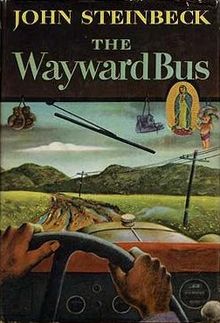
The Wayward Bus is a 1947 novel by John Steinbeck. Many of Steinbeck’s novels are long-ranging affairs, some taking place over several generations. In contrast, The Wayward Bus takes place over a single day.

What is the novel about? Well, it’s about a bus that gets stuck in the mud. This only happens towards the end of the novel. The rest is build up to the bus getting stuck in the mud. Looking back now, I am not sure entirely sure how Steinbeck spun out an entire novel based on that. He did though, and it was interesting.

One thing I have always enjoyed about Steinbeck’s work is his ability to create emotion within me. With The Gapes of Wrath I felt a small sampling of the frustration felt by the farmers who were victims of the financial system. With The Wayward Bus I experienced if only for a moment, the frustration of being trapped in a small town with dreams of getting out.

The-Wayward-Bus

River Cottage Cookbook

Tuesday, February 16th, 2016 | Books

river-cottage-cookbook

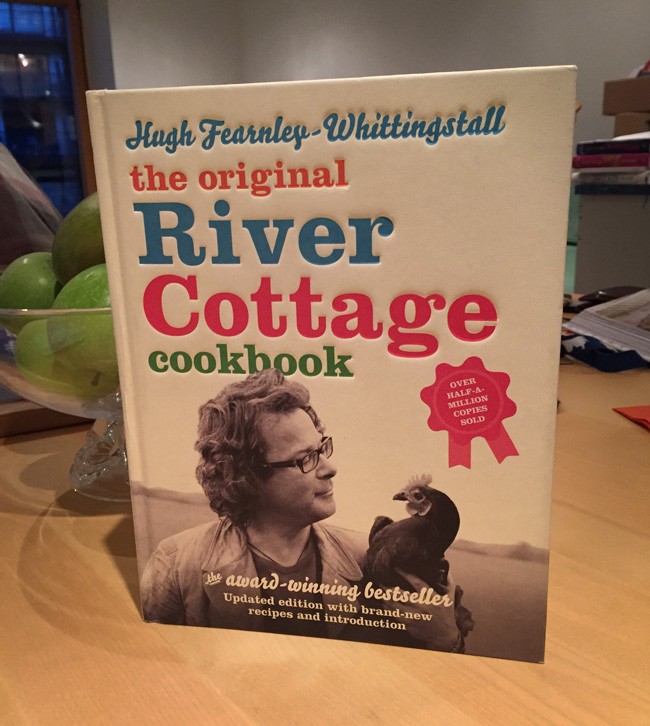
The original River Cottage Cookbook as it proudly exclaims on the cover has now sold over half-a-million copies, apparently. It comes as a hardback with an embossed cover and a ribbon marker.

It calls itself a cookbook, but that is perhaps misleading. It is not a cookbook as you might expect. It is more of a handbook for River Cottage. It is broken down into sections: herbs, vegetables, fish, poultry, etc. Each one contains a lengthy guide to the subject followed by a few recipes.

In a way it follows the River Cottage TV show. It goes into more detail on each topic but not into the same detail as something like John Seymour’s Self-Sufficiency. This makes for interesting reading if you want to make your own River Cottage adventure. There is some information of city-dwellers too, though not as much.

I found the recipes a little boring. I think I have used maybe two of them. This is due to a combination of having tried basically the same recipes in other River Cottage cookbooks, or often because the recipe is something I have already tried, but with an ingredient I cannot get. Therefore, if you are looking for a good cookbook, this is not it. However, if you like River Cottage and want to read more, with a few recipes, this might be worth a glance.

The River Cottage Fish Book

Saturday, February 13th, 2016 | Books, Food

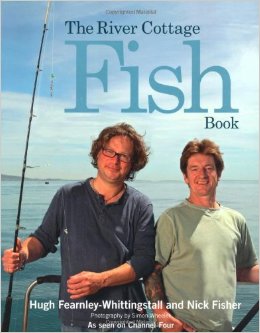
I have already written some stuff about January being fish month. See raw fish, turbot and shellfish. What was it all in aid of you wonder? I have been working my way through the River Cottage Fish Book. Co-written by Hugh Fearnley-Whittingstall and his aptly-named friend Nick Fisher.

It is a comprehensive book. Hugh talks a lot about conversation before moving on to fish skills. Things like how to prepare fish, skin them, clean them, dress shellfish, etc. There is then a large selection of recipes broken down by cooking method. Finally, the book finishes with an in-detail description of the fish you can find around Britain.

I have gone into detail about some of the recipes below.

chinese-fish-parcels

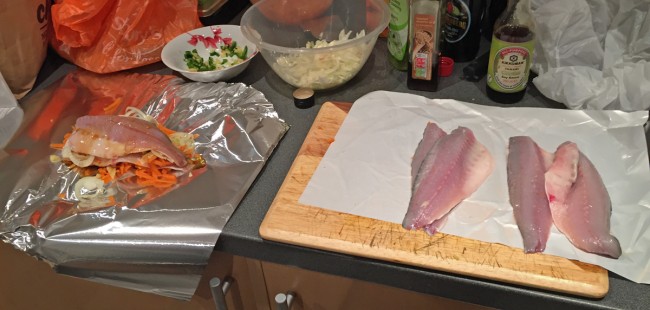
Chinese fish parcels. You make a bed of vegetables, then layer up fish fillets and soy sauce. Wrap it neatly in kitchen foil and roast the whole thing. It is difficult to get out of the parcel gracefully, but great for eating outdoors when you can eat it straight from the parcel.

This was a great chance to try out the cutting blades on my food processor. They are pretty brutal.

slow-cooked-squid

Slow-cooked squid. While it does produce a rather tender squid, I was not a big fan of this dish. Even when I tried it’s close-cousin the stuffed squid.

stuffed-squid

I also tried the slow-cooked mackerel with similar results. It does have some bold flavours, but it was not quite to my taste.

squid-rings

The squid rings proved more to my taste. Even the homemade garlic mayo was acceptable. This was a good chance to attack my fear of deep-frying. I have always been dubious about doing it at home. At McDonald’s, I knew I had a ring to pull that would coat the entire kitchen in foam if things went wrong. Without that safety net the prospect of heating a large pain oil to 180 degrees Celsius has always been a frightening one. But I did it and the results were good.

Overall the book is excellent for those who love fish and want to do interesting things with them. Will the recipes make it into my regular rotation? Maybe. Though River Cottage Every Day still provides my every day basic fish recipes. It was also an interesting read though, one that you could do without even looking at the recipes.

river-cottage-fish-book

Leeds Restaurant Guide print edition

Thursday, February 11th, 2016 | Books, News

amazon-paperback

It has been two and a half years since we launched the Leeds Restaurant Guide. It originally came out as an eBook. This is a natural format for it. You can search it, index it and update it. It works great as an eBook.

However, there is something magical about a physical book. Something that you cannot replicate with an electronic copy. I always wanted to do a print edition alongside it but the logistics of it were sizeable.

One of the great things about the eBook edition is the speed we can put out updates. In its basic form, the guide is not a book: it’s a database. In fact, that is how we store all the information. I wrote a custom content management system to handle it all. This takes all the reviews in and spits out an eBook in a matter of minutes. If we wanted to publish a new edition, we could do within an hour.

The print route is more difficult. Print books do not have the fluid content support that eBooks do. You have to design for a fixed layout, fudge pages and spend a huge amount of time getting it all right. Then if you want to make any changes, you have to re-done everything. Possibly the entire book. That would cause a huge time-lag and that just did not cut it for me. The guide evolves and the print edition needed to be able to evolve with it.

Thankfully, after several failed attempts at getting the system correct, we finally have it in place. It is not quite as fast as the eBook, but gives us the ability to publish a new edition within 24 hours. This means that the print edition will not be a second-class citizen in comparison to the eBook.

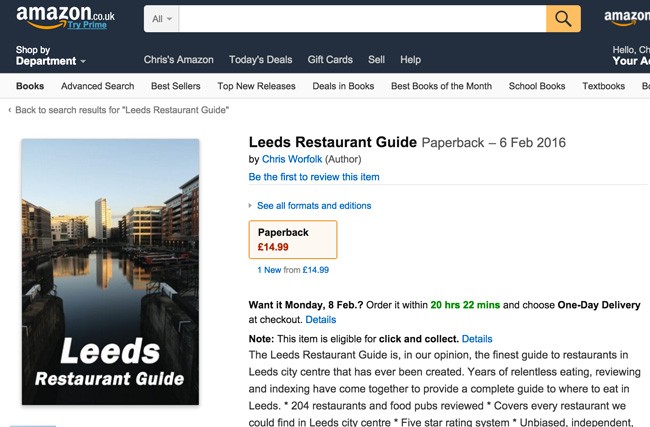
Initially, the book is available on Amazon. In the future: who knows where else!

The Hard Thing About Hard Things

Monday, February 8th, 2016 | Books

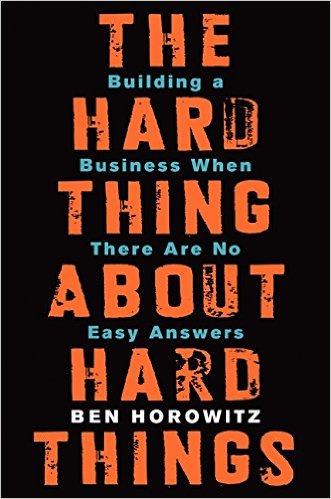
The Hard Thing About Hard Things: Building a Business When There Are No Easy Answers is a 2014 book by Ben Horowitz. Horowitz worked at Netscape before founding Opsware/Loudcloud and later the venture capitalist firm Andreessen Horowitz.

It is mostly a book for people who are running tech companies. This is mostlu obviously from the title. However, it’s appeal outside that setting is quite limited. If you’re not in that situation I would probably say that it is not a particularly useful read.

He covers a wide variety of topics. Primarily these are hard topics with no obvious answers. His conclusion is that some things are really hard and you can only learn to be a CEO by being a CEO. Nevertheless, there is good advice dispensed along the way.

It’s important to draw a line between facts and perceptions for example. It sounds obvious, but is difficult to do in the moment. He also says that if you want to do a successful start-up, you need to be doing things 10 times better than the competition if you want to succeed. It’s a high bar, though perhaps lower than Peter Thiel sets in Zero to One, who makes the case for only entering markets you can have a monopoly on.

What should you do about titles? Mark Andreessen suggests giving them out because they are the cheapest benefit you can provide for employees. In constrast Mark Zuckerberg gives deliberately deflated titles to ensure everyone is re-levelled when they enter Facebook.

He also mention’s the Facebook slogan “move fast and break things”. I have always liked this mindset. I am doing a lot of this at Sky at the moment, usually with a bug fix right behind it, and everyone seems to be happy with my delivery so far. If you want to change the world, you have to be bold.

Horowitz also recommends the film Freaky Friday as a great management resource. When sales and customer support went to war with each other at Opsware, he simply switched the heads of department with each other. They soon understood the other side and began working together to solve problems.

The-Hard-Thing-About-Hard-Things

Reasons to Stay Alive

Sunday, February 7th, 2016 | Books

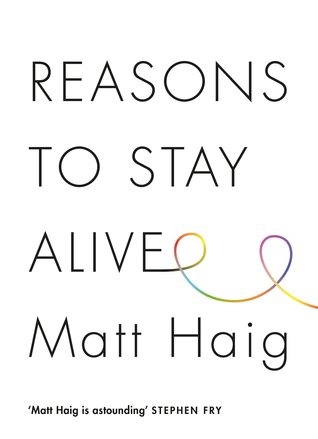
Reasons to Stay Alive is a book by Matt Haig about depression. He talks about his own breakdown in his twenties and how he survived it.

It’s a short read. Not only is it a short book but Haig keeps the chapters very short too. He mixes up the content. Sometimes he talks about his personal story, sometimes offers a list up and sometimes presents it as a discussion across time with his younger self.

I did not learn anything, but I did identity with a lot of the content. As such, I think for someone coming into contact with depression and anxiety for the first time, it would be a valuable read.

reasons-to-stay-alive

The 4-Hour Work Week

Friday, February 5th, 2016 | Books

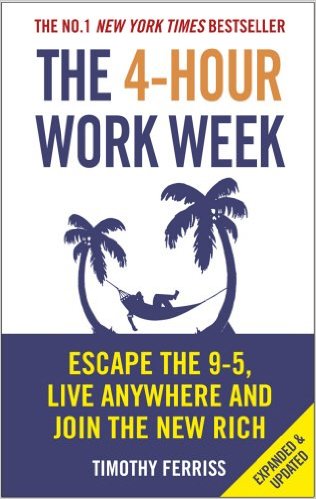
The 4-Hour Workweek: Escape 9-5, Live Anywhere, and Join the New Rich is a book by Tim Ferriss. It it he lays out his history of how we reduced his commitments and built a living from outsourcing everything to free up his time to live a fulfilling live.

He starts by laying out his vision for how everyone can do it. I was skeptical given how much of a classic self-help scam it sounded like it. I was full of promises about how great my life would be and case studies of people transforming their lives. I stuck with it because if nothing else, it was interesting.

Having finished it, I’m now sold though. This is a great book.

Ferriss makes some key points. Nobody really wants to be rich. What you want is a rich person’s lifestyle. Therefore having loads of money may not be required. Secondly, once you accept this, the aim is not to make loads of money. You just need to make enough money to cover what you want to do. Therefore the aim is to cover your costs with the minimum amount of time, thereby freeing up the maximum time for living.

He suggests doing this in a number of ways. Remote working for example. If you can get a remote working agreement, you can work anywhere in the world that has an internet connection. This is most of the world these days. Once you are out of the office you can focus on being productive and probably do your work in half the time (avoiding the half where you spend answering emails, sitting in pointless meetings and procrastinating).

Muse products are even better. These are small online retail businesses. You import a product in a tiny niche and sell it on for a large markup. You don’t compete on price because you are not bothered about building a huge business, you just want a revenue stream. Then you outsource everything – manufacturing, distribution, customer services. It then runs with very little input.

Finally, he talks about outsourcing your personal life. Get a virtual assistant, either in the UK or a cheaper one in India. Have them do your boring and repetitive tasks such as filtering emails, managing your diary, doing background research, paying bills and a million other small tasks.

He recommends not reading the news. I agree, and wrote about this last summer. He also advocates speed reading, which probably isn’t a thing. He reminds you of great strategies like reversal trials: it makes everything more palatable even though it is hardly ever switched back.

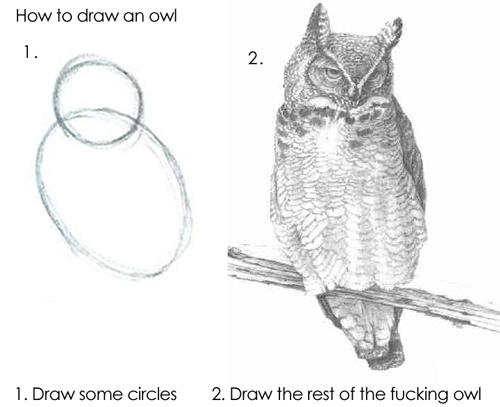
Of course just being able to think of a high-mark-up product in a forgotten niche is no easy thing. It reminds me a lot of the draw an owl meme:

draw-an-owl

The step is essentially “find the magic product” and that is never going to be easy. However, what impressed me about the book was its comprehensive advice as to how to do everything else. Want to know how to find suppliers, test the market with advertising then outsource distribution? It’s all in the book.

Ferriss gives details of all the companies, services and websites he uses. A bold thing to do in a world that moves so fast as your book will be out-of-date quickly. There are no abstract details here, it is all about exactly how he did it and practical strategies to implement.

How much of the stuff in this book I will actually be able to implement remains to be seen. Ferriss is clearly an intelligent guy with business smarts, and so replicating his success is a tough challenge. However, I was impressed and inspired by the message that it is possible to escape the 9-5. It is not the hollow book you might expect.

4-hour-work-week

Leeds Restaurant Guide proof prints

Thursday, February 4th, 2016 | Books, News

leeds-restaurant-guide-print-proofs

I am currently working on a printed version of the Leeds Restaurant Guide. It has been a long time coming. Three years ago, when we launched the guide, I always wanted to do a print version. However, the logistics of doing so have been complicated. Multiple attempts have been made. This time though, I think we have the setup correct.

This proofs represent the first attempt. They have gone back with changes, so it depends on how that goes. However, it’s a good first step towards the end goal.

Zero to One

Saturday, January 30th, 2016 | Books

Zero to One: Notes on Startups, or How to Build the Future is a book by PayPal co-founder Peter Thiel. In it he talks about the challenges of producing real innovation to drive a start-up business.

He emphasises doing something new. You have to get a monopoly, with a broad scope. I could start a Finnish restaurant in Leeds for example but I wouldn’t have a monopoly. I would be the only Finnish restaurant in Leeds, but I would actually be competition with all the other restaurants in Leeds nonetheless.

In comparison the biggest tech start-ups typically have achieved near monopoly. Google handles more search traffic than all other search providers put together. The key is to start with a niche market that you can dominate and grow from there. Facebook started by only accepting students from Harvard for example. University by university it opened its doors one at a time and achieved domination. Similarly eBay started with only collectables, and PayPal started by online targeting eBay power sellers.

It also needs to be a business that can stick around. How sustainable is it in the long term? Decades from now? Zynga is a good example. The games company was worth a huge amount of money thanks to the success it had with FarmVille and Zynga Poker. At its peak, its shares were worth $10 a pop. Now they’re worth only a quarter of that because continuing to predict what social games will continue to captivate the world is an unreliable business model.

Thiel argues that you should have a small a board as possible. Ideally three people; a maximum of five. Everyone at the company should be full time: no consultants, no part time workers, no remote working. A start-up is a family and people need to be together every day to bond. Founders and CEOs should pay themselves a little as possible. This sets an example to the company, but also helps keep themselves motivated.

If you are thinking about doing a tech startup, or actually starting one, this is probably a worthwhile book to read. It is not very hands-on, but contains a lot of theory that seems useful. Given it is quite short, it seems like a sensible investment.

zero-to-one

The Everything Store

Thursday, January 28th, 2016 | Books

The Everything Store is a biography of Amazon and Jeff Bezos. It is written by Brad Stone.

It discusses Walter Isaacson’s Steve Jobs biography and it is easy to make comparisons between the two. Both seem demanding people to work out. IN fact, Bezos more so. Life at Amazon is painted as relentless. Bezos speaks out against work-life balance and seems to work every employee into the ground. I think I have come away being put off by the idea of working for Amazon.

This is an interesting contrast to Netflix. They claim they don’t care how long employees are in he office for as long as they do good work. How true that is in practice I am not sure though it is true that they do not track the amount of holiday staff take (you can take as much as you want), which suggests they do have a relaxed policy. Netflix have of course been hugely successful as well.

It also makes me wonder whether you have to be a bad guy to succeed in business. Though successes such as Richard Branson would suggest there are alternatives.

Bezos is a man driven to build The Everything Store. He wants every product to be available immediately for customers. This is why Amazon sometimes drifts away from selling directly (Amazon auctions, Amazon marketplace) but often comes back to fulfilled by Amazon. They want to be able to control the whole customer experience, just like Apple.

Amazon itself appears in a mixed light. It is an innovative company. It did a great job of bringing together online retail. Look inside the book, search inside the book, super-saver delivery, prime, affiliates and recommendations were all developed or popularised by Amazon. It was the first to get e-books correct with the Kindle, and its purchase of Audible has helped audiobooks as well. KDP and CreateSpace allow you to publish directly onto Amazon. Not to mention Amazon Fire, Amazon Web Services (AWS), A9 and the many technology fronts Amazon has. In terms of market share, AWS is huge and probably under-appreciated on that list.

Amazon’s core retail business has always been about books. Bezos has a passion for books, which probably partly explains why they have been so successful. Compare this to music where Apple dominated. Stone correctly points out that Steve Jobs loved music, whereas Bezos had no interest in it. Even when you have a giant corporation behind you, it would seem you still need to do things with passion to succeed.

Bezos does embrace the same view as Jobs in disrupting your own company. I love the Jobs quote, if you don’t cannibalise your own company, somebody else will. This is exactly what Bezos wanted with the Kindle: he told his team to destroy Amazon’s core market of paper book sales. This had worked out as one of Amazon’s biggest successes.

They are also a relentless competitor. Like Walmart they are willing to stomach major loses to drive competitors out of business. They don’t treat their suppliers well either. Something I experienced first hand when publishing the Leeds Restaurant Guide. Amazon give me only around 30% of the sales price, whereas Apple give me 70%.

Getting an insight into Amazon’s logistics was fascinating. For example, super-saver delivery. I had lazily assumed it was that they used some kind of cheaper, slower delivery. Not necessarily so. The idea behind it is that they don’t even get it out of the warehouse until they have spare capacity. You might get lucky and they will have capacity straight away. Or you might not.

There is also the complexity of delivery. How often have you bought a USB stick and it turned up in box the size of a microwave? It’s amusing for the customer (ignoring the environmental effect, which we should not). However, for the business, putting the right products into the smallest possible packaging is actually an important part of cost-saving efficiency.

In some ways, Amazon could be seen as a bit of a mess. In the conclusion, Stone talks about how Amazon often has poor communication between departments and effort is also often duplicated. However, the company uses these things to their advantage. Different projects compete with each other on their own internal market, like their search routines did, with the best one surviving. Often companies are desperate to avoid duplication, but maybe it is not always that bad.

The-Everything-Store