Chris Worfolk's Blog


Chocolate soufflé

May 29th, 2017 | Food

My first batch didn’t rise much and collapsed quickly when I took them out of the oven.

It wasn’t a lack of time because I baked this one to death.

For attempt three, I used Gordon Ramsey’s recipe. It was tediously complex. There were so many stages. But, as you can see above, it did produce better results.

GetResponse review

May 28th, 2017 | Business & Marketing, Tech

I use MailChimp for a lot of my projects. However, while it is awesome for most things, it does lack in automation. There are workflows, but they are pretty straight forward and linear affairs with no tagging: the only action is to send another email. There is no flow chart style interface, either.

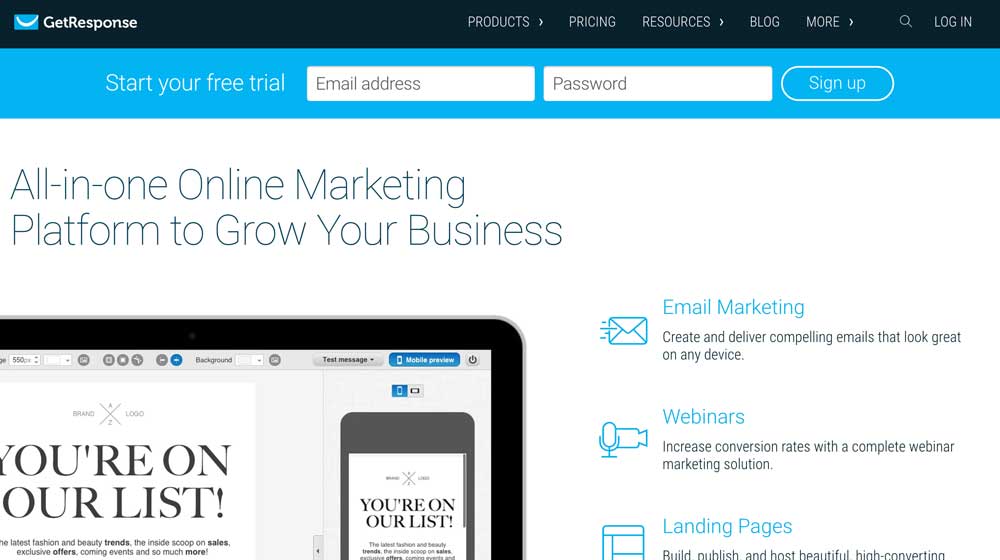
So, I have been exploring other options. The first one I picked up is GetResponse. It is very reasonably priced in comparison to its competition with the basic package starting at $15 per month. Their site says, $10, but it’s actually £10 plus VAT, which is £12, which translates to $15.56 at time of writing.

Interface and workflow

I found the interface a little confusing. I was trying to edit my campaigns, for example. This is not in the menu. You have to click a little cog next to the campaigns drop-down. This shouldn’t be a big thing, but it took me ages to find it, and it was infuriating.

I also found the workflow a little confusing. You have to create a draft message. But then when you try and drag it into a workflow, it pops up a little box saying it has to copy it to the automation folder. Then I have two copies of the message. What is going on here?

And if you want to use Google Analytics integration, you can’t do that through automation. You have to use the newsletter editing screen and copy the message over to automation.

When you click exit on editing a message, you go back to the homepage, rather than the messages page. Again, not a huge thing, but it feels like the workflow for someone using it in the real world could use more attention (MailChimp isn’t brilliant at this, either).

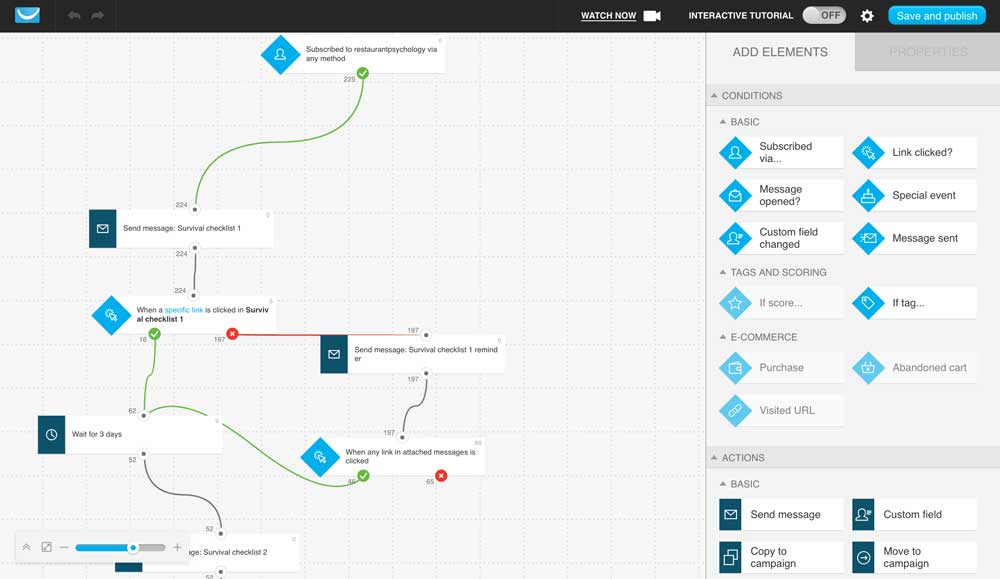
The automation builder itself is really nice. You can drag and drop elements onto the page, such as messages or decisions, and configure the output easily. There are lots of options including tracking opens, clicks and specific link clicks, and re-arrange and add elements to your heart’s content.
Message editor

The editor itself is okay. It lets me edit the HTML directly, which I like. However, you have to generate a plain text version manually. There is a “Copy HTML” button, but this does not bring in the paragraphs, which you then have to fix manually. It doesn’t handle links very well either, in my opinion.

I could never get the inbox preview to work, but the test emails arrived soon enough.

User management and API

The user system and API are where I really struggled with GetResponse, though. You are unable to add tags to a user when you create them. This is frustrating when someone joins by making a purchase because you want to tag them with that purchase straight away.

You might think “oh, well I’ll have to create the user, then query for that user ID, then tag them, making three requests to the API. It’s not ideal, but it will work.” Except it won’t work. Because users are not added to your list in real-time. They are done via a queue. So if you query for a user immediately after creating them, they won’t be there.

They have a PHP library for the API, but it needs some work. It typecasts everything as an object. Even the arrays. So you end up with things like:

stdObject->0

PHP doesn’t allow this, so you have to JSON encode the object, and then JSON decode it to get back to:

stdObject->{"0"}

Even if you could add tags, there is no screen to allow you to manage them.

Support & live chat

They do offer 24/7 live chat. This was a mixed bag. The first time I spoke to them they confirmed there was no tag management screen and that they did not support the API, so would not be able to answer my question about that.

The second time I spoke to them was when their message editor was playing up. I was trying to edit the HTML, and every time it broke. It turns out that unless you select “HTML editor” when you first create the message, you are stuck. I had started with a template, and there is no way to switch. So I had to create a new message and copy it in. It was difficult to get the message across to the support agent, but eventually, we found ourselves on the same page and sorted out the issue.

Other problems

Copying things over is more difficult than it seems. GetResponse uses the session to track what message you are editing. This means that if you open one message, and then a second, it things you are editing the second message on both screens.

Let me explain this with a scenario:

  • I have message A, and I want to copy over the content from message B
  • I open message A
  • I open message B and copy and paste the content to message A
  • I click “save” on message A to save the new content
  • GetResponse thinks I am editing message B and overwrites the content of message B, ignoring message A

I lost a lot of content before I realised this. Luckily, I had backups on my computer.

And in case you’re thinking an easy way to avoid this would be to duplicate message B and then edit it, think again: there is no duplicate functionality.

Getting people into an automation workflow can be tough. You can filter what happens based on custom fields. However, this doesn’t work on the initial subscription: it only works when you go in and edit the custom field of the user. Which is not very automated.

Other features

GetResponse also offers landing pages, webinars and some other stuff. I watched a webinar about their webinars, but I haven’t tried any of these systems because I just want the mailing list functionality. It might be great.

Summary

I love GetResponse’s automation builder. The drag and drop interface makes it easy to create an email sequence that follows what people do and delivers them relevant messages. It is powerful and shows you how many people are at each point.

But that is where my love ends. Coming from MailChimp, where everything is beautiful and works well, GetResponse has a lot of issues. There are so many problems that working with it becomes infuriating, undoing much of the power that the automation functionality should be adding in.

Ultimately, you can launch a simple automation workflow that is more advanced than MailChimp. However, there are so many bugs, dead-ends and limits to what would otherwise be a great tool, that you don’t get much advantage.


Panini in Pateley Bridge

May 27th, 2017 | Photos

This is not how you spell panini. Panini itself is plural. It’s an Italian word. The singular is panino. Therefore, there is no need to put an s on the end.

Worst still, though, is that if you zoom in, you can see someone has rubbed something out before the s. An apostrophe, no doubt.

Mushroom town: how a tiny corner shop beat Sainsbury’s

May 27th, 2017 | Food

Unless you are from Yorkshire, you have probably never heard of Pateley Bridge. Why should you? It has a population of 2,000 people and a single high street that, if made any steeper, would be a vertical drop.

If you want to buy groceries, it’s a drive to the nearest supermarket. Or, you could try one of the two local stores located in the town.

This is a far stretch from my home city of Leeds. It has a population of over 600,000, and that is just the city itself. The wider metropolitan area makes up the biggest population outside of London.

So, you would think that the product ranges available would be incompatible. And, for the most part, they are. But, on a recent trip to Pateley Bridge, one store threw up a pleasant surprise.

Where to buy mushrooms in Leeds

If you want to buy mushrooms, a supermarket seems the obvious place. They sell food, after all. If you want to buy any mushroom more interesting than the standard varieties, you can find them at Sainsbury’s.

In a box called “speciality mushrooms”.

Which includes a selection from the following list:

“Shiitake, Buna-Shimeji, Shiro-Shimeji, Eryngii, Oyster mushrooms, Enoki, Golden Enoki, Maitake”

So, while you will end up with something more interesting, there is no way to know what you will get or in want quantities. There is no way to plan a meal, for example. And even if there was, because you get a selection, you never have enough of what you actually want.

Unless you buy a lot of boxes and throw most of the mushrooms away. Which, again, you can’t, because you do not know what you are going to get.

And there are no chanterelles anywhere to be found. Nor can they be found in Ocado’s spacious warehouse.

A surprising find in Pateley Bridge

Last month, we visited Pateley Bridge. On returning from our walk, we wanted to buy some bread and had a choice of the two convenience stores located in the town.

One of them advertised it was selling “paninis”. This quickly ruled the store out: as a pedant (yes, despite my awful spelling), I couldn’t possibly buy from a store that did not understand that “panini” was already the plural of “panino”.

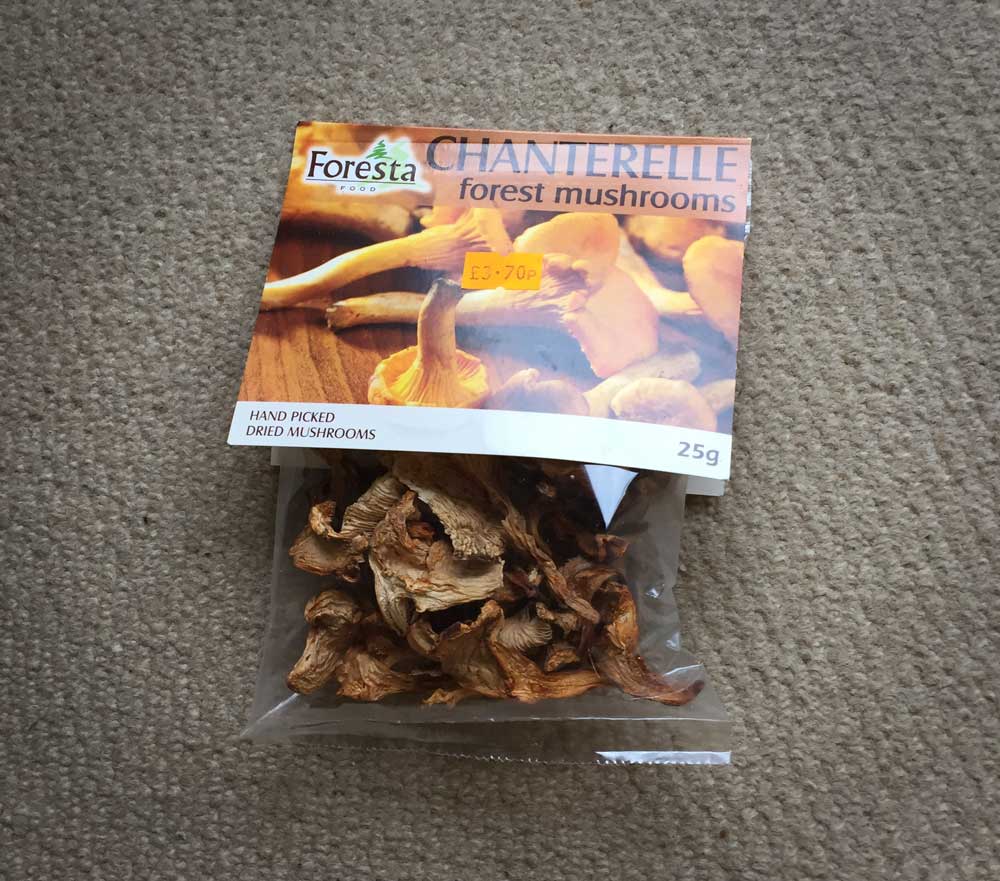
By process of elimination, we entered the other store. And found this sitting on the shelves.

Despite never having seen chanterelle mushrooms in any supermarket in Leeds, nor at Kirkgate market of street stalls, here in this small town of 2,000 people, they were on sale.

Sure, they are dried. The store wasn’t having fresh chanterelles shipped in every few days. But that makes it even more inexplicable as to why you cannot buy them anywhere else.

Conclusion

There probably is an obscure shop somewhere in Leeds that sells them. If you know of it, let me know.

Until then, as I don’t fancy the hour’s drive to Pateley Bridge every time I want some mushrooms, it may be time to follow the adage “if you want a mushroom done right, you have to grow it yourself.”

Baskin Robbins: a review

May 26th, 2017 | Food

Baskin Robbins have a store in the Merrion Centre. We went in to try their wares: it would have been rude not to, really. I love Joe Deluccio’s in Trinity, so that was our main basis for comparison.

I had the chocolate mud and the mint chocolate chip. It’s not quite as smooth as Deluccio’s, but is still tasted great. The cone was a mixed bag: it was big, so contained the ice cream very well. However, it was a bit difficult to get to the ice cream and it collapsed towards the end.

On our second visit, they had no chocolate ice cream. No regular chocolate, no Mississippi mud, not even a mint chocolate chip.

The staff were surly both times. In fairness, they weren’t overly unfriendly, but they definitely are not pleased to see you. Which seems strange given they have so few other customers. Service at Joe Deluccio’s is also unfriendly, though.

Why Ocado (and Amazon Fresh) are doomed

May 25th, 2017 | Thoughts

Remember when supermarkets started doing online deliveries? And it turned out that they just had people going around their own stores picking out items to send to people?

Oh, how we laughed. “What a silly way to do it” we jeered. “Why don’t they have one central warehouse where they can do everything efficiently?”

I don’t think supermarkets did it this way because they thought it was the best way. I think they did it because of path dependency: they already all of these stores and it was the easiest way to do it. However, here we are a decade later, and it turns out that their approach is the best.

In fairness, I’m being overly provocative with my headline. I’m a fan of Ocado. You can read my review of Ocado here. But my guess is that if they want to build on their success in the long-term, they have some fundamental business challenges to overcome.

This is why…

Why is Amazon looking for retail space?

The story starts as many do, with some fascinating insight from Scott Galloway. He said that Amazon would eventually buy a large department store.

Why? Because such a company would have stores in every major city. This is important because it allows Amazon to deliver products quicker. One of their big problems is time: I can drive to the shop and buy something instantly. And customers love instant gratification. Amazon cannot deliver that, which is why they are spending time messing around with drones.

Jeff Bezos has always wanted to find a better way to do this. In Bezos’s biography, The Everything Store, Brad Stone talks about how Bezos wanted to hire college kids to keep a stock of Amazon products in their bedrooms and cycle them round to customers the minute they ordered.

Short of that, Amazon needs a distribution facility in each area to allow them to get products to customers quickly. That is tough when you operate a huge monolithic centre. But way easier when you have loads of local stores.

What does this mean for Ocado?

Ocado has the same problem that Amazon does. They operate out of a giant warehouse down south. This means that you have to pick the orders there and drive them to every corner of the country. Doing this is expensive for Ocado and slow for consumers.

Compare that to the major supermarkets: Sainsbury’s have their warehouse located literally only a few miles from my house. And everybody’s house. And running this warehouse costs them practically nothing because the stores are profitable in themselves.

Therefore, even when you add the cost of an inefficient system in which employees go around the shop picking out items like an in-store customer would, it still produces a business model that works and works well.

What can they do about?

Ocado needs to find other ways to compete. Amazon was successful in competing against existing high street stores. It did this in two ways. 1) it offered cheaper prices and 2) it offered a way bigger selection. Their tagline is, after all, “Earth’s biggest selection”.

Ocado doesn’t do this. Their prices are more expensive. Their selection is good, but not amazing. Take fish, for example. The selection at most supermarkets is rubbish: cod, salmon, seabass, maybe some tuna or another white fish if you are lucky. Morrison’s is a bit better. Ocado better still: their selection is maybe twice as big.

But, as Peter Thiel points out in Zero to One, if you want to do the same thing as everyone else, you can’t be 2x better: you need to be 10x better. Leeds Fish Market is 10x better. I can get maybe 100 different specifies of fish and seafood there. So I go. Just like Amazon offered way more books than my bookstore.

Summary

Traditional supermarkets have a huge advantage over online ones because they have a far better distribution network. This is important because that is all a supermarket essentially is: they buy other people’s food and distribute it to people before it goes off. If the online world wants to compete, it needs to offer an experience that is so much better you cannot possibly not switch. Ocado and Amazon Fresh do not yet do that, in my opinion.

The 4-Hour Chef

May 24th, 2017 | Books, Food

Tim Ferriss is a super-star. Jeff Goins nailed it when he said that people didn’t love Tim Ferriss for the message he brings, but just because he’s such a cool person that you want to me like him.

Since rising to fame with The Four-Hour Work Week, he has gone on to push the franchise with The Four-Hour Body and this, The Four-Hour Chef.

It’s quite clever the way he sells it (or sneaky). He sends you the audiobook for free when you join his mailing list. But there are no recipes in it: every 5 minutes the narrator says “please refer to the print or eBook edition for recipe steps and sidebars”.

Ferriss suggests that cookbooks are written for those who can already cook. They are arranged by category and don’t explain what is going on. Instead, this book is arranged by technique, starting from the basics and building up.

It is arranged into five sections: meta, domestic, wild, science and pro. In meta-learning, he talks about how to learn faster and more efficiently. He then takes you through the building blocks of cookery in dom.

In wild, we are treated to a narrative of Tim’s adventures. How to survive a disaster and catch a pigeon, for example. Science is similar: there is some science in it, but also plenty of stories: the time he attempted Ben & Jerry’s Vermonster, for example, or his food marathon: 26.2 dishes in 24 hours. Something I would love to try.

Finally, in pro, he rounds off with talking to some of the best chefs in the world about how they do what they do.

I tried a lot of the recipes in domestic. They’re fun. None have made my regular rotation, but I made the Vietnamese burgers more than once.

I also really enjoyed a lot of the explanations. Why do you need to brown meat? I knew why already, but no cookbook ever takes the time to explain it: it’s more folk knowledge. Why do you need mustard in a vinaigrette? Why do you rest steak? It’s all in here.

The science is a mixed bag. It’s really interesting to learn about all of the different aspects of the cooking process, gels, emulsions, etc. However, I struggled to follow along with the theory. I more felt like I was getting starter points to learn about it on my own. And some of the science in here is a little dubious. Like his original book, I suspect Ferriss doesn’t let the truth ruin a good story.

If you’re a Tim Ferriss fan, this is a no-brainer. Get the hardback: it’s a monster.

How to poach a pear

May 23rd, 2017 | Food

Recently, I’ve given in to the sheer volume of people telling me I should be watching MasterChef, and jumped it. I’m enjoying it. But it also really undermines my confidence in my cooking: how does everyone on there know how to make their own pasta?

For dessert, they’re always poaching pears. That doesn’t take that much skill, does it?

It does look impressive, though. So I thought I would dive in.

For this, I filled a pan with water and dissolved some sugar in it. I then used a dessert pair and poached them for around 15 minutes. Results were okay. It was served with a vanilla cream.

For attempt two, I poached the pears in red wine. This involved a bottle of merlot (because that is what I had to hand) and some conference pears. I poached them for an hour to get them really tender and allow the colour to sink in on all sides. Along with the sugar I dissolved in the red wine, I also added some cinnamon and star anise.

I served it with some lemon curd. The tartness adds some nice contrast to the sweetness of the pair. A few pomegranate seeds and a simple biscuit crumb finished the dish.

The last holdout of Chinatown has fallen

May 22nd, 2017 | News

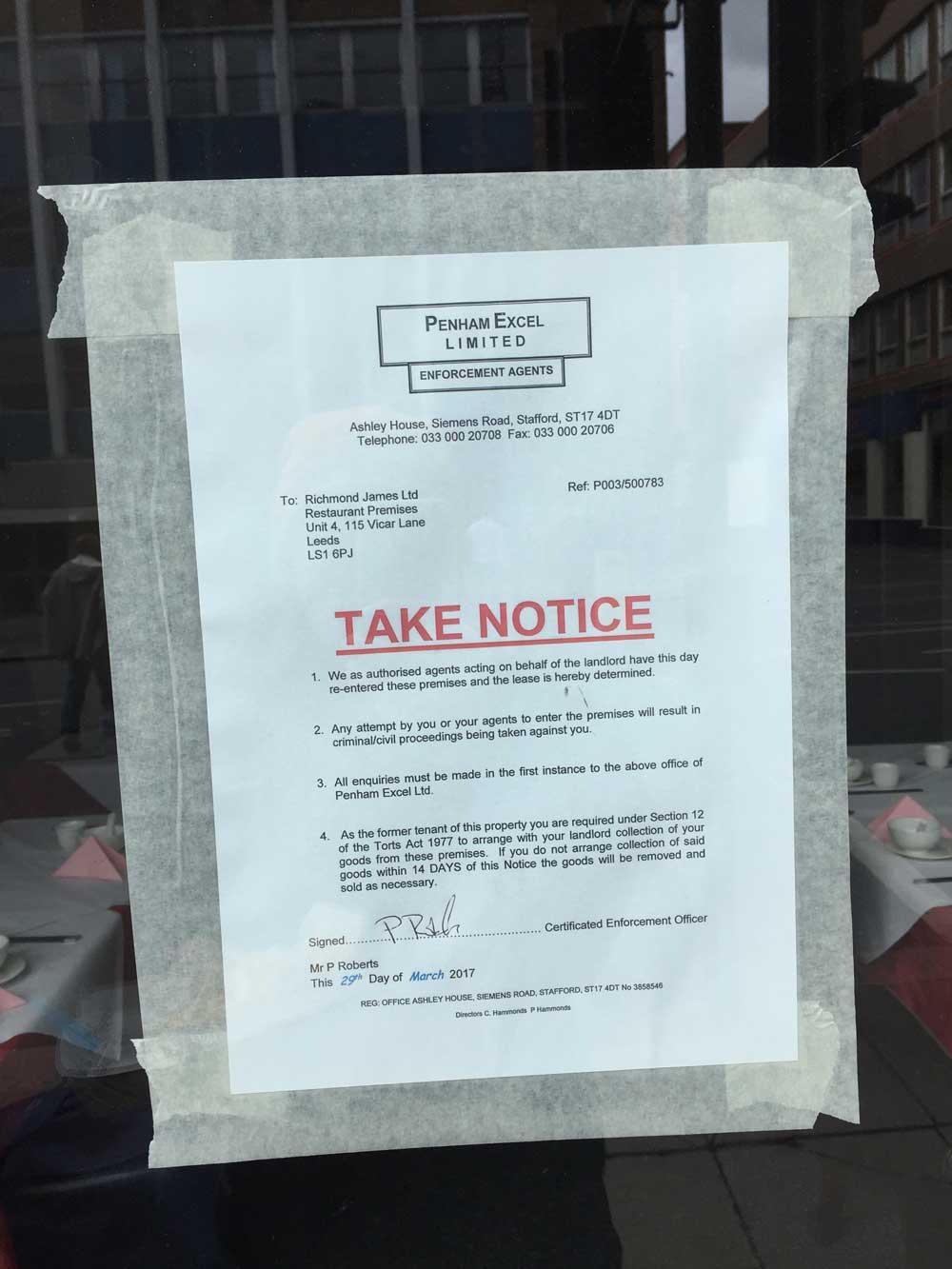
I’m sad to report that the last remaining restaurant of Leeds’s Chinatown has closed down.

Not that it was ever that big: a total of three restaurants. Hometown, Tong Palace and Ho’s. Plus the international supermarket remains, and Crown Buffet and Oriental City are nearby (though Mulan has also closed).

Luckily, the area booms with great food. Thai A Roy Dee, Zaap Thai and Bar Soba all provide Asian cuisine. But given Hometown and Ho’s were such enjoyable restaurants to visit, it is a shame that the street is now bereft of Chinese restaurants.

Sadly, restaurants live or die for a variety of reasons that you may not expect. Which is why I wrote a book about it.

We tried Ocado and this is what happened

May 20th, 2017 | Life

Ocado always seemed like a mythical super-supermarket. A land of plenty that stocked everything you could imagine and more besides. So, we gave it a go. Here is what we thought.

We usually order from Sainsbury’s. They are not without their problems. I’ve also tried Morrison’s online delivery, so those are my basis for comparison.

Ordering

Their website is a mixed bag. It’s crowded: the interface is crammed with buttons and promotions. However, the ordering functionality itself is fine. I like the quick view pop-up and being able to hover over a product to zoom in. They often have a lot of product photos, too.

While they have an extensive range, a lot of stuff is sold out. I like the fact that they are honest about this. I’m not sure what Sainsbury’s do, but based on past experience (one time loose tomatoes disappeared, for example) I think they silently remove stuff. Still, being so close to red delicious apples and missing out was frustrating.

Your delivery slot is only reserved for one hour. This is fine if you sit down knowing what you want. However, it was a bit of a rush when you are recipe planning at the same time. I had to place the order and go back and edit it later.

My biggest gripe with the ordering process is that I could only edit it until 5:40 pm the day before. Morrisons also have a cut off of 5 pm, whereas Sainsbury’s is 11 pm. This is probably the biggest reason we are still with Sainsbury’s.

It might not seem like a big deal, but it is to me. I work late, so 5:40 pm means I have to finish the order on Thursday evening, which is a whole day lost. I am regularly on the Sainsbury’s website at 10:45 pm on a Friday night, tweaking my order to accommodate new recipes I want to try or taking food out because I’ve been invited out to dinner one night.

Yeah, that is how I spend my Friday nights. Fuck you and your rock and roll lifestyle.

Product range

This is where I was expecting Ocado to excel. But, honestly, I was a little disappointed.

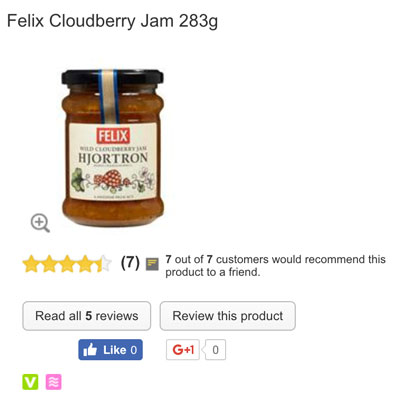
Sure, they had veal, and goat, and cloudberry jam. That is awesome. But we had been keeping a list of all the things we couldn’t get at Sainsbury’s and when it came down to it, that list was not that long.

On the flip side, they have stuff missing, too. No longley farm yoghurts, no smarties, no strawberry old moot cider. They have a better range of speciality mushrooms, but only to the extent that I could get them in larger quantities. No chanterelles.

They do have all of the Schwartz spices that Sainsbury’s have decided not to stock anymore. However, they do not have all of the own-brand stuff that drives down the cost of your shop. They have Waitrose Essentials, but it’s Waitrose, so it often the same price to get the branded stuff.

Fresh produce is a problem, too. They’re not a supermarket; they’re a warehouse. So you can’t buy a red pepper or a single apple. You have to buy a bag of them. This is probably okay if you are a cook who just opens the fridge and decides to make something based on what is in there. But I’m not there yet. I have plans. And those plans get expensive when you have to buy a bag of carrots just to get one.

Delivery

We usually get our shopping delivered in the 10 am – 11 am slot on Saturday morning. This has never been a problem. However, Ocado had no availability between 8 am and 11 am, so we had to push it back to the 11 am – noon slot.

Taking a look now, if I book a week in advance, I can get almost any time I choose for next Saturday. They have a system where you can reserve a time slot on a weekly basis, so if we went with them full time, I should be able to sort this.

The delivery was on time.

They have the best receipt I have seen. Everything comes in order of date, so you can easily tell when things are use by. This is great: I can easily compare if anything is going out of date before my meal plan schedules them in. With Sainsbury’s, you have to do this manually.

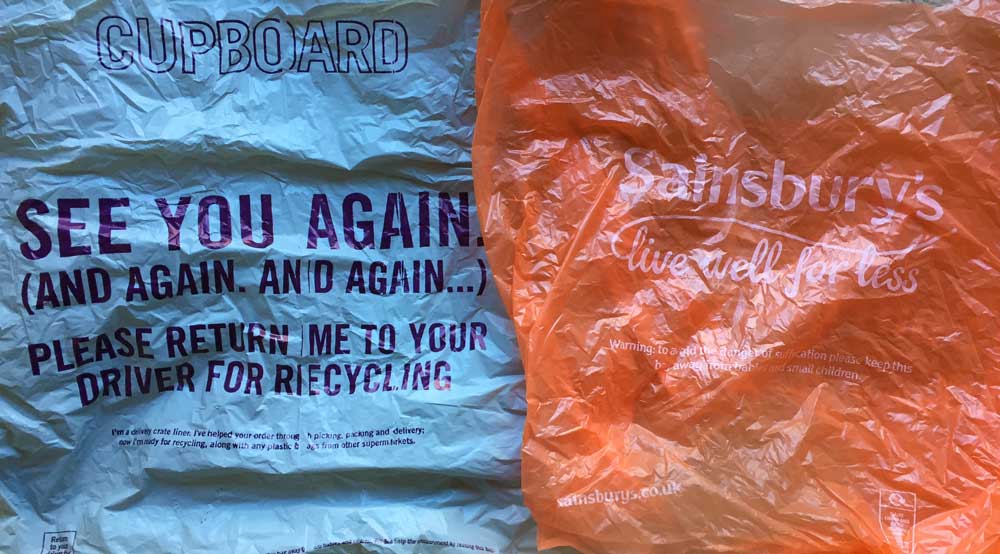
The bags are colour coded for freezer, fridge and cupboard. Morisson’s do this, too.

There is a substitution on my order. Not a great start for somewhere to claims to have very few of them. Worse, although they email me to tell me about it in advance, the guy never asks me if I want to return the substitution. I did want to return it. But, as they’re not separated into separate bags, I never got the chance to say anything.

Product quality

One of our big issues with Sainsbury’s is the expiry date of bagels. When we buy them from the Co-op, they last four weeks. When we buy them from Sainsbury’s, they expire in about five days. We were hoping Ocado would product Co-op results, but they do expire in five days.

Cost

It was an expensive shop. We sent £120. We got £20 off this off for being a new customer, but that is still a lot of cash.

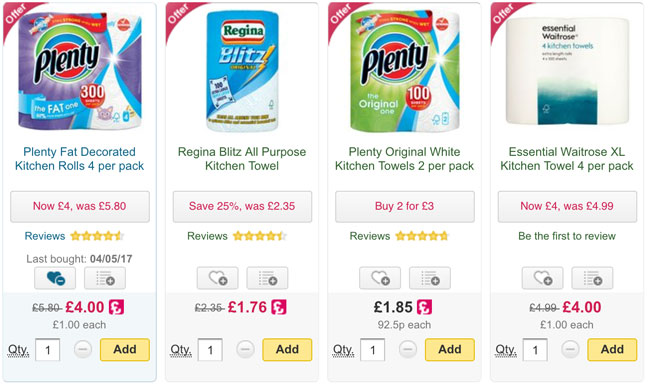
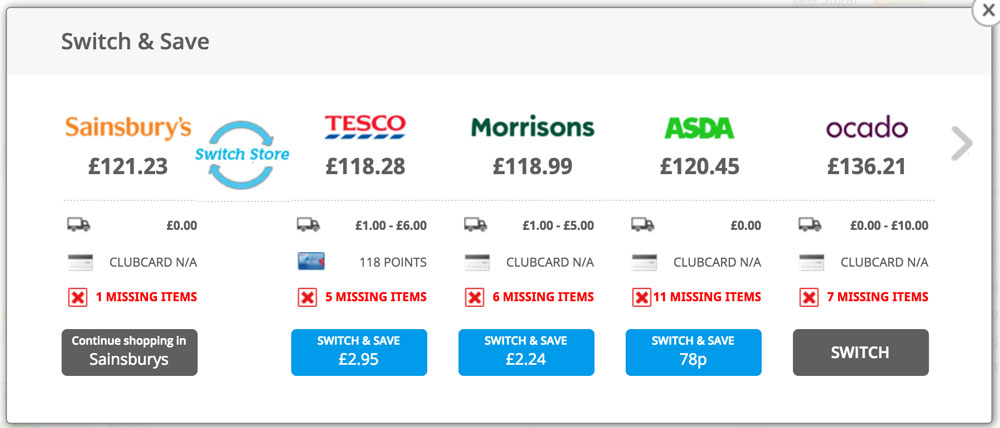
It’s true that some of that cost was because we saw we could finally get veal loin and rack of lamb, and did so. However, I have put my regular order into mySupermarket for price comparison several times and Ocado regularly comes out more expensive. See this comparission from 2015.

There are a number of reasons for this. Having to buy branded products rather than own-brand. Having to buy multipack vegetables rather than individual ones. But Ocado is also just more expensive. Take Pampers nappies, for example. Our current pack is £7 from Sainsbury’s, but £8 from Ocado.

£10 extra per week is a pretty big deal: that’s £500 extra per year.

There is also the cost of delivery. I am not sure what the cost of individual deliveries are but the Smart Pass (free deliveries) costs £110 per year. It’s £60 for one at both Sainsbury’s and Morrison’s.

Conclusion

Ocado has a lot going for them. However, I don’t think we will be switching anytime soon. The biggest issues, for me, are that I cannot edit my order after 5:40 pm and the cost (which I think is a result of the lack of individual fresh produce, higher prices and smaller range of won-brand items).