One-Dimensional Man
Sunday, August 31st, 2025 | Books
One-Dimensional Man is a 1964 non-fiction philosophy book by Herbert Marcuse.
In the book, Marcuse argues that suppression of individuality is presented as rational and efficient in advanced industrial society, but in fact this rationality itself serves domination. That is to say that it becomes logical to drive people to conformity because that scales well in capitalism (literally economies of scale).
New forms of control
This creates what Marcuse describes as “free competition among unequally equipped economic subjects”. For example, if a corporation mistreats you, you can take them to court. But they have millions of pounds and an army of lawyers, so good luck with that. Some of this can be rebalanced with trade unions but both western and eastern countries tend to legislate against this.
Marcuse identifies that we already have the technology to free people from needs and yet we are subject to the grind to survive even more. This is because modern society turns waste into need and we build our identity around commodities. Nobody needs a brand-name shirt. And we have loads of shirts. But we’ve created a world where we work overtime to get the X-branded shirt.
Refusing “to go along” with the system is then pathologised. Too burnt out to work? You have an anxiety disorder.
But why would you even want to rebel? Modern society does not oppress overtly, but rather by offering a life that seems tolerable, rewarding, and comfortable, and then threatening to take that away. By offering us a sense of comfort, it restricts our freedom, because we dare not choose to make our lives harder.
He also encourages to grapple with the concept of freedom itself. Freedom is defined to fit the existing system. You are given a thousand different products to consume but you are not given the choice not to consume.
To me, this brings to mind the question of what is freedom in 21st century society? For example, does freedom include universal healthcare? Libertarians would argue no because then they have to pay tax to fund it. Socialists would argue yes because in what sense are you free if you are too sick to live your life?
Closing of the political universe
Marcuse notes that oppression is hidden behind layers of bureaucracy, management and corporate structures. Workers used to be oppressed by the factory owner themselves, now they themselves answer to a board or shareholders who you will never see.
This is reminiscent of The Grapes of Wrath where the farmers are trying to work out who to shoot. Ultimately, they find there is nobody to rise up against because the system is faceless.
Excess capacity becomes a threat to society because if we do not consume it all, the surplus upsets the capitalist balance and this may impact our “comfortable” lives. Thus the threat of this potential upset becomes greater than the threat of losing our freedom, so we meekly sacrifice freedom for safety.
Chapter three and beyond
I managed to follow the book to here. After that, the philosophy became too dense for me to follow. This was very frustrating and I would love to read a more accessible text on the subject.
Conclusion
If you are a philosopher, you will likely find One-Dimensional Man an excellent critique of technological society. If you are a non-philosopher like myself, I still think you will enjoy the first chapter, but may get lost in the text after that.
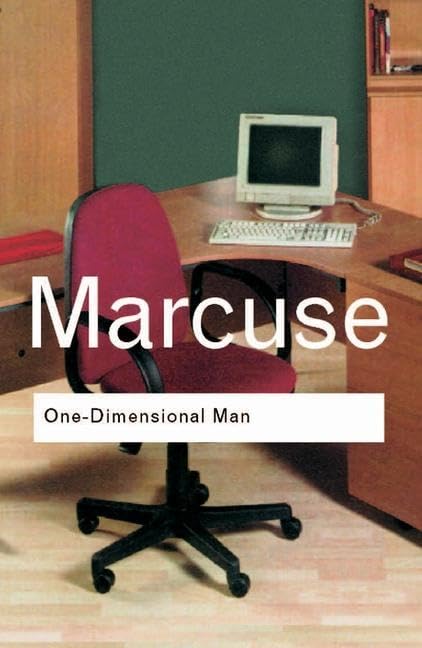
One-Dimensional Man is a 1964 non-fiction philosophy book by Herbert Marcuse.
In the book, Marcuse argues that suppression of individuality is presented as rational and efficient in advanced industrial society, but in fact this rationality itself serves domination. That is to say that it becomes logical to drive people to conformity because that scales well in capitalism (literally economies of scale).
New forms of control
This creates what Marcuse describes as “free competition among unequally equipped economic subjects”. For example, if a corporation mistreats you, you can take them to court. But they have millions of pounds and an army of lawyers, so good luck with that. Some of this can be rebalanced with trade unions but both western and eastern countries tend to legislate against this.
Marcuse identifies that we already have the technology to free people from needs and yet we are subject to the grind to survive even more. This is because modern society turns waste into need and we build our identity around commodities. Nobody needs a brand-name shirt. And we have loads of shirts. But we’ve created a world where we work overtime to get the X-branded shirt.
Refusing “to go along” with the system is then pathologised. Too burnt out to work? You have an anxiety disorder.
But why would you even want to rebel? Modern society does not oppress overtly, but rather by offering a life that seems tolerable, rewarding, and comfortable, and then threatening to take that away. By offering us a sense of comfort, it restricts our freedom, because we dare not choose to make our lives harder.
He also encourages to grapple with the concept of freedom itself. Freedom is defined to fit the existing system. You are given a thousand different products to consume but you are not given the choice not to consume.
To me, this brings to mind the question of what is freedom in 21st century society? For example, does freedom include universal healthcare? Libertarians would argue no because then they have to pay tax to fund it. Socialists would argue yes because in what sense are you free if you are too sick to live your life?
Closing of the political universe
Marcuse notes that oppression is hidden behind layers of bureaucracy, management and corporate structures. Workers used to be oppressed by the factory owner themselves, now they themselves answer to a board or shareholders who you will never see.
This is reminiscent of The Grapes of Wrath where the farmers are trying to work out who to shoot. Ultimately, they find there is nobody to rise up against because the system is faceless.
Excess capacity becomes a threat to society because if we do not consume it all, the surplus upsets the capitalist balance and this may impact our “comfortable” lives. Thus the threat of this potential upset becomes greater than the threat of losing our freedom, so we meekly sacrifice freedom for safety.
Chapter three and beyond
I managed to follow the book to here. After that, the philosophy became too dense for me to follow. This was very frustrating and I would love to read a more accessible text on the subject.
Conclusion
If you are a philosopher, you will likely find One-Dimensional Man an excellent critique of technological society. If you are a non-philosopher like myself, I still think you will enjoy the first chapter, but may get lost in the text after that.