Archive for the ‘Books’ Category

A Tale of Two Cities

Thursday, June 12th, 2014 | Books

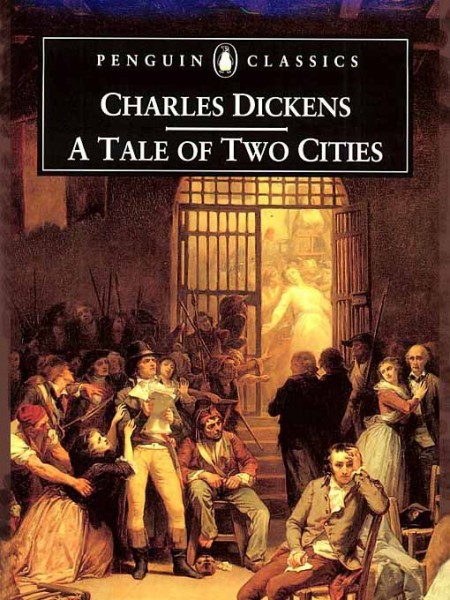
If you take a look at Wikipedia’s list of best-selling books of all time, A Tale of Two Cities by Charles Dickens comes right at the top. Of course, it was published over 150 years ago, so who can say where Fifty Shades of Grey will be after a similar time has lapsed…

It also shares a very similar name with the Leeds-based food blog A Tale of Two Sittings. I am not sure whether it is a deliberate reference to the book, or whether the blog pre-dates the novel and Dickens was making a reference to the blog. More research is needed.

Dickens tells the tale of a small cast of characters and their jet-setting lifestyle between London and Paris, both before and during the French Revolution. It takes quite a while to get into. I think I got to about half way through the book, still wondering what it was actually about. Of course it all comes together in the end though to form a beautiful tapestry of interwoven stories that culminate in what is probably a happy ending. Ignoring the tens of thousands that went to the guillotine of course…

A Tale of Two Cities

Liar’s Poker

Monday, June 9th, 2014 | Books

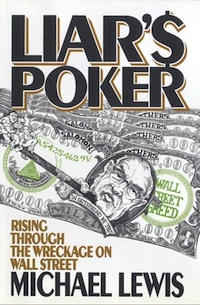
Liar’s Poker is the first book Michael Lewis published and the one that transformed him from a bonds salesman to a writer. It tells the tale of how he came to work at Salomon Brothers and key figures at the company that oversaw rise and fall. It’s an interesting insight into the excess of Wall Street.

Liar's Poker

More thoughts on The Blind Side

Sunday, June 8th, 2014 | Books

I’ve been thinking some more about why I did not find The Blind Side quite as satisfying a read as I had hoped for. I think it is because the story does not really fit together as well as it could have, and thus the ending was a bit of an anticlimax.

The early part of the book set out a clear narrative. The NFL was taking up to the fact that left tackle was a really important position while simultaneously Michael Oher but a quark of fate was both huge and nimble. It was a fairy tale story ready to be put to paper.

Unfortunately, it did not pan out that way.

The NFL had in fact woken up to the value of left tackle well before Michael Oher arrived on the scene. Far from being unique, the league had already sourced a collection of elegant giants to protect their quarterbacks.

He was drafted in 2009 by the Baltimore Ravens and despite trying him out at left tackle, he has spent most of his time on the right. That is not to say he is not an excellent player. The Ravens won the Super Bowl (after the officials refused to call blatant pass interference on what would have been the 49ers winning drive – I’m not bitter about it though) with him in the offensive line. However, re-write the book he did not. Bryant McKinnie was their left tackle.

That is not to detract anything from what is a wonderful story. It was a very moving tale and an enjoyable read.

The Case-Book of Sherlock Holmes

Wednesday, June 4th, 2014 | Books

Arthur Conan Doyle’s final set of stories about Sherlock Holmes is compiled into Case-Book. It has some interesting tales, but at times I could not help but feel that the ideas were running a bit thin. One wasn’t even really a mystery, it was just someone reciting a story. Others were narrated by Holmes himself. It was true to his character, which while being accurate, was a less engaging style of storytelling. I did not get bored though, so these points aside, it was an enjoyable read.

Case-book_of_sherlock_holmes

The Blind Side: Evolution of a Game

Tuesday, June 3rd, 2014 | Books

Pretty disappointed by this book. It was a truly heart warming tale about how a rich white family brought a poor black kid into their home and turned his life around. But what I really wanted was an insight into an industry. That is what Flash Boys and The Big Short delivered.

That is not to criticise Michael Lewis as a writer. He is, as ever, poetic in his storytelling. It is a strange and wonderful story. However, it did not create the “I cannot put this down” feeling as much as the books of his that I have previously read.

The_Blind_Side_Evolution_of_a_Game

The Big Short

Tuesday, May 27th, 2014 | Books

The Big Short is a book by Michael Lewis that tells the story of the 2008 financial crises and some of the people who saw it coming. Lewis is a great writer. He takes a subject which is fundamentally rather dull and boring, and tells stories in such an accessible and engaging way that it is difficult to put it down.

It preaches a similar story to that of his later book, Flash Boys. That is that almost nobody in the banking industry really knows what is going on. They churn out new products and new systems so fast that none of them really understand it. Their, and our doom. But at least it makes good reading.

The Big Short

His Last Bow

Sunday, May 25th, 2014 | Books

His Last Bow is another of the collection of short stories written by Arthur Conan Doyle around Sherlock Holmes. They continued Doyle’s improved storytelling style and offered some further interesting insight into the characters, particularly Mycroft.

Some of it made me think I had read before, particularly when Holmes describes how he reads Watson’s thoughts. I’m not sure if it actually was the same as an earlier story or not. It also jumps around quite a bit in terms of when the stories were set and so a bit more of an explanation at the start would have been nice.

His Last Bow

Flash Boys

Monday, May 19th, 2014 | Books

When someone says the phrase “high frequency trading” (HFT), most of us have no idea what it means. Even those of us with some idea, probably think it is trading by computers, but essentially doing what traders do – wheeling and dealing in an attempt to make some money.

Michael Lewis’s book “Flash Boys” tells a different story. High frequency trading is all about front-running. You want to buy 10,000 shares in Apple? Great, I’m going to buy them before you can and then sell them to you at a higher price. It’s illegal, or it was, but with the deregulation of central stock markets in favour of competition between markets, you can now exploit milliseconds it takes for them to talk to each other.

This caused huge investment into the history with HTF firms making enormous profits. The banks didn’t say anything because they were making money from selling the HFT companies the data they needed. The stock markets didn’t say anything because they were making money from the huge increase in trading activity. Everyone was getting rich from scalping the ordinary investor.

I say was, but the problem has not gone away. However, the book also discusses how former trader Brad Katsuyama has gone on to set up IEX, a private stock exchange that tries to eliminate all the unfairness in the market.

It is a fascinating by scary read. To see how totally wrong the entire banking industry is. We all kind of know it, but it really brings it home.

Flash Boys

Kick the Drink… Easily!

Sunday, May 18th, 2014 | Books

Jason Vale’s book “Kick the Drink… Easily!” suggests that it is easy for someone to stop drinking because there is no such thing as an alcoholic. Alcohol completely leaves your system within 10 days so the idea that it is a lifelong problem is “brainwashing”. Once you remove it, you can just stop drinking.

It was an interesting read, though I do not agree with all of it.

He makes a lot of astute points. Alcohol gets a special treatment among recreational drugs. When you say you don’t drink, people ask you why. Nobody has ever asked me why I don’t take crack. Alcohol is a drug and it messes up the human body.

It also tastes like piss. We all know it. We all had that first drink, it was horrible. But we kept at it because it was the socially acceptable thing to do and gradually built up a tolerance to the horrible taste. But at the end of the day it is still a poison that our body does not like.

It goes on. Does it make you more sociable? Probably not when you think about it. People slur their words, withdraw themselves from conversation and become violent. 75% of stabbings involve intoxication. It’s expensive. It’s had for our health. It makes us feel horrible the next day. Why then do we do it?

I don’t agree with all his points. For example, it could offer a pleasurable effect. Being “numb to the world” as it he puts it, could be thought of as pleasurable if you are not happy with your live.

It also does grease the wheels of social interaction. While I do not think being intoxicated actually does make it any easier for me to talk to new people at parties, or make me a more interesting or lively person, it does help many of us get together with long-term partners.

As for his tenet that there is no such thing as alcoholism, that is less clear. Mainly because nobody can really agree on what alcoholism is.

Overall, I think it makes a good case against alcohol. It is more a large collection of anecdotes than a well cited review of the evidence. However, we all know that this evidence is out there. The book is designed to convince people to stop drinking, and people often respond better to anecdotes than hard evidence.

Kick the drink easily

Although, that does appear to be a quote from the Daily Mail on there.

The Valley of Fear

Saturday, May 17th, 2014 | Books

The last full Sherlock Holmes novel that Arthur Conan Doyle wrote is The Valley of Fear. It is a great example of how Doyle’s writing progressed as his career went on. It has a similar structure to that of his first novel A Study in Scarlet but is delivered in a far more coherent and logical way as to make the pleasure of reading it greatly increased.

It does, however, like quite a number of the stories in the Sherlock Holmes canon, lack an entirely-satisfying ending. However, there have been worse conclusions of stories in the series.

The_Valley_of_fear