Archive for the ‘Books’ Category

Strictly English

Sunday, January 3rd, 2016 | Books

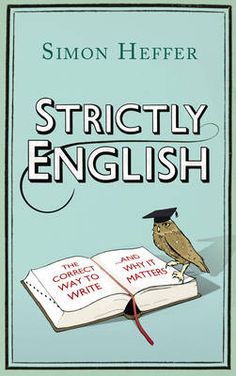
Strictly English is a book by Simon Heffer. It is a forerunner to Simply English, which I have already read.

While Simply is an A to Z of words and how they are often misused, Strictly is a work of following prose. It goes from subject to subject describing the English language in detail.

In the introduction to Simply, he describes it as complementing Strictly. This is for the most part true. However, there is a significant amount of crossover. I regularly found myself skipping through sections because I had already read the point in Simply. On balance, I think this might be the more valuable of the two.

Strictly-English

The End of Eternity

Friday, December 25th, 2015 | Books

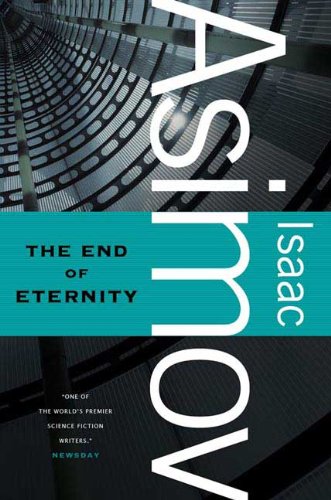
The End of Eternity is a science fiction novel by Isaac Asimov. It is one of a handful of full-length novels that does not form part of one series or another (Robot, Foundation, Empire).

It’s a wonderful read. It explores the idea of time travel and the causal loops and problems that follow from that. It had some suspense, but once you have read some Asimov some of it is a little predictable. Other bits are brilliant because I should have been so closing to getting it but did not quite make it.

This is one of my favourite Asimov novels.

The-End-of-Eternity

Teach Like a Champion

Thursday, December 24th, 2015 | Books

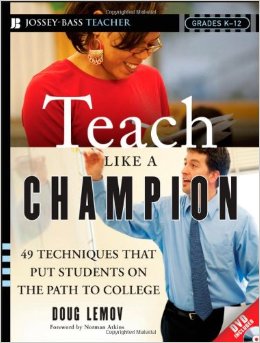
After being recommended the book Teach Like a Champion by another book, I decided to give it a read. I thought it was worth doing because it would have a lot of transferable skills that I could take into my community groups and public speaking. I was wrong; lesson learned.

A lot of it sounded very useful (although I am not a school teacher, so how would I know) but directly relatable to a classroom environment and therefore of little use to a wider audience. In my opinion, this certainly is not worth reading unless you are a school teacher.

One issue that came up again and again was time. This certainly does have wider applications. Time boxing for example. At Sunday Assembly we often give people “about 5 minutes” to talk to the people around them. We call it ‘meet your neighbours’. It’s always a struggle to get people focused again though. Ideally we would say something specific “take 3.5 minutes” and then conclude with a “time is up”.

teach-like-a-champion

Dataclysm

Saturday, December 19th, 2015 | Books

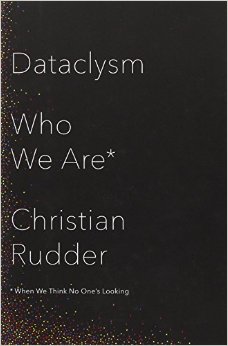
Christian Rudder is a founder and head of data trends at the dating site OkCupid. For years he ran the blog OkTrends which looked at what data you could mine from their site. This book is a continuation of this work as well as bringing in other data sets, mostly to talk about human sexuality.

The full title is Dataclysm: Who We Are (When We Think No One’s Looking).

The anonymised data of OkCupid in aggregate provide some surprising facts, and some expected ones. Take gender differences, for example. Women rate men of a similar age to themselves as the most attract. Up until 30 women will rate men a year or two older than them as the most attractive; after 30 they find men a year or two younger than them most attractive. A drop off starts at 40. That is a good innings though. Compare this to the way men rate women. They rate 21 year olds the most attractive and it goes down hill from there.

He looks at the use of English on Twitter. Many people suppose the internet is degrading the quality of language used. Not so. The average length of a word used on Twitter is actually longer than that in professional publications, and historically. It turns out that when you limit people to 140 characters, they write concisely using a wide lexicon.

He quotes Steve Jobs: “people don’t know what they want until you show it to them”. This always reminds me of the Henry Ford quote “if I had asked my customers what they wanted, they would have said a faster horse”. Whether Ford actually said that is unknown, but it makes a good point. When asking for feedback you really need to find out what they think the problem is that you want to solve, rather than asking them what they think the solution is. In Ford’s case a faster way to get from A to B and in Job’s case an easier way to play and listen to music.

Back on OkCupid, it turns out that everyone is a racist. Rudder breaks the data down into how four groups: white, asian, latino, black, rate each other’s photos. It turns out that people generally rate their own race as the most attractive, but the real drop off is for black women by any other group, who consistently rate them lower. This has geographic differences however. There is a big gap in the US for example, while almost no gap in the UK.

He also looks at the differences between the heterosexual and LGBT communities. Is sexuality a spectrum, for example. Only 19% self-identifying bisexuals regularly message both males and females. This could imply a number of things. It could be that there is a spectrum and many bisexuals fall at either end of it. It could also be that some gay people identify as bisexual for cultural or social reasons. Especially given it correlates with their state’s tolerance of homosexuality. The answer is probably a number of different factors.

Rudder also mentions that Justine Sacco, the woman who made the “hope I don’t get aids” tweet, worked for OkCupid’s parent company. Sacco was discussed in Jon Ronson’s book So You’ve been Publicly Shamed. The hashtag #HasJustineLandedYet is a classic example of how quickly things can travel world the world these days.

In summary, it’s not too clear what Dataclysm was actually about. It seemed to be mostly “here is some interesting data about people”. From that respect, it was genuinely interesting. It also had a lot of crossover with A Billion Wicked Thoughts in using anonymous internet data, a source that has only come around in the last few decades, to reveal fascinating insights into human thoughts and behaviour.

dataclysm

Leeds Restaurant Guide, 5th Edition

Monday, December 14th, 2015 | Books, News

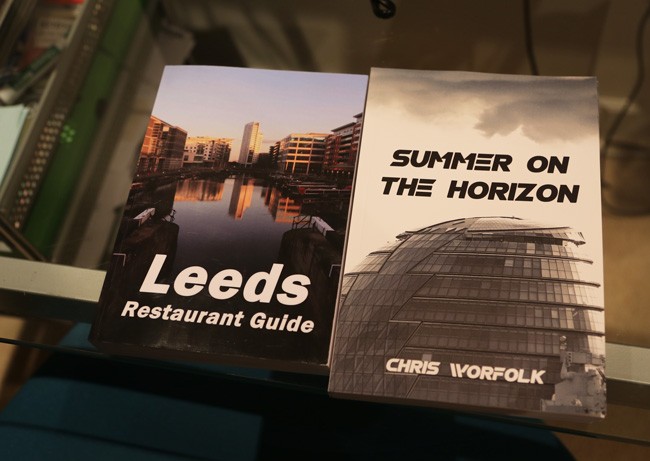
Still looking for that perfect gift for someone? I’ve come to your rescue, as yesterday saw the launch of the 5th edition of the Leeds Restaurant Guide! It should now be available on Kindle Store. This edition has 20 new restaurants and 4 updated reviews.

Added

  • 2 Oxford Place
  • Archie’s
  • Bilbao
  • Bill’s
  • Brotherhood of Pursuits & Pastimes
  • Five Guys
  • Gusto
  • La Rambla
  • Manahatta
  • My Thai
  • Pie Minister
  • Pintura
  • Revolucion de Cuba
  • Smoke Barbecue
  • Soba
  • Stockdales
  • The Headrow
  • The Liquorist
  • The Phoenix
  • Zaap Thai

Updated

  • Akbar’s
  • Elysium
  • Stonegate Pubs
  • Thai A Roy Dee

Pebble in the Sky

Saturday, December 12th, 2015 | Books

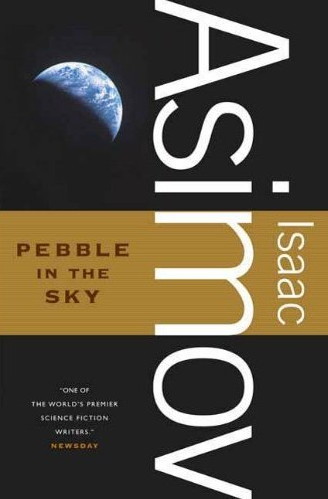
Pebble in the Sky is the third novel in Isaac Asimov’s galactic empire series. The empire of Trantor is now firmly established and spreading to every corner of the galaxy.

Earth on the other hand is not doing so well. The people of the galaxy have forgotten that it was the original home world of man, and Earth has fallen out with the rest of the galaxy. However, they gave a secret plan to destroy the empire.

Having read the Foundation series, it adds a different perspective. Spoilers start here by the way. This novel ends with a note of hope that Earth will rebuild. However, as those of us who have read Foundation and Earth will know, it doesn’t.

Foundation also benefits from originally having been short stories merged into novels. This means a lot happens and you see the story unfold over hundreds of years. The galactic empire series typically take place on one or two planets, and not much happens. They are still good, but it does not have quite the same effect of the first Asimov novels I read.

It does do an excellent job of constructing the amazing world that makes Asimov’s storytelling so enjoyable though. The far future, and the familiar, blended into one.

Pepple-in-the-sky

The Code Book

Friday, December 11th, 2015 | Books

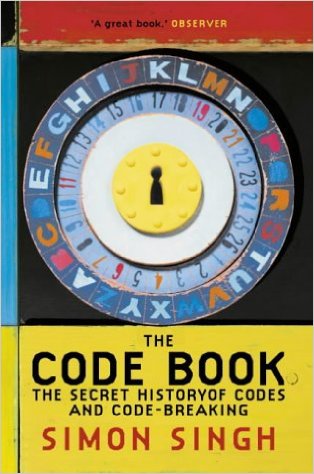
In The Code Book Simon Singh discusses the history of cryptography. It is a journey through the first simple ciphers through to the war years and then the computerisation of encryption.

It was not a topic I thought I would be that interested in, but Singh’s writing makes it an enjoyable read.

It was originally published in 1999. Given the nature of the topic, the book is showing it’s age significantly. This only comes into play in the last few chapters, but is noticeable.

the-code-book

The Currents of Space

Thursday, December 10th, 2015 | Books

The Currents of Space is the second novel in Isaac Asimov’s galactic empire series. The first in the series, The Stars, Like Dust was not one of my favourite Asimov novels but this one is an improvement.

It still lacks that grander scale of lots of things happening, that the Foundation series has. However, it does open it up to the wider galaxy. It might all take place on two planets, but the empire of Trantor is there and on the rise.

The story follows the two planets of Sark and Florina. The former exploits the latter for it’s valuable kyrt plantations. But what length will they to go to protect it?

the-currents-of-space

The Stars, Like Dust

Wednesday, December 9th, 2015 | Books

The Stars, Like Dust is the first in Isaac Asimov’s Galactic Empire series of novels. I had grand visions when I started reading it. It would be the missing link between Robot series and the Foundation series, looking at the growing empire as it expanded and conquered the galaxy.

It was not like that. The empire never even comes into it. It talks about the fighting of a few kingdoms that control some planets. It is apparently set before the empire really arises and while it is okay as a standalone novel, it lacks the grip and brilliance of the better Asimov novels.

It is also a little predictable. Once you have read the Foundation series, you can pretty much guess where the rebellion world turns out to be. They came out at about the same time, so you could argue it the other way around of course.

the-stars-like-dust

Modernizing Legacy Applications In PHP

Tuesday, December 8th, 2015 | Books, Programming

Modernizing Legacy Applications In PHP is a book by Paul M. Jones on how to bring legacy codebases up to date. Jones is a relatively big-whig in the PHP community, being involved in most of the PSR standards and a contributor to the Zend Framework.

For me, the book was both excellent and uninformative. What I mean by that is that I do not think I learnt anything from reading it. However, I flatter myself that I am pretty good at PHP and have spent many years working with legacy codebases. It was always been an interest of mine, and I have previously submitted conference papers on the subject. I have been doing just what this book describes with my current client.

That in itself shows the quality of the book though. It describes every step I have been going through in a logical and clear order. It explains introducing autoloading, separating out the concerns, adding unit testing and injecting your dependencies. It says you from the tangled mess to a clean and modern application in an easy-to-follow manner. In short, it is pretty much everything I would recommend to someone starting to clean up a legacy application.

It has code examples and some tips and tricks in it, but for the most part it is quite high level. It also deals with PHP 5.0 and onwards. There is perhaps room to expand here. At Buzz I had to come up with techniques to support ancient problems like register globals, and at the NHS I ran into PHP 4.6 installed on their servers. Solving these kind of problems, and the little code tricks you can do, might have been a useful additional also.

Overall, I would recommend this book to anyone who feels the least bit daunted by the idea of modernising a legacy PHP codebase. It is clear, easy-to-follow and takes you through exactly the steps you should follow.

modernizing-legacy-applications-in-php