Chris Worfolk's Blog


Announcing the HAG 2011 Holiday Food Drive

November 16th, 2011 | Foundation, News

Last year we launched and ran the Humanist Action Group‘s Holiday Food Drive.

Thanks to all your generous donations we were able to provide food parcels for three local homeless shelters. We managed a total of 24 boxes packed full of a variety of different kind of food either directly donated or bought with donations. It was a good start, but we think that this year we can do a lot better!

As with last year, we need your help in three ways. First of all, we need food. That is the main part of a food drive, so any food you can donate is great. Anything which will last for a few months or more is ideal. Secondly, we need time. We need people to help us collect everything together and package it up. Finally, any money donated will be used to buy more food in bulk from wholesalers to help us fill even more boxes.

If you think you can spare some time to help those less fortune this holiday season, then please do get in contact with us. You can also sign up on Facebook, or if you want to donate, you can do so via our page on Virgin Money Giving.

Together, we can make this a truly special holiday season. Which, to me, is what the holiday season is really all about.

Chris

Humans are amazing animals. But animals none the less.

November 16th, 2011 | Science, Thoughts

A long time ago, and by that I mean several years ago now, I started an essay on whether humans had stopped evolving. I never quite finished it and due to its length, every time I sat down to finish it, I needed to re-read what I had written so far and then thought better of it.

Well, that has been dragging on for far too long now, since 2008 in fact, so I’ve patched it up with the few final notes I had left myself and decided to publish as is.

I’m sure if I sat down and wrote something from scratch today, it would be better. But never the less, I have some confidence in what I wrote back then, so here it is in its full glory.

Humans are amazing animals. But animals none the less.

One issue which has come up quite a lot recently is the idea that humans have evolved beyond the idea of being an animal into something higher.

Many people make this claim without meaning to or without really considering its implications. I am not talking about the people that claim that animals are merely automatons while humans alone can think intelligently. These people are wide spread, obviously within the religious community but also within the non-religious community to an extent as well but any such argument, at least from an atheist perspective, is clearly rubbish.

However what I am getting at here is people who make claims such as “humans have now evolved to control their own evolution”, “humans are no longer subject to the laws of evolution” and “humans are no longer subject to the wrath of mother nature.”

These claims may seem apparent [to be true] with some thought on the subject but when examined deeper actually come up along the same line of thinking as believing that humans are the only creatures which can think and are self-aware, it grants us a special place in creation which is a perfectly acceptable view within religious communities but one which does not fit with the atheist world view. This would be accepted by all but I suspect the people that make the sample arguments I have supplied would disagree this is the claim they are making.

However, when examined it does in fact come down to this point of view. So it is important I think that I address the points made on this line of thinking to explain why I do not believe this to be the case. Humans are still animals, we are still subject to the laws of evolution and we still play within the framework that all life does.

I believe one of the problems which lead to this line of reasoning is that we assume the same metrics used to measure what we would consider a successful person within society are equally good metrics for measuring how successful someone is in terms of evolution. In this case it is a far more simple equation – who is likely to survive and breed the most.

Take for example, the chav. In today’s society they are considered the bottom of the pile. They are uneducated, unmannered, annoying and often regarded as a group we would be better off without. It therefore seems perplexing to many people that chavs are breeding faster that well mannered well educated individuals because this suggests they are the next stage of human evolution.

The mistake here is, as stated above, that we use the same metrics to measure value in society as to value from an evolutionary perspective. Considering the problem from an evolutionary perspective, the chav is indeed the next stage of human evolution. Why? Because they are better at surviving and breeding than the smart highly educated yet less sexually promiscuous individuals (probably such as you and me if I am so bold as to make a judgment about my readership). A lot of people would at first laugh when it would be suggested chavs were the next stage of evolution but why should it not be true? How self righteous is it to presume that you must be the next stage in evolution?

As it happens in this case chavs probably aren’t the next stage of evolution. The reason for this is that there are questions raised as to how an entire society of chavs would fair and I shall return to this later but for the moment I would like to move on as this is somewhat of a side track, it does not illustrate my argument in the best way but more stands alone as an important point.

Returning to my original argument, humans are in fact in no special way in control of their evolution or protected from mother nature. Every year millions of people around the world perish in natural disasters. Of course many do not because of the efforts of mankind but this is no different than to the animal race. They too are fighting for survival and they too have a degree of success with this. Our degree of success is generally regarded as higher – but it is all on the same scale.

For example humans build themselves tools and shelter to protect against the wrath of mother nature. We have flood barriers, shelters from hurricanes, etc. But of course animals build themselves shelter too. Take a look at the humble ant, building mightly ant hills to protect themselves. These are not always successful, just as man’s efforts are often unsuccessful when mother nature claims lives in floods, earthquakes and volcanic eruptions. Both are “artificial structures” created by animals to live and shelter in.

Secondly I believe the idea that humans are now in control of their own evolutionary path is equally flawed. One of the prevailing arguments for this is that people within our society who would not survive in the animal world now survive in our society such as people born with severe disabilities.

However much like the uneducated chavs, severely disabled people rely on the infrastructure created by society in order to support them. It is a fantastic feat of human advancement and kindness that we are now able to keep alive and care for the severely disabled. But they no more form the next step in human evolution than they ever did. A society consisting purely of severely disabled people would be unable to survive effectively. Similarly a society solely consisting of uneducated chavs would be without the medical, engineering and logistical knowledge required to make modern society function effectively. Therefore the idea that human evolution will not continue along the natural path is simply unsubstantiated. Society is not about to devolve into chavs or people unable to look after themselves – the bulk of the population will remain fit, able and evolutionarily advancing individuals.

Further along this line of thought, it is worth noting that society’s apparent lack of potential to evolve further is also false. Take for example a change in the climate. Let us say it becomes colder, there is a global drop in temperature. Many people would claim this shows that human evolution has stopped because while animals (a term taken to mean non-human animals of course) would evolve thicker fur or a similar evolutionary trait, humans would simply manufacturer themselves thicker coats.

This at first glance seems to make sense but on closer examination does not in fact stand up as an argument. The main reason for this is that evolution covers the adaptation of a species – it does not state how this adaptation has to occur. Therefore, humans manufacturing themselves thicker coats to survive the cold is the human race adapting to better survive in it’s environment. It is not a case of us “breaking” evolution, it is a case of evolution happening right in front of our eyes.

This is often disregarded as it is seen as something external to us ourselves as evolving but when some thought is put into such arguments it does not seem to hold much water. Furthermore this is likely to be less true in the future as the “artificial” or “external” advancements we make become far less external as we begin to alter our own genetics and breeding ourselves fitter, healthier and better able to survive.

As we’ve already established, you have to accept humans as just part of nature, and once you do, it’s very difficult so say, “oh, that isn’t part of nature” when we do something. Animals make nests to live in and sometimes use basic tools – how is that any different to the more advanced tools we use?

Evolution seems to be continuing on humans unabated. Take, for example, height. We’re definitely getting taller as a species. If you compare the average height of someone a thousand years ago, they were shorter than we are today – and that is entirely natural if you will.

Mutations also occur at just the same rate as they ever have. Just because we’re moving faster with our own technology and improvements to life, doesn’t mean that the classic methods of evolution have stopped – mutations occur at just the same rate as they ever have. The reason it seems to be happening could perhaps be to do with the fact that it’s a very slow process and as humans we’re used to things advancing increasingly quickly.

Our basic desires also still drive us. Deep down we all still want to find a mate and have babies. It’s wired into us and the majority of people over the age of fifty will be happy to tell you that at a certain point, you just get the urge to procreate. We might be master of many things as a species, but we haven’t wiped out our basic emotions yet (and probably never will, unless people start seeing Vulcan as the ultimate utopia).

Therefore to summarise, my points are as follows. Most of us will agree on the premise that humans are animals and have no divine special place in the universe, we’re just doing pretty well. Once we agree on this there is no reason to believe that we are not subject to the laws of evolution, that we have somehow stopped evolving or that we now control mother nature.

Homosexuality and natural selection

November 15th, 2011 | Religion & Politics, Science

In my post on the taste of meat I briefly mentioned the problem of homosexuality and natural selection. That is to say, why does homosexuality persist, given you think natural selection would weed it out because gay men are not having babies and therefore not propagating their genes.

Many people have taken this to mean that homosexuality is some kind of defect, where something has gone wrong because the ultimate goal in life is making babies and these people aren’t doing it.

Luckily, Rich had written a talk to explain all about it. Having first delivered it at Rationalist Week 2009 he also delivered it to Leeds Skeptics later that year.

I’ll skip the interesting, but never the less skippable introduction and get straight to the answer.

Genes do different things based on their environment. So in one person with one set of genes, a specific gene may do one thing – but take that gene out and put it in someone else with a different set of genes and it may well do something else.

This is what we find with the so-called gay gene. In men, it is more likely to make them homosexuals. But put that same gene in a woman and it actually makes them more fertile. Therefore a woman carrying the gay gene is more likely to have children and even though some of them may turn out to be homosexual men, the women will continue to propagate the gene because of their increased fertility.

There are other factors at work as well of course – homosexuality is a combination of both nature and nurture. Having the gay gene doesn’t mean you will be gay – it just increases your chances. But that is Rich’s argument as far as the genetic side goes.

Lying

November 14th, 2011 | Books, Thoughts

While browsing the Sam Harris website for some information to add to my recent post on The Moral Landscape, I came across a new essay that Sam had published, entitled Lying, which was available exclusively via Kindle.

At 26 pages long I was able to get through it before going to bed yesterday and it makes for an interesting read.

In the essay, Sam puts forward the case that you should almost never lie. It’s qualified with almost as there are times when normally immoral actions can be moral – for example, if you’re willing to kill in self defence, it seems silly to rule out lying as well. But for the majority of our life, lying is best to be avoided.

This is something most of us would follow anyway, but Sam concentrates his efforts in persuading the reader that white lies are equally an enemy to be avoided – something that most of us probably are guilty of (I’ll be honest, I certainly am).

Examples are things like telling a friend your busy when you actually don’t want to go to an event, pretending your friend doesn’t look fat in that dress, or not being honest about how you think the book they have just written is rubbish, or even as far as being honest when someone gives you a present that you actually don’t like.

A good example is this – you overhear a friend leaving a voicemail for someone else (that you don’t know) saying that she has had to cancel plans at the last minute because something has come up. You know this isn’t true, but you don’t call the person on it at the time. Still, every time they cancel you on because something came up in future, you are disinclined to believe them.

This is something that I can really relate to. Many friends I just won’t believe when they cancel me because they claim to be ill. Carl is a good example of this. Sometimes he probably is ill, but most of the time I just don’t believe him. Given that trust is a very valuable commodity, that really isn’t a position you want to be in.

Of course, sometimes white lies can actually just be code for something else, and we all know it. “I have no money” for example. It’s amazing how many people say this and then suddenly have money when we’re doing something they really want to do. But then, we all really know that saying that actually means “I only have limited funds in my budget so it has to be really good to make it worth it, and your event isn’t worth it.”

Another example of this is “I’m busy.” As Gijsbert says, we’re all busy people, what we mean when we say we are busy is “I have other priorities.”

Harris argues that it’s best to avoid these white lies, though. If your friend genuinely is fat, be honest, maybe it will inspire them to lose some way and be happier with their own body image. If your friend’s film script is genuinely awful, tell them, don’t let your friend waste more of their time on a project that isn’t going anywhere. It’s better to face short-term discomfort for the overall benefit of your friends.

It’s a good read. Not as great as the reviews claim, but interesting none the less. If you’re interested, you can find it in the Kindle Store.

EDIT: The essay is now also available in a PDF edition, for those that don’t want to download the Kindle software. Thanks to Aaron for the heads up.

SocietasPro v0.1

November 13th, 2011 | Foundation

This is a process report on the community group management application, SocietasPro, which we announced last month.

The first iteration of the application is now complete. The developers among you can download it from GitHub. That doesn’t mean that it’s in any way complete. but as it is being developed it an iterative development cycle we want to get something out as soon as possible.

We’re hoping to have version v0.2 out by the end of the month which, all being well, will be the first version we can install and open up to gather general feedback from.

We’ve also got a shiny new logo…

Why does meat taste so good?

November 13th, 2011 | Science, Thoughts

I’m a vegetarian. And I think everyone should try it.

The problem is though, it’s very heard because steak tastes so good. So do ribs. So does chicken. And many, many other meat based foods. Meat tastes amazing!

So here is the question – if vegetables are so good for us, why don’t they taste amazing? Think about it from an evolutionary perspective – if you had a human who preferred eating food that was good for them, then they would prosper, so you would expect natural selection to lead us to humans that love vegetables because they are really good for us.

But we don’t have that, we live in a world where many people eat vegetables because they are good for us but enjoy eating meat far more.

This seems strange, much like the problem of natural selection and homosexuality, and much like that problem, I’m sure there is an answer to it.

My guess would be this – back when humans were evolving, there was a lot of plant life and vegetables to be eaten. Humans didn’t actually have to like them to eat loads of them because they were the most abundant food source and so people ate plenty of vegetables anyway, by default almost.

People do need a bit of meat though, or at least, did in those days, and that was much rarer and indeed, harder to get hold of. So it had to taste good to motivate humans to go out and hunt down animals for meat.

Of course, that could all be nonsense, that’s the best-educated guess I can come up with sitting here as a computer scientist with a casual interest in evolutionary biology and the combined knowledge of the first two chapters of Richard Dawkins’ Climbing Mount Improbable.

Another reason is that it could just be an accident of the way that the human taste sense has evolved and the texture of meat. Maybe someone who studies biology can enlighten us?

The Moral Landscape

November 12th, 2011 | Books, Reviews, Science

Last month, myself and Elina attended a One Life session on Ethics, to tell the young people why they are wrong.

Specifically, about why I believe morality is objective, rather than subjective.

For many years previous to this I had argued that morality must be subjective – after all, without a god, what universal source is there to say what is right or wrong? This is the position that most non-believers take and ultimately forms quite a coherent world view – but does mean that you have to admit that in some ways, you can’t say what Hitler did was wrong because that’s only your subjective point of view and from his point of view, he was doing the morality right thing.

Of course, they should automatically lose the argument by resorting to Godwin’s Law, but it is something that has never sat particularly well with me.

However, after reading The Moral Landscape, the new book from Sam Harris, author of The End of Faith – the book which really got me passionate about atheism, it presented to me for the first time a worldview which makes coherent sense with objective morality without a god.

I didn’t entirely buy into it at first, but after a few months mulling the topic over, I have to hold my hands up and say that I believe Harris puts together the best argument and so I will hold my hands up and say I now beleive I was previously wrong about the nature of morality.

To give you an overview, Harris’ argument is this:

Morality is a human construct, but it’s actually about an observable fact.

When it comes down to it, the field or morality is about welfare. If you do something which is good for the welfare of others, it is a moral act. If you do something which is bad for the welfare of others, it is an immoral act. And if you do something which has no impact on the welfare of others it is an amoral act. Of course others actually includes yourself, and isn’t limited to humans, but it seemed like a more poetic term to use.

So, if we work on this basis, every act can be measured by it’s impact on welfare and then judged to be moral or immoral accordingly. How you define welfare is of course very complicated – but although it’s a hard concept to define, we all really know what we are talking about when we use the term.

Based on this then, we have an objective way to measure an action as moral or immoral. If it does more harm than good overall, it is a immoral action and if we did more good than harm then it is a moral action. Objectively.

This is great because you can now say “Hitler’s actions were objectively immortal” rather than just “I believe Hitler’s actions were immoral, in my subjective opinion.”

In fact, it’s clearest to see at the edges. Take an action, for example throwing acid in a woman’s face without cause – that is clearly wrong, not wrong in our Western society but OK in the correct cultural settings – it’s just wrong! Indeed, another advantage of objective morality is you can tell the cultural relativists to go fuck themselves when they say it’s OK for certain cultures to practice beating wives, stoning homosexuals and the horrific practice of genital mutilation because that’s their tradition.

Of course, the next question is, “well how do you know what is right and wrong? Surely there are too many variables to take into account – it’s never that simple.” You’re right, it never is as simple as my example above, but that is beside the point. Just because it’s very tricky to work out what whether an action causes more harm than good, doesn’t mean it’s inherently subjective – it just means it’s very difficult to work out!

A lot of physics is also extremely difficult to work out, but it’s definitely objective (and I will be so bold to insist that that does include quantum mechanics). Similarly, just because we don’t have all the information just yet, it doesn’t mean that eventually we won’t be able to find the objective answers to the question or morality, and until then, we can give it our best educated guess.

And if we’re wrong, then we’re wrong. It’s not that it was moral to keep slaves when the slave trade was thriving – it was immoral back then as well, but people were just wrong about it. We still don’t have to blame them, because they didn’t know, just like we don’t blame people for being wrong about the world not being flat, but never the less, the world wasn’t ever flat, even when everyone knew it was.

Another common criticism is that if morality is objective, it can never change. This seems inherently wrong because morality has to change depending on circumstances – killing is wrong in cold blood, but acceptable in self defence. Another example would be that killing animals for food was acceptable thousands of years ago when you had to to survive, but now that you don’t have to, it’s not acceptable.

But this is a misunderstanding of the kind of objective morality Harris puts forward in his book. Objective facts can change. For example, my age is 25. That is an objective fact. But next year, my age will be 26 and that will be the same objective fact about my age – it’s just that time has moved on and things change. My age still remains objective.

Finally, another potential criticism of this somewhat utilitarian view is that it supports ideas that we would not agree with – as the old joke goes, nine out of ten people enjoy gang rape. That is to say, of course, the nine rapists enjoy it, and the one victim does not – the greatest good for the greatest many and all that.

This doesn’t hold up to any kind of examination of course – none of us actually want to live in a world where we could get gang raped at any time, even if nine of out ten times we would be the rapist and enjoy it (not that any of us actually would enjoy it of course, but hypothetically), we would spend our lives living in fear and so overall welfare would in fact decrease. Therefore such nonsense is not by any stretch of the imagine, tolerated under a utilitarian system.

Anyway, I’ve rambled on enough. Please give The Moral Landscape a read, it’s £12 on Amazon and I’ll happy lend you my copy if you’re too cheap to buy it. It really offers some fantastic food for thought and challenges an area of debate which I think many of us considered closed – of course nothing is closed given we claim to be the freethinkers and all.

Getting blood out of an iPhone

November 11th, 2011 | Tech

Having recently upgraded to iOS 5, I thought great! I’ll be able to use iCloud to send the photos from my iPhone straight to my laptop using Photo Stream and that will be the end of it.

No more will I have to connect my phone up using my cable, then open iPhoto, then import the photos into iPhone, then select the photos and click “Show in Finder.”

But of course, it isn’t actually as simple as that.

I opened up iPhone, the one that comes with my Mac and didn’t know anything about Photo Stream. Turns out you have to get the new version of iPhone, and that costs £10.49. I reluctantly did, and then found the Photo Stream option and turned it on.

But no photos appeared.

I waited a day or two in case it only synced once every twenty four hours. Still no photos appeared.

So in the end I plugged my iPhone into my Mac and imported the pictures into iPhoto manually. Then I went to right click on the photos to go to “Show in Finder” so I could get them. But that option seems to have disappeared.

In fact, the only way I seemed to be able to get them out was to connect my gMail account to iPhone and email them to myself.

Good work there Tim, I would like my £10.49 back.

Wine

November 10th, 2011 | Life

Despite little success last time I complainted to Sainsbury’s, I decided it was worth one more go when I had another complaint.

To whom it may concern:

Earlier today, I visited your branch located on The Headrow in Leeds.

Upon arriving at the tills and scanning my items I was asked to produce identification to complete my purchase. I have recently turned 25 and therefore was expecting not to be flagged by your Check 25 policy, given I have now been able to legally purchase alcohol for 8 years and nice as it is to think, there is no way I look 9 years younger than I actually am.

More to the point, however, is the fact that I was attempting to purchase non-alcoholic wine. It therefore baffles and frustrates me that I would have to produce identification to prove I am over the age of 18, for a product which is alcohol free.

I asked the assistant who approved the item for me why such a product would be classified as restricted, but she said she didn’t know.

I believe such a restriction should be removed from such items, to avoid further aggregation for your customers.

Look forward to hearing from you.

Best wishes,
Chris Worfolk

Luckily, this one was slightly more fruitful. Well, I say that, this time they said that it was indeed a problem and generally a bit silly, but there wasn’t exactly a promise to do much about it.

I contacted the store and spoke with Lisa, the Customer Service Manager, who advised the checkout automatically prompts colleagues to ask for identification when items are scanned. Lisa apologises if this has inconvenienced you and advised she will have your feedback logged for future reference.

We appreciate you taking the time to make us aware of this issue and look forward to seeing you in store again soon.

Still, better than nothing. And way better than Co-op who don’t even respond to your complaints.

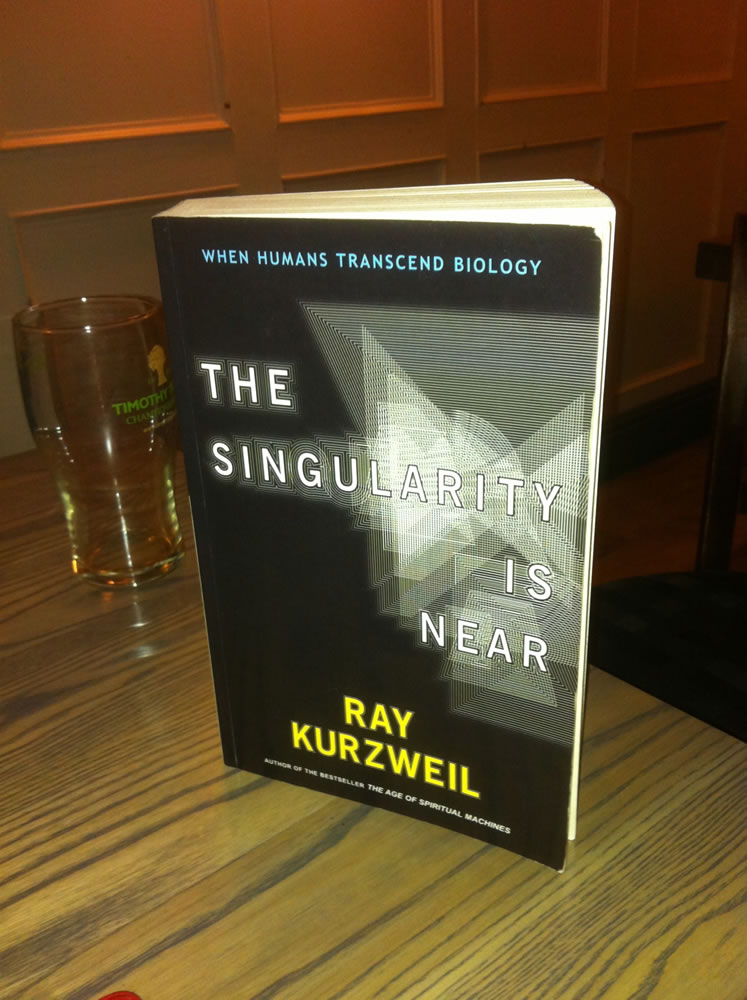
Inaugural Leeds Transhumanists meetup

November 9th, 2011 | Events, Foundation

Last month we held the first ever Leeds Transhumanists meetup at the Veritas bar in Leeds city centre.