Chris Worfolk's Blog


Inclusivity at the World Cup

December 14th, 2011 | Religion & Politics, Thoughts

Most of us reading this will live in 2011, in the Western World. We’re used to living in a civilised society, summer riots aside. But thanks to globalisation, we’re increasingly finding a clash of cultures on many issues.

A good example of this is the World Cup hosting duties being awarded to Qatar.

The problem with this is that being an Islamic nation, homosexuality (well, homosexual acts, but it amounts to the same thing) is actually illegal there. These are enforced, including against people just on holiday there[1].

Yet, in 2022, thousands of footballers, and several hundred thousand fans will travel to the country. And many of them will be gay. Even if you take a conservative estimate that 1% of people are gay, that puts at least 1,000 gay people in a country where just being themselves – is illegal.

That’s mental. I really don’t think we should be OK with this situation.

Luckily, everyone’s favourite football character Sepp Blatter stepped in to offer some advice. He explained “I’d say they [gay fans] should refrain from any sexual activities.”[2]. Problem solved, I guess. Of course, this is from the same man who doesn’t seem to have a problem with racism[3] and is constantly dogged by allegations of corruption[4].

So what do we do about it? Well, we could get all the major countries to boycott it. Or at least Western countries, who knows how much control His Holiness commands over South America’s attitudes, and the answer is probably quite a lot. We could certainly give it a try though, and it would be a worthy cause. As Bryan Goldberg points out, Qatar also has a terrible human rights record, and that’s just the start of it.

Of course, we probably won’t do that, not because missing the World Cup would be mega rubbish (which it would be, that would be the biggest drawback of not taking part), but because it would be politically insensitive for us to call a nation out on the fact that their state religion is the most intolerant faiths currently practiced in the modern world (then again, maybe I’m just being over critical – it’s easy to take 534 verses out of context5).

Instead, our fearless leader David Cameron hopes that bringing the World Cup to Qatar will show them that homosexuality is actually fine[6]. Apparently, “football can be a great engine for social change and a change of attitudes” and, when it comes down to it, at least there is such a thing as an Islamic soup kitchen.

So, eleven years from now, in an attempt to change social attitudes, we will send hundreds of our citizens into a country where making love to their spouse is a crime punishable by execution. Wonderful.

[6]: http://www.insideworldfootball.biz/worldcup/bids/qatar/8894-cameron-believes-qatar-world-cup-can-change-attitudes-towards-homosexuality – this resource is no longer available

Faith Schools: Why They Matter

December 13th, 2011 | Religion & Politics

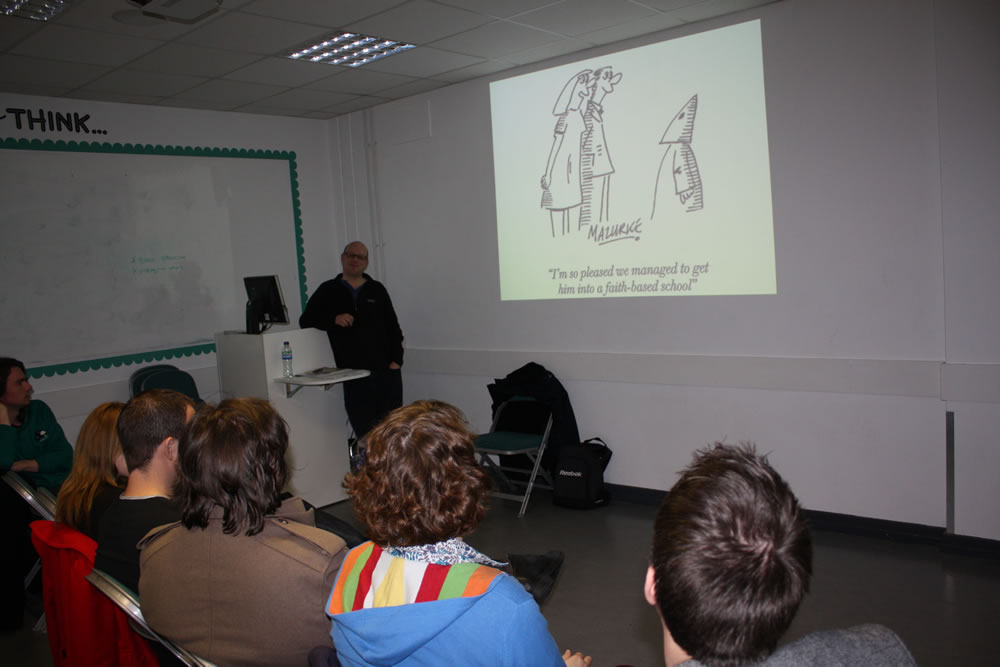
Dan Bye, council member of the National Security Society who has previously spoken at my Skeptics in the Pub group, presented a talk to the Atheist Society on faith schools and why they are such a ridiculously bad idea.

Unfortunately such talks often end up preaching to the converted – the people who turned up were the people who already know faith schools are a scar on our education system whereas those who aren’t all that aware didn’t manage to make it down.

One point of debate I found though was whether you were morally responsible if you lied to get your child into a faith school (pretending to be religious) because it was the best school in the area. Ultimately, the answer is, yes, you are a bad person. But much like Mr Cameron, I can probably see why parents do it.

My parallel was that with some recent health issues, I am now cashing in on my private BUPA cover. Yet, I’m not really sure if I agree with the idea of private healthcare. Surely the ideal in our society should be that everyone has access to healthcare and you shouldn’t be able to buy a longer life?

It’s a bit of a hypothetical argument because of course you can – those who come from a more well off, well-educated background tend to have a healthier lifestyle, make more educated life choices and avoid manual labour and as a result, end up living longer. But ignoring the pragmatic truth, what would we want as an ideal for our society? Probably one in which your health was not compromised by the amount of money you have.

Ultimately we decided that it wasn’t the same thing – while I have BUPA cover, I also continue to make my contribution to taxes and therefore the NHS, and by using my BUPA cover to go private, I am actually freeing up more time for NHS staff to treat others.

But I didn’t have to rationalise myself into that position before I decided to use my BUPA cover. I just did it, because my health is more important to me, to the point where even if I decided I did morally disagree with it, I would have been happy to compromise my principles because when you’re having a medical crisis, it’s very hard to think about anything else other than getting better.

Similarly though, if I had a child, I suspect that my emotional drive which has allowed evolved life to flourish so well would quickly turn the override switch to make sure that I put the future of my own child ahead of any sense of moral duty.

So yes, lying to get your child into a faith school does make you a bad person. But I think I can understand why people do it.

P.S. Just so we’re clear, there is no evidence that faith schools do produce better results. This is only applicable if your local faith school happens to produce better results, which could be down to a number of factors, but faith almost certainly isn’t one of them.

Thought Bubble

December 12th, 2011 | Friends, Life

Thought Bubble isn’t a comic convention. It’s a sequential art convention :D. I didn’t go or anything, but Si did, and afterwards, we went to Pizza Express. I keep ending up there, despite the fact I dislike pizza.

Nothing to Declare

December 11th, 2011 | Distractions, Thoughts

Recently, I’ve been watching Nothing to Declare (aka Border Security: Australia’s Front Line). It’s about customs officers working at Australia’s airports and seaports. It’s pretty similar to UK Border Security, except that I actually find it interesting.

I use the term I because ultimately it’s trash TV. There is no real intellectual merit to either TV show but for some reason I find Nothing to Declare entertaining, while I find UK Border Security quite dull.

Indeed, we’ve been getting into it so much that last week I set a reminder in our calendars about it. Why is it so addictive?

The story gets stranger though. I randomly got an email from Gijsbert entitled “Nothing to Declare” with a message saying I’ve been watching loads of Nothing to Declare recently. Why do intelligent people, including myself, watch this rubbish?

It’s a fascinating question. It’s so predictable – it’s just people getting caught with cocaine on them and people trying to sneak into the country with the intention of working on their tourist visa, episode after episode. But we’re all addicted to it. Why?

It’s also interesting that both we, and Weili picked up on the fact that the show opens with the title caption “thousands of people dedicate their lives to protecting Australia’s border.” Not just work there – dedicate their lives.

German Christmas Market

December 10th, 2011 | Humanism

Huzzah, the German Market has once again arrived on Millennium Square. So, A-Soc headed down there for a good bit of German sausage.

Translating proper nouns

December 9th, 2011 | Thoughts

Have you ever been to Germany?

I have. Well, sort of. Because the reality of the situation is that there is no such place as Germany. There is, however, a place called Deutschland.

In fact, in the English language, we have names for most countries which are entirely different to their native. I’ve studied both the French and German language, and I’m currently browsing Complete Finnish, a book Elina bought me for my birthday and all of those have different names for each country in their own language that differ from the actual place name as well.

But why?

We don’t translate any other proper nouns. People’s names for example. Or brand names. It would just be strange meeting Gijsbert and saying “Gijsbert? No, I speak English so I’m going to all you Ken.”

There is perhaps an argument to be made that when languages have significant differences, such as Far East or African languages where the native words are particularly hard to pronounce, but given most of Western Europe is based on Latin, they are quite easily interchangeable pronunciation.

It gets stranger though. For example, the Finnish domain name is .fi. It’s named .fi because that is short for Finland. But Finland is the English name for the place – they call it Suomi! What is going on…

Evanescence

December 8th, 2011 | Distractions

Last month, I went to the Leeds Academy to see Evanescence. The gig was enjoyable, but not quite as good as I was expecting. I had a similar experience when I went to see Feeder in February, so I’m wondering whether it is the venue.

Never the less, I got to sing along to a great mixture of songs from their new album and the old classics as well. A very enjoyable night!

I also bought a t-shirt and unfortunately I was given the wrong size. Due to my expanding belly, I definitely cannot squeeze into. Still, at least that’s Elina’s Christmas present sorted :D.

Are condoms the answer?

December 7th, 2011 | Thoughts

Condoms are fantastic, they protect against pregnancy and STIs. They’re increased usage has massively reduced the number of people dying from such diseases and reduced the number of unwanted pregnancies, leading to lower crime levels too.

But there is one massive problem with them. After you’ve engaged in foreplay and your penis is full erect and ready to go, the last thing you want to do is stop in the middle of it all and put a condom on.

Also, what if you can’t find a condom? That is a nightmare situation to be in. Do you stop? What else can you do? Put on a very, very baggy pair of trousers and hot foot it down to the local convenience store?

The reason I mention it is because I recently had a discussion with a good friend of mine. We both consider ourselves to be quite intelligent, well educated, rational human beings. Yet, we have both, at previous points in our lives, been in a situation where we were in the middle of foreplay and found ourselves unable to find a condom.

Interestingly, we both had the same thought process – “can I just risk it? It will probably be OK…” Luckily, we both came to the same conclusion, that it wasn’t worth the risk. But I had to think about it for a 30 seconds.

So here is my concern. If me and my friends are having to have a serious think about whether we could justify risking having unprotected sex with a new partner, what about people who are less well educated?

Actually, is it any wonder that so many people do have unprotected sex? When you’re in the middle of it, your rational mind is otherwise occupied and while I’ve never engaged in it, it really took some thinking to decide that and so I can easily understand why other people may end up making less wise decisions.

It probably goes as far as justifying why 14% of students had unprotected sex in Freshers’ Week.

How do we tackle such a problem? I guess the answer would be education. Restlessly drilling into people that you absolutely always do need to use a condom when having sex with a new partner. But the rational part of the mind is quickly overwhelmed by the emotional one and in some ways, we may be fighting a losing battle.

Alcohol

December 6th, 2011 | Thoughts

Alcohol is an interesting creature. As Gijsbert points out, it makes us feel really ill every Saturday morning and yet we all go out and drink it again next Friday night. That is in large part due to how addictive alcohol is, and leads it to be classified as a more dangerous drug than cannabis, LSD, ecstasy and many others.

Some groups are so afraid that their members will go off the rails if they drink the Devil’s Nectar that they are banned completely. Some groups are even so intolerant that they refuse to enter buildings which serve alcohol, even if they aren’t participating themselves.

A few months ago, I started to wonder if my life would actually be better without alcohol. I don’t really get hangovers because I always take a lot of time to sober up before going to bed, but that none the less brings its own problems with sleep deprivation on school nights.

I hadn’t wondered enough to actually give it a go, but as a result of recent events I ended up giving up alcohol as a side effect of some health issues. I also have up caffeine and have made a few other small changes to my diet and lifestyle as well.

However, having been trying all this for a few months now, it turns out that it isn’t any better.

Actually, your life is much better with alcohol. Alcohol is something which can bring real, measurable benefit to our lives. Of course, if you abuse it there are consequences, much like chocolate, credit cards, gambling, vitamins and basically everything in life ever. But enjoyed responsibly, drinking alcohol is really a pleasurable experience.

So learn from my experience. Alcohol is great and there is little to be gained from this clean living nonsense. As with everything else in life, the best path is responsible usage.

The trouble with war

December 5th, 2011 | Religion & Politics, Thoughts

Following on from yesterday’s post about Remembrance Day and my recent thoughts about venerating the military, I thought I would expand a bit on the subject based on some of the conversations I’ve had.

As I said in my previous post, it is interesting that we give so much respect to those who gave their live in war, but so little respect to those who gave their life to keep our supermarkets stocked with fish, or our power plants stocked with coal – even though fishing and mining are high fatality industries. You’re right, I wouldn’t want to go to war and I’m glad someone else is willing to do it, but I would equally hate working down a mine!

The standard response to such a question is that people choose to work as fishermen and miners, but then people choose to sign up to the military as well. We don’t operate any kind of conscription in the UK, beyond that of economic conscription that I discussed in my previous post, so every solider in the army today signed up voluntarily, and is handsomely rewarded for it. Interestingly, I’ve never heard anyone say “no, don’t bother paying me, I’m joining because it’s the right thing to do, not for the money.”

It becomes a different matter when we were talking about actual conscription during the world wars, when people were forced to go to war. But the sad reality of it is, if you were conscripted into the army, that wasn’t really a noble sacrifice was it, because you didn’t have a choice. It’s a pretty horrible truth, but a truth none the less.

Actually, the truth is much more horrible when you think about conscription. It wasn’t that these people chose to die for their country, it’s that we, as a society, murdered them. We executed them; sent them to their death. They didn’t decide to go and die, we made them go and die. If anything, Remembrance Day should share a similar tone to Holocaust Memorial Day.

What I found most interesting about the attitudes of people surrounding Remembrance Day, was how closely it fits in with what I said in my previous post about venerating the military. The upper classes sending the lower classes to die in their wars.

This was most apparently in specifically two of my friends, Kieran who retweeted extensively on the subject and Rebecca whose idea it was to go out to the war memorial on November 11th. Now, neither of these are people are either royalty nor right wing nutters. I consider them both good friends, but they are both from well off backgrounds and if I was to pick the two of my friends most likely to vote Conservative, I would pick those two (except for Norm, who I suspect mostly votes Conservative because even though he wants to vote Labour now, could never admit he was wrong about a political party 😉 ).

Indeed, when I had a discussion with Rebecca about it, and pointed out that if you sentence someone to death using conscription (it’s a to lot easier because you don’t have to bother with that whole trial by their peers nonsense), then it’s not really a noble sacrifice because they didn’t choose it, she seemed to get very flustered and told me to “just stop it now.”

That upset me somewhat because I felt like she was trying to claim the moral high ground, even though she was speaking on the pro-war side and I was suggesting it isn’t cool to sent working class people to their death just so our dirty work can get done. But this isn’t about my sensitive emotional centre carefully wrapped in an excessive amount of hair.

The response struck me as that of a religious believer when you’ve just found a massive problem with their worldview. They don’t know what to do. “You can’t say that – that’s not on the script! Don’t you understand how this works. We have to maintain the veneer or all the poor people will realise that our wars aren’t worth them dying for.”

Though as I discussed in my previous post, just because I feel that is the truth, doesn’t provide an answer as to what to do about it. Maybe we do need to keep even our own minds ignorant of the beast below.