Posts Tagged ‘psychology’

Widening the View – Looking at the limits of Human Perception

Saturday, March 22nd, 2014 | Foundation, Humanism

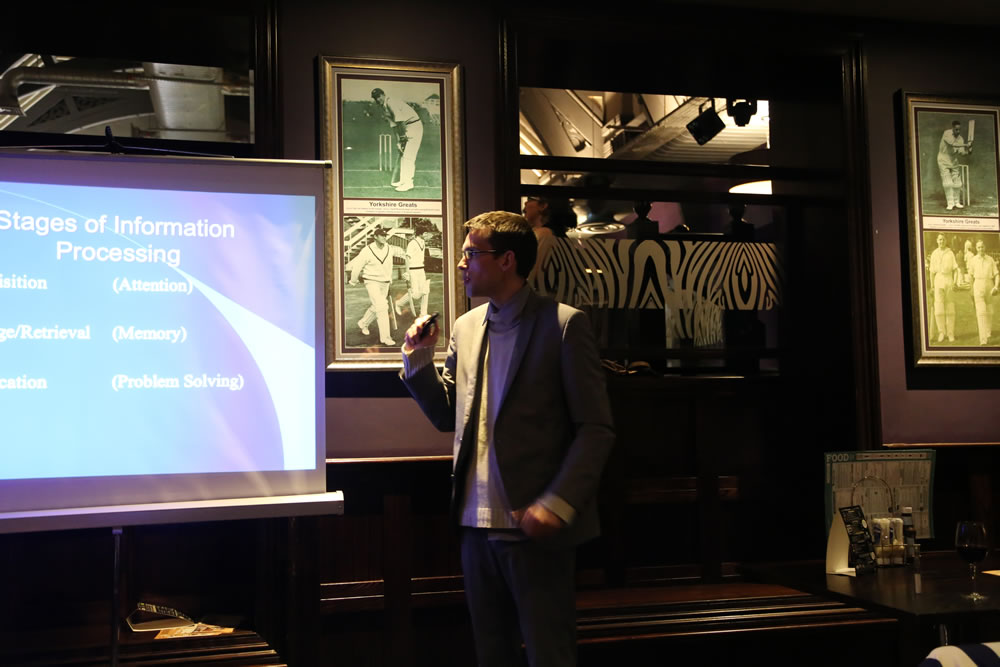
Paul Hopwood had previously spoken at Leeds Skeptics on the topic of “You Know Less Than You Think”. If you missed it, you can watch it online. He has since developed a follow-on talk, “Widening the View – Looking at the limits of Human Perception”, which he delivered for us earlier this week.

As ever, Paul delivered an interesting talk, though it is hard to listen to it all the way through without having an existential crisis. Not to mention the many additions to my reading list!

IMG_3985 IMG_3986 IMG_3990 IMG_3991

Best touchdown ever?

Wednesday, May 1st, 2013 | Video

Nonverbal communication

Friday, April 5th, 2013 | Public Speaking

Have you ever been told that only 7% of communication is verbal? The other 93% is not about the words you say, but the body language, tone and gestures that accompany it.

Incredible isn’t it? Almost too incredible. Indeed, there is a reason that it feels too incredible to be true – because it isn’t true. It’s a statistic based on the work by Albert Mehrabian at the University of California, which you can read all about on Wikipedia, that tests how people feel towards the speaker. But it doesn’t accurately translate into what percentage of your message is verbal or nonverbal.

Mehrabian states this on his website:

“Total Liking = 7% Verbal Liking + 38% Vocal Liking + 55% Facial Liking. Please note that this and other equations regarding relative importance of verbal and nonverbal messages were derived from experiments dealing with communications of feelings and attitudes (i.e., like–dislike). Unless a communicator is talking about their feelings or attitudes, these equations are not applicable. Also see references 286 and 305 in Silent Messages – these are the original sources of my findings.”

And has previously said in an email that was reproduced in the book Lend Me Your Ears:

“I am obviously uncomfortable about misquotes of my work. From the very beginning I have tried to give people the correct limitations of my findings. Unfortunately, the field of self-styled ‘corporate-image consultants’ or ‘leadership consultants’ has numerous practitioners with very little psychological expertise.”

Of course body language and vocal variety are an important part of communication. But the words you actually say do count for something too.

You Know Less Than You Think

Wednesday, February 20th, 2013 | Humanism

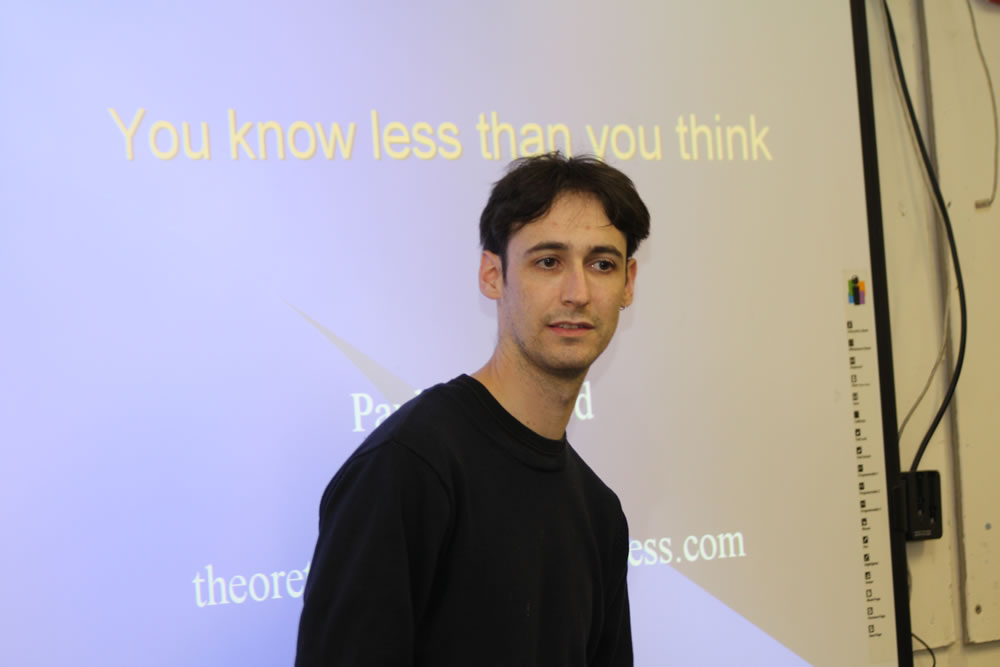
Last month, Paul Hopwood presented his talk “You Know Less Than You Think.” I have already blogged about it, but this time, I’ve got pictures. Also, if you missed the talk, don’t worry as it was the 2012 Worfolk Lecture, so you can watch the Leeds Skeptics event online.

IMG_2444 IMG_2446 IMG_2447

On humanism, and being positive

Monday, September 10th, 2012 | Humanism

One of the criticisms that has been put forward about humanism is that it always has to be positive. Many aspects of that humanism is there for are simply not positive – it’s an alternative to religion, and religion is a thought controlling, people oppressing, unscientific load of nonsense.

However, as someone who labels myself as a humanist, I think both these statements can be true, and work together well.

Yes, religion is an evil that the world would be better off without. But saying that you can’t tackle this issue with a positive attitude is not only incorrect, but it is also naively counter-productive, even though it may seem intuitive.

The reason is, is that we know by now that, most of the time, arguing with someone’s beliefs only entrenches them further.

I mean, how many people do the believer and atheist camps actually win over to the other side? Almost none. In fact, it’s so rare that when we do, we feel the need to put a spotlight on them and get them to give talks about their conversion, because it almost never happens.

One of the reasons for this, is that arguing your case, even if you’re case is incorrect, actually reinforces your own belief that you must be right. In fact, even for us skeptics, who are aware this is a problem and try to counter against our own biases, it is difficult to avoid.

This has been general knowledge for a long time, but a great example is given in Richard Wiseman’s recent book about captured American soldiers in the Korean War.

During their time in the prison camps, they were often bribed to say or write about how positive communism was, and were encouraged to take part in mock debates in which they argued for communism.

The result – because they undertook the actions of promoting communism, an idea that not only doesn’t work and isn’t fair (in my humble opinion) but was specifically what they were fighting against in said war, they actually started believing what they were saying.

Similarly, when you get someone in a confrontational argument about their beliefs, where it be religion or any other form of ill-founded prejudice, bigotry or simply factually untrue belief, getting them to argue the point is only going to reinforce their belief most of the time, not weaken it.

So what can we take from this?

Firstly, I think it is a mistake for those in the freethought movement who suggest humanism’s approach of being nice and positive with people, is a sign of weakness or that we not as firmant in stopping the evils of blind faith from damaging our society. It isn’t – they’re just going about it in a more rational, scientific way.

Secondly, when considering your attitude, especially when running groups, it is important for it to be informed by this research.

For example, at A-Soc we discussed, on several occasions, the idea of having a debate with the religious societies where we would take the opposite position. IE, we would argue there was a god, while they would argue there wasn’t. Unfortunately, we never followed through with the idea. It is also worth considering what interfaith (sorry, can’t think of a better term) activities can be done between atheist and believer groups that promote an understanding of each others principles, rather than a confrontational nature – which in the end, actually have a reverse effect from what they are intended to have.

Rip It Up

Sunday, September 9th, 2012 | Books

I’ve recently finished reading Richard Wiseman’s new book Rip It Up.

If you’re not familiar with Wiseman, he is a psychologist based in Edinburgh, and the man that showed expensive wine doesn’t taste any better.

It’s an excellent demonstration of Wiseman’s brilliant business skills. The book encourages you to change your actions and this is done by literally ripping the book up – you are supposed to tear pages out. This was somewhat difficult on my Kindle but means if you really want to get the most out of it – you have to buy a new copy every read. Genius.

Beyond that, the book looks at the As If principle, first proposed by William James, that suggests that rather than our thoughts influencing our behaviour, it is actually our behaviour that influences our thoughts.

Take this example – we often assume that we smile because we are happy. But the As If principle suggests that it is actually the other way round – we are happy because we smile. The book goes into hundreds of examples of this, but if you want to test it out now, why not spend a minute or two smiling and see if you feel any different?

Assuming that for the moment we put some stock into this, why does it mean? Well, there are lots of real-world applications.

For example, if you’re dieting, and you have a chocolate bar on your desk – try pushing it away from you. According to the theory, this will create the idea in your mind that you like it less, and so will less tempted to eat it. I’ve often done this anyway, though I’ve often attributed it to getting it further away from my eye line.

Another example, get over procrastination by allocating a few minutes to starting a task. This should be easier, as you can just tell yourself you’re going to do 2-3 minutes and then take a break. But once you find yourself doing it, it will be easier to continue.

In any case, it certainly makes for an interesting read. You can find out more on the book’s website.

Surviving Identity

Thursday, August 2nd, 2012 | Events, Religion & Politics

Recently, Leeds Salon hosted Ken McLaughlin, author of Surviving Identity: Vulnerability and the Psychology of Recognition.

The book itself is a good read. I found the first chapter or so, which discusses the transition from the old social movements (such as traditional labour and trade union movements) so the new social movements that we say today, went over my head somewhat. Not that it wasn’t well written or easy to follow, but I won’t claim to understand the nuances of the historical development of sociology. But beyond that, I settled into an enjoyable read.

Ken’s thesis looks at the increasing prevalence of the “survivor mentality” – once a term used for people who survived the Holocaust, now an increasing number of groups describe themselves as survivor groups, even though the category of things you can die from had been left long behind.

He also commented on the increase of people classified as “vulnerable adults”, which only 40 years ago was restricted to those with mental health issues that explicitly put them at risk of serious abuse, to today’s standard where simply being old can qualify you as a vulnerable adult, in which everyone who comes near you must be rigorously CRB checked, of which the extended CRB checks can include information like accusations – even if you are found innocent. Such restrictions don’t help the field of social care, but more importantly, they don’t help the people they are designed to protect.

If interested, you can find the book on Amazon.

Flying Without Fear

Friday, January 20th, 2012 | Life

Earlier this month, I attended a Flying Without Fear course.

It consists of a morning session which looks at both the theory behind flying and why it is safe, and the psychology of anxiety and how to control your mind. After lunch you head over to the airport and actually take a flight.

The theory part was brilliant. Captain Dom explained the basic physics which keep you in the air, the various sections of the flight, what he does on take off, the backup systems they have in place – this was absolutely fascinating. Unfortunately it didn’t calm my nerves as I know a lot of the science behind it and I’ve never been worried about whether the plane is going to fall out of the sky or anything like that.

The psychology section was rather disappointing though, which was rather a let down as I was hoping this section would actually be useful to me. Unfortunately, the course uses Neuro-linguistic programming which has now been almost entirely discredited. Why? Because it’s all nonsense.

That isn’t to say their hearts weren’t in the right place. All of the course leaders (most if not all were volunteers who had given up their time to help out!) were incredibly supportive and that is the real benefit of the course. I’m incredibly grateful for the support I received from Sarah, Jill, my dad and everyone else on the course (if you’re reading this, thank you SO much!). They got me here:

Smiling and everything. Because the irony is that I love the idea of flying. I mean, it’s really awesome right, being so far up in the air, watching everything down below like you’re living all those hours spent on Google Earth. If only I didn’t feel ill every time I got near a plane, it would be a magical experience.

Still, I’m now one step forward in the battle for Los Angeles.

IQ and religious adherence

Sunday, September 18th, 2011 | Religion & Politics, Science

My friend Stuart Ritchie, who is currently working towards his PhD in Psychology at the University of Edinburgh, was recently involved in a writing a paper looking at the relationship between IQ and religious adherence.

While you will find a far more in depth write up on Stuart’s blog, the key points found that there is a correlation between higher IQ and lower scores in five of the six measured used to gauge people’s religious belief.

The only factor which did not see this pattern was people who just described themselves as “spiritual.”

Interestingly, another of my friends is currently researching this area, and the results so far suggest that there is a link between describing yourself as spiritual is correlated with bad parenting – but I can’t comment further on this until the research has been completed.

Can you rewrite your own brain?

Tuesday, June 21st, 2011 | Science, Thoughts

I’m currently in the process of re-reading Ray Kurzweil’s The Singularity is Near and having read the section about how the brain rewrites itself as you learn got me thinking. This is nothing new of course, it’s basic brain biology, but chancing on the subject again made me wonder.

If you can reinforce a pattern in your brain simply be repeating the activity over and over again, and this doesn’t even including physical actions but can also be done by thinking a certain idea, can you by mere repetition, implant a false idea in your head?

If you can, the consequences are obvious.

But this seems to be a hypothesis that is quite testable. What would happen for example, if we all collectively decided to believe a lie. If say, all the members of the A-Soc circle, picked a false statement to collectively believe, spent all their time thinking it was true and telling each other it was true for social reinforcement.

Of course, it could well fall flat on it’s face. Because you would know it wasn’t true, you could well spend all your time thinking “I’m pretending to believe this, even though I know it isn’t true” and therefore strongly reinforce the pattern that you know it secretly isn’t true.

Still, it might be an interesting project for someone to undertake.