Chris Worfolk's Blog


Multi-course meals

January 24th, 2016 | Food, Thoughts

dinner-party

For our New Year’s Eve murder mystery dinner party I planned a multi-course meal. To be exact I planned 11 courses. However, everyone was so full after the ninth course that we never made it to the final two.

Here is the menu I served up.

MENU

Wood-smoked salmon pâté
Served on baguette

Goat’s cheese tart
Served with Asian-inspired coleslaw

Mexican tomato and bean soup
Served with maneesh and bloomer

Breaded fish
Served with tomato chutney and lettuce

Yorkshire pudding
Served in a Thai red curry sauce on a steak

Meatballs
Served with slow-cooked ratatouille

Carrot, orange and chervil salad

Fruit pie
Served with honeycomb ice cream

Caramel chocolate shortbread

Cheese board
With crackers and grapes

Tea & coffee
Served with chocolate biscuits

Usually, I would go for a big bang approach with dinner parties. There may or may not be a starter. Most of the food would arrive with the main course, which might consist of multiple potential centrepiece dishes and many different sides.

This was very difficult to do well. The myriad dishes all had to come out hot at the same time. There was competition for attention in those final minutes and a constant strain on hob and oven space. Then you had to fit everything on the table at the same time, as well as people’s plates, and provide implements for serving everything.

My plan on New Year was to avoid all of this. By breaking everything down into small courses I would eliminate many of these problems. There was be less competition for hob and oven space as every course was spaced half an hour apart and prepared one by one. Dishes were then plated up in the kitchen and bought to the table.

Some of the effort was also wiped our by cheating, or arguably careful planning. Many of the dishes were simply cold for example. There were only four hot dishes: the soup, the fish and the two meat courses. The rest were served at room temperature, or chilled (some in my second fridge: the balcony!). I also pressed my slow cooker into use to make the ratatouille. I was able to prepare this hours in advance, slow cook it and have it sat there ready.

The advantages were clear. Each dish got more attention. Everything could be nicely presented. There was no fighting for oven space. Taking the plates to the table meant that were was plenty of space for people’s drinks, bottles of wine and even an array of candles. Many small courses also allows for more variety in the meal.

The disadvantages were reasonably few. It could be that I spent more time at the kitchen rather than at the table, but it did not feel that way. The biggest problem was plates. You need a lot of them. You either need a lot of them, or the ability to wash and dry them quickly. In the end, we used a combination of both.

We bought some high-quality disposable plates. They were made of plastic but easily stood being washed up and re-used. Being plastic I could not warm them, however. We also had to re-use cutlery.

Overall, I think I am a convert to the multi-course meal. The biggest advantage being it takes the pressure off the one big delivery. It also allows you to spend more time crafting small and varied dishes. I suspect 11 is probably a little over the top though…

Piano: six months on

January 23rd, 2016 | Music, Thoughts

piano

Six months ago I bought myself a piano and began taking lessons. It was hard to fit in: I had to give up my guitar lessons and when my singing teacher left I did not pursue another. I am not moaning like some rick stuck-up kid, but it was a good reminder for me that you can only do so much and need to allocate your time accordingly.

Now that I have spent six months with it, it seems like a good time to reflect on my progress so far.

I am still practising every day. You have to, if you want to achieve mastery (or even basic competency) of an instrument. I am finding it about as difficult to motive myself as I did with guitar. It’s a struggle to sit down ever day, but I do get it done.

I am finding it easier than guitar. With guitar, I literally could not play anything for the first six months. After that, I finally got one basic song down. Getting the muscle memory to make those chord shapes takes ages. With piano, I was playing a song in my first lesson. It was very simple song, but I was playing it. I can also see myself making progress, whereas often with guitar it feels like I am not getting any better. This has all be done with around twenty minutes practice a day. With guitar, I was usually doing an hour.

I can’t read music yet. I know how to, but in the heat of the moment I am lost. I have to start counting up the bars using FACE or ACEG. Interesting though, I need the music in front of me, and to keep my eyes on it, to be able to play the music.

I feel like I am building muscle memory, rather than learning. I can nail a piece, but as soon as I make a mistake or lose my place, it takes my ages to find it again. I am hoping this will disappear over time. As the songs her more challenging, it should push me to sight read more and more.

Always break it down. If you are struggling, break it down into a small section. Once you have this down, build it back up again. Slowly. Use the metronome to help yourself keep the beat. It is annoying, but useful.

Having a teacher is really valuable. Not only do they instruct and help you correct your mistakes, but they also reinforce the stuff you already know. I know I should break it down and use the metronome, but often I do not because I don’t like doing it. Having these concepts constantly reinforced is useful on its own.

Syndicating your blog to Facebook

January 22nd, 2016 | Tech

Back in the day, Facebook supported RSS feeds. You could put your RSS feed into the site and it could automatically crawl it and post your new blog posts into the Notes app. Facebook later discontinued this as they wanted people to post in content rather than use Notes. RSS Graffiti arrived in it’s place, automatically posting blog posts onto your Newsfeed. This perished too as it was unable to make any money.

Here are some alternatives.

IFTTT

IFTTT has been around for a while and I have been using it since RSS Graffiti disappeared. It is free but has some limitations. For example, you seem to have to include a title, so I have the title in the link and a comment above it saying the same thing. Also, there is no description.

IFTTT

HootSuite

HootSuite is a social media manager that also supports RSS feeds. It does not check as often as IFTTT does, but it can be set down to once per hour. This is fine for a personal blog. You have no control over how the RSS post is displayed, though it does a pretty good job by default.

hootsuite

Zapier

Zapier is a recipe site, like IFTTT. They have a free tier that gives you a few recipes. This is enough for my personal blog, though you might need a paid tier if you were running a lot of social media. Like IFTTT it checks every 15 minutes and gives you control over how the post appears.

zapier

Conclusion

I have settled on using Zapier for now. It is free and allows me to customise how the posts will display. However, any of the solutions gets the job done.

I am a middle lane driver

January 21st, 2016 | Thoughts

middle-lane-driver

Recently the police have started cracking down on middle lane drivers. This is a great news. They not only slow traffic down, but make it more dangerous for everyone on the road. Where is the evidence for this? That’s less clear. There doesn’t seem to be any direct evidence. However, there is research to suggest it causes congestion, which in itself makes roads more dangerous.

The problem is though, have you tried not being a middle lane driver when everyone around you is?

If you are stuck in a crowd of middle lane drivers, and you are most of the time you are driving on motorways these days, you have two options. The first is to go to the outside lane. This is a tactic that serves people well. You accelerate up to 80-90mph, cruise past all the middle-laners and keep up with the speeding car in front of you to ensure you are not holding anyone up.

But what if you do not want to drive at an illegal speed? This is a growing concern for me, not just as I get older and more sensible, but also with the increased of managed motorways with speed cameras everywhere.

The alternative is to pull in to the inner lane. This is fraught with difficulties also though. You have your middle lane driver, not overtaking anyone, doing 65mph in the middle lane. Then you approach a truck. It’s doing 55mph. You could pull out again, but typically someone else will have closed up behind the slow middle lane driver, trapping you in the inside lane and forcing you to slam on to 55mph and sit behind the truck.

This is not fair on you, the conscientious Highway-Code-following driver. It pisses me off. In fact it has pissed me off so many times I have stopped doing it.

Now, if someone is doing 65mph in the middle lane, I just sit behind them. I don’t overtake them because I don’t want to speed, and I don’t pull in because then the other drivers behind me will close the gap on the slow driver and I will be boxed in. The only safe thing I can do is to remain in the middle lane, sitting behind the other car.

Technically, you could argue that probably makes me a middle lane driver. But what else is one to do?

I would argue that technically it doesn’t, because I am trying to overtake the slow driver in front. I am just waiting for them to pull in, as they are legally obliged to do, so that I can overtake them.

This is an important demonstration of morality though. People follow laws when they see other people following laws. The reason that people will no ‘go green’ is because they do not want to sacrifice their quality of life if the people around them are not making similar sacrifices. They feel it is unfair – probably because it is unfair. Whereas if everyone did it, we could save the planet and nobody would feel cheated.

Similarly, if you are middle lane driver, you start a chain of other people being forced to drive badly behind you. Whereas if everyone pulled in, people would not be forced to decide whether to risk pulling in and getting trapped, or speeding, and so could pull in also. And everyone would live happily ever after…

Humanist January

January 20th, 2016 | Humanism

humanist-jan

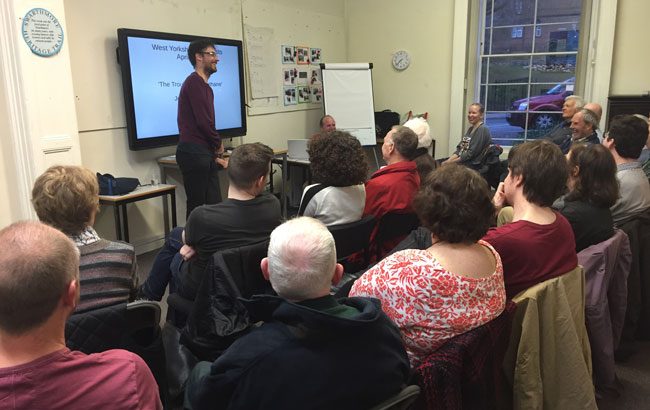
We saw another good turnout for the January meeting of West Yorkshire Humanists. We initially put out only a dozen or so chairs in a circle. However, we soon had to add more, making for a large and very misshapen circle. Always a good thing of course!

This month was debate night and we discussed a number of issues. The headline debate was ‘can terrorism ever be justified?’ The arguments are complex and myriad once you get into it.

After the meeting we went to The George for a few drinks.

selfie

They had alcohol-free cocktails for £2.95. I am not sure anyone had ever ordered them before was there was a lot of confusion about how to make them. However, they tasted good, and we ended up getting a second round.

Myth CSS preprocessor

January 20th, 2016 | Programming, Tech

myth-css-preprocessor

Myth is a CSS preprocessor that allows you to write easier-to-manage CSS, similar to LESS and SASS. The difference with Myth though is that you are writing “pure CSS” while still using features that will be available in the future (such as variables and maths). It then acts as a polyfill for browsers that do not support it.

You can see the full spec on the Myth website.

Should you use it instead of LESS and SASS? In my opinion, no. Not yet anyway. While it does offer some of the features, it does not offer the really useful ones yet. Nested roles and mixins are the big winners for me. Myth does not have these. Nor does it support includes.

It’s one advantage is that it does fill in prefixes. So if you are using flexbox, you can just have a flexbox entry, rather than the endless series of browser-targetted prefixed flexbox commands you currently have to use. You can do this using mixins in LESS and SASS, but it is messier than the way Myth implements it, where you just type the standardised CSS property.

While possibly not that useful right now, Myth is one to watch for the future.

NFL divisional round

January 19th, 2016 | Sport

american-football-pass

It was an okay weekend. The best game was the Packers at Cardinals. I almost fell asleep during the first game, so I decided not to try and stay up to 5am. Inevitability this resulted in me seeing the score before I could watch it on Monday.

Kansas City at New England

Solid performance by both of these teams. They consistently moved the ball and scored. In the end Brady and the Patriots just kept doing what they have been doing forever. You have to fancy them to get to Super Bowl 50 now, even with the injuries.

Green Bay at Arizona

Good game by both teams. Injuries are mounting up on the Packers’ receivers but they were still making plays. I thought their offensive line had an excellent game in particular. Palmer threw some questionable passes, but probably deserved the win.

Seattle at Carolina

This game was over almost before it began. Carolina got off to a dream start with two touchdowns within minutes. Full credit to Russell Wilson and the Seahawks who just kept playing and made an excellent come-back in the second half. It wasn’t enough though, meaning the Panthers have still only lost one game this season.

Pittsburg at Denver

Both of these times were uninspiring. It was just an endless series of field goals. Neither Roethlisberger nor Manning seemed at their best and so you have to wonder how either one of them would be able to outscore Brady in the championship game. Denver only really got it going when they started to really lean on the run. I don’t fancy their chances next week though.

Predictions

New England to beat Denver and Carolina to beat Arizona.

Paul Hollywood’s Pies & Puds

January 19th, 2016 | Books, Food

pies-and-puds

After we were both completely sick of curries, having eaten nothing but curry for about a month, Elina suggested pies might be a suitable next topic. Having enjoyed Paul Hollywood’s book on bread, his book on pies and puddings seemed like an excellent choice.

The first section of the book takes you through making pastry. I have tried most of them. Shortcrust and hot water crust are okay, but ruff puff is my favourite. I now substitute almost any pie pastry with ruff puff now because it is so tasty. I have not tried full puff, because I cannot be bothered to wait around eight hours for it to be ready.

The second section of the book looks at pies. This typically calls for you to make a pastry from part one, prepare a filling and combine the two. The Thai chicken pie is our favourite so far. My raised game pie worked well too, though it was heavily waited to the game I could get down the market. I don’t even know where to buy buffalo from, so I did the buffalo and ale pie with beef and it worked fine.

The puddings section has been less well used but I did make a concerted effort to give at least half a dozen of them a go. They tasted fine but often looked less than brilliant. For example, here are the fruit pies I made for New Year’s Eve. This was my third attempt.

fruit-pies

For posts about the recipes I tried from this book, see my attempt at short bread whiskey dodgers and my selection of pies. Looking back, none of them look that neat. Thankfully, they all tasted good.

River Cottage Light & Easy

January 18th, 2016 | Books, Food

river-cottage-light-and-easy

In River Cottage Light & Easy Hugh Fearnley-Whittingstall presents recipes that are healthier than his normal stuff. Everything is wheat-free and dairy-free and comes with icons to mark recipes as suitable for vegans and 20 minutes or less. A welcome sight for a series of books that often involves long and drawn-out recipes.

The book is divided into breakfast, baking, soup, salad, fish, meat, veg, fruit and treats. It follows the standard River Cottage book format of having a page for the recipe and a full page photo opposite. This, perhaps more than anything else, is why I like the series.

This book has inspired me less than Veg Every Day and River Cottage Every Day. Some recipes have been popular though. Soups in particular: the fragrant Asian broth is wonderful for a light meal and the swede and bacon soup proves that you can actually make swede enjoyable in certain situations.

Fish was the other section that managed to catch my interest. Th fish and tomato curry was simple enough to make, as was the mackerel, spinach and spuds. In fact, most of the dishes are simple and true to the title “easy”. Beef and bashed beans and minted lamb with green beans spring to mind.

Whether it will stand the test of time as a cookbook that I reach for often remains to be seen. Perhaps the real test will be when summer returns, and we’re looking for lighter meals. It has provided us with some nice dishes already.

Paul Hollywood’s Bread

January 17th, 2016 | Books, Food

paul-hollywoods-bread

I have tried a selection of the bread recipes in River Cottage Every Day, usually with success. This inspired me to take it to the next step with Paul Hollywood’s book on bread. I have had the book for ages but never got round to writing it up.

It covers a wide range: starting off with classic breads like bloomers, then moving through to soda breads, flatbreads, continental breads, sourdough and enriched breads.

For each type of bread, he first gives the recipe for the bread itself, then gives a recipe for using the bread in a meal. He claims he wants to put bread back in the centre of the table. A nice thought, though I must confess that it has had little effect on me. I just make the bread, and rarely use the bread-related recipe.

The bloomer has found the most regular rotation in our kitchen. I can probably do it without the recipe now, which is rare even for dishes I do regularly. The naans and maneesh have also become popular. I haven’t been sold on the soda breads or different kinds of grains though. I made them, but they are not to my taste.

Some of the continental breads I have had to skip. Hollywood says it is incredibly difficult to do by hand, so you really need a mixer. Hence why every combination I have had with my friends over the last month has invariably drifted to whether I should buy a stand mixer and which one to get.

I tried the sourdough starter too, but with little success. It did not produce tasty bread and ultimately went mouldy.

For individual posts about the breads I have baked from this book see rye and ale and the bottom half of this selection.