Archive for the ‘Books’ Category

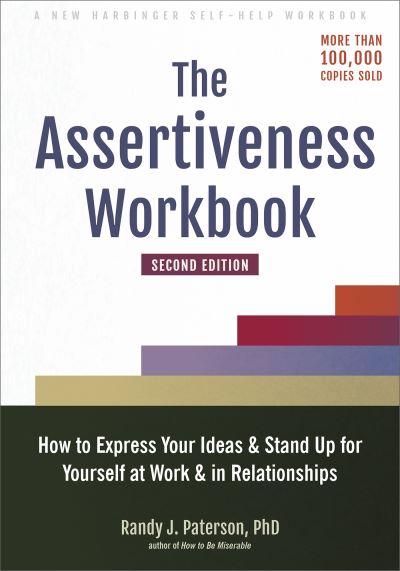
The Assertiveness Workbook

Friday, August 1st, 2025 | Books

The Assertiveness Workbook: How to Express Your Ideas and Stand Up for Yourself at Work and in Relationships is a book by Randy Paterson.

It’s written as a self-help book but makes for an accessible read for clinicians, too. The book begins by describing different types of communication and how they differ from assertiveness communication. It then breaks down specific topics such as giving compliments, giving and receiving feedback, saying no and handling confrontations.

The Power Threat Meaning Framework

Saturday, July 26th, 2025 | Books

Our current system of understanding mental health is typically based around psychiatric diagnosis. You go to your doctor and your doctor gives you a label like “social anxiety disorder” or “borderline personality disorder”. These labels are, on the whole, stigmatising and unhelpful.

Worse, they are not grounded in evidence-based medicine. After a hundred years of lookng, we cannot find the biomarkers for mental illness. Depressed people do not have lower serotonin, for example. Nor are there genetic markers. As far as we can tell (and research has been well-funded and plentiful), mental health issues are not an “illness” in the traditional medical sense.

So then we say “okay but they are functional”. Something happens to someone which activates underlying vulnerabilities and they develop social anxiety. But this does not hold up, either. There are no clear pathways of things that trigger specific labels (the everything causes everything problem) and the majority of service users meet the criteria for multiple labels (the everyone suffers from everything problem).

As a result, we don’t know what causes any of these labels (no biomarkers or pathways), what they look like (people’s symptoms transcend multiple labels) or what to do about it: most first line treatments like anti-depressants or single-diagnostic CBT seems to make things worse.

Much of psychology already recognises this problem and has suggested dropping the word “disorder” and changing the question from “what is wrong with you?” to “what has happened to you?” Trauma-informed approaches are opening up a much greater scope for what counts as trauma.

The Power Threat Meaning Framework goes beyond that. It asks how power been used in someone’s life (think oppression), what threat that created, what meaning the person made of it and what threat responses were activated. It suggests that all troubling experiences and behaviour, from mild anxiety and depression, to hearing voices, self-harm and eating disorders, can be understood from this perspective.

It also suggests that all behaviour is on a continuum, from “normal” to “clinical”. This is important because while some critics might agree mild anxiety is part of normal human experience, they often bawk at the idea that hearing voices or dissociation is typical. Even though most people regularly “zone out” (dissociate) on a regular basis.

The PTM Framework offers what it calls a general foundational pattern and seven provisional general patterns. These allow us to explore useful patterns without detracting from an individual’s personal narrative.

  • Identities
  • Surviving rejection, entrapment, and invalidation
  • Surviving disrupted attachments and adversities in care
  • Surviving separation and identity confusion
  • Surviving defeat, entrapment, disconnection and loss
  • Surviving social exclusion, shame, and coercive power
  • Surviving single threats

The PTM Framework is a contribution to the movement away from psychiatric diagnosis which still has much work to do, and the document acknowledges this.

But we are already seeing improvements. Many services, such as educational support and some NHS mental health services, look at individual need rather than labels and many have switched away from using disorder-specific measures to general outcome measures.

I don’t claim to have done justice to this document in any way in this blog post. You should go read it; it’s fantastic, if quite a technical read.

Sedated

Friday, July 11th, 2025 | Books

Sedated: How Modern Capitalism Created our Mental Health Crisis is a book by James Davies discussing the rise in use of psychiatric diagnosis and antidepressant prescribing.

Davies charts the rise of the DSM, Diagnostic and Statistical Manual of Mental Disorders, which is the standard textbook for psychiatric diagnosis. Now on the revision of its fifth edition, the DSM has massively expanded over the decades to include ever more labels. These labels have no biological basis and are generally the consensus of small committees many of whom have financial links to the pharmaceutical industry.

The author then goes on to connect this to the rise of neoliberalism. As Thatcher dismantled trade unions, increased inequality and reduced working-class people’s quality of life, something was needed to explain this suffering that depoliticised and managed that suffering. The answer was labelling people as mentally ill.

Today, if you are sad because your zero-hours contract means you both have a job and still need to rely on food banks, it is not because of inequality it is because you have an anxiety disorder, or a depressive disorder. It is you, the individual, that is broken, and not that you are living in an unfair society, or so the biomedical model of mental illness would have us believe. And wouldn’t you know it, uber-capitalism can sell us the solution in the form of some antidepressants or a course of CBT.

Some people do find labels helpful. But currently, this is the only lens we are using. And often, the only solution is antidepressants, or if you are lucky some non-trauma-informed CBT.

Thus, mental health has been redefined to conform to the needs of uber-capitalism. Someone who is “mentally well” is someone who can work. IAPT was explicitly set up with the idea of getting people back to work. And programmes like mental health at work initiatives or Mental Health First Aid try to teach us that we should find new ways to handle the suffering caused by low wages, lack of job security and 24/7 work stress.

Work can be meaningful and promote self-esteem. But many jobs today do not provide any dignity. 10% of nurses are using food banks. People are being forced into the gig economy never sure if they will get a pay cheque. People work in warehouses that are gutting their local high street while their bathroom breaks are timed.

Crucially, everybody suffers. Even those with well-paid jobs find themselves lacking meaning and social connectedness. So we try to fix it by buying more stuff. This creates a cycle of consumerism, and then having to invest in security systems and increased policing to protect our stuff, and that in turn divides communities further.

So, what do we do about all of this?

First, we need a model of mental health that targets the root causes: inequality and social isolation. Putting more money into training counsellors will not help because individual distress is a symptom of wider social problems and not something that can be fixed in itself.

Second, we need a wellbeing economy. We need a form of capitalism that works for the benefits of individuals, not for the benefit of capitalism itself. A good start would be undoing the harms of deregulation and rebuilding trade unions to move away from uber-capitalism to more balanced social democracy. This is the exact model that operates in Nordic countries who have the highest quality of life.

Bartleby, the Scrivener

Tuesday, June 24th, 2025 | Books

Bartleby, the Scrivener is a short story by Herman Melville. It tells the story of a lawyer who hires a new member of staff, Bartleby. At first Bartleby works hard but gradually refuses to do any work or even leave the office, answering each request with “I would prefer not do”.

It’s well worth a read. For me, the exploration of the psychological processes the lawyer goes through in responding to such a situation are both relatable and fascinating.

The Burnout Society

Thursday, June 19th, 2025 | Books

The Burnout Society is an essay by Byung-Chul Han.

In the essay, the author argues that there is too much positivity in the world. We now live in an “achievement society” and a “can do” culture, but we are the poor saps that have to do the doing. We find ourselves in a perpetual state of hyperactivity, unable to say no.

Traditional models of psychotherapy stem from Freud. But Han argues these are based on the repressive values of the Victorian era. Today everything is permissible and there are no rules, except that we must achieve and the potential to achieve more is endless, leading to burnout. We never reach the ultimate goal or achieve closure.

Traditionally, capitalism has achieved oppression by directly oppressing the working class. But in this new world, we are victims of self-oppression, believing that we are free and simply striving for better, which is supposedly good somehow, but are actually still mere slaves to the capitalist machine. Reduced to the essence of life, health becomes the new goddess. All focus is on keeping the body alive to serve the machine of capitalism.

It’s a hard read. It’s like reading Marx; I felt like I had been dropped into the middle of conversation at times and, again like Marx, he flips between a few different languages. Worth trying to get your head around, though.

Industrial Society and its Future

Tuesday, June 17th, 2025 | Books

Industrial Society and Its Future, perhaps better known as the Unabomber Manifesto, is an anti-technology essay by Ted Kaczynski. It was published in 1995 in The Washington Post. I watched the Netflix documentary on Kaczynski and thought I would give the essay a read.

Kaczynski argues that technology is the source of most of our problems. Industrial society is a system and human autonomy (which he calls the power progress) has to be limited in service of the system. If you are going to have a factory production line, you have to have workers there, at a time that suits the factory, working on the line.

Technology then becomes pervasive. For example, when cars were invented, you could live just fine and have a car or not have a car. It was good. But now, owning a car involves a driving licence, insurance, MOTs. And because people have cars, cities spread out and so now you have to have a car. Or rely on public transport, which limits your freedom even further.

It’s not correct that humans did not have an affect on the world before the Industrial Revolution. Yuval Noah Harari talks about how early humans eliminated most of the large mammals in Sapiens. But we are doing exponentially more damage now, as well as increasingly making ourselves miserable.

So it is arguably a good critique of the problems of our technological society.

He is wrong about everything else, though. Starting with the fact that he killed a bunch of people to get the thing published, which, it goes without saying, is morally wrong. Maybe things would have been different if social media had existed back then, allowing him to spread his message without violence.

Kaczynski would have hated me. The work starts and ends with an attack of “leftism” which is ill-defined but generally the political left including socialists, communists, and any group gammons would call “woke” these days such as LGBTQ advocacy groups or feminists. He argues that a lot of the people complaining are well educated white people. Which is true, because we are the people who have a voice. That’s how oppression theory works and I don’t see any understanding of oppression theory in the text.

Finally, he doesn’t offer any real solution. His solution is “nature”. But what does this look like? How does it work? Even if we wanted to live without all of our modern technology (such as a antibiotics, for example), how would we stop people just reinventing technology?

The Female Profile of Autism

Monday, June 16th, 2025 | Books

The Female Profile of Autism: A Guide to Clinical Assessment is a book by Isabelle Hénault and Annyck?Martin. It suggests its intended audience is both clinical professionals and autistic women looking to understand how autism presents in women and what the assessment process looks like.

It has three parts. The first talks about autistic experience in the third person. The second is a narrative written by Martin about her experience of discovering she is autistic. Part three is some guidelines for clinical assessment.

I wasn’t too sure what to make of the book. There is clearly a lot of relevant clinical experience here. But is it neuroaffirmative? I’m not sure. It’s not medical model but it’s not the language I would expect to see in a new book. However, it was written in French and then translated to English, so it is fair to say some of the language may have got off point in translation.

It also leverages the work of Tony Attwood a lot. Now, Tony Attwood is a legitimate bigwig with his own Wikipedia page. But some of the language is like “and the magnificant Tony Attwood says…” as if he is the Wizard of Oz. Maybe he is; I’ve not met him. But I would like a clinical book to reference research and integrate ideas a little more. And again, maybe some of this is the translation.

The assessment guide provides a lot of useful questions. I would tweak the language to pathologise a little less, but the questions hit on the relevant issues. Overall, I would say this is a useful book for clinicians working with autistic women and girls.

Under the Radar

Wednesday, May 28th, 2025 | Books

Under the Radar: An Essential Guide to Autism and Girls is a book by Dr Emilia Misheva.

It’s a short book at arounf 140 pages which makes it a nice easy read. There are not enough short books in the world. It is written for a general audience and would be a good read for anyone looking to understand a lot of the key issues for autistic girls. Clinicians might want something a little more technical but it would still be a good overview.

The Adult Autism Assessment Handbook

Monday, May 26th, 2025 | Books

The Adult Autism Assessment Handbook is a clinical guide to carrying out autism. It is written by Davida Hartman, Tara O’Donnell-Killen, Dr Anna Day, Jessica K Doyle (Author), Dr Maeve Kavanagh, & Dr Juliana Azevedo, most of all of which are connected to the Adult Autism Practice of Thriving Autistic.

Although it is typically a guide to assessment, it’s a brilliant book to help anyone understand autism. It has a guide to neuroaffirmative language, in-depth explanations of what it is like to be autistic, up-to-date research on models of autism, a critique of current autism assessments and a guide to conducting collaborative assessments neuroaffirmatively. Well worth a read.

The Lost Girls of Autism

Sunday, May 25th, 2025 | Books

The Lost Girls of Autism: How Science Failed Autistic Women and the New Research that’s Changing the Story is a cognitive neuroscience book by Gina Rippon. It looks at the gender disprepenacy in autism. Previously, it was thought that it was mostly a “boy thing” with a 4:1 ratio. But increasingly, this difference is disappearing, and this book likes at why.

The two key issues the book identifies is that because it was thought of as a boy thing early on, researchers were mostly looking at boys, as well as girls that confirmed to a traditional male presentation. Women and girls who presented in a female way or non-traditional way were not spotted. Then the criteria and the standardised tests were developed on mostly male populations reinforcing the gender gap.

The second issue is that girls typically engage more on camouflaging and masking. Whereas boys will act out very visible behavioural differences, girls will typically internalise their struggles. This means they don’t display the same outward characteristics of boys but still have the same struggles. As a result of these internal struggles, they are often given a variety of labels such as anxiety, social anxiety, borderline personality disorder and basically almost anything other than the correct one: autism.

Women, regardless of neurotype, typically have more highly developed social skills than boys and are socialised to be more empathic. Autistic girls, like neurotypical girls, often feel a greater need to fit in, speeding more time modelling, writing social scripts, and practising social interactions in front of the mirror.

Having outlined all of this, the book dives into what neuroscience can tell us. I found this hard going without a neuroscience background but some of the possible models of autism that neuroscience is developing are interesting.