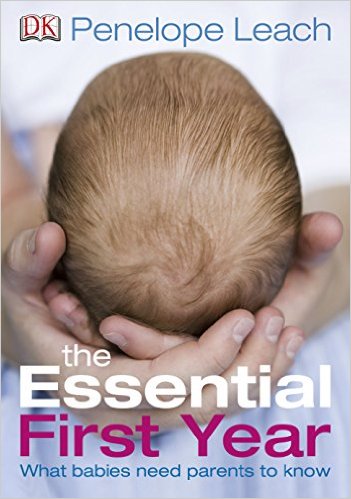
The Expectant Dad’s Survival Guide is a pregnancy book by Rom Kemp.
It cuts a nice channel between the super-factual but not very engaging What To Expect, and the highly engaging but far less informative Fatherhood: The Truth.
It covers the practical stuff that you need, what to expect during labour and the first few months after the birth. As with other books, he has surveyed his friends to back each point up with a range of anecdotes. More interestingly, there is also advice from a midwife (who is also a father himself), The book does a far-better-than-average job of not patronising (no “oh wow, you want to be involved with your baby – but you’re a man!” that is common with pregnancy books).
The ice hockey world championships are currently taking place in Moscow. No prizes for guessing who the Worfolk household is supporting. Finland won gold in 2011, and took a silver in 2014, but failed to score any medal last year.
To predict our chances, I took the medal data from the past ten years and graphed it.
The competition has been going for almost a hundred years now. In comparison to the early days, it is a pretty open contest. In the first 26 years, Canada took gold in 18 of them. Great Britain also took a gold in 1936! From 1963 onwards, the Soviets were unbeatable. Until 1987, when Sweden took gold, the only other team to beat the Russians were Czechoslovakia: the Soviet Union took the other 18 golds.
Today, Russia remain the dominant force in ice hockey. In the past decade they have taken as many golds as their nearest rivals, Sweden and Canada, put together. They are far from unbeatable though. In three of those years, they failed to bring home a medal. Sad as I am to admit it, Sweden has the edge over Finland at the moment. Though a gold at this year’s event would put them clear ahead.
The “big five”: Russia, Sweden, Canada, Finland and Czech Republic win basically everything. This is a suprise to many people, who assume that because the United States’s NHL is the biggest ice hockey league in the world, their national team must be really good. But they’re not. Two bronzes, and a silver each for Slovakia and Switzerland are the only medals to go elsewhere.
So, Eurovision 2016 is over and Ukraine have won the day. Now that Russia haven’t won, I can start enjoying Sergey Lazarev’s “You Are The Only One” for the quite good song that it really is. There were no obviously rubbish songs this year. I think that is the problem with the semi-final system: it filters out all of the really crazy stuff.
Sweden rocked our world
I thought Sweden did a brilliant job of hosting. It was a little different, and definitely for the better. I am pleased Justin Timberlake performed. Not because I am a big Timberlake fan, but I hope that it will lend a note of legitimacy to the contest that will encourage bigger names to take part, which can only benefit the UK (with our massive stock of big artists).
They also stole the show with the best song of the night…
The UK did not do very well
Alas. It was looking quite good for Joe & Jake when the judges’ votes came in, but the public did not feel the same way. It’s a shame because I think it is one of the better songs we have put up recently.
The new voting system is odd
I think I prefer the old system. The new system does keep the surprise until right at the very end, but then it also makes the rest feel a bit pointless. They have to rush round the other countries, with only one score announcement each and the tedious reminder to get on wit hit. Do they not brief the people giving the scores beforehand so they know to just get on with it?
I was hoping we could make some FiveThirtyEight-style paths to victory which showed how a country was doing compared to how it should have been doing. For example, if Belarus gives us two points and Russia eight points, on the face of it, that would seem to put Russia ahead. But it doesn’t of course, because they would normally give Russia 12 points and us nothing. It would be interesting to model, but the new system makes it impossible (it would have been difficult before anyway).
The public have very different opinions
Poland, who you will remember entered a rubbish song, were rightly at the bottom when the judges’ scores had been set up. Yet when the public vote came in, they were third from top. This happened to them a few years ago when their churning milkmaids were shunned by the British jury but very popular with the British public. This time, on a European-wide scale.
I’ve come round to songs
I initially shunned Laura Tesoro’s “What’s The Pressure” when listening beforehand. However, seeing it in the contest brought it to life.
It’s a fun, upbeat song and I like the retro disco theme. Even more impressive, that girl has moves! Have you tried doing a dance that choreographed while belting out a song like that? It is damn hard to sing and play an instrument at the same time, and I imagine singing and dancing is harder.
Also, Jamie-Lee’s “Ghost” was so bizarre that I can’t get it out of my head.
As Graham Norton pointed out, they clearly had a lot of costume ideas: and liked them all.
The Nordic Cookbook is a book on Nordic cooking by Magnus Nilsson. The first thing you notice about it, is it’s size. It’s not quite A4, but it’s not far off. The depth of it is even more impressive. It weights in at over 750 pages. It’s so heavy: a real struggle to lift with one hand.
It covers Finland, Sweden, Denmark, Norway, Iceland and the Faroe Islands.
It is well presented. Being so big, it does not have great structural integrity. The spine moves around a lot. It stays open really well though. It also comes with two ribbons for saving your place.
The chapters, organised by food type, are broken up with full-page photographs from across the Nordics. Many of which are very beautiful. It’s printed in quite a dull matte.
The recipes themselves are poor. Nilsson starts the book by explaining that you won’t be able to make a lot of the recipes because you will not be able to get the ingredients or do the cooking methods. He’s right. There are maybe five recipes to a spread, so there are probably somewhere in the region of 800 recipes in this book. How many did I manage to make? 19.
This is in-part by design. He explains that is a guide to Nordic food, rather than a recipe book. Some of the stuff is just boring. Everything is served with boiled potatoes. Some stuff you have to cook for six hours.
You also need some local knowledge. There is typically a paragraph or two for each recipe, one explaining where the dish comes from and a brief one explaining what to do. Other than that though, you are pretty much on your own. Photos are few and far between. Occasionally you get a full-page photo with six dishes on it, each one labelled. So there is sometimes a pictorial guide, sometimes not.
If you are after a book that captures the essence of Nordic cuisine, tells you how to make authentic recipes and contains some beautiful photography, this is a good book to get. As a straight-up cookbook, it’s less useful.
I have added a related posts feature to my blog. If you click through to the full page for the post (by clicking the title), you will now see a list of up to four related posts at the bottom. Unfortunately WordPress is not picking up the images correctly on all posts, so some are missing thumbnails. The content seems to work quite well though.
After Elina was given a book in barbecuing as a Secret Santa present (as you do) I was determined we were going to make some use out of it. So I put in my calendar that on the first of April, we would buy a barbecue. Basically none of that happened. We never cracked the book, my dad gave me a small barbecue, so I didn’t have to buy one, and then the weather went back to winter for a month.
Now it is May though, and the warmth has returned. So, armed with a sea bream and a red mullet I assembled the barbecue, filled it with briquettes and lighting gel, and set the thing in fire. It went out. I added more paper and tried it again. It went out again. Determined to prove my manliness I tried a third time with loads of paper. Still no luck. I stormed off angrily.
I took five minutes to calm down, and then back to sort it out and clear it away. It was packing out heat. Turns out that even though the flames had died down really quickly, the thing was in fact lit. Victory! My manliness in fact I put the fish into my fish-holder-thing and began to barbecue.
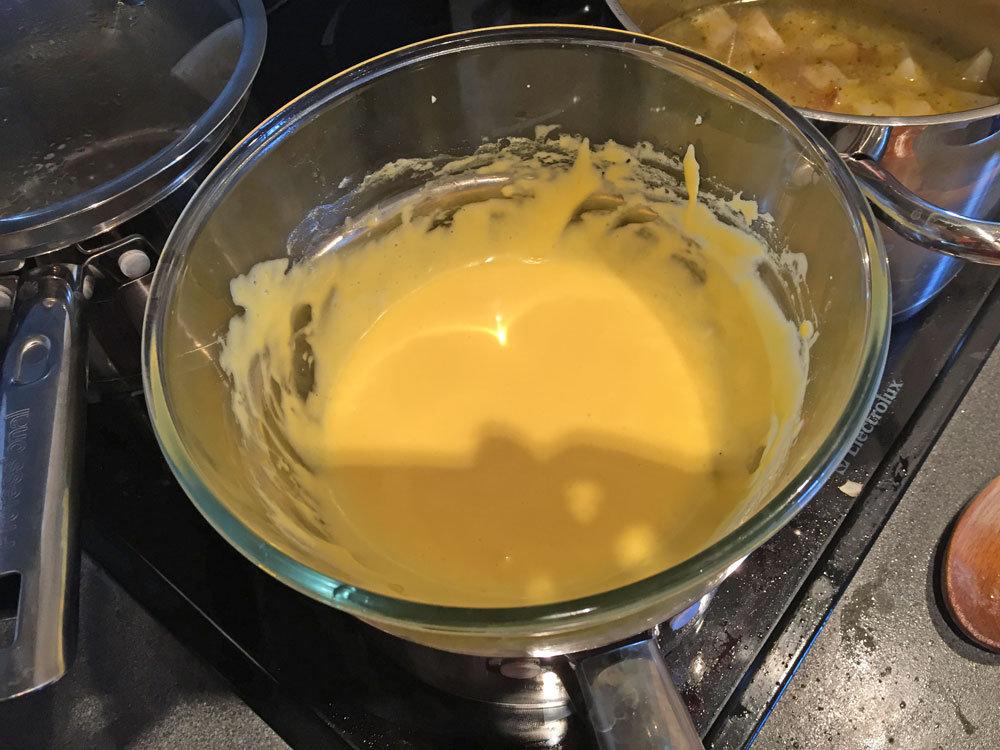
In the mean time I started cooking a soup, so I spent the next twenty minutes running between the balcony and the cooker trying to keep both of them going at once.
The red mullet was not a big winner on the dinner table. It’s firm flesh did not come off the bone easily. However, the sea bass cooked beautifully. The flesh tore away, the skin was crispy and the meat was tasty. Further research comparing it to sea bass and mackerel is needed.
Last month, I wrote about my experiments with Nordic cooking. Having worked my way through the recipes, I then moved onto the second half of the book: the desserts and baking chapters. Excitingly, this opens Nordic cuisine to a whole range of colours, rather than just brown.
Okay, I’ll give you, this one is still brown. But a ginger cake in any other colour might look a little strange. Those biscuits at the side of the tin are actually…
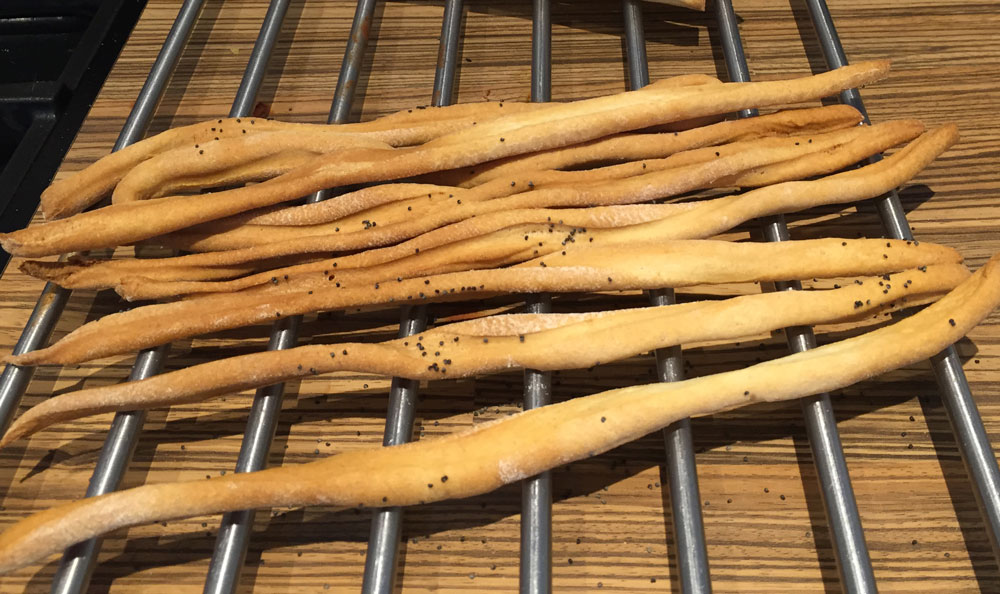
Shortbread. Made to Douglas’s recipe. I don’t know who Douglas is, but he worked in a Swedish restaurant. You hollow out the middle, fill it with jam, and then bake.
Blueberry tart. Of all the Nordic baking I have done, I think this probably looks the most Nordic. The filling is made with sour cream, and then you scatter the blueberries over (and inevitably into) it.
Danish glazed raspberry squares. You bake it as a full sheet of pastry and end up with a 30cm by 40cm single pastry that you then cut up. I found it easier to slice into fingers (finger shaped biscuits, rather than my own fingers) than squares. It’s simple to put together as you bake the two layers, leave to cool a little, then add the jam. You can add the icing later. Make sure you slice it up while still warm though, or it will become very brittle.
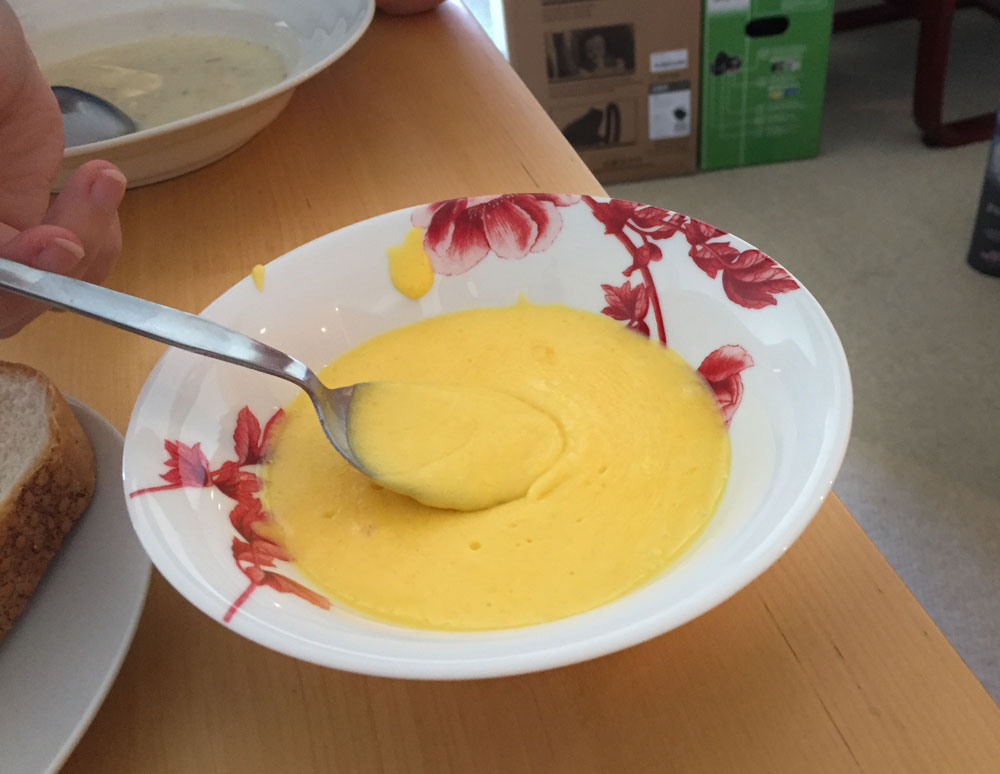
Gooey chocolate cake. Oh my god this was so good. It comes out as a really thin layer in my 18cm tin, so I might try a smaller one. Or, more likely, the same tin with several times the amount of ingredients. You bake it until not quite set, then leave it to cool before eating. It is amazing warm as well.
Last weekend I published a preview of some of the songs to watch. Well, that’s all changed. I’ve been listening to the songs on Spotify all week and have some new favourites.
Russia
Not a song I want to win. In fact, I’m starting the hashtag #AnyoneButRussia. They are now heavy favourites though. Paddy Power are offering 1.57 on them. 2.0 would be evens (50% shot at winning), so they’re running away with it. The nearest rival is Australia at 11/2.
Australia
They have moved up to second favourite. It’s a good song.
Ukraine
Third favourites. They must be counting on a lot of political sympathies though. The song just isn’t that good. Bold topic, but not great music.
Poland
Poland are having a nightmare! The song I have been singing along to most this week has been Margaret’s Cool Me Down. It’s super-addictive. Great song. The bookies were loving it too.
Then I find out that they picked another song to compete in Eurovision. And it’s shit.
Norway
I’m disappointed Norway did not make it through. Agnete’s Icebreaker is a nice tune.
Malta
Another slower but nice song is Malta. It’s got that nice kick-up.
Conclusion
Obviously, I hope Joe and Jake nail it for the UK. However, as I can’t vote for them, my favourite so far is Amir, representing France. It’s the only song I have been singing as much as Margaret.
Version 6 of my website has been around for a few years now and I am pretty happy with it. It is simple, responsive and says what it needs to say. However, the internet is an ever-evolving place, and so an update felt in order. Here is what has changed in version 6.1.
Design
I have switched from Arial to Open Sans. It is an elegant font and as you can probably guess from the name, open source. It is used by Google as their standard font. Along with the font change, the font size has now been standardised, and is bigger than it used to be. This makes everything easier to read, especially on a smaller screen.
There is also more space, in two respects. First the headers are now bigger and more spaced out. Second the header will no longer stay glued to the top of the page if you are on a small screen. Mobile users will now see the navigation bar disappear as they scroll, freeing up more reading space.
Content
The content pages have had an overhaul. Some of the information on the about me and charity pages was getting a little old. This has now all been updated. The videos page now works with YouTube’s new feed, so you can once again see a list of video previews on the page.
Images
Previously, the images were a little on the small side. They worked fine on the tiles you see on a larger screen, but did not fit to 100% width on a mobile screen. These have all now been replaced by larger versions so no matter what size screen you have, you will see the perfect image size.
Blog
My blog has received some attention too. I have removed some of the distracting features like the tag list included in the post listings. The date and categories are now in the sub-heading bar, with no meta data underneath until you click through into the post’s page.
The sidebar has also been moved to the bottom of the page. This is where it was on mobile anyway. Instead of getting a list of 100 months to browse, you now get the past year with the option to click through to the archives page if you want to see a full list. I’ve also added a sitemap to make it easier to search.
Speed
Those larger images eat up a bit more bandwidth. Luckily, speed improvements elsewhere in the site help make up for it. All of this is ‘behind the scenes’. Images and static assets now have appropriate cache headers, the CSS is compressed and everything is delivered via gzip. The homepage’s blog post feed now loads faster too.
Five Star Babies was a two part BBC documentary looking at Portland Hospital, a private maternity hospital in London. No expense is spared. The dining is gourmet, you get your own private consultant, and the birthing suites come with a lounge area for guests.
Having not been through the process myself, it’s hard to judge some aspects. For example, sending your baby off to the nursery for the first few days. If that was an option, I think I might take them up on that. As a new parent, I imagine I am going to want all the help I can get.
Other things just seemed downright strange though. Sending your new-born off for a clean and a nappy before holding it for example. That seems like a weird rich-person thing. In fact one of the most interesting confessions on the show was when one of the nannies admitted that she almost always saw the baby’s first smile, but would never tell the parents that.
There is also something about private healthcare. My dad told about the time my granddad went private for something. He needed pain relief and the doctor, rather than recommended what would be best, just gave them a price list. The quotes for epidurals, which come in at just under £1,000 if you are interested, reminded me of that.
As the show goes on, it just becomes silly. People redecorating entire floors, bringing in their own designers, making secret entrances and spending up to £250,000 reveal a deep problem with the growing income inequality in the UK. Do you need all of that? The answer is almost certainly, no.