Hoegaarden
August 13th, 2017 | Food
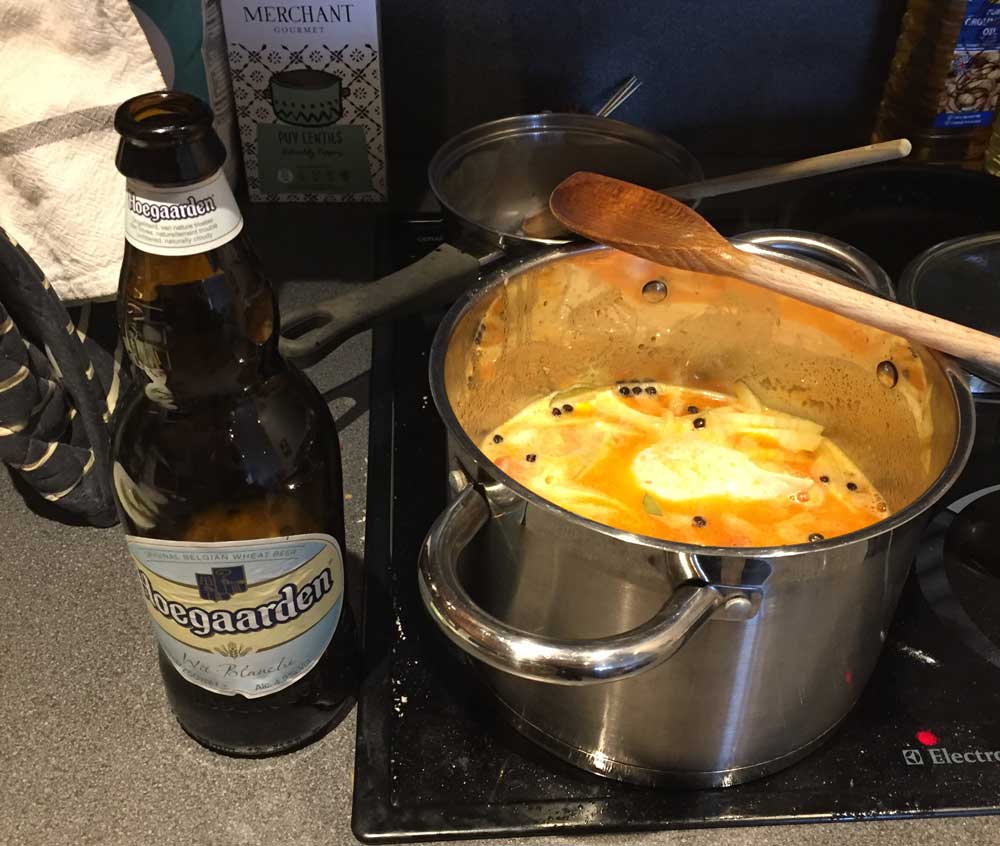
It’s my first time cooking with Hoegaarden. It is producing some interesting colours.
It’s my first time cooking with Hoegaarden. It is producing some interesting colours.
The Wizard of Ads: Turning Words into Magic and Dreamers into Millionaires is a book by Roy H. Williams.
My current series of blog posts is a clearing out and putting to bed of all the books I have half-finished. Typically, when I start a book, I finish it. But Napoleon’s Hill’s Think and Grow Rich has inspired me to give up on a bad book.
The Wizard of Ads is somewhat more interesting. But the trouble is that I have now read most of it and I am still not sure what it is about. I think it is about marketing and advertising. But the author jumps around so much that it is almost impossible to follow his chain of thought.
Indeed, there may be done. There is no real structure to the book. It is a collection of anecdotes that Williams thinks will be useful to marketers.
And they are. There is a lot of gems to be gleaned from this book. Including:
But the lack of structure of clear theme to the book making the whole thing rambling and confusing. The religious references also get tedious.
The most controversial aspect of the book is probably that Williams rejects targeting and sales it is all in the copy. This goes against what most marketers teach. Indeed, it even goes against what Gary Halbert teaches in The Boron Letters: “more than anything, give me a list of qualified buyers”.
It does have a fun title, though.

Elina and I are considering getting back into cycling. So, I did what any self-respecting young professional would do, and went out and bought a fancy bike at the cost of nearly £1,000.
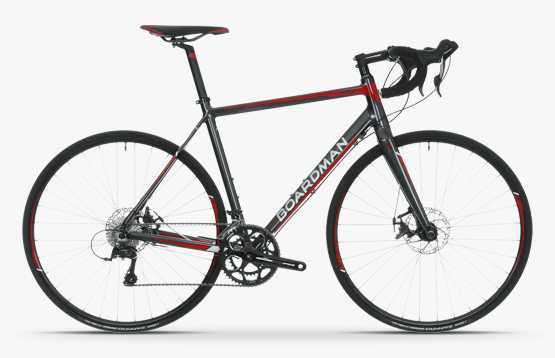
Actually, I didn’t do that. What I did do was to spend £3.80 hiring a bike from Leeds CyclePoint to see if we could both still ride a bike.
It turns out that you really do never forget how to ride one. It must be 15 years since I last rode my bike and I was rather cautious about stepping back on. But as soon as your foot goes down you’re back in old habits.

The scheme is called Bike & Go and you cannot really go wrong at £3.80 per day. You can register online and get started straight away: you don’t have to wait for your membership card to turn up.
It has plenty of features, too: a kick stand, an integrated bike lock and easy-to-use hub gears.
That said, as your day-to-day bike, it wouldn’t cut it. It’s incredibly heavy. I struggled to lift it by myself. It barely fits in the lift in our apartments (might be a problem with all bikes). The seat is rock hard: even a few minutes riding leaves you sore. The brakes don’t fill you will too much confidence, either.
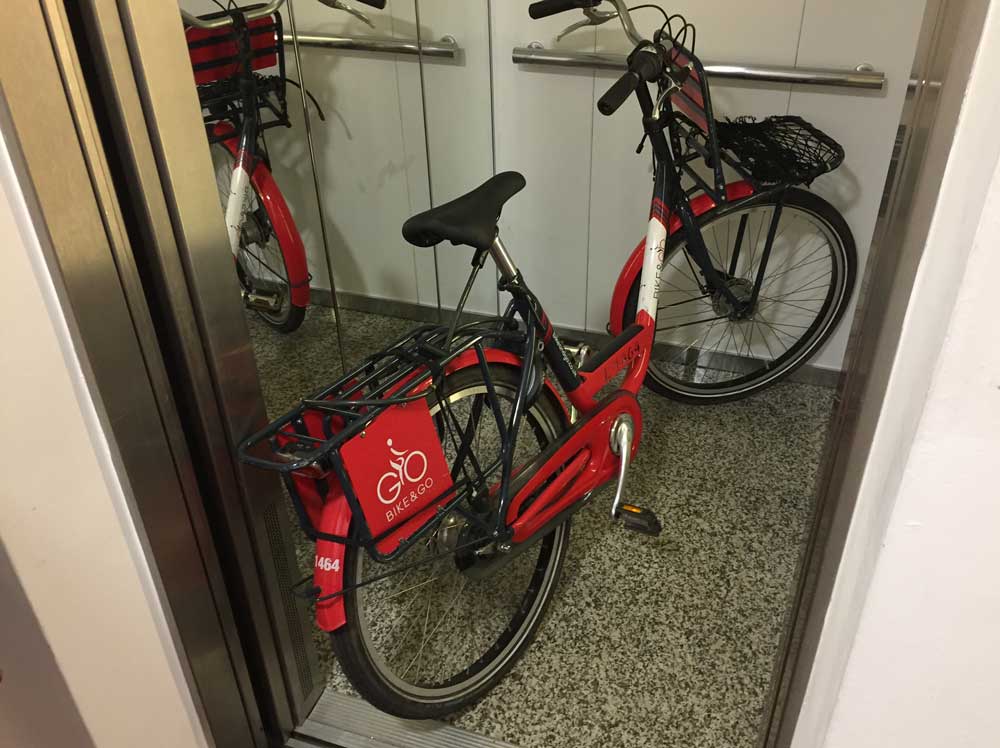
But, overall, it does the job. For the price of a cup of coffee.
For a long time, I’ve joked that I wanted to get my 5km run time down to Mo Farah’s… 10km time.
But this was never a joke. His personal best over 10,000m is 26:47, although this somewhat lags behind the world record of 26:17 set by Kenenisa Bekele in 2005. For years, my Parkun PB (personal best) was 28:50. Quite a long way behind…
The 5km race pace is even quicker. That world record is held by Kenenisa Bekele, too. 12:37 set in 2004.
Then there is also a system called age grading. This is how it works:
They take the fastest recorded time that someone of your age and gender has run a specific distance. Then they give you a percentage based on that. So, if you match the time, you get 100%. If it takes you twice as long, you get 50%. Four times as long, 25%, etc.
The fastest a 30-year-old male has run 5km is 13:01. Therefore, to achieve a 50% grading, I would have to run 26:02. Even tougher than matching the 10k world record, of course.
The last year or so have been great for my running. I’ve taken 10 minutes off my 10k time and 24 off my half marathon (though to be fair, I’ve only done two and the first one was in 25-degree heat).
You can read more about my 10km races here and half marathons here.
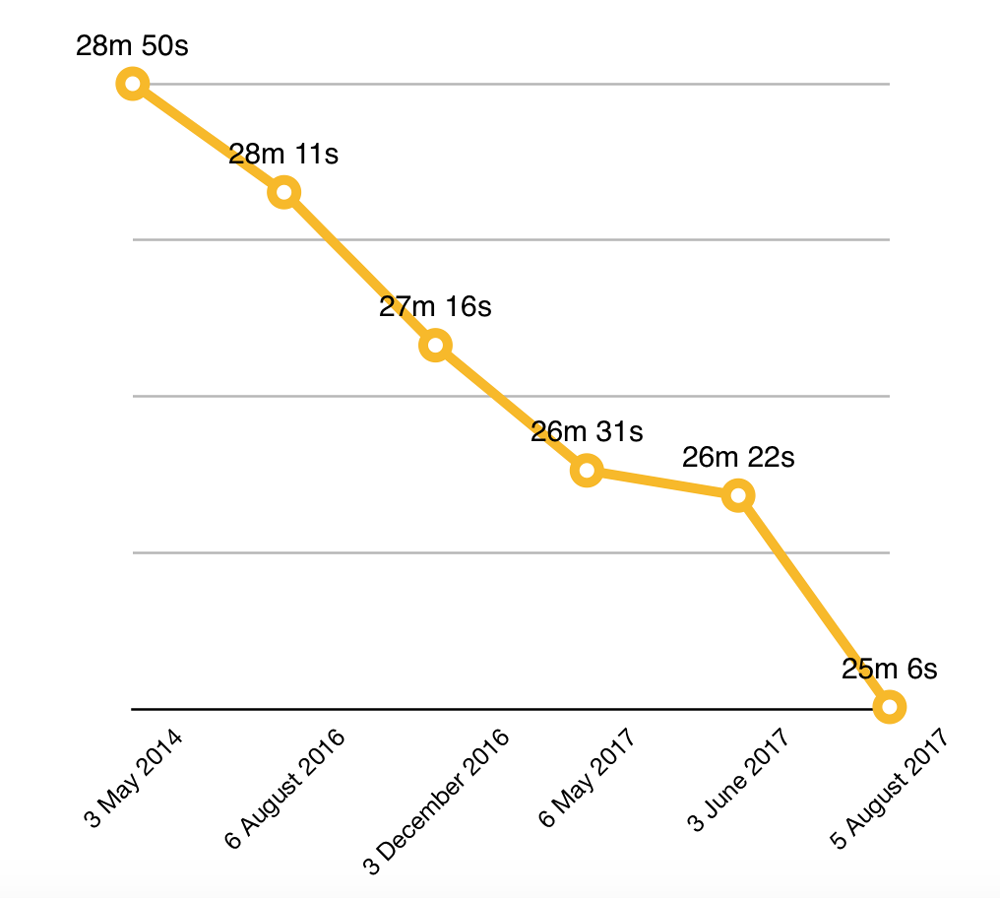
But my 5km times have been tumbling too…
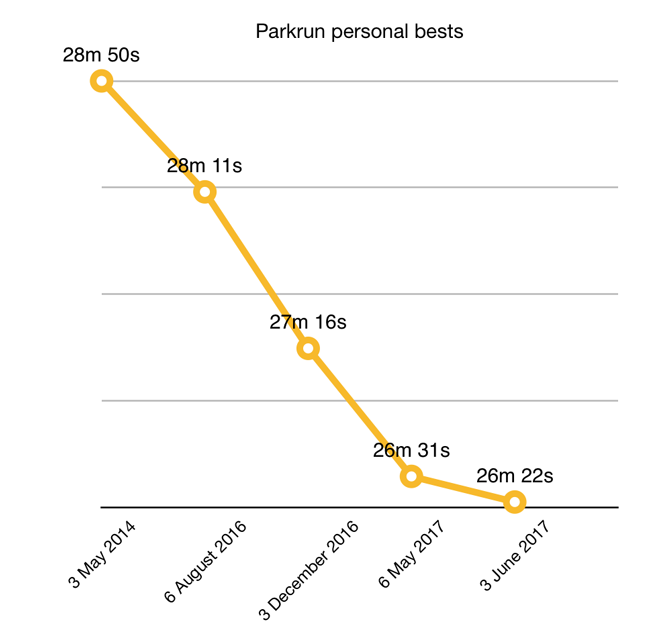
Note that these dates are evenly spaced on the chart, but not in time. I set my PB on my 3rd ever Parkrun back in 2014 and then did not better it until a year ago. Since then, I’ve set an additional three personal bests.
When I turned up to Parkrun last Saturday, I was feeling okay. Not amazing, but fine.
I noticed they had pacers, so I went over to the other side. I’ve been struggling to keep my time under 27 minutes: only managed it four times, including the two PBs. Therefore, I decided to follow the 27-minute pacer and make sure I was ahead of him.
As we raced down the first straight, I saw the 26-minute pacer just ahead. So, I thought “what the hell: I need to be somewhere around him anyway” and jumped across.
It was hard going. At around 3km I started falling behind. Which is fine, expected almost, given I had never hit 26 minutes. But the roar of the marshalls and the fact that, probably for the first time ever, I managed to avoid being lapped, I got back on his tail.
As we hit 4km he confessed that we were running ahead of schedule. He slowed down a little and a cat and mouse game began as he dropped behind me, before catching up each time I tried to draw breath.
For 500 metres this continued until we entered the back straight. At “the hill” (in quote marks because it only goes up two metres, but it is surprising how many people slow down) I was loudly groaning. But as we reached the top I decided to give it one last push and went clear of him.
As I rounded the final corner, I saw a beautiful sight for tired eyes: the 25-minute pacer wasn’t that far ahead of us. I found I had renewed energy for the final kick as I chased him down with all my will.
And missed him.
It was too much ground to make up. But that did not matter. I finished a mere six seconds behind him, giving me a time of 25:06. One minute 18 seconds faster than my previous PB, faster than the 10km world record and giving me a 51.53% on the age grading; the first time I had ever been over 50%.

Let’s put things into context here. Despite my attempt at epic storytelling, 25:06 is not that fast for a 30-year-old healthy man to be running 5km. But, given how much of an improvement it was over my previous PB, it is worth considering what was different.
Here are some ideas:
The time was incorrect. This was my first thought. Parkrun timings are often out, sometimes significantly. But there are a few reasons to believe this one is correct.
First, I was just six seconds behind the 25-minute pacer. Second, I was well ahead of the 26-minute pacer. Third, Strava had my km splits at significantly faster than usual.
Both Strava and MapMyRun report me running at 5:00 to 5:20 minutes per km. This would give me a typical run time of 26 minutes. But it never works out like that. However, measuring the differences, I clearly did beat the 5:00 per km on this occasion.
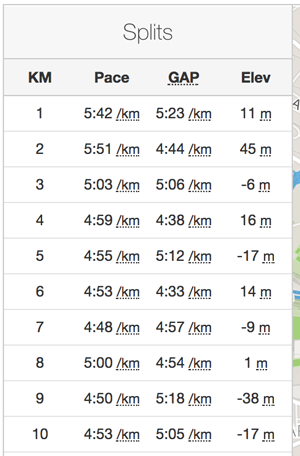
It’s also difficult to measure my exact time on the app because I start it from when I leave home, and stop it when I return home. So the Parkrun itself is from 2.5 km into the run and ends 7.5 in.
So, given that the Parkrun time and the pacers’ times agree, and my Strava report agrees I was on a good day, it suggests the time is accurate.
It could be that the time was off in my recent 27 and 28-minute runs, which were actually faster. I have, for example, comfortably beaten the 27-minute pacer before and been given a 27+ time.
I have new trainers. I had completely worn through the soles of my old running shoes, so I gave in and bought some new ones. It may be that they contributed to recent runs. This is only my second Parkrun in them.
I have been cross training. I have played a lot of basketball at work recently, and I’ve also been back in the pool a few times. Not many, but it could have helped.
I was just on a really good day. As an amateur runner, my performance is not very predictable. It could have been that I was just on a really good day.
Maybe there is hope for my hitting my target time in this year’s Abbey Dash after all.
This is it, friends. The end of an era. I am saying goodbye to my current running shoes.
It’s heartbreaking. I have had my current trainers for many years. They have seen me through all of my races. They were even my everyday trainer until I decided I wanted to save them just for running.
But, they have had their day. I have worn through the sole so much that all that remains is the spongy padding. This means that when it rains, the shoe actually sucks up water rather than keeping my feet dry. And there is a little hole, too.
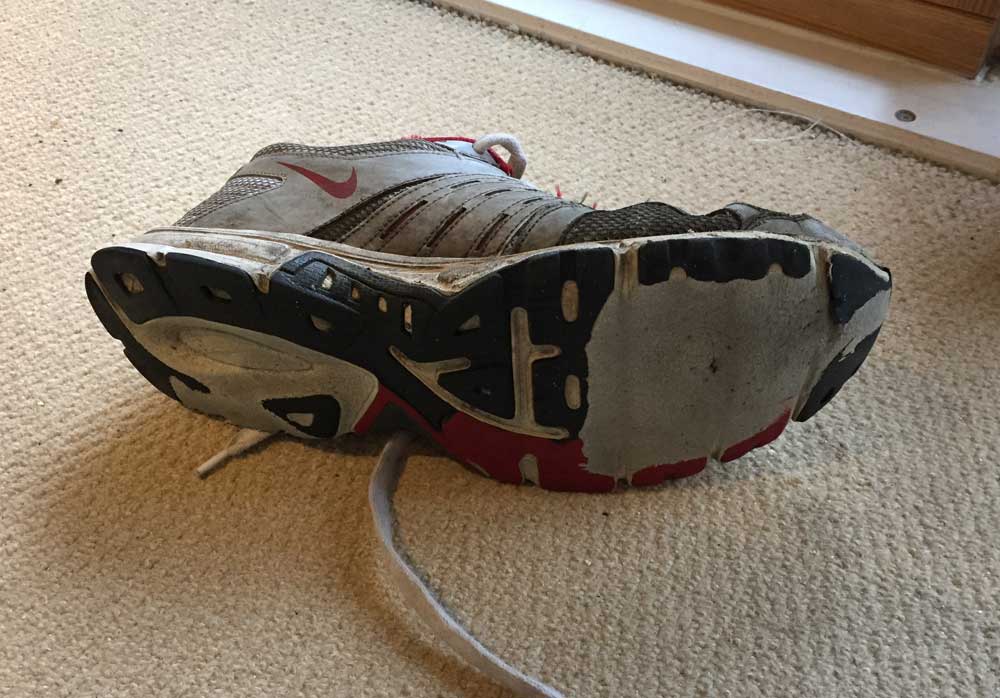
So, I’ve given in and bought some new ones.
At the Nike outlet store, of course. It’s awesome. Nobody speaks to you or tries to touch your feet. They just have boxes of shoes out that you can pull off the shelf and try on.
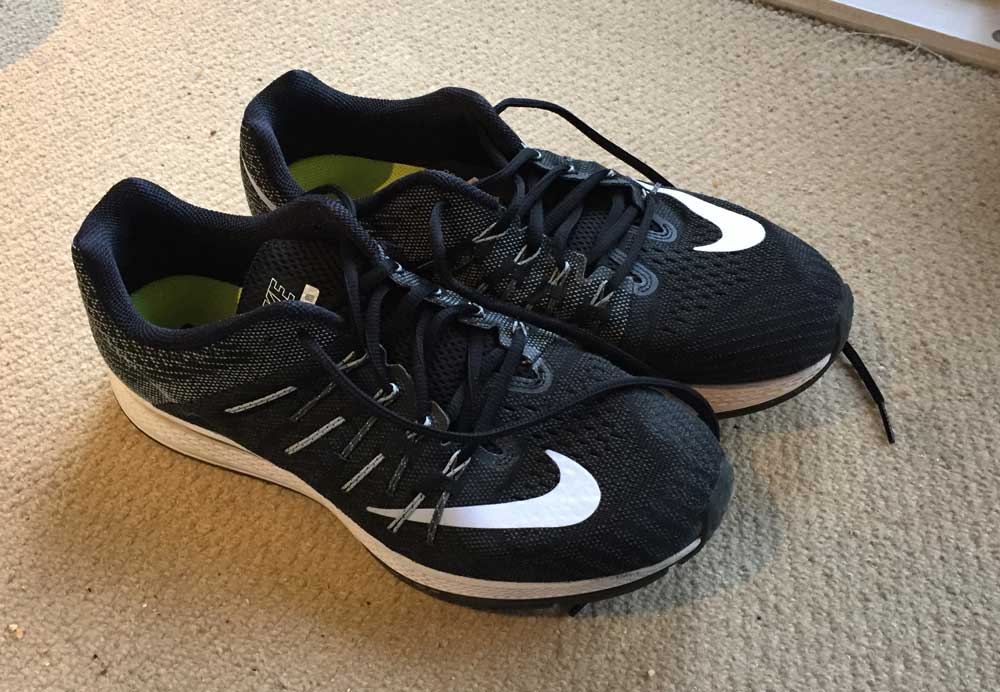
Will the extra padding make me soft and slow? We’ll find out soon…
For week three of our swimming tour, we drove up to Harrogate to visit The Hydro.
Changing facilities were okay. It’s all one big mixed changing room with individual cubicles. This made it quite difficult to get Venla changed as we had to use a changing table, which is complicated when everyone is wet.
The pool itself very good. The main pool actually has a deep end. It claims to be 1.8 metres deep, but my measurement put it at about 1.7 metres. They had three swim lanes as well as a general area.
The children’s pool was very warm and had a slight gradient, too. In the shallow end, I could sit on the bottom while holding Venla. There were lots of toys and floats about. Venla really enjoyed the watering cans.
They have a diving pool, too.
The “session” was just general swimming all morning. This was great as it meant we did not have to be there for a specific time or get kicked out.
The viewing area is much nicer than other pools. They have a cafe that serves a good range of hot food including breakfast and main meals, and you can sit inside or pool side. It is cash only, though.
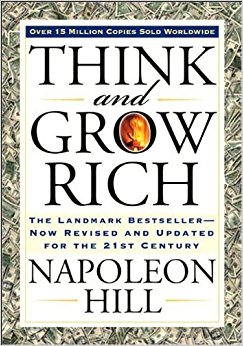
Think and Grow Rich is a self-improvement book, written by Napoleon Hill and published in 1937.
In it, he sets out 16 “laws” (and yes, the quote marks are there on Wikipedia, too) on achieving success. The book certainly did do that: it has sold over 100 million copies and best of all, it is a super simple formula to follow: think positive and you will soon be drowning in money.
Unfortunately, Hill seems to have been unable to apply the principles to his personal life. He frequently ran out of cash and was forced to take up touring the United States lecturing again. Most of his business ventures went south.
It’s almost as if you can’t just think and grow rich.
Though I must confess, I didn’t even make it half way through the book. Maybe all of the pearls of wisdom are hidden in the second half. Or I’m too negative a person to see the ones right in front of me. But, either way, I think there are perhaps more practical books I could spend my time reading.
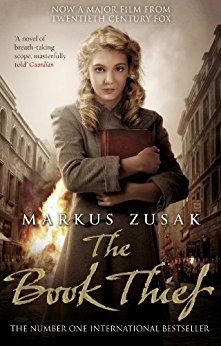
I confess that I have not fared well with Markus Zusak’s novel The Book Thief.
It is certainly a well-written book and interesting story. Who doesn’t love death as a narrator? However, it has not captivated me. Half way through I found that my reading simply stagnated and I did not get any further.
I’m just not that excited to find out how it ends. And, well, I kind of know that already, because it’s included in the story. No doubt there were some exciting twists to come. But I shall never know.
Fresh from our trip to Kirkstall leisure centre, we decided to hit Fearnville this week.
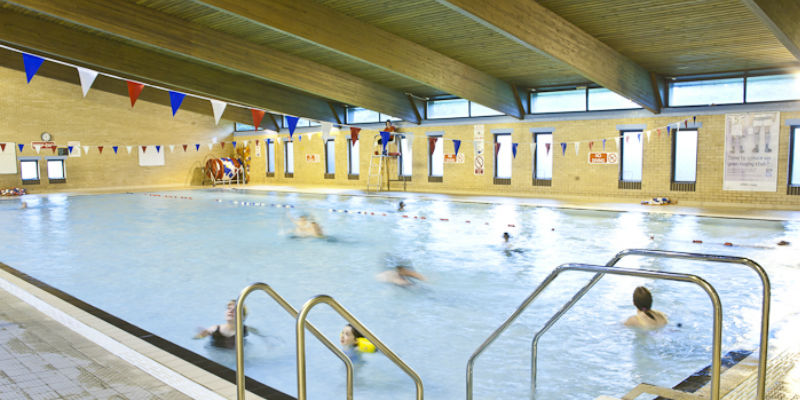
It is also operated by Leeds City Council and as such as much the same facilities and pricing. It’s £4.90 for an adult and under 5s go free. There is a 25-metre pool at the same depth of 0.8 metres to 1.6 metres, making it almost deep enough for an adult in the deep end.
Their children’s pool was open and it was nice and warm. Venla enjoyed having a good splash.
The changing room setup is a little different. They split into men and women but then merge back together for family changing: with big cubicles, changing tables and lockers. This worked really well because we could double-team Venla.
The showers were back in the separate gender changing areas and there was still no plug socket for my hair dryer. The lockers required £1 and the keys were less fancy: it was literally a rubber band with a key attached to it.
I have never watched cycling before. For the obvious reason: that men peddling away on bikes for five hours does not sound that interesting.
However, when you are working with Sky Sports, you sometimes get caught up in the excitement. It happened with golf, and now it appears to have happened with cycling, too.
Plus, I have stopped watching Formula One since Sky announced they were getting almost-exclusive live coverage of it. So, I am in the market for a new boring sport to watch. Cycling seems an excellent candidate.
A cycle race may seem like a bunch of people riding around for hours before sprinting towards the finish line at the very end. And, to a large extent, it is that. It is much easier to ride together in a peloton, so that is what happens, especially on the flat stages.
But it becomes more complicated than that. Riders can “attack”, which means they cycle off up the road and the peloton has to decide between chasing them down or letting them go. Cycling by yourself or in a small group is tiring, so it then becomes a competition to see if they can build up a big enough lead to hold off the peloton when they speed up towards the end.
Tour de France has four different jerseys:
| Jersey | Description |
|---|---|
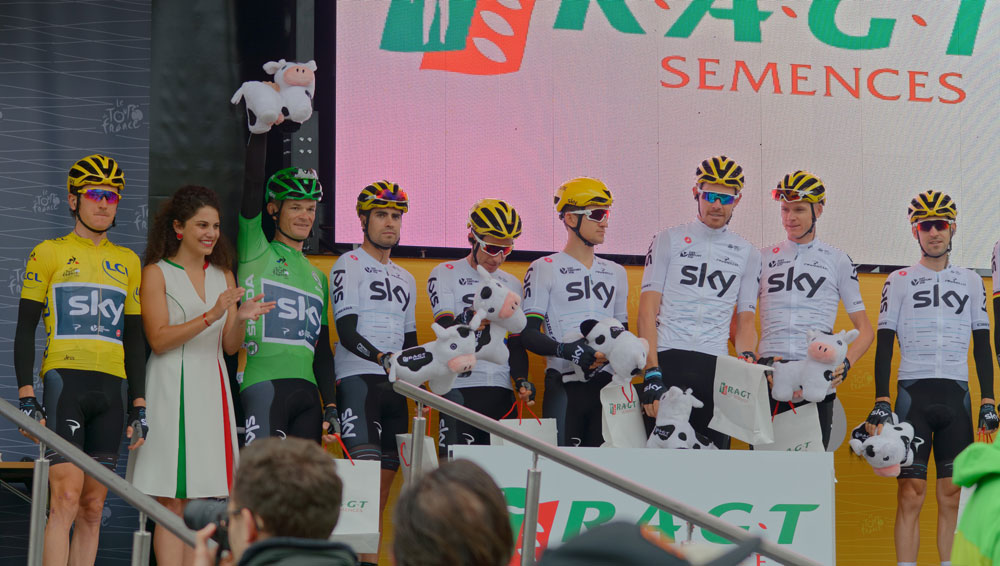
| Yellow jersey | This is the most prestigious one: and the one Wiggins and Froome raced for and won. It is a sumation of your time for each stage: the one with the lowest is the winner. You also get time bonuses for winning stages. |
| Green jersey | The points jersey. You get points for winning stages, intermediate sprints (designated points along the route) and reaching the top of hills first. |
| Polka dot jersey | King of the Mountains. This is given to the rider who scores the most points from reaching the tops of hills first. |
| White jersey | Best young rider, similar to general classification but with an age limit. |
So, lots going on. And because different riders are aiming for different jerseys, tactics change a lot. It’s a team sport. If you want to win a sprint, for example, it is easiest if you have a line of team-mates to get you in the perfect position.
Or, if you are competing for the yellow jersey, it makes sense have some of your team mates attack. That way, the yellow jersey is forced to either chase them down, tiring himself out so you can pass him at the end, or leave the attackers to the stage, taking valuable time out of his lead.
There are four big races in cycling, known as the grand tours. These are the Tour de France, Giro d’Italia, Vuelta a España and Tour de Yorkshire. Some people dispute whether the latter is really a grand tour.
But Yorkshire is certainly a hub for cycling. In 2014, the Tour de France started here, with the Grand Depart starting on The Headrow in Leeds. I was there.
Chris Froome took the win in relatively easy fashion. While his winning time was narrower than his previous victories, and he briefly lost the yellow jersey at one point, it never really looked in that much danger given how dominant Team Sky was.
The real outrage of the tour was that Warren Barguil was awarded the combativity prize. He rode an excellent race and won the King of the Mountains jersey fair and square. But how anyone other than Thomas De Gendt, who spend over 1,000km in breakaway groups (mostly leading them), could be awarded the combativity jersey is a mystery to a novice cycling-watcher such as myself.
Image courtesy of Wiki Commons.
.jpg)