Ice cream helper
October 26th, 2017 | Photos

I tried to order three scoops of ice cream at Kaspas. Instead, they brought me three separate ice creams. It was very lucky that my ice cream helper was on hand to get the job finished.
I tried to order three scoops of ice cream at Kaspas. Instead, they brought me three separate ice creams. It was very lucky that my ice cream helper was on hand to get the job finished.
Last Saturday I completed my 131st Parkrun. I was feeling good so was determined to make it a PB (personal best) day. Of course, intentions don’t always match up to how you feel on the morning.
As it happens, the wind as with me. Not literally, there was a headwind on the back straight. But I pushed, and having only set my current PB back in August, managed to set a lower one of:
24:37
I’m pretty pleased with that, especially with the Abbey Dash looming large. Here is an updated graph of my Parkrun history:
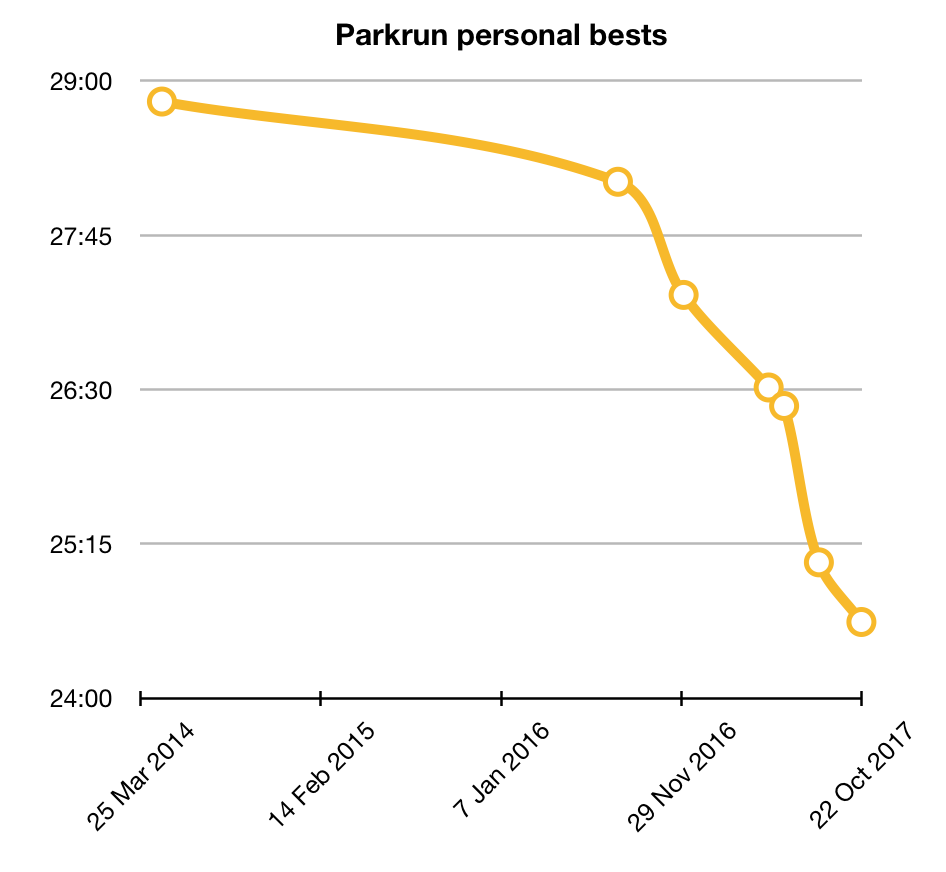
You’ll notice that with the trend line, I should be world champion sometime next week. I’m pretty sure that’s how it works.
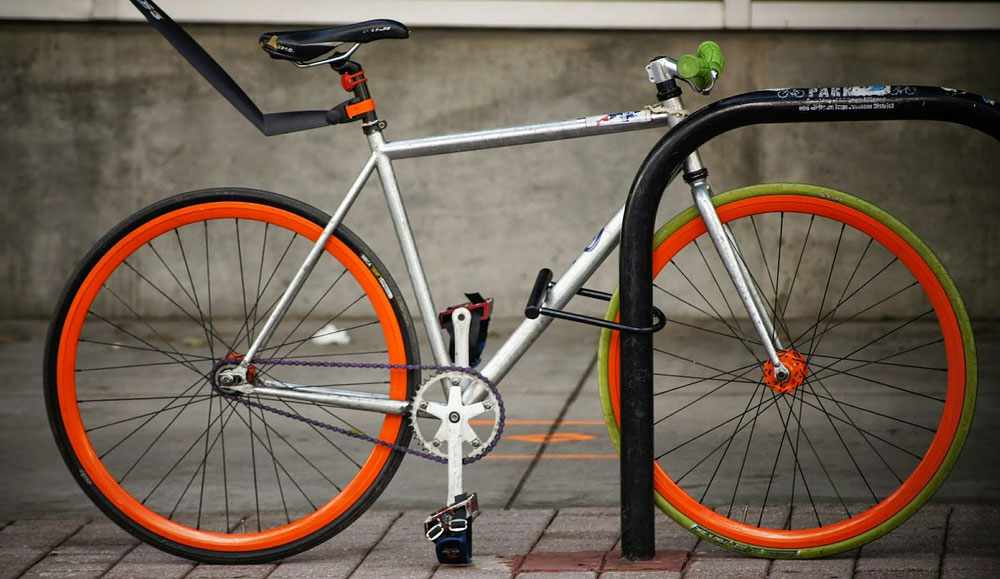
Every bike shop is stacked to the rafters with expensive accessories. But, wanting to be frugal, I rejected the idea that you needed them. I bought a bike and nothing else. No accessories at all. I refused to be pulled into this expensive world.
And then the real world hit me, and I realised how wrong I was.
This is my story. A story of how you actually do need a bunch of accessories, and will massively regret it if you don’t get them.
True, you don’t really need these. Just like you don’t need a cup even if someone is going to kick you in the genitals over and over again. But any sustained time on the bike and you’re going to start getting sore.
I managed one ride. By the end of the first hour, my bottom was regretting it. Padded shorts are well worth the investment.
Human beings literally die if they don’t get water on a regular basis. Even by re-using a sports bottle that I already owned, I still had to buy a cage to put it in.
Oh, you want to fit that cage to your bike? Too bad, because the Allen key size doesn’t quite match the six different ones you have left over from Ikea. So, you have two options. One is to go cap in hand around to your dad’s every time you want to change your saddle height. Or two is to buy a multitool.
I tried to get away with option one. But my parents go on holiday too often for it to work.
Great, so, I’ve now got my water, but nowhere to put an energy bar. Or my wallet or keys, or basically anything. This is because if you have a regular pocket on a bike, things fall out of it. So, you either need to use shorts or trousers will jip pockets (of which I do not have loads), or buy something with pockets.
Like a jersey. Which has three. For things like keys. It’s that or use some kind of elaborate wave system to try and tell your wife you’re home and want to be let back in.
On my fifth bike ride, my back wheel fell off. I don’t know how to change a wheel. But even if I did, it wouldn’t have been much use because I don’t own a pump or a spare inner tube. Useful purchases, then.
Oh, you want to have those things for when you need them in an emergency? Looks like you will be buying a saddle back to store them in, then.
Now we’re rocking and rolling. Sure, we’ve had to give in and buy seven accessories, but now we’re set, right?
Well, yes, unless you have any friends. Or want to ride your back to any kind of location. Because if you wanted to do any of that, you’re going to need a bike lock to lock it up at your destination.
Again, you have options.
You could get your friend to use their bike lock to secure both your bikes, for example. In which case, hope you have a generous friend with a suitably flexible bike lock.
Or you could move to Oxford, where nobody really uses them.
Short of that, you will be investing in an expensive lock because even the expensive ones only provide about a minute’s protection from determined thieves. And one lock is pretty much a starting point: you will want to get a second one to try and hang on to your wheels as well.
Now your bike is covered in expensive things in a country where it rains all of the time. Maybe you have an indoor storage area. We live in a flat, so the bikes have to live on the balcony. That means investing in a rain cover.
I don’t bother with a helmet because the evidence for them is mixed. But a lot of people look at my weirdly. And if I want to ride any organised events or competitions, a helmet will be mandatory.
Lights are optional, unless, of course, you ever plan on commuting on your bike. In which case, you best hope you only work 10 am to 3 pm, otherwise, you’ll be riding to and from work illegally.
Glasses aren’t required unless you want to a) see where you are going in the sun and b) ever ride near a canal or river. If you do want to ride by a waterway, you have the choice of either wearing some glasses or repeatedly being hit in the eye by insects until you blindly ride your bike into said waterway.
You can live without gloves unless you want to be able to use your hands at the end of the cycle. For example, being able to use a keyboard in the office or operate your keys to unlock your front door when you get home.
In either of these scenarios seem likely, you will want to ensure there is at least some heat left in your hands when you arrive at your destination.
I don’t care about getting muddy when I go cycling. However, if you ever plan on riding when anyone else, you might start to care. And, if you go out with a cycling club, they are likely to be mandatory.
There is one thing you genuinely don’t need to buy for your bike, and that is a computer. The one thing that is actually fun and interesting. Which really digs the claw in. If you want to be frugal, you need to buy every single cycling accessory except the one you actually want.
People sometimes say that you should avoid spending a fortune on cycling accessories.
However, that is a little unrealistic. I tried it. I bought zero accessories for my bike. But, one after another, I was forced to invest in them. Cycling is a tricky thing to do on a budget.
As a software consultant, I spent a lot of time going into big, slow-moving organisations with legacy software and helping them sort it out. One persistent feature of these organisations is regular but infrequent releases of their platform and a fear of moving to anything more rapid.
By infrequent, I mean they might release a few times a week (Tuesday and Thursday are fairly common), or maybe each weekday, or maybe even just once a week. In the world of agile, all of these schedules are infrequent. Modern, agile platforms release constantly.
Typically, these companies will be afraid to move to anything more agile because they have a system in place and they think that it works. They say things like “we can’t risk continuous delivery (CD), people depend on our platform”.
This, in my view, is a mistake. And in this post, I am going to set out the reasons why it is safer to use CD. Not why it is better for the product owners, makes more money and keeps your developers happy, though those are all good reasons. I will make this case purely from the view of change management and their worry that it will damage the integrity of their system.
The old model involves people from every team merging their code into a release branch, that branch being put on a staging environment and then manual tests being run against this.
This is a terrible way to do things. As everyone merges in their code you get conflicts. Some of which will be resolved correctly, some will not.
The changes interfere with each other in ways that you cannot predict and there is just too much ground for the manual test engineers to cover.
Worse, when everything does break because you have pushed 20 features live at the same time, it is then really difficult to do anything about it because you have to check whether you can roll back, then check whether there is anything critical that needs to go out, then do a fix branch or a new release branch and rush through the whole process again.
And it produces a huge number of incidents. If you have zero incidents right now, you have a good system. But does anybody have that?
Such companies often say “we will move to CD when we have 100% automated test coverage”. But this is an unrealistic standard because they do not have 100% manual test coverage now.
Worse, because people rely on the manual test engineers to do the regression test, they don’t bother to put in place the correct level of automation. Maybe someday there will be a company that magically finds out how to do that. But nobody I have seen has so far.
The only way to force your engineers to do it is to move to a CD model and let them know that if they don’t put the automation in place there is no safety net and it will be traced back to them.
Under the CD model, you release one feature at a time. So, gone are the days when two changes are merged in and don’t play nicely with each other. Each change goes out separately having passed all of the tests.
Sometimes, you have to push something out that is really important.
Under the traditional model, this is a major issue. Either you push it out as part of the scheduled release, and risk another feature breaking and you having to rollback your critical change. Or you block out the entire release and stop everyone else releasing for a few days. Which, as you can imagine, creates an even bigger big bang release later down the line.
These problems are eliminated with the one-feature-at-a-time CD model.
If you do get a problem, it is super easy to roll back. You just hit the rollback button.
Under the traditional model, you have to check if you can roll back (due to all of the dependencies) and then if you are allowed to roll back (checking with the product owners that they are all okay with it) and then do some complicated rollback script.
All of this is simplified under a one-feature-at-a-time CD model where if it doesn’t work, you just roll it back straight away and don’t block anything else from releasing their features.
If something does slip through the net, you can get a fix out of the door faster than ever before. Gone are the days when you make the fix, try to work out what release branch it needs to go in, do all of your manual testing and then push it out the door.
Instead, you just write the fix and release it. And it’s fixed, way faster than it could be using the traditional model.
Yes, continuous delivery will make for happier product owners, happier developers and a faster-moving business.
But, and this is most important of all, it will also make your platform safer and more reliable. People think it will make things riskier, but, as I have outlined above, this is simply not the case.
With the CD model, you isolate every feature and every release, which is the gold standard of good change management. And, if anything does go wrong, it’s easier than ever to rollback and push a fix out.
Companies often believe that they cannot risk moving to a continious delivery model. However, if their platform truly is important, then they cannot risk not moving to the CD model.
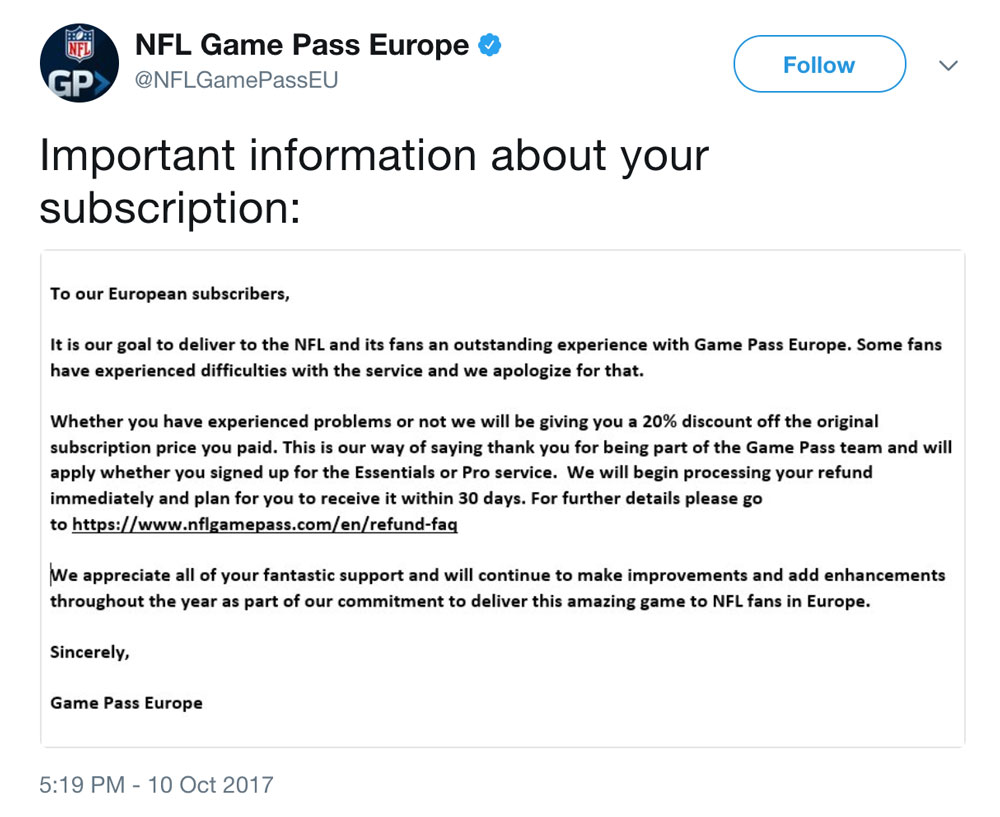
On Tuesday, the NFL announced they would be partially refunding all of their European Game Pass customers because of the problems people experienced with the streaming service.
The announcement comes just six hours after I published my article setting out the problems. I’m not saying my blog post was solely responsible for their announcement, but the timing is clearly too similar to ignore.
They’re giving everyone 20% back, which is fair, though not beyond expectations.
However, the real test will be whether they sort the streaming issues out. Roll on Sunday…
I’m not sure Leeds City Council have quite mastered this marketing thing yet…

This week, it was announced that Richard Thaler had been awarded the Nobel prize for economics. It is long overdue. Here is why.
Thaler is best known for his 2008 book Nudge: Improving Decisions About Health, Wealth and Happiness which he co-authored with Cass Sunstein. He was a summation of his many years of work on behavioural economics. You can read my review here.
This understates his contribution though: Thaler is considered by many to be the father of behavioural economics.
To understand why that is important, we need to look at what behavioural economics is. Economics, as a subject, has been around for thousands of years. Except that in many ways it really hasn’t. Traditionally, at least in recent tradition, it has focused on building financial models based on people making perfectly rational decisions.
Take the free market, for example. If you put prices up, you decrease demand. It’s nice and simple.
But then Thaler came along and said: “hang on, do people act like rational beings all of the time?” The answer, of course, was no. And a new field of economics was born: behavioural economics. The study of what people actually do.
But what exactly is non-behavioural economics? The more you think about it, the more you realise that we can basically can anything we thought we knew about economics beforehand, because all economics should be behavioural economics. Models that use “econs” rather than “humans” do not work in the real world. Which is where all research should eventually have some kind of relevance.
So, well done to the Nobel prize selection committee for making such an excellent choice. In a perfect world, it would have happened much sooner. But the selection committee, like the rest of us, are humans, not econs.
NFL Game Pass is an internet streaming service. You pay around £140 per year and get access to live streams of all of the games. Except if Sky Sports is showing them, in which case they’re blacked out. You also get on-demand replays of the games.
Or that is the theory. Except, this year more than most, the NFL has been unable to deliver on their side of the bargain.
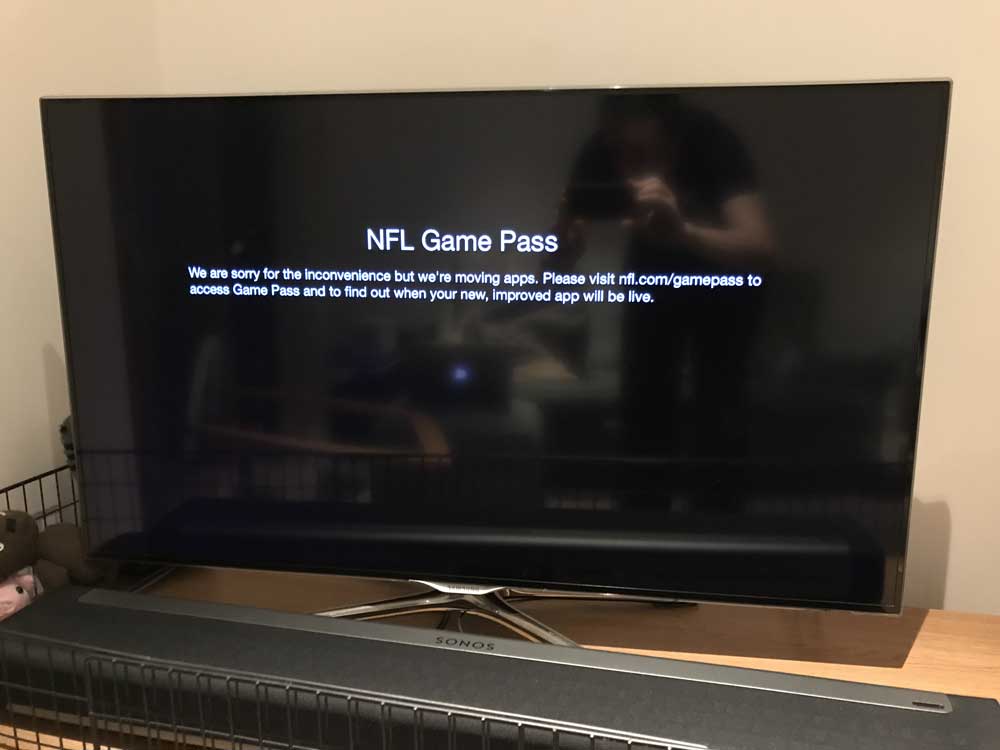
Let’s start with Apple TV. The app just doesn’t work anymore. At all. If you try and use it, it just says that they are migrating to a new app. But there is no App Store on the old Apple TV, so it doesn’t work, that’s just tough luck.
The iOS app does not seem to be fairing much better. Here is the endless spinning of the login screen:

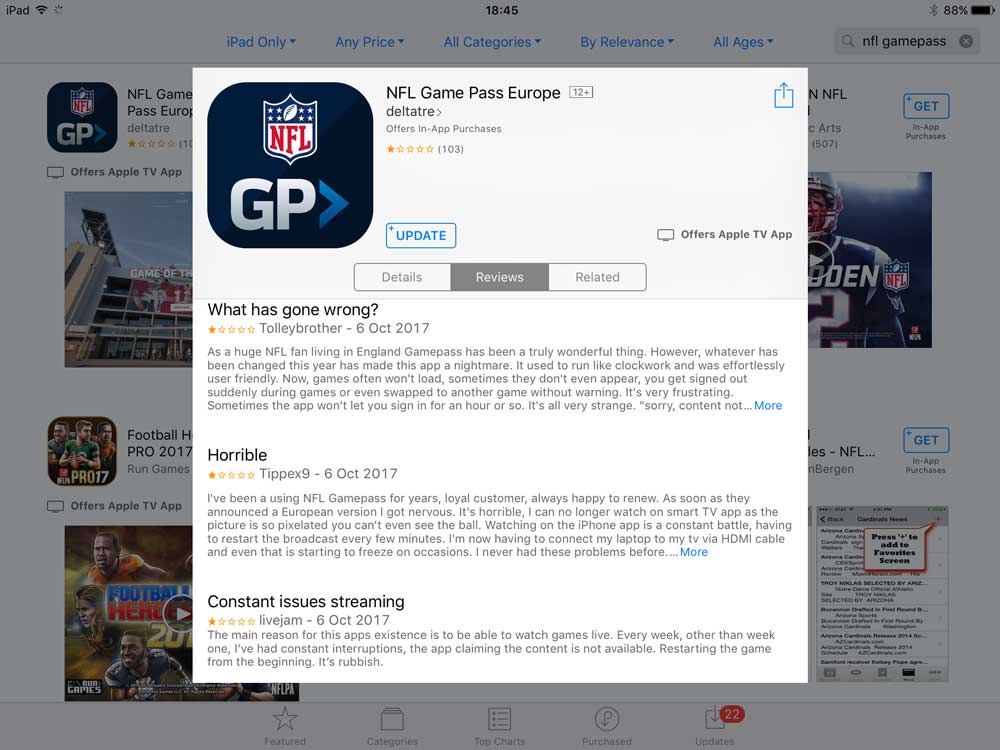
This is probably one of the many reasons why they have managed to score a total of 1 star on the App Store reviews system:
I used to use Firefox to watch the video streams on my desktop. But that is no longer an option because the sound doesn’t work any more. So, I’ve been forced to switch to Chrome instead.
In week four, as customers often experience, the video streams would often freeze up or drop to an unwatchably low quality. Yet, when you contact the NFL about this, they blame it on your connection.
In fact, we have become so used to this now that we are forced to run a speed test alongside the stream in preparation for the NFL blaming it on us. Here is mine:

With enough speed to watch 30 simultaneous Netflix shows, it seems unlikely that the problem is at my end. Or the many other ends from which people are complaining.
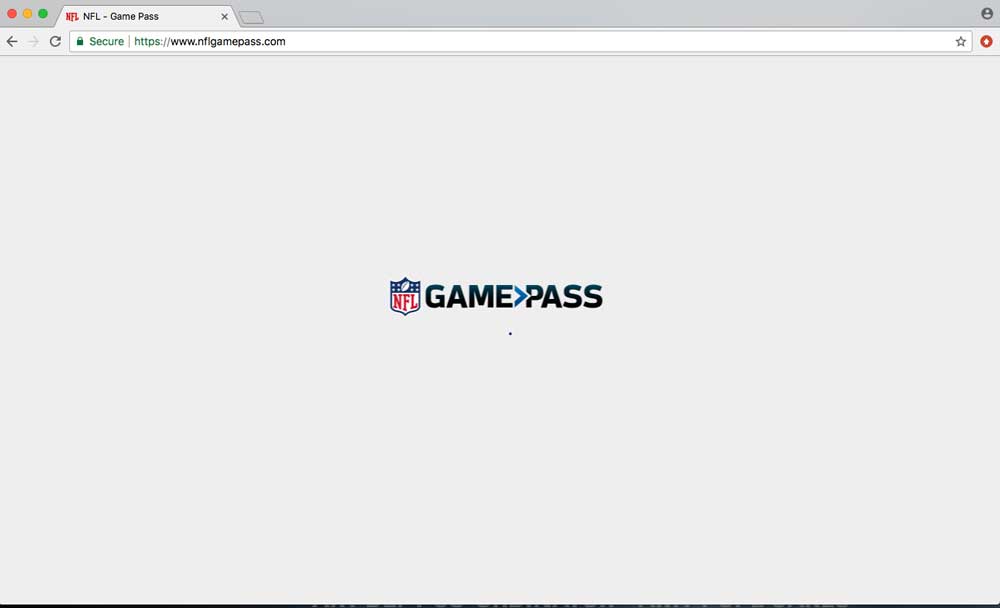
Week 5, things got worse. The website wouldn’t load and nor would any of the streams. You either got stuck on accessing the website itself:
Or, if you were lucky enough to get through, you got no video:

It eventually started working at 7:23 pm, almost an hour and a half after kick-off, and four scores into the game.
After week 4, I send out a full and detailed complaint setting out why I thought the NFL’s service was unacceptable and that they were failing to provide the service I was paying for.
I would post it here, in full, except I cannot because the NFL did not give me a copy of it, or ever respond to it. You have to use their online contact form to send your message, and they do not seem to respond to them or even acknowledge their existence.
I’m not the only person they are ignoring:
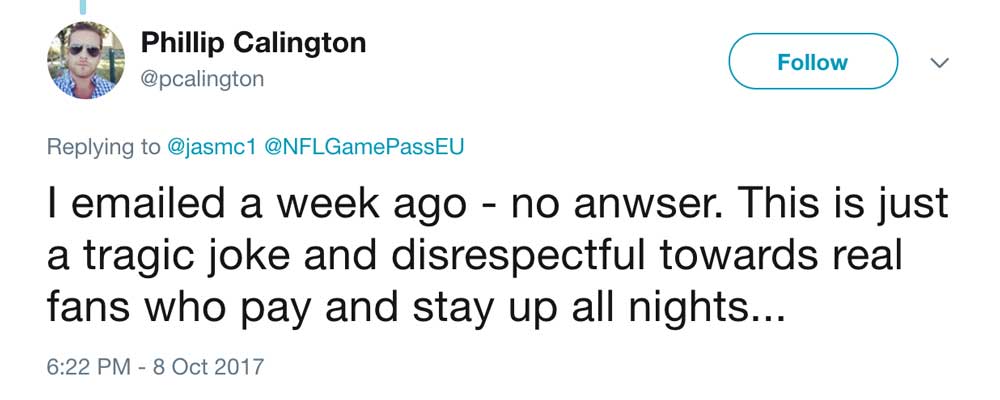
BBC journalist Mark Simpson has been on the case to the NFL. He questioned them about it, and they said: “we have a 99.3% reliability”. Which is terrible, of course. Data centres typically offer you a 5/9 reliably, which is 99.999%. 99.3% does not cut it, especially when the .7 is when the games are actually on.
Here is the interview:
NFL respond to complaints
* @NFLGamePassEU customer service "has to improve"
* compensation not ruled out
* Game Pass has 99.3% stability pic.twitter.com/a4Bc25DT1S— Mark Simpson (@BBCMarkSimpson) 5 October 2017
And it turns out that to try and cover up how poor the apps were, staff have been faking reviews to make it look better than it was:
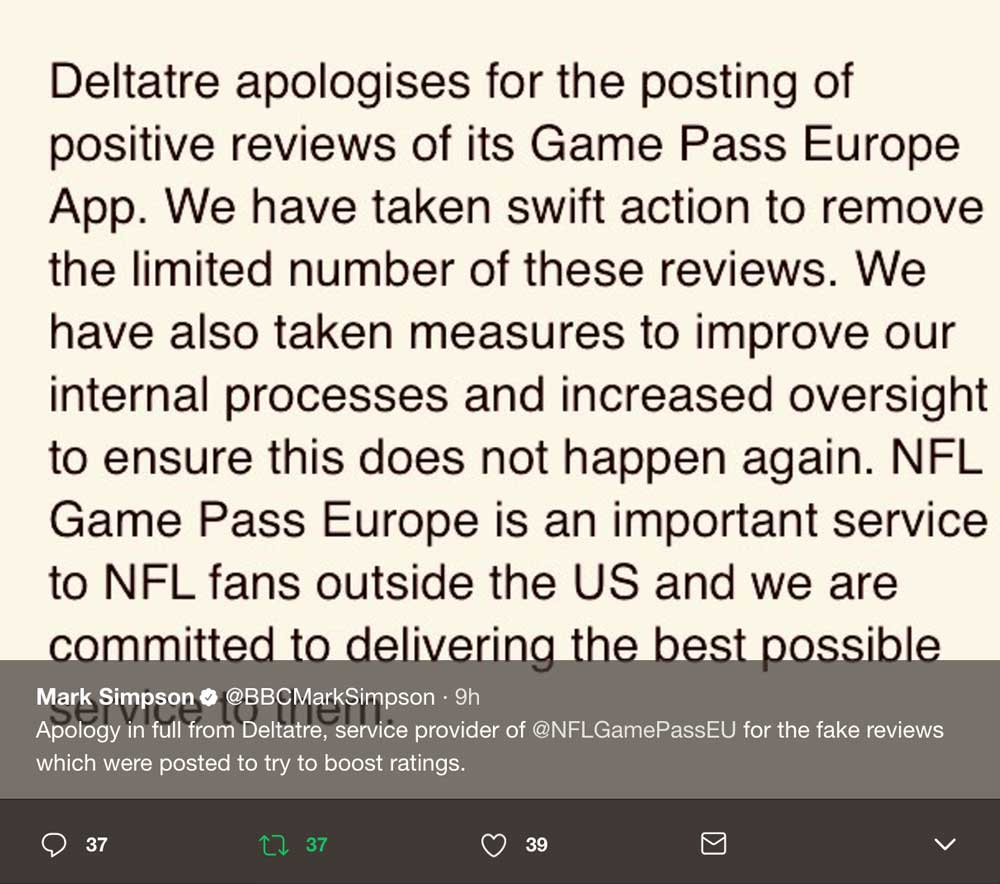
The Independent covered the story, as did NBC Sports.
A quick search of Twitter shows how many people are having problems. While the NFL put out insulting tweets saying:
We are aware of an issue that some users may be having. We’re working to get it fixed as quickly as possible.
Note that “some users” seems to be the whole of the UK and Europe. 20 tweets a second were appearing from angry users during Sunday’s 6pm kick-off.
Can't even op the @NFLGamePassEU tonight. Guess it's time to pay our money back for this horrendous service!? #nfl #nflgamepass
— Jakob Nørgaard (@JakobNoergaard) 8 October 2017
Early October means the Yorkshire Marathon Festival. It’s a “festival” because not only is there the Yorkshire Marathon but they also run a 10-mile race alongside it. It’s set on the streets of York which makes for a flat course.
The route starts out on the university campus. It runs into town, going around the minster and then leads out into the countryside. At five miles the marathon and 10-mile split before joining back together later on.
There is only one hill in the whole of York and it is at the start and finish straight. This is the worst design ever: at the start, you go down the hill, when you’re fresh and bottlenecked in so you can’t take advantage of it. On the way back you’re exhausted and have to up the thing.
It takes in a lot of lovely scenery. However, the sections through the centre of York are often cobbled, uneven and cramped, so you have to spend your whole time watching where you are going. Once you get out into the country you can relax a little more.
The event was well organised. They had several transport routes including a park and run option and a city shuttle bus. I decided to get an Airbnb in the centre and then get the shuttle bus over. I didn’t turn up until 9:30 am and still managed to get to the start by the time the race kicked off: 10:15 am.
Here is me on the bus:
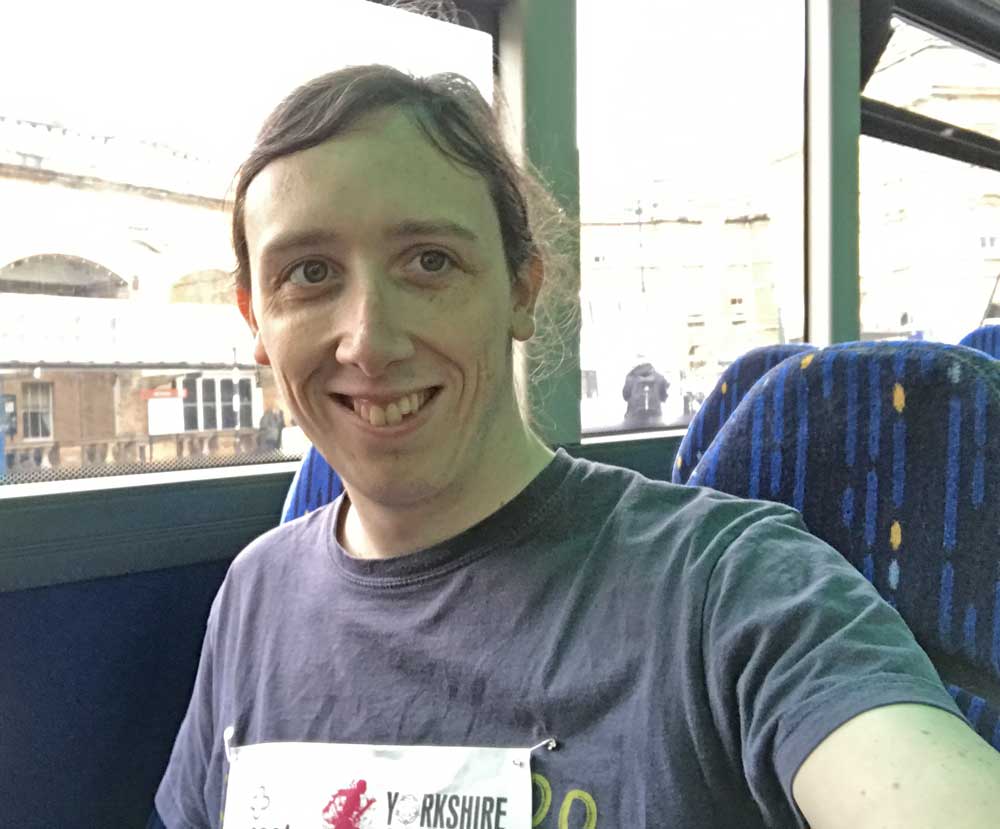
As soon as I finished there was a bus to take me back, too. There were some queues for another bus, which I think was the park and run. That did not open until noon, which is after some of the 10 milers finish, so that could explain it.
There were plenty of toilets and separate urinals. There were not many pacers, but those that were there had the big flags that Run For All always put on.
The only confusing thing was the event village. You get off the bus and then it is quite a walk to the start and finish line. Not only does this add a lot of walking but it is quite confusing to find. On the way there I followed everyone else. However, on the way back I had to find my own way and got confused several times.
I’m going to have to give them a D for goody pack quality. It had three chocolate-type bars in there. But two of them had peanut in: not much use for anyone with an allergy, or merely a strong dislike of peanuts. And the shoestring sweets where impossible to tear into.
York is a beautiful city as most of us know. However, accessible it is not. Anyone with a pram (like us), wheelchair or simply limited mobility is in for a rough time. It’s not just that the buildings are inaccessible and the streets are cobbled. It’s that the pavements are often small, broken and badly maintained. This makes it very difficult to get around if you are not a fit and healthy adult.
I haven’t been doing much long distance stuff since the Leeds Half Marathon 2017 and have been ill for the last couple of weeks so I set myself some fairly relaxed target of 1:36:00. My stretch target was 1:30:00 as this would indicate whether I would be able to go sub-2 hours in the next half marathon (of course, Leeds is a lot less flat).
In the end, I felt pretty good on the day and brought it home in 1:27:30, two and a half minutes ahead of my stretch target.
1:27:30
Here is me at the end:
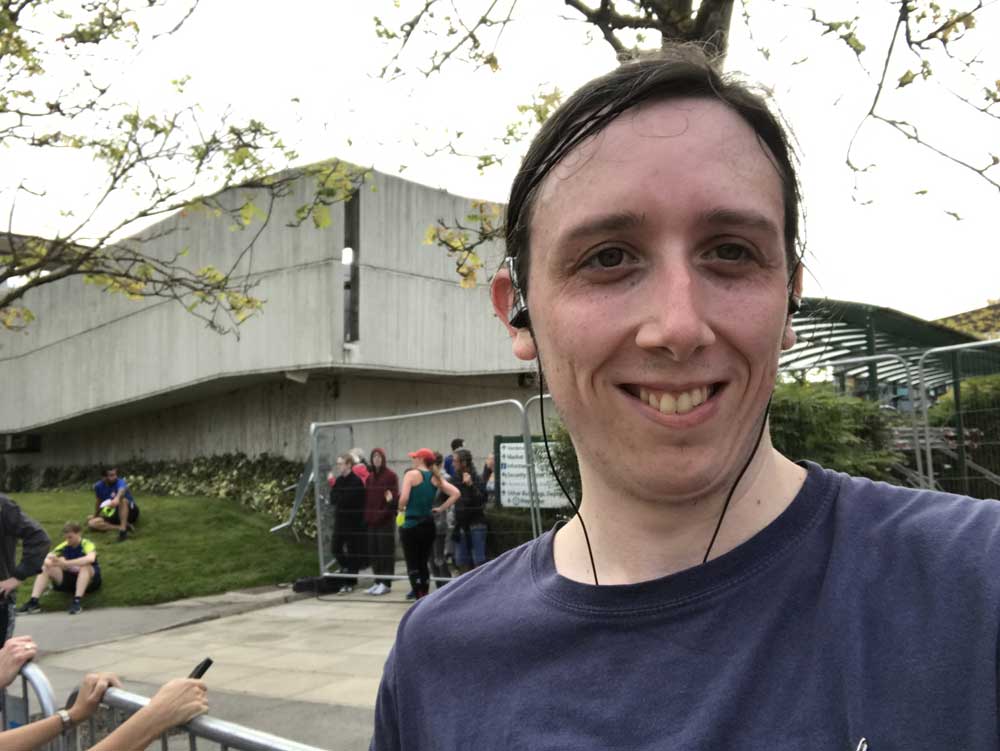
I waited around for the first marathon runner to finish. I thought they would finish before me: 90 minutes running plus 45 minutes head start means they only needed to run a 2:15:00 to beat me back. As it happens, the first runner didn’t make it back until 2:24 something. Far faster than I could ever run it, but a good 22 minutes behind the world record. He was also white, which suggests that serious marathon runners don’t come to York.
Speaking of unusually white people, here is Venla with my medal:

My new trainers have been causing a few blisters on my longer runs (anything above 10k) so I was quite pleased that I finally put enough vaseline on my toes to keep them healthy.
This was a fun event and good test for me to see how running a race away from home worked out (everything in Leeds starts next to my house). I am looking forward to going back to the festival next year.
It’s a good race to do if you want to avoid hills and see some nice scenary, as long as you’re willing to brave the transport challenges.
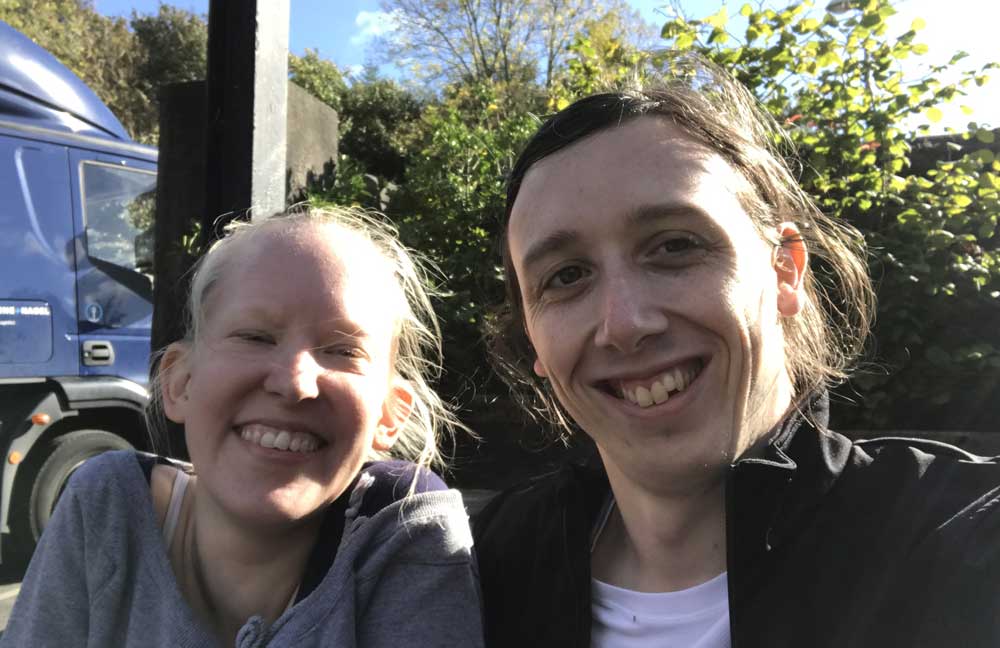
It’s been a horrible few weeks in the Worfolk household. We had food poisoning, then Venla got a cold, then we got her cold, then Venla got another cold, then we got that cold, then I had to have some dentistry work, the list goes on.
But, as we adapt to our new lifestyle: Venla in daycare, Elina back at work, me studying, we have finally seen some benefit.
For example, if we line up Elina’s holidays with my study days, we can do things without a baby. Like a romantic cycle ride. On two bicycles each made for one.
We made it as far as the Abbey Inn.
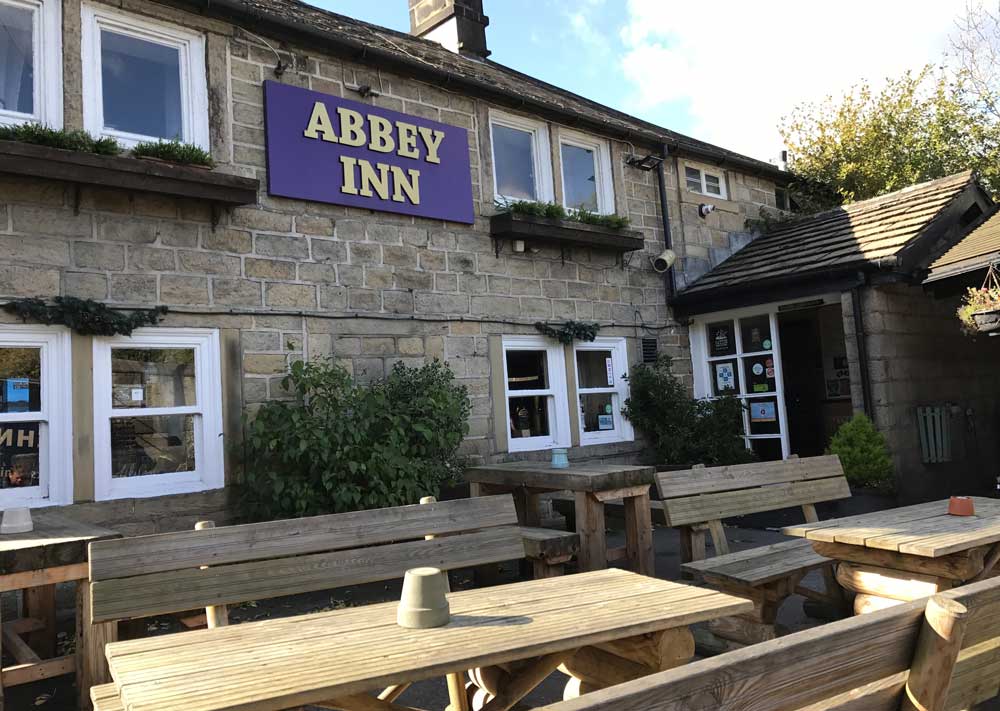
Our aim was to have a quiet lunch outside as we enjoyed some autumn sun. This what somewhat foiled by the delivery lorry turning up, and the family that turned up and decided to sit right next to us, but was much brightened by running it to our friend Robin.
The food was poor, but the pub was nice. Given that decided to skip dessert and get a piece of cake from The Stables on the way back, instead.