Chris Worfolk's Blog


Giant’s Causeway

August 22nd, 2025 | Travel

It’s a bunch of rocks.

They are cool rocks. I always imagined it being a whole coastline of suff, but it is one rocky ourcrop. Much smaller than Filey Brigg, but then everything is better in Yorkshire. Still, it was cool to see, and the scenary around it was lovely.

The site is managed by the National Trust who heavily monitise it. They have to provide public access for free. But what they have done is built a visitor’s centre and car park that they do charge for. So if you want park near the site, or want to have a wee, it’s £15 per adult. And if you want to use the shuttle bus ro get up an down the hill, that costs extra money.

Portrush parkrun

August 21st, 2025 | Sport, Travel

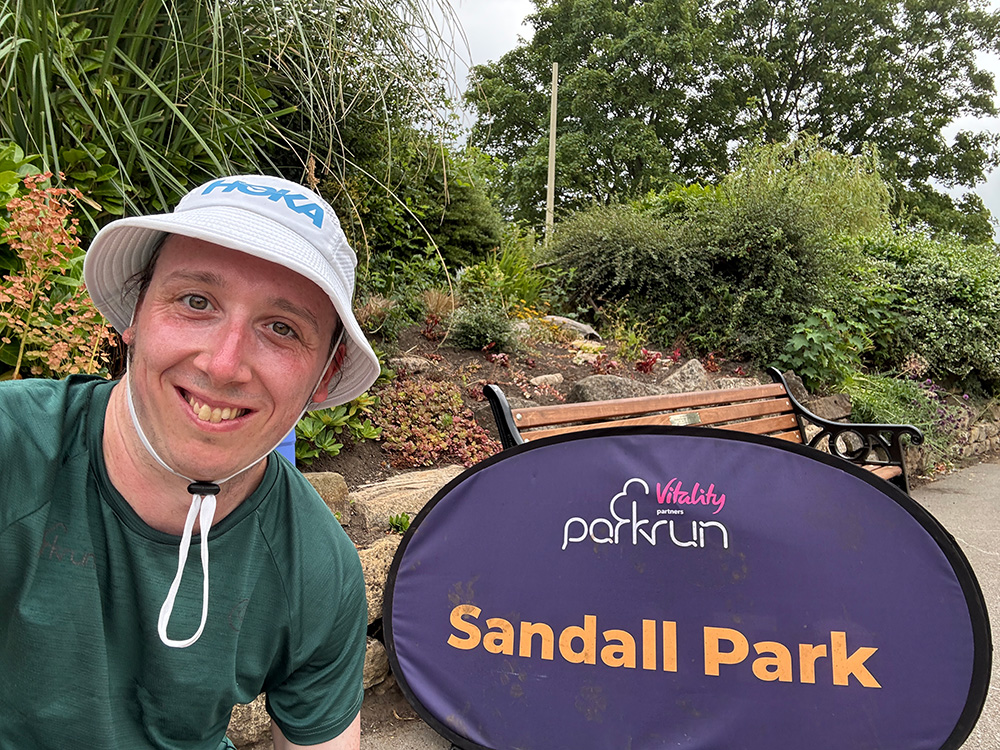
Our first base camp for our road trip was the seaside town of Portrush. Long beaches, fish and chip shops, arcades, the whole classic British seaside town feel. It also had a parkrun. With Portrush being a summer hotspot, over 500 runners turned up for an out-and-back along the beach. The sand was firm enough under foot but there were some wet bits to run through. A lot of runners did it in bare feet.

After parkrun, Venla and I built the first of many sandcastles.

North Coast Road Trip

August 20th, 2025 | Travel

Earlier this month we a wee trip around the north coast of Ireland. Starting in Larne we followed the Causeway Coast all of the way to Derry where we picked up the Wild Atlantic Way and followed that, on and off, as far as Sligo.

I will be filling in some blog posts here, but if you want to follow the whole story, visit our North Coast Road Trip photo essay.

The Assertiveness Workbook

August 1st, 2025 | Books

The Assertiveness Workbook: How to Express Your Ideas and Stand Up for Yourself at Work and in Relationships is a book by Randy Paterson.

It’s written as a self-help book but makes for an accessible read for clinicians, too. The book begins by describing different types of communication and how they differ from assertiveness communication. It then breaks down specific topics such as giving compliments, giving and receiving feedback, saying no and handling confrontations.

Dublin Mountain Trail Festival

July 31st, 2025 | Sport

What better way you could spend a Saturday than running through the Dublin Mountains?

The Trail Festival is run by the same people that run the Dublin Mountain Backyard Ultra and takes you through 30k of hilly terrain with the option of doing one, two, or three loops.

The run starts at Kilmashogue Forest and goes straight up. There were about 30 of us taking on the 30 km single loop and I soon found myself at the back of the pack. The uphill was a lovely wide gravel track but also uphill. The downhill was single track and I’m not much of a trail runner so I didn’t pick up a lot of speed there. Luckily, there was a two-kilometre road section into Glencullen that allowed me to catch the back of the pack.

Trail is a word with a wide definition. Once we were through Glencullen, we ended up climbing a steep bank (I would have completely missed the turning if I hadn’t seen others) and then onto what the locals called the “bog road” where the path disappeared and we were running through small bushes. Then there was a small gully with a river at the bottom and ropes to help us climb down. The ropes did not save me and I fell over twice here.

We almost made it back onto the Wicklow Way track before turning again towards a trig point at the top of the hill. This offered spectacular views of the whole of Dublin Bay and Wicklow in one scene.

Here we got into the real bog. I stopped on what I thought was a solid bit of mud and found myself above submerged up above my knee and had to climb my way out. At around 15k, Dublin disappeared behind the hills and I felt panicked about being in the middle of nowhere even though I knew it was just over the horizon. That was an unpleasant half an hour.

At around 23k we came down into ZipIt where there was a water drop. I had brought enough food and drink for five hours but was drinking more than expected so glad to be able to refill my bottles. Then it was straight up the hill again and towards the finish. I was tired by this point and started stumbling over rocks a lot but luckily did not fall.

The final two kilometres were downhill again and my quads were on fire as I descended. I managed to find the correct turning point, which I was quite proud of, as almost everyon else that finished came in the wrong way. Very glad to be done. I’m not sure I had fun but I’m glad I did it :D.

Euro 2025

July 30th, 2025 | Sport

It’s coming home… again!

Great resilience from England coming back from deficits in all three games in the knock-out stage. I thought Spain did themselves proud of the final. But the solid passing and ball control never converted into more than one goal, so the result felt fair enough.

The Power Threat Meaning Framework

July 26th, 2025 | Books

Our current system of understanding mental health is typically based around psychiatric diagnosis. You go to your doctor and your doctor gives you a label like “social anxiety disorder” or “borderline personality disorder”. These labels are, on the whole, stigmatising and unhelpful.

Worse, they are not grounded in evidence-based medicine. After a hundred years of lookng, we cannot find the biomarkers for mental illness. Depressed people do not have lower serotonin, for example. Nor are there genetic markers. As far as we can tell (and research has been well-funded and plentiful), mental health issues are not an “illness” in the traditional medical sense.

So then we say “okay but they are functional”. Something happens to someone which activates underlying vulnerabilities and they develop social anxiety. But this does not hold up, either. There are no clear pathways of things that trigger specific labels (the everything causes everything problem) and the majority of service users meet the criteria for multiple labels (the everyone suffers from everything problem).

As a result, we don’t know what causes any of these labels (no biomarkers or pathways), what they look like (people’s symptoms transcend multiple labels) or what to do about it: most first line treatments like anti-depressants or single-diagnostic CBT seems to make things worse.

Much of psychology already recognises this problem and has suggested dropping the word “disorder” and changing the question from “what is wrong with you?” to “what has happened to you?” Trauma-informed approaches are opening up a much greater scope for what counts as trauma.

The Power Threat Meaning Framework goes beyond that. It asks how power been used in someone’s life (think oppression), what threat that created, what meaning the person made of it and what threat responses were activated. It suggests that all troubling experiences and behaviour, from mild anxiety and depression, to hearing voices, self-harm and eating disorders, can be understood from this perspective.

It also suggests that all behaviour is on a continuum, from “normal” to “clinical”. This is important because while some critics might agree mild anxiety is part of normal human experience, they often bawk at the idea that hearing voices or dissociation is typical. Even though most people regularly “zone out” (dissociate) on a regular basis.

The PTM Framework offers what it calls a general foundational pattern and seven provisional general patterns. These allow us to explore useful patterns without detracting from an individual’s personal narrative.

  • Identities
  • Surviving rejection, entrapment, and invalidation
  • Surviving disrupted attachments and adversities in care
  • Surviving separation and identity confusion
  • Surviving defeat, entrapment, disconnection and loss
  • Surviving social exclusion, shame, and coercive power
  • Surviving single threats

The PTM Framework is a contribution to the movement away from psychiatric diagnosis which still has much work to do, and the document acknowledges this.

But we are already seeing improvements. Many services, such as educational support and some NHS mental health services, look at individual need rather than labels and many have switched away from using disorder-specific measures to general outcome measures.

I don’t claim to have done justice to this document in any way in this blog post. You should go read it; it’s fantastic, if quite a technical read.

Dundalk parkrun

July 25th, 2025 | Sport

Dundalk parkrun takes place on the Dundalk Institute of Technology campus and consists of three laps around the playing field. While it is not the most exciting of parkruns, it was well marshalled and I had fun.

Ozzy Osbourne, 1948-2025

July 24th, 2025 | News

The Prince of Darkness has left us. Like everyone learning guitar, Paranoid is a key part of my repertoire. And Iron Man is one of the songs I regularly serenade Elina with. I like to think Ozzy had all of this in mind when creating the heavy metal genre.

MAXQDA

July 23rd, 2025 | Tech

My current research paper is qualitative and I’m using descriptive-interpreative analysis to analyise the interviews. I decided to try using some of the data analysis software available out there and settled on MAXQDA.

Overall, the experience has been good. You can code your text and play any audio or video recording you have along with it to make corrects. You can also group and colour code your tags for organisation. It also has tools such as word frequency that allow you to do further analysis.