Chris Worfolk's Blog


Are exams getting easier?

August 19th, 2011 | Religion & Politics, Thoughts

It’s everyone’s favourite time of year again – the debate as to whether exams are getting easier.

Yet again of course, exam results have gone up and everyone is asking “have exams gotten easier?” The answer, of course, is yes. Clearly if such a large sample size as the whole of the United Kingdom, probably going on a million children, have consistently achieved higher grades than last year, the exams are getting easier.

The educational community will quickly argue that it is in fact teaching methods getting better, but this to me, seems irrelevant. Even if it is teaching methods getting better, which I’m not disputing – I’m sure they are, if the exams stay the same and don’t get more challenging in proportion to teaching methods getting better, then from the perspective of the child, the exam has got easier – with the same amount of effort and intelligent on their part, they are able to achieve a higher grade.

You can then argue that, given they have done better in the exam, they deserve that higher grade, but I disagree. Firstly, just because teaching methods have improved to allow them to do better, doesn’t mean that they have actually learnt more – maybe teaching methods have just improved in terms of teaching kids to pass exams and not actually learn more, which seems a very plausible scenario.

Secondly, even if they are more knowledgeable about a specific subject, doesn’t mean they necessarily deserve a higher grade. That sounds counter-intuitive at first, but in reality the main purpose of exams is to test how intelligent someone is and just because schools have found a way to better put knowledge into their head in order to pass an exam doesn’t really help that purpose. On that basis, the only reason that exam results should go up is if children are genuinely getting more intelligent – this could be the case but I haven’t seen any evidence to show it’s happening, at least at the same rate as exam results are improving.

Therefore, I would argue that the constant year on year improvement in exam performance, is a problem.

The solution, I would put forward is percentile banding of exam results. Rather than setting specific levels which a candidate has to reach, you put all the results together and give a certain percentile each grade – for example the top ten percent get A*, the next ten percent get an A, the next ten percent get a B and so on.

I’m not arguing this is a perfect system, and you probably need to have something in place where there isn’t a “fail” percentile, if possible, but below I will outline why I think it would arguably be a fairer system than the current one.

Primarily, it ends the debate on whether exams are getting easier. Every year exam results would stay the same, because the same percentage of people will get each grade, and it doesn’t matter if exams get easier or harder because the system sorts itself out. It is impossible to make exams the exact same difficulty every year because you have to change them and under the current system, children are unfairly punished if they happen to get a slightly harder exam and unfairly rewarded if they happen to get a slightly easier exam. This eliminates that.

Secondly, it stops the grade creep which leads to everyone getting grades closer and closer to the top and therefore makes it harder for universities and employers to distinguish between the top candidates.

There are criticisms of such a system, and I will deal with these now.

Firstly, it means that a child could lose a grade just because they end up in a year where everyone does well. This doesn’t really stand up because, because of the sample size involved, if everyone else does well it is more likely to be because the exam is slightly easier this year and therefore they haven’t lost a grade, they simply weren’t good enough to achieve it.

Indeed, sample size is important. When dealing with an entire year group, which as I previously stated I would imagine is heading towards a million children, the probability that an entire generation happened to suddenly be more intelligent than the year before, is far less likely than this year’s exams simply being a little easier.

You could also argue that everyone deserves the change to get an A* if they achieve the required level. There are two parts to this answer, first of all, they have target just like the current system – except, instead of a specific number of marks, their target is to reach the top ten percentile, but either way they have a set, fixed target to reach. Secondly, you could argue that if everyone in the country all worked really, really hard, they should all deserve to get A*.

This is true, but this has never, ever happened. Indeed, what is the probability that this would ever happen? The answer of course is negligable, when you are dealing with such a big sample size, it evens out and you don’t get disadvantaged by statistical anomlies as you do under the current system.

So…

You could replace the current system with a banded percentile system and ensure that the grades accurately reflect a candidates performance, irrelevant of how accurate the difficulty level of the exam was and without worry that they were disadvantaged due to circumstance because of the sample sizes involved. This will then allow employers and universities to accurately select the best candidates, which is the whole point of standardised testing after all. It’s not a perfect system, but it’s arguably fairer than the current one.

Unfortunately, there would be very little incentive to change because the current system plays into the favour of schools and governments, because it makes them look like they have done better every year. This is probably true, but at the disadvantage that it makes the achievement far less meaningful.


Leeds Pride 2011

August 18th, 2011 | Events, Photos

The first Sunday of August saw Leeds Pride 2011. Everyone likes to see a parade, particularly when it comes right past your house, so as with last year I took plenty of photos. I was a little disappointed by the floats this year, but it was an enjoyable day nonetheless.

You can see more photos from the event on Atheist Stock.

Live poker

August 17th, 2011 | Distractions

Yesterday, I blogged about Poker Stats Library, a couple of scripts I wrote which I’ve now published on Github. On Saturday, it was time to try them out.

I headed down to Grosvenor to take part in their freeroll tournament. I say freeroll, it was a £10 rebuy tournament, which gets you twice the number of chips, so almost everyone buys in again. As I sat down at the table I found myself sitting opposite a guy named Christopher Norfolk – while I’m aware of the laws of probability, it’s still an amusing coincidence.

I ended up placing 11th, out of the 79 that entered. I was doing quite well but having started at 2pm, I had arranged to meet Elina at 6pm and by this time it was 7pm, so I went all in on an ace high for boom or bust and lost. Still, an enjoyable evening none the less.

Poker Stats Library

August 16th, 2011 | Tech

A few weeks ago, I wrote some tools which would help me out in getting to grips with poker, which in general I fail at.

It annoyed me because it should be fairly simple for someone like myself to get my head around the poker maths (well, it is, pot odds are easy), so even despite the lack of social understanding the life of a computer scientist brings, I should at least be able to achieve a level of averageness in the game. I clearly have failed to do this, and so I decided a bit of work on my basic strategy was needed.

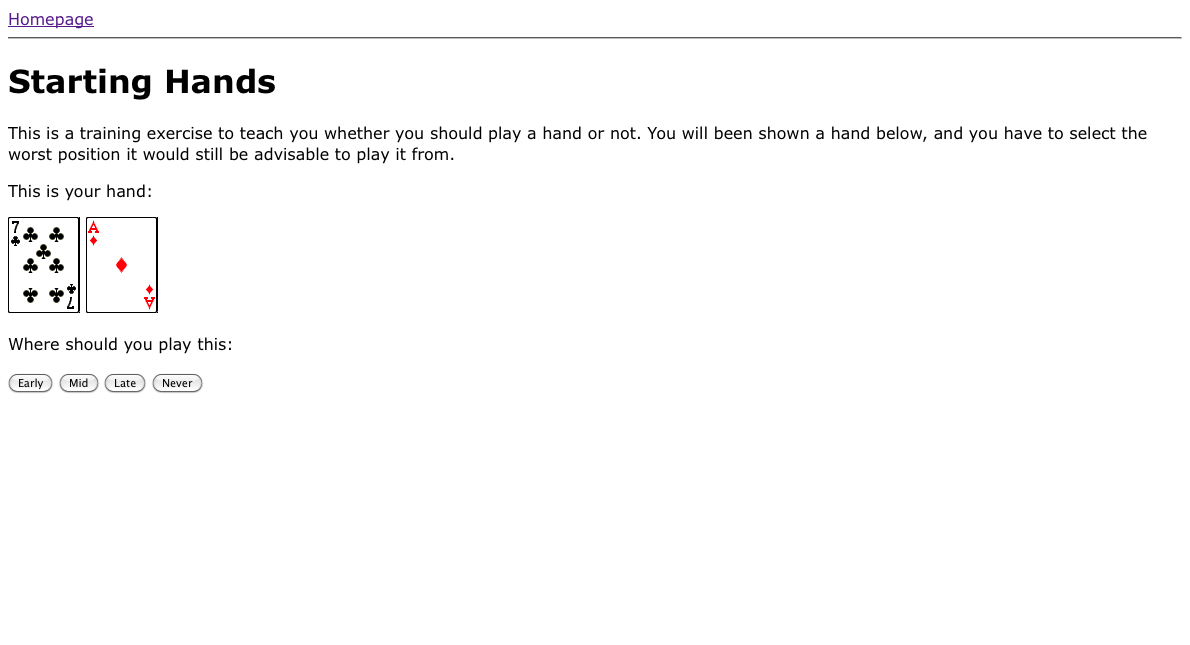
As a result, I built an interactive tool which would teach me what starting hands I should play, similar to the concept of Basic Strategy in blackjack. It presents you with two cards and you have to say what position you can play them from, if any. It will then tell you if you are correct or not, if not it will ask you to try again and if so, it will move on to the next hand.

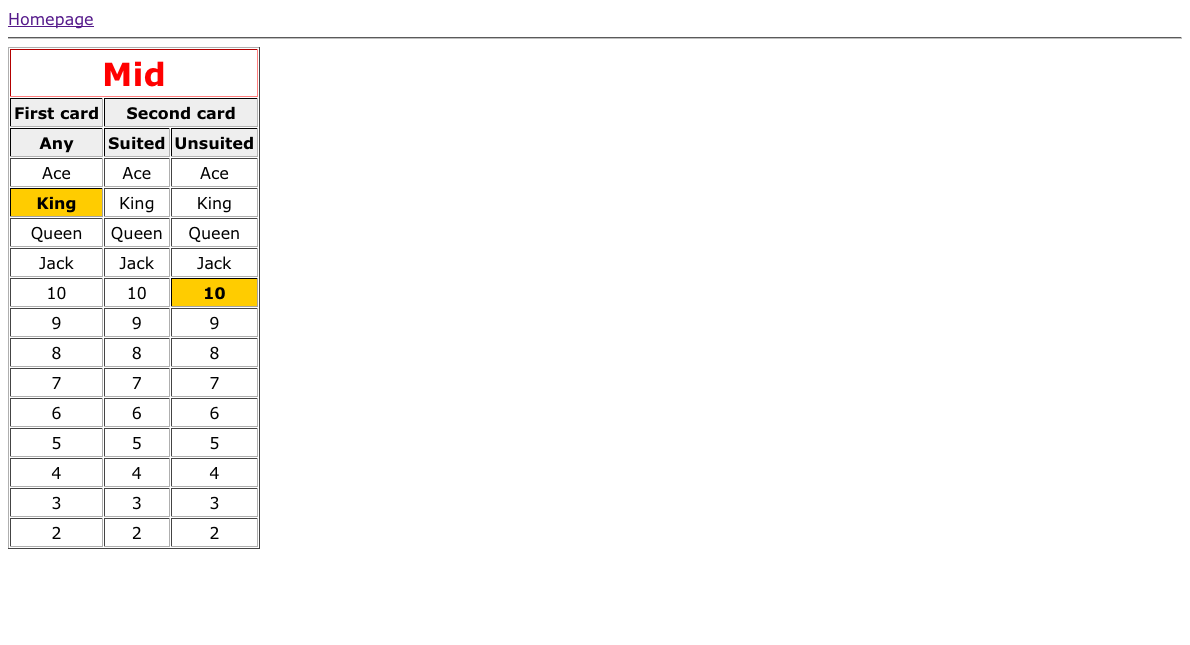
I also wrote a tool which allows you to select the cards you have, and using the same formulas it will tell you what position that hand is worth playing from. I’ve thrown in a few other simple odds calculations in there as well.

Of course, these won’t make you a great poker play by themselves, but it should provide a good basis to learn from.

Given the tools would otherwise just disappear into the depths of my hard drive somewhere, I’ve decided to publish the code on Github. Should you have any interest, you can download the source from the Github repository. It’s all written in PHP and should run out of the box.

Btw, the images below are screenshots, but the way they have been scaled down looks rubbish. They make more sense when you open them…

Human Planet

August 15th, 2011 | Distractions, Reviews

Recently, Jason recommended I check out a series called Human Planet, which first aired earlier this year. The series looked at how humans have adapted to live in every environment on Earth, and it was incredibly interesting – so you’ll imagine how shocked I was when I found out it hard first aired on BBC One ;).

Some of the stuff just seems impossible – one guy can free dive without coming up for air for over five minutes. As the show suggested, I tried to hold my breath along with him, but even before he had got half way down I was gasping for air, let alone the time it takes for him to walk around down there and spear the fish.

Other highlights included hunters in Africa who would just walk up to lions and take their meat, then get out of there before the lions realised what was going on, and tribes in Brazil who build their houses at the very tops of trees in the rain forest. Long range photos of uncontacted tribes in the rainforest were also pretty breathtaking.

You could also tell when they were showing you mother nature at it’s biggest and best, as occasionally they would be describing an event, and then zoom out into orbit – and you could still see it!

Great series, well worth checking out. You can find out more information on the BBC website.

GA Conference 2011

August 14th, 2011 | Events

Laster this month will see the inaugural Genital Autonomy conference taking place in at Keele University. It’s a two-day event looking at “Law, human rights, and non-therapeutic interventions on children.”

My friend Antony Lempert from the Secular Medical Forum will be speaking on the subject of “Conscience and Foreskins: A Medical Paradox”, which is well worth attending as anyone who made it to his talk at Enquiry 2010 will know.

Crab!

August 14th, 2011 | Life

Last week I decided to buy a crab. There was a disappointing amount of meat inside, but it was fun to prepare.

Announcing Sunrise Conference 2011

August 13th, 2011 | Foundation, News

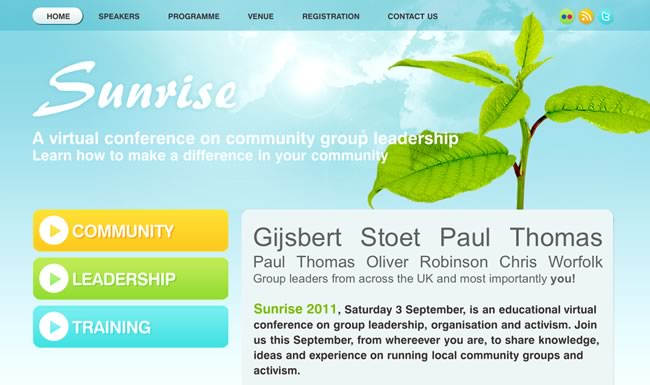
Sunrise Conference 2011

We’re pleased to announce the launch of Sunrise Conference 2011, our second annual conference on community leadership and activism. Join us on Saturday 3rd September for a day of learning and sharing ideas and experience in running local community groups.

Sunrise ran for the first time in 2010, featuring talks, workshops, seminars and discussions from community groups leaders from across the UK.

This year’s event will be run as a virtual conference, streamed live across the internet so you can attend from wherever you are based. Best of all, registration to this year’s event is free, so it is accessible to everyone.

Registration is now open, so sign up today to reserve your spot.

Romantic nights in

August 13th, 2011 | Life

Recently, I’ve been trying to finish off some candles so I can get rid of them. This has resulted in a rather alarming number of romantic nights in with Norm and George. Still, at least it brings back memories of Munich…

Introducing Worfolk Lectures

August 12th, 2011 | Foundation, News

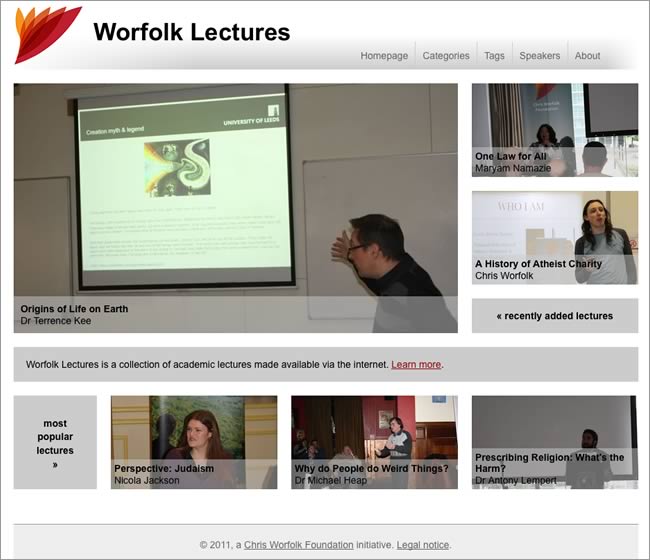
Today, we’re proud to launch our latest project, Worfolk Lectures! The site is an online archive of academic lectures on a variety of ever expanding topics, all available to download or stream in full high definition.

Over the past twelve months we have been rapidly recording and editing together lectures from a variety of talks, conferences and events and after a long and hard slog, we’re finally able to bring this content to the world.

As well as issues with transferring and editing the content together, the final piece fell together in June when Dailymotion offered us a partnership agreement to allow us to host the content, in full HD.

There are already ten lectures available on the site and we will be releasing a new video every Friday in something we’re hoping to coin the Friday lecture. No prizes for guessing how we managed to come up with that name!

Speakers will include Professor A. C. Grayling, Processor Chris French, Dr Gijsbert Stoet, Dr Antony Lempert, Dr Terrence Kee and many others. You can follow us on Twitter to keep up with all the latest updates.