Yesterday, I blogged about Poker Stats Library, a couple of scripts I wrote which I’ve now published on Github. On Saturday, it was time to try them out.
I headed down to Grosvenor to take part in their freeroll tournament. I say freeroll, it was a £10 rebuy tournament, which gets you twice the number of chips, so almost everyone buys in again. As I sat down at the table I found myself sitting opposite a guy named Christopher Norfolk – while I’m aware of the laws of probability, it’s still an amusing coincidence.
I ended up placing 11th, out of the 79 that entered. I was doing quite well but having started at 2pm, I had arranged to meet Elina at 6pm and by this time it was 7pm, so I went all in on an ace high for boom or bust and lost. Still, an enjoyable evening none the less.
A few weeks ago, I wrote some tools which would help me out in getting to grips with poker, which in general I fail at.
It annoyed me because it should be fairly simple for someone like myself to get my head around the poker maths (well, it is, pot odds are easy), so even despite the lack of social understanding the life of a computer scientist brings, I should at least be able to achieve a level of averageness in the game. I clearly have failed to do this, and so I decided a bit of work on my basic strategy was needed.
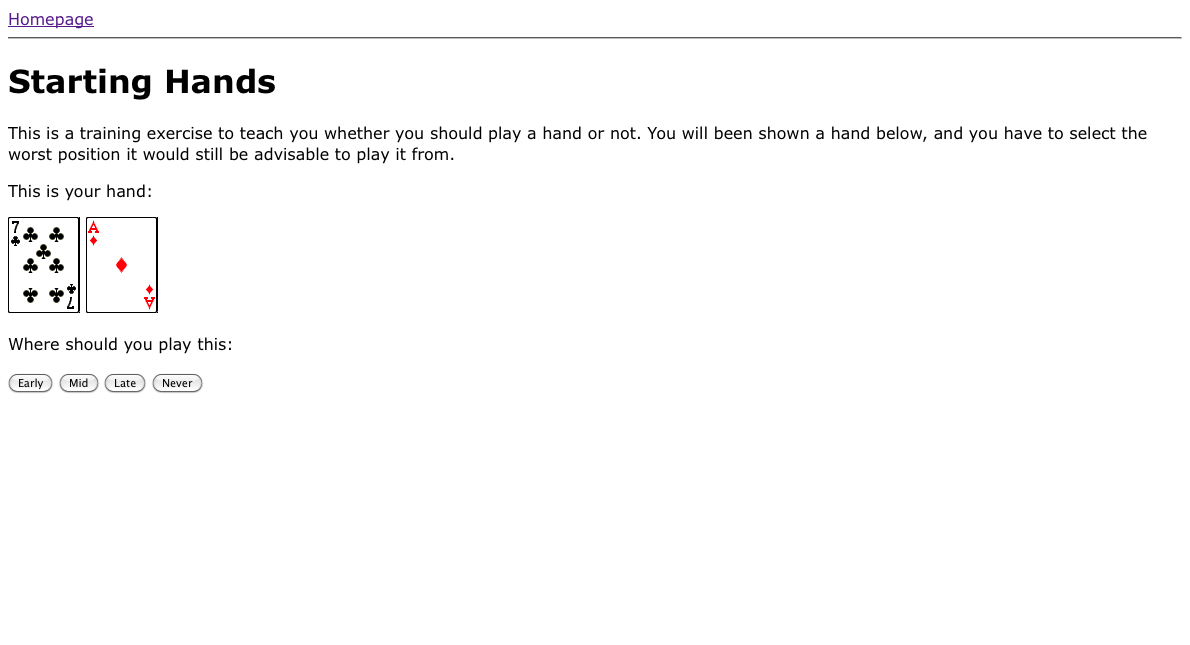
As a result, I built an interactive tool which would teach me what starting hands I should play, similar to the concept of Basic Strategy in blackjack. It presents you with two cards and you have to say what position you can play them from, if any. It will then tell you if you are correct or not, if not it will ask you to try again and if so, it will move on to the next hand.
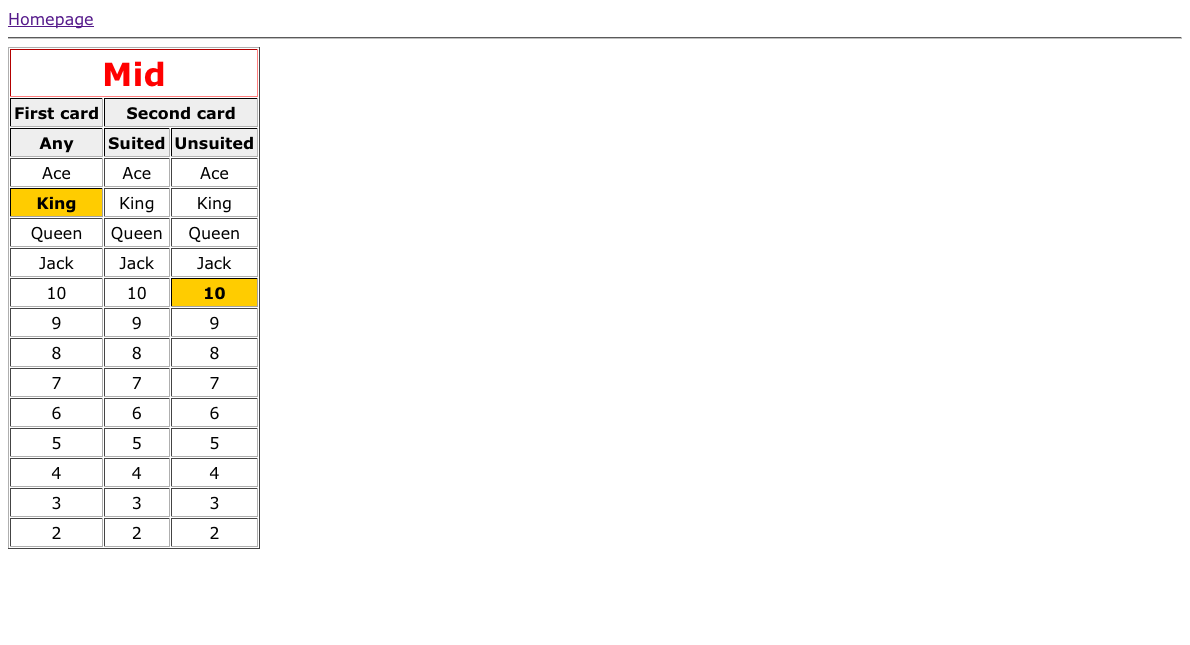
I also wrote a tool which allows you to select the cards you have, and using the same formulas it will tell you what position that hand is worth playing from. I’ve thrown in a few other simple odds calculations in there as well.
Of course, these won’t make you a great poker play by themselves, but it should provide a good basis to learn from.
Given the tools would otherwise just disappear into the depths of my hard drive somewhere, I’ve decided to publish the code on Github. Should you have any interest, you can download the source from the Github repository. It’s all written in PHP and should run out of the box.
Btw, the images below are screenshots, but the way they have been scaled down looks rubbish. They make more sense when you open them…

Recently, Jason recommended I check out a series called Human Planet, which first aired earlier this year. The series looked at how humans have adapted to live in every environment on Earth, and it was incredibly interesting – so you’ll imagine how shocked I was when I found out it hard first aired on BBC One ;).
Some of the stuff just seems impossible – one guy can free dive without coming up for air for over five minutes. As the show suggested, I tried to hold my breath along with him, but even before he had got half way down I was gasping for air, let alone the time it takes for him to walk around down there and spear the fish.
Other highlights included hunters in Africa who would just walk up to lions and take their meat, then get out of there before the lions realised what was going on, and tribes in Brazil who build their houses at the very tops of trees in the rain forest. Long range photos of uncontacted tribes in the rainforest were also pretty breathtaking.
You could also tell when they were showing you mother nature at it’s biggest and best, as occasionally they would be describing an event, and then zoom out into orbit – and you could still see it!
Great series, well worth checking out. You can find out more information on the BBC website.
Laster this month will see the inaugural Genital Autonomy conference taking place in at Keele University. It’s a two-day event looking at “Law, human rights, and non-therapeutic interventions on children.”
My friend Antony Lempert from the Secular Medical Forum will be speaking on the subject of “Conscience and Foreskins: A Medical Paradox”, which is well worth attending as anyone who made it to his talk at Enquiry 2010 will know.
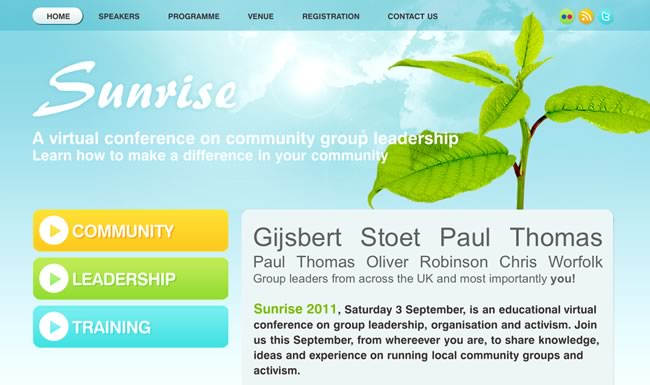
We’re pleased to announce the launch of Sunrise Conference 2011, our second annual conference on community leadership and activism. Join us on Saturday 3rd September for a day of learning and sharing ideas and experience in running local community groups.
Sunrise ran for the first time in 2010, featuring talks, workshops, seminars and discussions from community groups leaders from across the UK.
This year’s event will be run as a virtual conference, streamed live across the internet so you can attend from wherever you are based. Best of all, registration to this year’s event is free, so it is accessible to everyone.
Registration is now open, so sign up today to reserve your spot.
Recently, I’ve been trying to finish off some candles so I can get rid of them. This has resulted in a rather alarming number of romantic nights in with Norm and George. Still, at least it brings back memories of Munich…

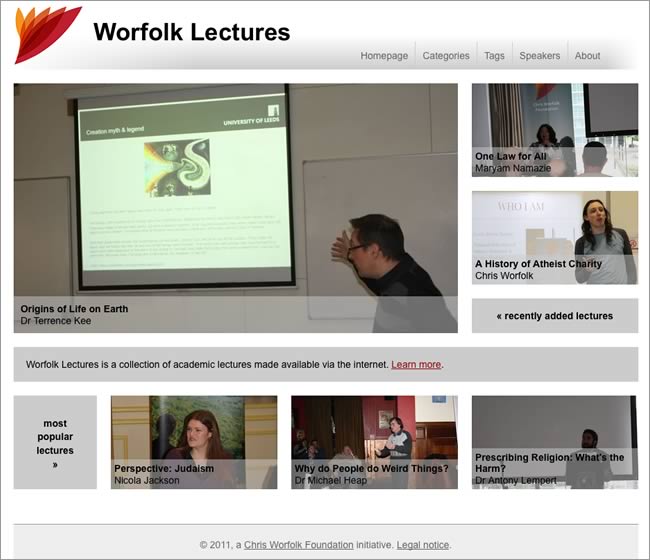
Today, we’re proud to launch our latest project, Worfolk Lectures! The site is an online archive of academic lectures on a variety of ever expanding topics, all available to download or stream in full high definition.
Over the past twelve months we have been rapidly recording and editing together lectures from a variety of talks, conferences and events and after a long and hard slog, we’re finally able to bring this content to the world.
As well as issues with transferring and editing the content together, the final piece fell together in June when Dailymotion offered us a partnership agreement to allow us to host the content, in full HD.
There are already ten lectures available on the site and we will be releasing a new video every Friday in something we’re hoping to coin the Friday lecture. No prizes for guessing how we managed to come up with that name!
Speakers will include Professor A. C. Grayling, Processor Chris French, Dr Gijsbert Stoet, Dr Antony Lempert, Dr Terrence Kee and many others. You can follow us on Twitter to keep up with all the latest updates.