Chris Worfolk's Blog


Venerating the military

November 23rd, 2011 | Religion & Politics, Thoughts

The Humanist Society of West Yorkshire recently had a discussion about whether we should participate in an official remembrance service, as many faith groups do and the BHA had encouraged local groups to join in by laying a wreath. In the end, the group decided not to, because there was a split feeling about whether it was a cause we should endorse.

After all, killing is wrong. The military is not a positive institution; it’s an institution of death. In a perfect world, it wouldn’t exist.

Of course, we don’t live in a perfect world and the military does exist in practically every country in the world. Even Switzerland has a small armed forces. War is even arguably necessary – though in some cases, significantly less so than others.

Yet we, as a society, have a great reverence for the military. The United States, significantly more so. Being a solider is something noble, something to be looked up to, people sacrificing themselves for their country. This is an attitude reinforced by many different groups within our society and is deeply ingrained in our traditions.

But, I would propose that this isn’t congruent with many peoples attitudes. Many people, humanists and religious people alike, strongly detest the idea of war. A million people marched through the streets of London to protest against the Iraq war.

And anyway, is it really that noble to sacrifice yourself in such a way? The military is quite well paid, not to mention you get accommodation, free meals, a company car (so the advert picturing a young soldier driving a tank would have me believe) and get to travel round the world going to a variety of interesting, if a little dangerous, places.

Not to mention the fact that many people sacrifice themselves in a similar way. Yes, soliders can be seen as putting their lives on the line to keep us safe (though when was the last time sovereign British territory was under threat – The Falklands?), but similarly fishing is a very dangerous industry, it has one of the highest mortality rates of any industry and yet we don’t have remembrance days for those who lost their lives filling Tesco with cod fillets. This special privilege is afforded to the military alone.

However, I think I have an idea why. Much like Doctor Who’s The Beast Below, it’s hiding a terrible secret that none of us really want to acknowledge – giving special reverence to the military is the only way we can trick poor people into going to fight the wars we want to fight, so that we don’t have to go ourselves.

That, I suspect, is the cold hard truth.

We always send the poor to go die in our wars. It’s not officially conscription but when you have little education, little chance of gaining a well paid job and improving your quality of life significantly, the military must sometimes seem like the only option. It’s called economic conscription. It’s a condition created intentionally by us as a society, to railroad poor people into joining the army.

However, simply by forcing people to join up, doesn’t mean that you can automatically get them to lay down their lives for their country. You can brainwash them of course, and that is essentially what basic training is, but the best way is to make them think there is some noble, higher cause for what they are doing.

In a way, there is. It’s just not one that we think is personally worth fighting for. Because given the choice, none of us are going to join the military. It’s not worth it – we might die, and there is nothing worse than dying. That’s the worst thing that can happen to you, the end of the line, nothing is worth your life.

But we have a problem. Wars need to be fought. This is a whole separate argument in itself, but lets agree that whether we personally agree that wars need to be fought or not – society on balance, especially the government, thinks that wars do need to be fought. More so in more clear cut examples like defending ourselves from invasion in World War II, but also you could argue that humanitarian intervention is countries like Iraq, Zimbabwe and North Korea are well worth while.

So the problem is this – how do you fight a just war, if you’re not willing to actually do it yourself because you don’t want to die and as a rational human being you therefore won’t go to war. The solution is simple. You convince other people, through a combination of creating a society which venerates the military and coerces poor people with economic conscription, that it is noble for them to lay down their lives for their country.

But what do you do about this? If you agree that there is in some situations an argument for war, such as those mentioned above, and you agree that as a rational human being you don’t want to go to war, then have you rationalised yourself into a corner where you can morally support the propagation of nobility in military sacrifice? I’m not sure what the answer to that question is yet. Answers on a post card.


SocietasPro v0.2

November 23rd, 2011 | Foundation

We’re pleased to announce the second iteration of SocietasPro is now available to download! As we mentioned in our last release, we were hoping to have this iteration out by the end of the month and we’ll pleased to see we’re well within that deadline.

What has changed in this release:

  • So many bug fixes they aren’t even worth listing 😉
  • Ability to order pages
  • Ability to filter audit trails
  • Magic getters added to objects
  • Added Bug Scanner to pick up on coding errors
  • Audit trail now translates
  • Restructured the file and directory layout
  • Added Klingon translation
  • Implementing namespaces into coding framework
  • Implementing stackable error messages
  • Partial saving is now done even when there are errors
  • Improved handling of database errors
  • Added submenus to each controller
  • Custom columns for the members system
  • Adding group name option
  • Admin module has a fresh new look
  • Expanding the control panel

Here are some screenshots too:

Netherlands considers ritual slaughter ban

November 22nd, 2011 | News, Religion & Politics

The BBC recently published a report on the Dutch parliament voting on a proposal to ban ritually slaughtered meat – and it’s expected to pass.

I found the BBC news report rather biased. For example, when reporting on a Halal butcher, she said that if the law came into force he would “be forced to leave.” This is entirely misleading, it sounds like they are about to get kicked out of the country or something, not just having to sell meat slaughtered differently – which he could do. Or get another job. Or import his meat from outside The Netherlands. Or use pre-stunned Halal meat, like they have in New Zealand.

Not to mention that the debate genuinely is about animal welfare. There is a reason we have independent advisory boards, and the Farm Animal Welfare Council has spoken on the issue.

Of course, ultimately they lose the argument thanks to a good bit of Godwin’s Law. Much like Chanoch Kesselman’s offensive video broadcast on Channel 4, the rabbi in the news piece equated the banning of Kosher meat to Holocaust. I fail to see how one appalling act of slaughter justifies him committing another, but it doesn’t matter, he resorted to Godwin’s Law and therefore loses the argument by default.

Speed debating

November 21st, 2011 | Humanism

As part of their Give It A Go, the Atheist Society finally got a session of speed debating organised. The concept is similar to speed dating, but instead of finding out about each other, you just basically argue.

The turn out was quite good, though unfortunately the implementation was disappointingly poor in all honestly. The sessions were also 10-12 minutes long, and so you only got four topics – I would have much preferred to be on each topic for five minutes and got through many more topics.

Still, an enjoyable evening none the less.

Saturday night dinner

November 20th, 2011 | Life

Having left the cinema from seeing Johnny English Reborn, we decided to find somewhere to grab dinner.

It was Saturday night and a lot of restaurants would be busy – so we decided to hit Thai Edge as they always have a table free :D. Of course, I was hoping they didn’t remember me after the now infamous change incident.

Dinner was good and I almost finished my main – something which I would have considered quite an impressive feat given I had a starter as well and I’m not getting any younger.

The only thing you can count on, is change

November 19th, 2011 | Friends

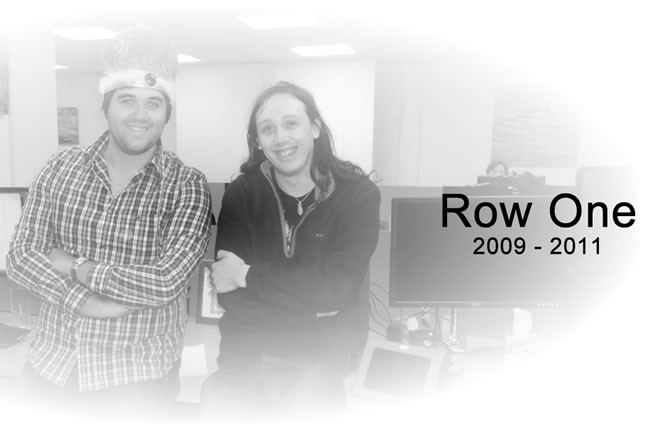
I’ve been blogging a lot about great losses to the world recently. Sir Jimmy Savile, Steve Jobs and the Space Shuttle program to name a few. Sadly, I must now blog about a loss I have personally experienced too.

Two and a half years ago, I left Open Door Design and started a new job at Buzz.

On my first day, I was given a seat on the first row of the office. The man sat next to me, a fellow University of Leeds graduate was named Jason. Little did we know, this was the start of a friendship that would define us both.

Over the next 30 months we would become part of the furniture at Buzz, always there on Row One as others would come and go. We would engineer Suit Day, come to dominate the office keepy uppy competition, achieve Pub Week and share many happy memories.

However, yesterday I worked my last day at my desk. On Monday, technical will be moving to the other side of the office, and Jason won’t be moving with us. Of course, we will always be Row One no matter where we are – but it will never be the same again.

Johnny English Reborn

November 18th, 2011 | Distractions, Reviews

Given we were all a big fan of the original Johnny English film, myself, Elina and Norm headed out to the cinema to see Johnny English Reborn.

The film was good, not great. It was entertaining, I didn’t find myself clock watching, which I often do at the cinema, and presented quite a few laugh out loud moments, but it was always going to get compared to the original and in the end, wasn’t quite as funny.

More of a concern though was the fact that my ticket into the cinema was £9.25! I’m sure when I was a kid it was like £4 to go to the cinema, now it’s more expensive than being a DVD to own :S.

I also got an earful off the guy checking out tickets in on the way in because I had bought Elina a student ticket but she didn’t have her student card on her. I understand they need to check it occasionally, but given we had bought full price tickets for myself and Norm, it seems pretty obvious that we were being honest – if we were trying to scam them we would have just bought three student tickets.

Announcing the HAG 2011 Holiday Food Drive

November 16th, 2011 | Foundation, News

Last year we launched and ran the Humanist Action Group‘s Holiday Food Drive.

Thanks to all your generous donations we were able to provide food parcels for three local homeless shelters. We managed a total of 24 boxes packed full of a variety of different kind of food either directly donated or bought with donations. It was a good start, but we think that this year we can do a lot better!

As with last year, we need your help in three ways. First of all, we need food. That is the main part of a food drive, so any food you can donate is great. Anything which will last for a few months or more is ideal. Secondly, we need time. We need people to help us collect everything together and package it up. Finally, any money donated will be used to buy more food in bulk from wholesalers to help us fill even more boxes.

If you think you can spare some time to help those less fortune this holiday season, then please do get in contact with us. You can also sign up on Facebook, or if you want to donate, you can do so via our page on Virgin Money Giving.

Together, we can make this a truly special holiday season. Which, to me, is what the holiday season is really all about.

Chris

Humans are amazing animals. But animals none the less.

November 16th, 2011 | Science, Thoughts

A long time ago, and by that I mean several years ago now, I started an essay on whether humans had stopped evolving. I never quite finished it and due to its length, every time I sat down to finish it, I needed to re-read what I had written so far and then thought better of it.

Well, that has been dragging on for far too long now, since 2008 in fact, so I’ve patched it up with the few final notes I had left myself and decided to publish as is.

I’m sure if I sat down and wrote something from scratch today, it would be better. But never the less, I have some confidence in what I wrote back then, so here it is in its full glory.

Humans are amazing animals. But animals none the less.

One issue which has come up quite a lot recently is the idea that humans have evolved beyond the idea of being an animal into something higher.

Many people make this claim without meaning to or without really considering its implications. I am not talking about the people that claim that animals are merely automatons while humans alone can think intelligently. These people are wide spread, obviously within the religious community but also within the non-religious community to an extent as well but any such argument, at least from an atheist perspective, is clearly rubbish.

However what I am getting at here is people who make claims such as “humans have now evolved to control their own evolution”, “humans are no longer subject to the laws of evolution” and “humans are no longer subject to the wrath of mother nature.”

These claims may seem apparent [to be true] with some thought on the subject but when examined deeper actually come up along the same line of thinking as believing that humans are the only creatures which can think and are self-aware, it grants us a special place in creation which is a perfectly acceptable view within religious communities but one which does not fit with the atheist world view. This would be accepted by all but I suspect the people that make the sample arguments I have supplied would disagree this is the claim they are making.

However, when examined it does in fact come down to this point of view. So it is important I think that I address the points made on this line of thinking to explain why I do not believe this to be the case. Humans are still animals, we are still subject to the laws of evolution and we still play within the framework that all life does.

I believe one of the problems which lead to this line of reasoning is that we assume the same metrics used to measure what we would consider a successful person within society are equally good metrics for measuring how successful someone is in terms of evolution. In this case it is a far more simple equation – who is likely to survive and breed the most.

Take for example, the chav. In today’s society they are considered the bottom of the pile. They are uneducated, unmannered, annoying and often regarded as a group we would be better off without. It therefore seems perplexing to many people that chavs are breeding faster that well mannered well educated individuals because this suggests they are the next stage of human evolution.

The mistake here is, as stated above, that we use the same metrics to measure value in society as to value from an evolutionary perspective. Considering the problem from an evolutionary perspective, the chav is indeed the next stage of human evolution. Why? Because they are better at surviving and breeding than the smart highly educated yet less sexually promiscuous individuals (probably such as you and me if I am so bold as to make a judgment about my readership). A lot of people would at first laugh when it would be suggested chavs were the next stage of evolution but why should it not be true? How self righteous is it to presume that you must be the next stage in evolution?

As it happens in this case chavs probably aren’t the next stage of evolution. The reason for this is that there are questions raised as to how an entire society of chavs would fair and I shall return to this later but for the moment I would like to move on as this is somewhat of a side track, it does not illustrate my argument in the best way but more stands alone as an important point.

Returning to my original argument, humans are in fact in no special way in control of their evolution or protected from mother nature. Every year millions of people around the world perish in natural disasters. Of course many do not because of the efforts of mankind but this is no different than to the animal race. They too are fighting for survival and they too have a degree of success with this. Our degree of success is generally regarded as higher – but it is all on the same scale.

For example humans build themselves tools and shelter to protect against the wrath of mother nature. We have flood barriers, shelters from hurricanes, etc. But of course animals build themselves shelter too. Take a look at the humble ant, building mightly ant hills to protect themselves. These are not always successful, just as man’s efforts are often unsuccessful when mother nature claims lives in floods, earthquakes and volcanic eruptions. Both are “artificial structures” created by animals to live and shelter in.

Secondly I believe the idea that humans are now in control of their own evolutionary path is equally flawed. One of the prevailing arguments for this is that people within our society who would not survive in the animal world now survive in our society such as people born with severe disabilities.

However much like the uneducated chavs, severely disabled people rely on the infrastructure created by society in order to support them. It is a fantastic feat of human advancement and kindness that we are now able to keep alive and care for the severely disabled. But they no more form the next step in human evolution than they ever did. A society consisting purely of severely disabled people would be unable to survive effectively. Similarly a society solely consisting of uneducated chavs would be without the medical, engineering and logistical knowledge required to make modern society function effectively. Therefore the idea that human evolution will not continue along the natural path is simply unsubstantiated. Society is not about to devolve into chavs or people unable to look after themselves – the bulk of the population will remain fit, able and evolutionarily advancing individuals.

Further along this line of thought, it is worth noting that society’s apparent lack of potential to evolve further is also false. Take for example a change in the climate. Let us say it becomes colder, there is a global drop in temperature. Many people would claim this shows that human evolution has stopped because while animals (a term taken to mean non-human animals of course) would evolve thicker fur or a similar evolutionary trait, humans would simply manufacturer themselves thicker coats.

This at first glance seems to make sense but on closer examination does not in fact stand up as an argument. The main reason for this is that evolution covers the adaptation of a species – it does not state how this adaptation has to occur. Therefore, humans manufacturing themselves thicker coats to survive the cold is the human race adapting to better survive in it’s environment. It is not a case of us “breaking” evolution, it is a case of evolution happening right in front of our eyes.

This is often disregarded as it is seen as something external to us ourselves as evolving but when some thought is put into such arguments it does not seem to hold much water. Furthermore this is likely to be less true in the future as the “artificial” or “external” advancements we make become far less external as we begin to alter our own genetics and breeding ourselves fitter, healthier and better able to survive.

As we’ve already established, you have to accept humans as just part of nature, and once you do, it’s very difficult so say, “oh, that isn’t part of nature” when we do something. Animals make nests to live in and sometimes use basic tools – how is that any different to the more advanced tools we use?

Evolution seems to be continuing on humans unabated. Take, for example, height. We’re definitely getting taller as a species. If you compare the average height of someone a thousand years ago, they were shorter than we are today – and that is entirely natural if you will.

Mutations also occur at just the same rate as they ever have. Just because we’re moving faster with our own technology and improvements to life, doesn’t mean that the classic methods of evolution have stopped – mutations occur at just the same rate as they ever have. The reason it seems to be happening could perhaps be to do with the fact that it’s a very slow process and as humans we’re used to things advancing increasingly quickly.

Our basic desires also still drive us. Deep down we all still want to find a mate and have babies. It’s wired into us and the majority of people over the age of fifty will be happy to tell you that at a certain point, you just get the urge to procreate. We might be master of many things as a species, but we haven’t wiped out our basic emotions yet (and probably never will, unless people start seeing Vulcan as the ultimate utopia).

Therefore to summarise, my points are as follows. Most of us will agree on the premise that humans are animals and have no divine special place in the universe, we’re just doing pretty well. Once we agree on this there is no reason to believe that we are not subject to the laws of evolution, that we have somehow stopped evolving or that we now control mother nature.

Homosexuality and natural selection

November 15th, 2011 | Religion & Politics, Science

In my post on the taste of meat I briefly mentioned the problem of homosexuality and natural selection. That is to say, why does homosexuality persist, given you think natural selection would weed it out because gay men are not having babies and therefore not propagating their genes.

Many people have taken this to mean that homosexuality is some kind of defect, where something has gone wrong because the ultimate goal in life is making babies and these people aren’t doing it.

Luckily, Rich had written a talk to explain all about it. Having first delivered it at Rationalist Week 2009 he also delivered it to Leeds Skeptics later that year.

I’ll skip the interesting, but never the less skippable introduction and get straight to the answer.

Genes do different things based on their environment. So in one person with one set of genes, a specific gene may do one thing – but take that gene out and put it in someone else with a different set of genes and it may well do something else.

This is what we find with the so-called gay gene. In men, it is more likely to make them homosexuals. But put that same gene in a woman and it actually makes them more fertile. Therefore a woman carrying the gay gene is more likely to have children and even though some of them may turn out to be homosexual men, the women will continue to propagate the gene because of their increased fertility.

There are other factors at work as well of course – homosexuality is a combination of both nature and nurture. Having the gay gene doesn’t mean you will be gay – it just increases your chances. But that is Rich’s argument as far as the genetic side goes.