Gangnam style
August 12th, 2012 | Distractions, Video
Michelle has very inconsiderately infected me with Korean pop music memes.
Michelle has very inconsiderately infected me with Korean pop music memes.

When did it become fashionable to start referring to the Union Jack as the Union Flag? Well, we probably all know when.
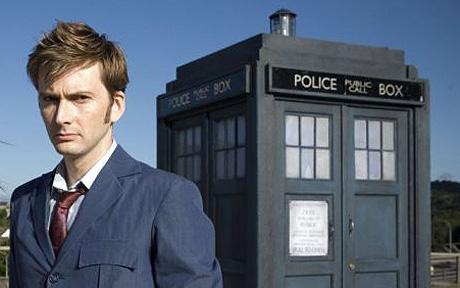
It was then this man appeared on our screen and, in the middle of a rant, his assistant helpfully snapped “That’s the Union Flag. It’s the Union Jack only when it’s flown at sea.”
It might have worked well in the heat of the moment, but it had one lasting problem – everyone believed it, even though it simply isn’t true. As the Flag Institute notes, this whole concept is a relatively new invention; and the flag, both on and off dry land has long been referred to as the Union Jack.
So stop arrogantly correcting me when I use the term Union Jack. I know you think you’re big and clever because you can parrot back a phrase you heard on the telly, but you’re not – go read an actual encyclopedia instead 😉 .
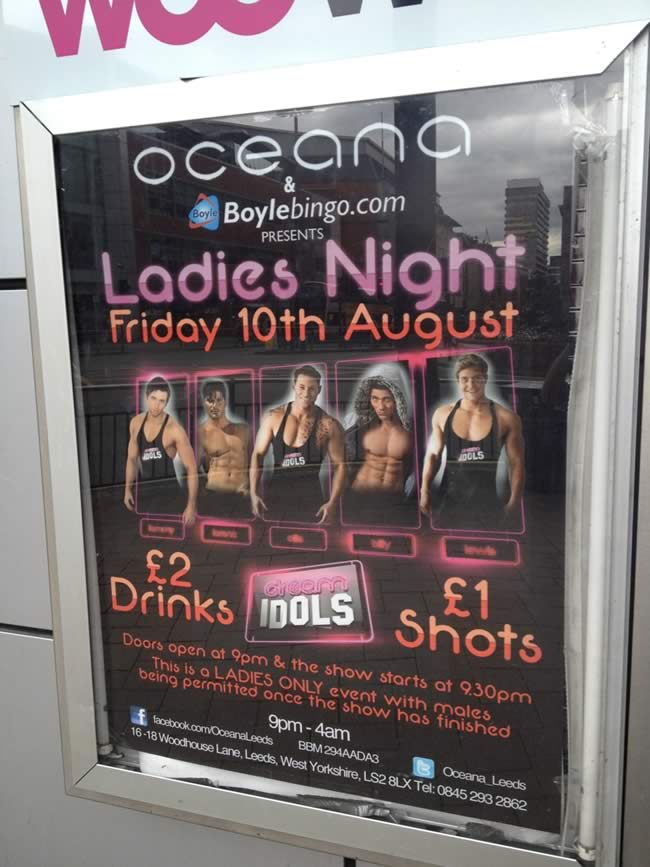
Tonight is “Ladies Night” at Oceana. You’ll notice the sexualised images of some young “buff” men in the posters, collectively known as the “Dream Idols” apparently.
This caught my eye because it’s easier to stand behind a claim such as “people should have the right to use their bodies for whatever purposes they wish”, when you’re not the victim. But take this example, it is my gender that is being used in sexual imagery to sell a product (in this case, entry to a night club).
Yet, I’m still entirely behind it. True empowerment and equality come from granting people the freedom to do as they wish. If they want to appear on a poster without a shirt on, who am I to tell them otherwise?
According to Wikipedia’s own figures, 91% of editors are male. According to another set of their figures, it’s 90%, with 9% women and 1% transgender.
Why is there such a bias towards males?
Stereotype threat doesn’t seem a very good fit for explaining – it’s a fairly anonymous system on the internet, and they only know what gender you are based on the answer you choose to give in the editor’s survey. Not to mention that the Foundation itself is dominated by women – Sue Gardner is Executive Director of the Wikipedia Foundation and Kat Walsh is the Chair of the Board.
The New York Times caused quite a stir when they wrote about it, quoting Jane Margolis who suggests “women are less willing to assert their opinions in public”. Meanwhile Pascal-Emmanuel Gobry, writing in Business Insider, suggests that would upset many existing editors if they were discriminated against by pro-female initiatives.
Many people have weighed in on the debate too and Sue Gardner has done an excellent job of rounding up the opinions on her blog.
Indeed, opinions are so varied, that perhaps the message we can take from it is that more research needs to be done on the subject. It’s interesting to note that while women are very unrepresented, transgender people are actually over represented (1% of Wikipedia compared to 0.3% in the general population), so suggestions of it being a patriarchal problem wouldn’t seem to stand up.
In the meantime, you can always take some positive action and begin contributing to Wikipedia.
When I was young, there was a lovely shopping centre in in the city named The Headrow Centre. It was located on The Headrow, hence the name. Inside there was a statue of a man holding a bunch of balloons and on the top floor was a toy shop packed to the rafters with everything a child could want (in terms of material possessions). Happy memories.
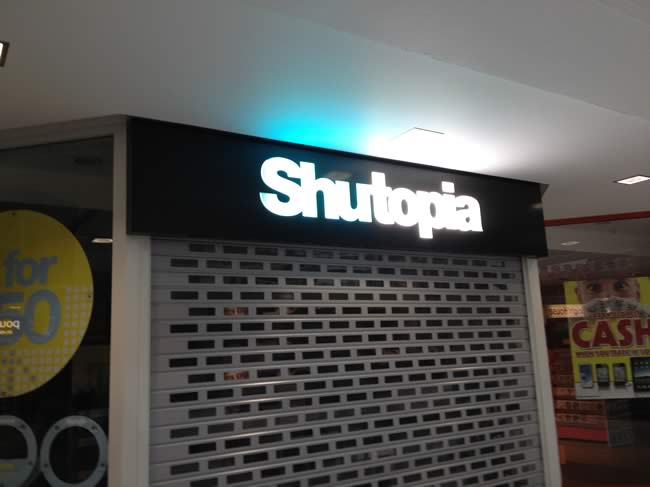
However, in 2008 they decided to kick all the shops out and renovate the centre, re-naming it The Core. Turns out this was a mistake. Indeed, probably one of the biggest mistakes in Leeds’ retail history. The Core is now a barron desert of white walls where shops used to be, and posters desperately trying to attract new businesses.



But of course, who would want one there? It has almost no foot fall; it is simply three floors of emptiness. I doubt they could even give the retail units away.
If that wasn’t the end of their trouble, they’re now surrounded by much more exciting retail prospects on all sides. Most notably, the new Leeds Trinity will form the showcase shopping centre of Leeds when it opens next year.

An entirely renovated Central Arcade sits just of Briggate too.

If that wasn’t enough, the development of the Leeds Arena has led to the Merrion Centre throwing a lot of money into renovating a lot of it’s units too, in the so called “Arena Quarter”.

No wonder the investor is going bankrupt. Sad times.
If you’re using version control (you are using version control, right?), the question sometimes comes up as to how often you should commit.
I’m a commit fanatic, I like to commit as soon as soon as I can, no matter how small the change. Other people prefer to wait a little and make large commits all at once. However often you choose to commit, you should make sure it falls within the constraint of being atomic.
This means that each commit is one single, complete change. That is to say that you shouldn’t commit multiple changes at once, nor should you commit a change that is only half done. This is scope in this for different approaches of course “one single, complete change” could be part of a several step refactor as long as the changes stand on their own, so could committing the refactor at once if it is all part of the same unit of work. But the important thing either way is to try and stick to atomic commits.
Think of it like an ACID transaction. Presumably you’re system works before you make the commit and it should work after too. It should contain just one feature so that if you want to roll that specific feature back, you can roll back that one commit without rolling anything else back.
With Git, where people may want to take out of sequence commits, this becomes especially important. People may want to take one of your changes, but not the other, so making sure two changes are in two separate commits is very important. Generally, if your descriptive commit comment (you are writing descriptive comments, right?) contains the word and, you probably need to re-think your commit.
I took my recently acquired flash to Wendy House to see if I could get better photos. What I got was a mysterious floating head of Fonze. Which was pretty cool.



Last month, a report by the Commons Culture Committee concluded that our gambling legislation was “outdated” and “ill-equipped” to deal with globalisation.
I strongly agree. Having worked in the industry for years, I know first hand that our legislation is lagging behind.
For example, you can only have four FOBTs (fixed odds betting terminals) in a bookies. But over the last ten years, traditional betting has been almost entirely replaced by the use of FOBTs, and without them high street bookies would close. You could argue this is a good thing, but with millions out of work do we really want to go slashing many more jobs?
Secondly, we simply don’t have the legislation to deal with new technology. At Buzz, we developed a bespoke wireless terminal for our games. But what does this count as? A FOBT? It’s just a tablet computer in a case. Does that mean we can put them in pubs? Probably not. But if you took your own tablet into a pub, you could then gamble online. The Gambling Commission simply didn’t know what to do.
Thirdly, because of the online nature and high taxes in the UK, bookmakers can just move abroad – and most of them have. Running a website is the kind of thing you can do from Gibraltar, so they do. Not that it’s cheap – you have to pay staff a lot more money to go work out on some god-forsaken rock, but the tax difference is so great that is still works out cheaper. If we lowered taxes, we would bring that income back to the UK.
This is becoming more and more apparent, as services continue to move online. For example poker tournaments and live dealer casino games, once exclusively the preserve of the real world have now moved onto the internet. You can sit, at a table, with a live dealer, on the internet. When the technology is this good, we need to ensure that our legislation can keep pace with it, or we’re only hurting ourselves.
To install VirtualBox guest additions on Fedora 15, you want to mount the ISO into the CD room of your host computer (either using Daemon Tools, or an actual CD drive) and give that to your virtual machine. Then run the following commands.
yum update
yum install dkms
yum install gcc
reboot
mkdir /mnt2
mount /dev/cdrom /mnt2
cd /mnt2
sh ./VBoxLinuxAdditions.run