Chris Worfolk's Blog


Who gets to care about equality

September 16th, 2012 | Religion & Politics

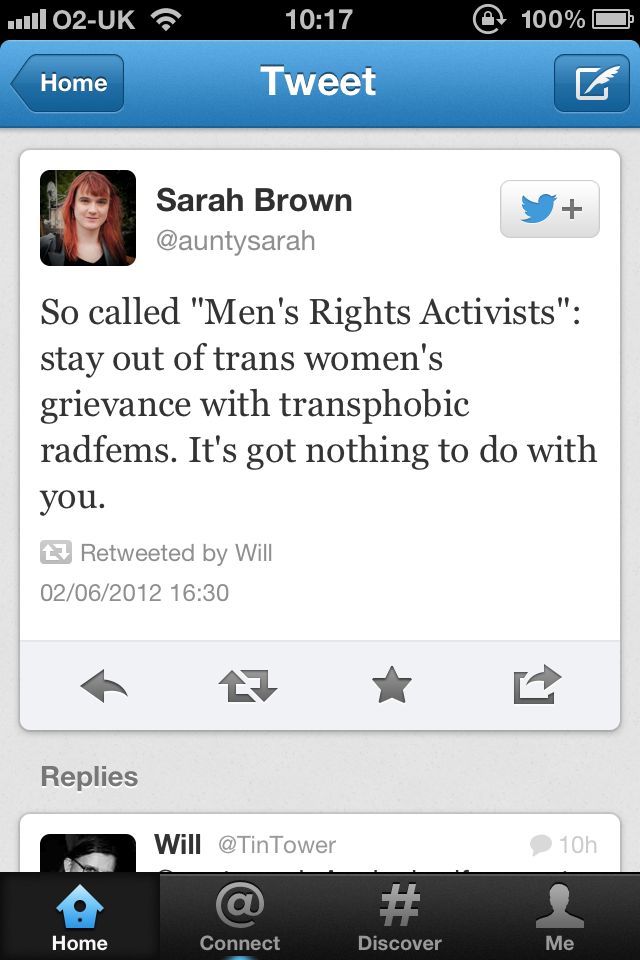
Recently, the following tweet appeared on my timeline.

I’m not ensure sure what so called men’s rights activities are. People who the author feels are not actually interested in men’s rights but have some other kind of agenda? How would you tell the difference between these people and people genuinely interested in men’s issues?

This recurring theme is very interesting though, as it suggests, as many comments have done recently, that someone can be disqualified from having an opinion or interest in equality, because of their gender.

This seems very strange to me. The idea that you could improve gender equality by banning one gender from having an opinion.

To me, having a fair and equal society is everyone’s business. Some people may consider it advantageous to their specific demographic to be privileged, but I believe that it is everyone’s interest to work towards equality.

Indeed, it may be considered more admirable for such individuals to fight for equality. Fighting for your rights if you are at a disadvantage is a welcome attitude, but ultimately, you are only acting in your own self interest. But those who are in the privileged group, and still fight for equality, are the epitome of morally conscientious citizens.

Humorously speaking

September 15th, 2012 | Public Speaking

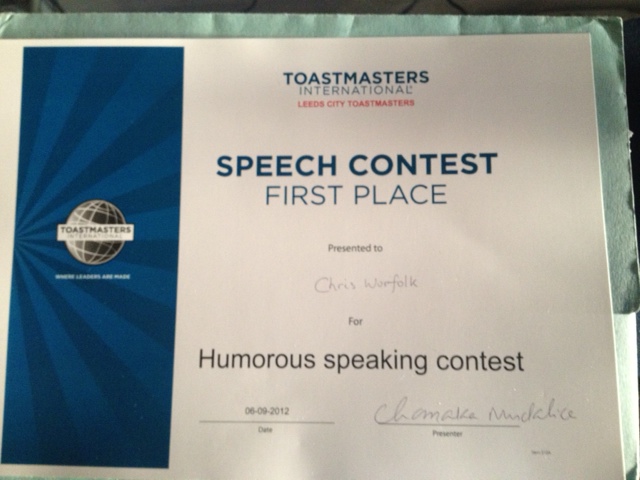
On Thursday, it was Leeds City Toastmasters “humorously speaking” competition. The club holds biannual competitions, one in the spring for motivational speeches and this one, for comedic ones – these then advance to the area competition and then continue moving on and up from there.

We started the evening meeting at Nawaab, an Indian restaurant on Wellington Street. It was good value at £11 for a three course meal, but my stomach certainly wasn’t too happy with what I put in it and the desserts were straight out of the freezer – packaging included and no time to thaw.

We made it to the competition just in time and I certainly didn’t fancy my chances – all three of the other speakers who had entered the contest were senior members of the club, one a former area governor who regularly speaks from the advanced manuals.

Somehow, I turned up with the victory though and now move onto the area competition in a few weeks!

La Grillade

September 14th, 2012 | Reviews

It was Wednesday evening and Elina was being too lazy to cook (we take it in turns, and it was hers). So we decided to head out to grab something to eat and eventually settled on La Grillade.

As a French restaurant in the city centre, it has tough competition from Sous le Nez.

We decided to take advantage of their three course set meal. I say set, we went for the slightly more expensive one, from which you can just pick any starter and dessert off the main venue.

I decided to go for the frogs legs as I haven’t tried them before. Turns out they taste a lot like chicken, but not as nice. I don’t think I’ll be having them again, but it was an interesting experience.

For the main we had a rack of venison, that was cooked to perfection and extremely delicious. It also came with a wide variety of side dishes – you wouldn’t think you could do that much with chips and veg, but apparently, you can.

The desserts were excellent too – you know what you’re getting with a mouse au chocolat, and the lemon sorbet lived up to expectations as well.

All in all, a fantastic meal, but comes up at least as expensive as Sous le Nez, so I would expect it to. Recommended, in any case.

Veritas

September 13th, 2012 | Reviews

Last week, we had dinner at Veritas. It’s a great pub, so we thought it would be nice to try the food.

It was reasonable, though I can’t even remember what I had, so clearly not very memorable. Elina had the special chicken and bacon pie, which she described as “a lot of meat”, which is definitely a compliment. Don’t think I’ll be rushing back there for the food though.

TGI Friday’s

September 13th, 2012 | Reviews

Apparently, in there, every day is Friday. Except for us, it was a Monday. But now that me and Elina work over the road from each other, and TGI Friday’s is just next door, we decided to try it out for lunch (I have been to TGI before, but not in the past 15 years, which is quite a long time lol).

We both went for the ribs, which were good, but then given how close we live to Cattle Grid, it was always doomed to leave us a little disappointed. It didn’t help that they had run out of the beer glaze sauce, so we had to have the regular.

Service wasn’t too snappy either, so ended up getting back slightly late. It is otherwise very convenient for lunch though.

September Humanist Community

September 12th, 2012 | Foundation, Humanism

This month saw the first of the new format “roving venues” Humanist Community. As such, we met for a meal at Akbar’s on Greek Street.

Install Memcache on CentOS 6 cPanel

September 11th, 2012 | Programming, Tech

Here is how to install Memcache for PHP on a CentOS 6 cPanel / WHM box. Some of the guides suggest that you need libevent (well, you do need libevent), though when I tried it, I already had it installed. But if you need it, yum will sort you out.

yum install libevent

Next, install memcache itself. Note that the package is called memcached.

yum install memcached

Of course, just installing it doesn’t mean that the daemon is running. So don’t forget to start it too!

/etc/init.d/memcached start

Finally, we need to add the PHP extension. Beware that the PECL installer on WHM won’t work! So you need to compile it manually from source. That isn’t too difficult though.

wget http://pecl.php.net/get/memcache
tar zxvf memcache
cd memcache-3.0.6
phpize
./configure
make
make install

And add the extension to your php.ini.

extension=memcache.so

Now restart Apache and a memcache section should appear in your PHP info.

Comments policy

September 11th, 2012 | Thoughts

One thing I have noticed more and more is that some blogs are publishing a comments moderation policy.

That’s fine, but I just don’t understand why.

Comments on my blog are moderated, if they are good comments (they don’t have to be positive, just not spam, or abusive – and even those I normally let through) I approve them, if not then I trash them. That isn’t a policy though, it’s just what I do. I don’t have to publish your comments, I don’t owe you any legal responsibility, so why would I have a policy on it? It would only seem to complicate matters when I can just deal with the comments without one.

This is perhaps why some people have become incensed over the recently flurry of harassment policies being introduced, especially at student groups where a student union wide one is already in place. You don’t need a second line of harassment policies, you just need to actually deal with the harassment.

On humanism, and being positive

September 10th, 2012 | Humanism

One of the criticisms that has been put forward about humanism is that it always has to be positive. Many aspects of that humanism is there for are simply not positive – it’s an alternative to religion, and religion is a thought controlling, people oppressing, unscientific load of nonsense.

However, as someone who labels myself as a humanist, I think both these statements can be true, and work together well.

Yes, religion is an evil that the world would be better off without. But saying that you can’t tackle this issue with a positive attitude is not only incorrect, but it is also naively counter-productive, even though it may seem intuitive.

The reason is, is that we know by now that, most of the time, arguing with someone’s beliefs only entrenches them further.

I mean, how many people do the believer and atheist camps actually win over to the other side? Almost none. In fact, it’s so rare that when we do, we feel the need to put a spotlight on them and get them to give talks about their conversion, because it almost never happens.

One of the reasons for this, is that arguing your case, even if you’re case is incorrect, actually reinforces your own belief that you must be right. In fact, even for us skeptics, who are aware this is a problem and try to counter against our own biases, it is difficult to avoid.

This has been general knowledge for a long time, but a great example is given in Richard Wiseman’s recent book about captured American soldiers in the Korean War.

During their time in the prison camps, they were often bribed to say or write about how positive communism was, and were encouraged to take part in mock debates in which they argued for communism.

The result – because they undertook the actions of promoting communism, an idea that not only doesn’t work and isn’t fair (in my humble opinion) but was specifically what they were fighting against in said war, they actually started believing what they were saying.

Similarly, when you get someone in a confrontational argument about their beliefs, where it be religion or any other form of ill-founded prejudice, bigotry or simply factually untrue belief, getting them to argue the point is only going to reinforce their belief most of the time, not weaken it.

So what can we take from this?

Firstly, I think it is a mistake for those in the freethought movement who suggest humanism’s approach of being nice and positive with people, is a sign of weakness or that we not as firmant in stopping the evils of blind faith from damaging our society. It isn’t – they’re just going about it in a more rational, scientific way.

Secondly, when considering your attitude, especially when running groups, it is important for it to be informed by this research.

For example, at A-Soc we discussed, on several occasions, the idea of having a debate with the religious societies where we would take the opposite position. IE, we would argue there was a god, while they would argue there wasn’t. Unfortunately, we never followed through with the idea. It is also worth considering what interfaith (sorry, can’t think of a better term) activities can be done between atheist and believer groups that promote an understanding of each others principles, rather than a confrontational nature – which in the end, actually have a reverse effect from what they are intended to have.
Rip It Up

September 9th, 2012 | Books

I’ve recently finished reading Richard Wiseman’s new book Rip It Up.

If you’re not familiar with Wiseman, he is a psychologist based in Edinburgh, and the man that showed expensive wine doesn’t taste any better.

It’s an excellent demonstration of Wiseman’s brilliant business skills. The book encourages you to change your actions and this is done by literally ripping the book up – you are supposed to tear pages out. This was somewhat difficult on my Kindle but means if you really want to get the most out of it – you have to buy a new copy every read. Genius.

Beyond that, the book looks at the As If principle, first proposed by William James, that suggests that rather than our thoughts influencing our behaviour, it is actually our behaviour that influences our thoughts.

Take this example – we often assume that we smile because we are happy. But the As If principle suggests that it is actually the other way round – we are happy because we smile. The book goes into hundreds of examples of this, but if you want to test it out now, why not spend a minute or two smiling and see if you feel any different?

Assuming that for the moment we put some stock into this, why does it mean? Well, there are lots of real-world applications.

For example, if you’re dieting, and you have a chocolate bar on your desk – try pushing it away from you. According to the theory, this will create the idea in your mind that you like it less, and so will less tempted to eat it. I’ve often done this anyway, though I’ve often attributed it to getting it further away from my eye line.

Another example, get over procrastination by allocating a few minutes to starting a task. This should be easier, as you can just tell yourself you’re going to do 2-3 minutes and then take a break. But once you find yourself doing it, it will be easier to continue.

In any case, it certainly makes for an interesting read. You can find out more on the book’s website.