Chris Worfolk's Blog


Comments policy

September 11th, 2012 | Thoughts

One thing I have noticed more and more is that some blogs are publishing a comments moderation policy.

That’s fine, but I just don’t understand why.

Comments on my blog are moderated, if they are good comments (they don’t have to be positive, just not spam, or abusive – and even those I normally let through) I approve them, if not then I trash them. That isn’t a policy though, it’s just what I do. I don’t have to publish your comments, I don’t owe you any legal responsibility, so why would I have a policy on it? It would only seem to complicate matters when I can just deal with the comments without one.

This is perhaps why some people have become incensed over the recently flurry of harassment policies being introduced, especially at student groups where a student union wide one is already in place. You don’t need a second line of harassment policies, you just need to actually deal with the harassment.

On humanism, and being positive

September 10th, 2012 | Humanism

One of the criticisms that has been put forward about humanism is that it always has to be positive. Many aspects of that humanism is there for are simply not positive – it’s an alternative to religion, and religion is a thought controlling, people oppressing, unscientific load of nonsense.

However, as someone who labels myself as a humanist, I think both these statements can be true, and work together well.

Yes, religion is an evil that the world would be better off without. But saying that you can’t tackle this issue with a positive attitude is not only incorrect, but it is also naively counter-productive, even though it may seem intuitive.

The reason is, is that we know by now that, most of the time, arguing with someone’s beliefs only entrenches them further.

I mean, how many people do the believer and atheist camps actually win over to the other side? Almost none. In fact, it’s so rare that when we do, we feel the need to put a spotlight on them and get them to give talks about their conversion, because it almost never happens.

One of the reasons for this, is that arguing your case, even if you’re case is incorrect, actually reinforces your own belief that you must be right. In fact, even for us skeptics, who are aware this is a problem and try to counter against our own biases, it is difficult to avoid.

This has been general knowledge for a long time, but a great example is given in Richard Wiseman’s recent book about captured American soldiers in the Korean War.

During their time in the prison camps, they were often bribed to say or write about how positive communism was, and were encouraged to take part in mock debates in which they argued for communism.

The result – because they undertook the actions of promoting communism, an idea that not only doesn’t work and isn’t fair (in my humble opinion) but was specifically what they were fighting against in said war, they actually started believing what they were saying.

Similarly, when you get someone in a confrontational argument about their beliefs, where it be religion or any other form of ill-founded prejudice, bigotry or simply factually untrue belief, getting them to argue the point is only going to reinforce their belief most of the time, not weaken it.

So what can we take from this?

Firstly, I think it is a mistake for those in the freethought movement who suggest humanism’s approach of being nice and positive with people, is a sign of weakness or that we not as firmant in stopping the evils of blind faith from damaging our society. It isn’t – they’re just going about it in a more rational, scientific way.

Secondly, when considering your attitude, especially when running groups, it is important for it to be informed by this research.

For example, at A-Soc we discussed, on several occasions, the idea of having a debate with the religious societies where we would take the opposite position. IE, we would argue there was a god, while they would argue there wasn’t. Unfortunately, we never followed through with the idea. It is also worth considering what interfaith (sorry, can’t think of a better term) activities can be done between atheist and believer groups that promote an understanding of each others principles, rather than a confrontational nature – which in the end, actually have a reverse effect from what they are intended to have.

Rip It Up

September 9th, 2012 | Books

I’ve recently finished reading Richard Wiseman’s new book Rip It Up.

If you’re not familiar with Wiseman, he is a psychologist based in Edinburgh, and the man that showed expensive wine doesn’t taste any better.

It’s an excellent demonstration of Wiseman’s brilliant business skills. The book encourages you to change your actions and this is done by literally ripping the book up – you are supposed to tear pages out. This was somewhat difficult on my Kindle but means if you really want to get the most out of it – you have to buy a new copy every read. Genius.

Beyond that, the book looks at the As If principle, first proposed by William James, that suggests that rather than our thoughts influencing our behaviour, it is actually our behaviour that influences our thoughts.

Take this example – we often assume that we smile because we are happy. But the As If principle suggests that it is actually the other way round – we are happy because we smile. The book goes into hundreds of examples of this, but if you want to test it out now, why not spend a minute or two smiling and see if you feel any different?

Assuming that for the moment we put some stock into this, why does it mean? Well, there are lots of real-world applications.

For example, if you’re dieting, and you have a chocolate bar on your desk – try pushing it away from you. According to the theory, this will create the idea in your mind that you like it less, and so will less tempted to eat it. I’ve often done this anyway, though I’ve often attributed it to getting it further away from my eye line.

Another example, get over procrastination by allocating a few minutes to starting a task. This should be easier, as you can just tell yourself you’re going to do 2-3 minutes and then take a break. But once you find yourself doing it, it will be easier to continue.

In any case, it certainly makes for an interesting read. You can find out more on the book’s website.

Gaucho

September 8th, 2012 | Reviews

Over on the Know Leeds website, I’ve written a review of Gaucho, the steak restaurant on Park Row. I don’t want to duplicate too much of what I have written here, but it is amazing! If you love your steak, you must pay it a visit, it is easily as good as Blackhouse and they even bring out a meat board, with their various cuts on to show you!

Ryanair

September 7th, 2012 | Thoughts, Travel

Flying to Dublin we had to go with Ryanair as I couldn’t find anyone else doing the flight times we wanted.

I think it’s quite an expensive airline in comparison to Jet2. We wanted to sit together on the flight, but to reserve seats cost us £10 per person, per flight, so that was £40 down, and just to pay for the flight (on my Visa as they don’t accept American Express) cost me £6 per person, per flight, so that was £24 as well. Altogether that is an extra £64 added on top of the price, which is a lot.

The outgoing flight was then delayed by almost an hour, which is basically the entire flight time.

Thanks to a legal requirement to have emergency exits on planes though, I did get enough leg room to stretch out fully.

Where is the Daily Mail when you need them

September 6th, 2012 | Photos

What kind of monster would do this…

2012 Annual Report

September 5th, 2012 | Foundation

The 2012 Annual Report for the Chris Worfolk Foundation is now available to download from our website. Find out what we’ve been up to over the past twelve months.

Add Scala to your system path on Mac

September 5th, 2012 | Programming, Tech

Lets say you are running Mac OS X Lion and you have installed Scala to /usr/local/scala. To access scala from the terminal you need to do the following.

cd /etc/paths.d/
sudo vim scala

Add one line with the following in.

/usr/local/scala/bin

Save the file and restart terminal. You’ll now be able to use scala from the terminal.

August 2012 Wendy House

September 5th, 2012 | Friends, Life

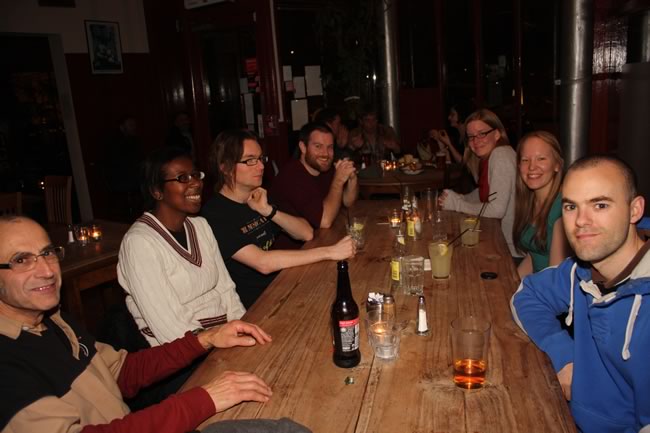
I couldn’t be bothered to take my camera to last month’s Wendy House. But we did enjoy a few drinks beforehand under threat of extermination.

StayCity Serviced Apartments

September 4th, 2012 | Reviews, Travel

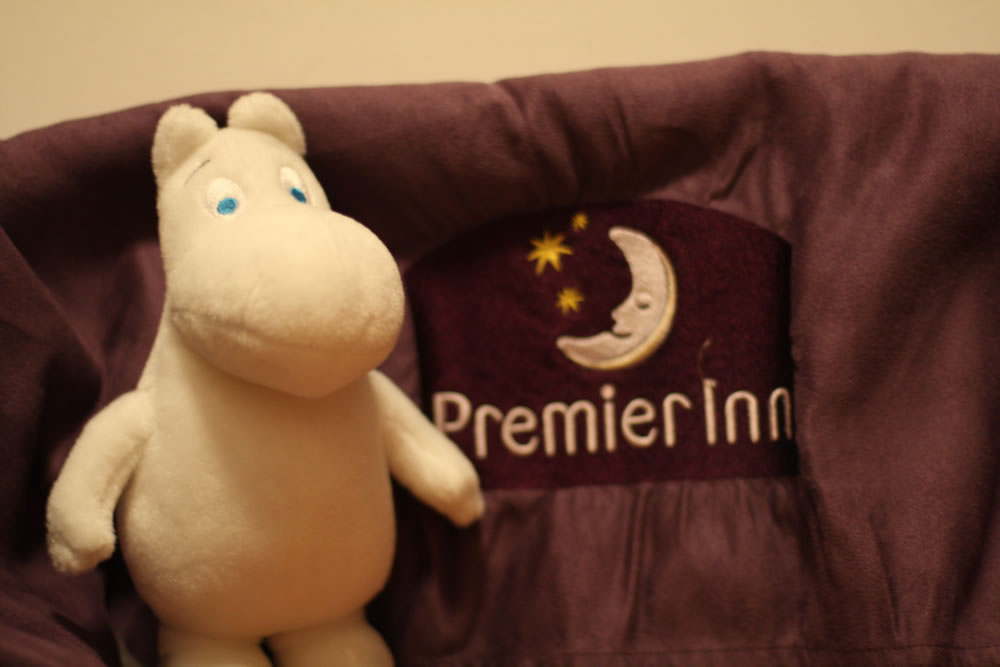
While in Dublin, we stayed at StayCity Serviced Apparents, so I thought I would share my thoughts on them.

When I originally tried to book online with Laterooms, it told me they had run out of available rooms and I had to call the Laterooms call centre. I did, and they confirmed there were no more rooms available, but suggested they could book me in at another StayCity just a few minutes away – and offer that I accepted.

Having turned up at said location, I was then told that we had actually been put in the original location. They were very nice about it and put is in a free taxi to the original location, where we found they had allocated a two bedroom apartment to us (couldn’t make use of it though as Elina insisted on sleeping in the same bed).

It was a bit run down, but when the serviced apartments I have to compare against it are Warwick and Oxford, you probably can’t expect the same standards. I can’t help but feel they were falling a little too much into stereotypes though by not providing any tall glasses, yet providing several types of wine glasses.

It was rather cold at first too as they had most of the windows opened when we arrived, so it took a while to warm up (and was never overly warm). It was also rather nosier than I was expecting when it came to trying to sleep.

The location was fantastic though – it was literally over the river from Temple Bar, so for the price and location, it still comes up as a good deal. Their wifi was good too. You do need a pass per device, but I had no problem streaming high-quality video.