Hugh Fearnley-Whittingstall’s first TV show was called Cook on the Wild Side. In his first series he converted a truck into a “gastro van”, which the back folded out into a complete kitchen for him to cook from anywhere. He then drove round the country foraging for food and cooking it up.
There was a surprisingly amount of illegal activity in it, which was amusing. He tried poaching, trespassing and raiding supermarket bins. He went everywhere from inner city London to the highlands of Scotland. In seemed quite realistic in that a lot of his attempts, especially fishing, just did not work.
In the second series he used a boat that he sailed up the canals and even included a bike with a pedal-powered stove so that he could leave the water whenever he needed.
While the series was highly entertaining, I also took away two practical tips. The first is that you can eat common garden snails. Literally you can just pick them up and fry them. Though you may also want to cleanse them for a few days before doing this. Gorden Ramsey has a great video on this as well:
Secondly Hugh recommends a book called “why not eat insects?” and then goes on to gather up woodlice from a wood and then fry them too. Apparently they taste like shrimp. I like shrimp…
Written by Charlotte Bronte, Jane Eyre makes up and important part of the Bronte sisters work. With Emily Bronte having written Wuthering Heights, these two novels represent the best work of the two sisters. It is only a shame there wasn’t a third Bronte sister to write another great novel. But there wasn’t.
I decided to go for the abridged version. I just couldn’t face the 500-or-so pages of the unabridged version. Of course you lose a lot of the detail that way, but I found it made for a more pleasurable experience for a book that I was not sure how much I would enjoy.
It started off very promising. An attractive young lady being restrained in “the red room”. Though it is luckily it did not end up going this way given how young the character was at the time.
Charlotte’s style conforms more to that of a Jane Austin novel than it does to that of her sisters and I think I am grateful for that. Wuthering Heights was an unpleasant story. It had depth, realism and emotion, and I’m not looking for that in a novel. I’m looking for a Jane Eyre style happy-ish ending.
After reading a book about Holocaust deniers I needed something a little more upbeat. A fairy tale about animals on a farm seemed to be the exact remedy I needed.
It’s very Nineteen Eighty-Four. Of course, it is no surprise it is similar given there are both Orwellian novels, but many of the ideas and concepts are taken almost word for word from each other. The constant threat of the enemy, the re-writing of history, the propaganda.
How can you pretend that someone as massive as the Holocaust never happened? That is the topic of Michael Shermer and Alex Grobman’s book. They look at many of the most widely recognised Holocaust deniers and what exactly it is that they believe.
The book spends a good deal of the book refuting the claims of Holocaust deniers. This was a little disappointing for two reasons. Firstly, it was just horrible to read. Transcripts of former German soldiers explaining how it was done made for extremely unpleasant reading. Secondly, I wanted to read this book because I wanted to know more about the psychology of Holocaust deniers, and I felt there could have been more on this.
The conclusion of the book looks at how we can learn from such obviously nonsense claims as Holocaust denial in terms of determining whether other people, looking at other issues, are promoting genuine revision or simple denial.
I’ve been reading George R. R. Martin’s second book in the A Song of Ice and Fire series ever since I finished the first over a year ago. Clearly with not much focus. Actually, I have been putting it off because I was a bit worried about not remembering what was going on.
Having restarted, however, I found it fairly easy to piece together. This involved fitting some of it in with the TV series though, and there are differences.
It is what you would expect from Martin. The good guys having a really hard time, the bad guys having a slightly less hard time, and all your favourite characters constantly being killed. The ending is also rather abrupt. It is almost like he just writes the entire thing and picks arbitrary points to slice into books (maybe he does).
American Gods is a novel by Neil Gaiman. I’ve read Good Omens which was a collaboration between Gaiman and Pratchett, but this was the first entirely Gaiman novel I have read. It follows the tail of a man named Shadow as he travels around America meeting gods, old and new.
From Gaiman’s introduction, I was expecting a story about some kind of road trip exploring American culture. To an extent, it probably was that, but America is such a diverse place that you can only really do small parts of it justice.
Its clever story arc makes for a very satisfying ending.
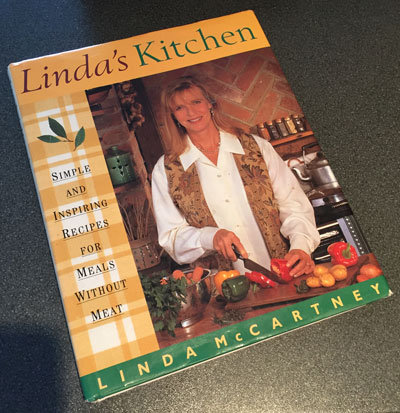
According to the cover, Linda McCartney provides meals that are both “simple and inspiring”. My friend Alan lent me a number of cookbooks and this was my favourite one (which he then very kindly gifted to me!).
It should be noted that Linda does not seem to have been a fan of spicy food. I’m not either, I usually get my Nando’s medium, but I’m developing a taste for a little bit of kick. Even at that level, I found myself regularly scribbling “leave the chilli seeds in” or “use two chillies, not one” next to recipes.
Good points
It does keep things simple. Most do not take too long to make or involve complicated steps. So far, they have all been tasty.
The photos that there are are very large.
There is also an excellent section at the back breaking down how to make a selection of sauces and dressings.
Bad points
It feels a bit dated. Most of the recipes call for chilli powder or dried chillis. I could be entirely wrong about this, but my guess is that these days that would all call for fresh chillies (Hugh certainly would).
Just less than half the dishes have photos.
Finally a lot of the recipes rely on a meat substitute. Many of the recipes are existing meat dishes with vegetarian mince instead. This is unfortunate because vegetarian meat usually tastes terrible.
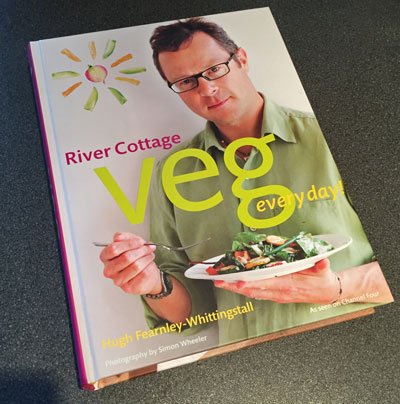
I wanted a good book on cooking with vegetables over Christmas and I eventually settled on Hugh Fearnley-Whittingstall’s “Veg Every Day!” book. It has quickly become my favourite cookbook.
Good points
I got it in hardback format which helps keeps the book open and protects it. There is a photo of pretty much every single recipe – a recipe on one page and a full almost-A4 size colour photo on the other. That is probably the best feature of the book.
It is also really good food. All of the dishes are interesting and tasty. None of if uses meat substitutes; there is a real focus on cooking with interesting vegetables rather than making dishes with meat alternatives.
It was only £12 for the hardback.
Bad points
Just one really, though it is a big one. Everything takes ages to make. Ages! If you are a vaguely competent chef, you can probably work a lot quicker than me, and might be able to do most of the recipes within an hour. Me, not so much. I normally budget an hour and a half, maybe even longer, to make each one.
It was only last Wednesday when I sat in a Toastmasters meeting and listened to a speech about Spock. Little did we know that less than 48 hours later his illness would take a turn for the worse.
It only seems fitting to remember him the way I am sure he would want to be remembered…