Using gzip compression allows you to deliver website content faster as it can be gzipped on the server and uncompressed on the client, reducing the file size you need to transfer.
Unfortunately mod_deflate, the Apache module required to do this, is not enabled on all cPanel installs. However, if it is, or you have access to the server, you can easily enable it.
Enabling mod_deflate
If you do not have mod_deflate, you need to use EasyApache to add it. Log in to Web Host Manager and go to EasyApache (only server admins will be able to do this). Select build from the previous configuration and customise it until you get to the exhaustive options list.
Check the box next to mod_deflate and then re-build Apache.
Enabling compression
Once you have mod_deflate enabled, cPanel will have a new option. Under “software and services” in the x3 skin you fill find an option called “optimise website”. Click through to that page.
Compress content will probably be set to “disabled”.
Select “Compress the specified MIME types” instead. You could enable it for all content but I would not recommend this as some content you will not want to compress and much of it (images for example) is pretty pointless. The third option allows you to customise.
By default it should have the following options:
text/html text/plain text/xml
I recommend adding some more:
text/html text/plain text/xml text/css text/javascript
Hit “update settings” and you are done!
There are some great online tools for validating that your website is looking and working well. Of course there are loads of these and many of them we’ve been using for years. Below though, I’ve listed a few I’ve been using the most in recent times or that are often overlooked.
W3C validator
An oldie but a goodie. The W3C validator ensures that your mark-up is valid. This is good for two reasons. One, it will find any problems, missing closing, tags, etc, that may be causing weird problems. Two, it will also point out stuff that you could be doing better like semantic tags and relevant meta tags.
http://validator.w3.org/

Mobile friendly checker
Google are starting to crack down on websites that do not consider mobile users. Of course we all know we should be building mobile friendly websites, indeed, it should be mobile first these days! But it is hard to debug sometimes, especially given the fragmentation of devices.
Luckily Google now provides a tool that will give you a pass and fail, as well as showing you a preview of the site on an Android device. It’s not perfect, sometimes it fails to load assets and you have to come back later, but it is still an awesome tool.
https://www.google.co.uk/webmasters/tools/mobile-friendly/
Google Developers testing tool
Over on the Leeds Restaurant Guide we expose our reviews using the hreview schema. This means that sites like Google can see what ratings we give restaurants and put them directly in the search results. To check it is working correctly, you can use Google’s testing tool.
https://developers.google.com/structured-data/testing-tool/
Facebook Debugger
Recently I wrote about the Open Graph protocol which allows you to tell social networks (mostly Facebook) what titles, images and descriptions you want it to use when sharing a web page.
Facebook have a debugging tool to test your tags are working.
https://developers.facebook.com/tools/debug/
Dylan Evans is an academic who works on robots with emotions. Or he was until he sold his house, moved himself and a group of volunteers to Scotland and tried to live out an experiment in whether he could survive the apocalypse. Turns out, he couldn’t.
This book really interested me. Unfortunately, there was not that much about the actual experiment in there. It doesn’t even begin until a third of the way into the book and most of the book is about the mental breakdown he had because of it and his subsequent time in hospital.
This in itself is interesting, though. The realisation of what he has done. In the novel, he talks about re-reading The Blank Slate and remembering that people are not the noble savage he hoped they would be when freed from society. That strong leadership is needed. He had even reviewed the book for a newspaper and yet still ignored it when starting his experiment. It is a sobering reminder into the mind’s power to compartmentalise.
He also realised that society is actually really good. You can lead The Good Life if you want to, but there is simply no reason you need to grow your own vegetables and make your toothpaste – the stuff you can get at the supermarket is fine. Better often.
Does this mean that any vision of utopia is dead? Yes. Deal with it.
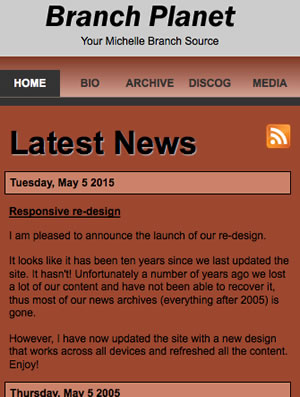
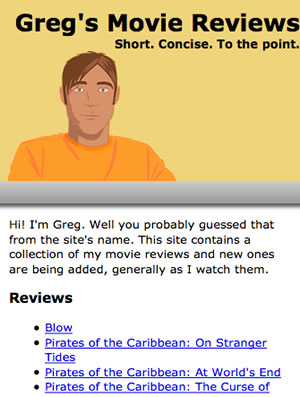
I’m pleased to announce the Worfolk Online network is now responsive. The sites now look great across desktop, tablet and mobile – and we’re even supporting IE8 as well!
I’ve previously blogged about Lyrics Burger and Star Trek: Random Sector, but we’ve also updated:
Check out our updated sites:
- Branch Planet
- Greg’s Movie Reviews
- TV Forge
- Hardware Tutorials
- Celeb Linkage
- Authority Forums
- Jimmy Turtlehouse
- Maze Finance
- Song Meanings


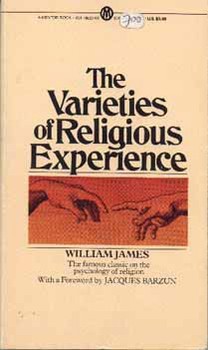
The Varieties of Religious Experience is a 1907 book by psychologist William James. I first came across James in Richard Wiseman’s book Rip It Up in which Wiseman talked about James’ beliefs in behaviourism, a subject which much evidence is now converging on.
James was also interested in religion as well and gave a series of lectures in 1901/1902, which formed this book. He focuses on direct experiences – that is to say the people who not only talked to god, but god talks back to them.
It was tough going. I didn’t find the language a problem but the subject matter is heavy and following the points made was at time difficult, even though each case was well illustrated by anecdotes.
It was interesting that he briefly mentioned the rise of atheist churches in the form of the flourishing Ethical Societies that were on the rise at the time. From Comte’s Religion of Humanist to the Sunday Assemblies currently sweeping the world, it’s interesting to see how the wheel turns.
A lot of the Chris Worfolk Foundation websites, such as this one, were already responsive. That is to say that they worked well across any device size. Some of them were not however, but I’m pleased to announce we have now fixed that.
I’ve already blogged about the Worfolk Lectures update but we’ve also upgraded many other sites across our estate too:
We’ve just relaunched Worfolk Lectures with a new responsive design. It looks great on desktop:
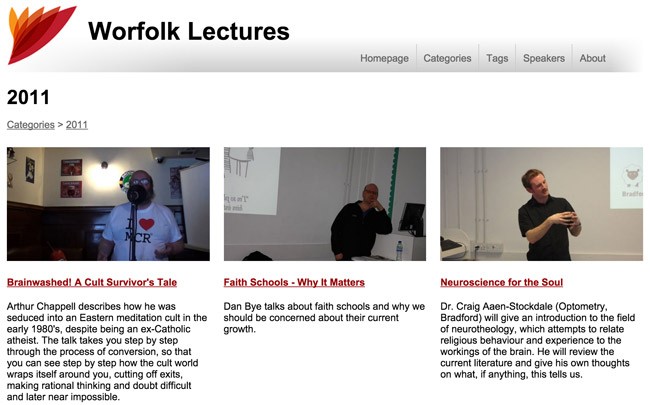
It looks great on tablets:

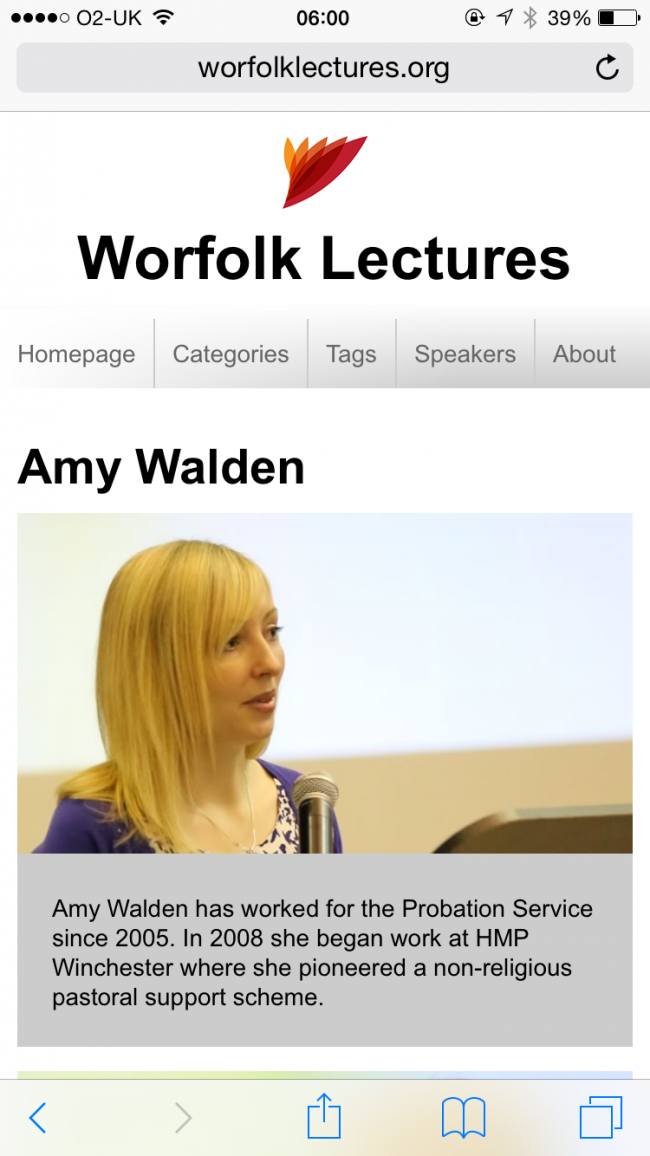
And it looks great on phones:
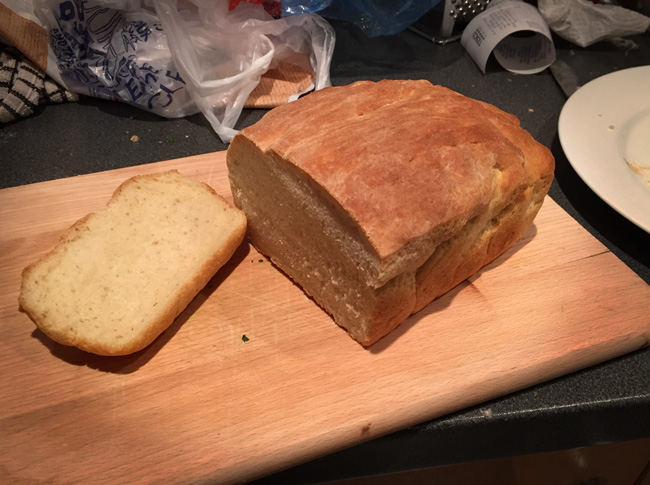
Bread baking is currently in vogue in the Worfolk household. Hugh Fearnley-Whittingstall assures me that once I start I will never go back. I’m sceptical, because I actually do really like the supermarket bread I buy, but I thought I would give it a try.
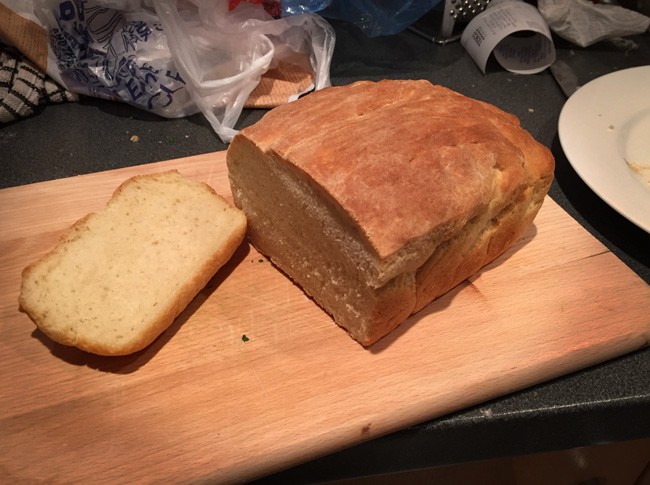
This was super-easy to make. I made a quantity of Hugh’s magic bread dough, put it in a tin and baked it in the oven (where else would I bake it?) for half an hour. It probably would have been even better if I had let it rise more in the tin, but I have places to be.
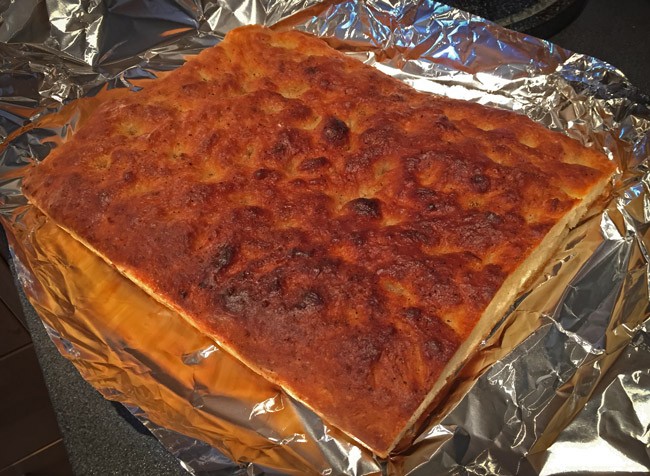
Focaccia has turned out to be a real winner. I bake this regularly now and take it to work in pieces to eat – it’s tasty enough to eat by itself. Pretty simple to make as well.
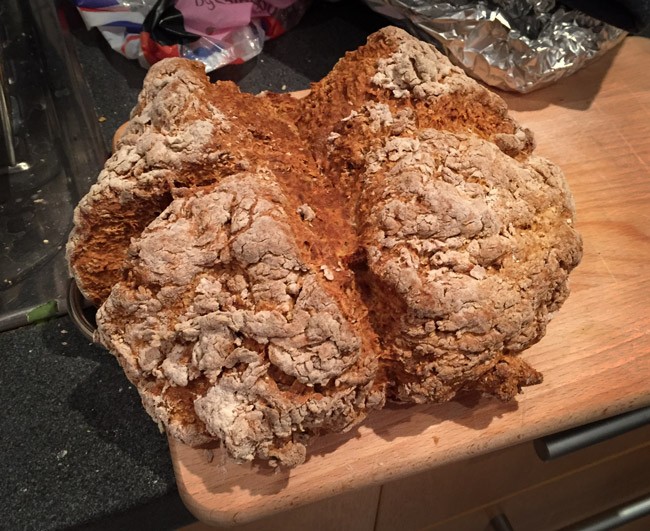
I’ve had soda bread from the Briggate farmers’ market and it was quite good, but mine turned out rather disappointing. It was too hard on the outside and the flavour inside was too strong.
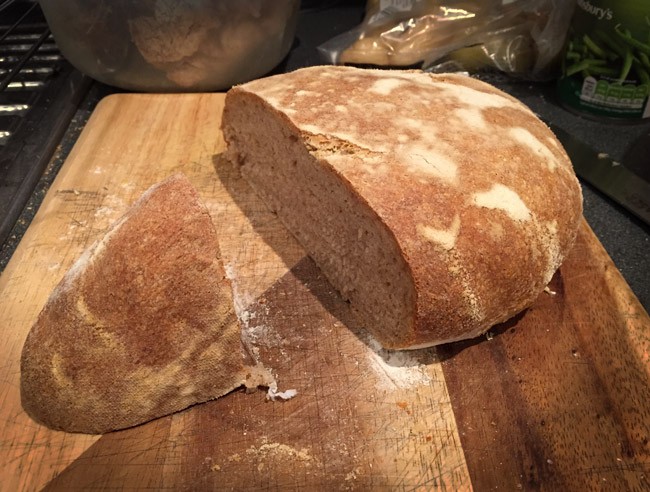
The jury is still out on the sour dough. I spent a week feeding up my starter so I am reluctant to give up on it but it has far too much flavour. Elina quite likes that, but I like the tastelessness of white bread. I have started feeding it with white flour instead of wholemeal to see if that makes a difference.
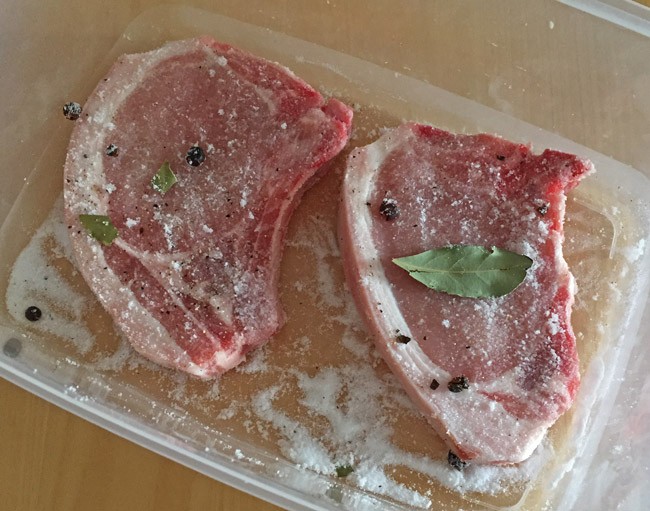
I have not been that impressed with River Cottage Every Day. The rabbit stew was bland and the Bloody Mary burgers fell apart. The home-cured bacon chops did work quite well though and mean that you don’t have to worry too much about the meeting going off as you can cure them then store them for another week.
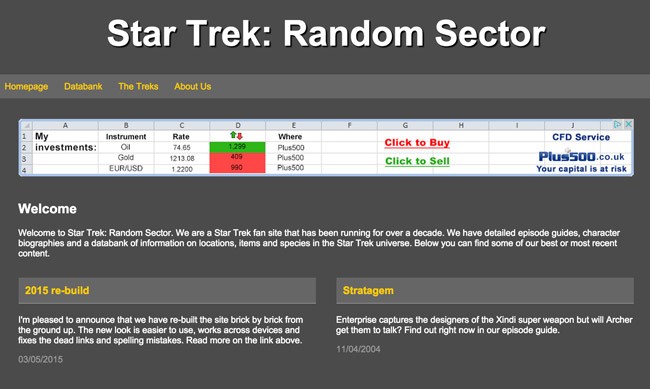
One of my websites that definitely has not been getting enough love over the years is Star Trek: Random Sector. It was really old. It used out-dated hover-over drop-down menus, tags that nobody knew still existed and had no way of easily updating the site.
That is a shame because there is a lot of super detailed content on there, especially round the episode guides.
No longer though is it a relic though! The site has been re-built from the ground up. All the URLs have been replaced by cleaner ones. The spelling mistakes have been corrected. The dead links removed. And best of all, it now works great on mobile as well. On top of that, there is even some new content. Happy days for Trekkers.