The Assembly Line July 2015
For the July 2015 Sunday Assembly Leeds we performed two songs. They sounds really good on the day though listening back, I’m less convinced.
I’m Gonna Be (500 Miles)
Weather With You
For the July 2015 Sunday Assembly Leeds we performed two songs. They sounds really good on the day though listening back, I’m less convinced.
I’m Gonna Be (500 Miles)
Weather With You
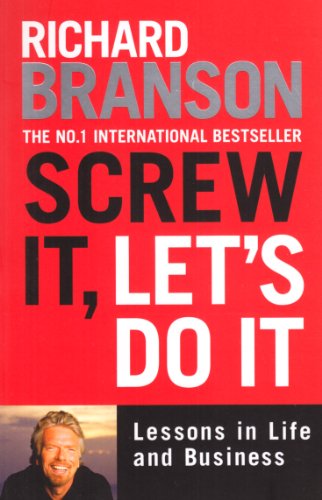
“Screw It, Let’s Do It” is one of Richard Branson’s autobiographies. Slash advice books. He says it is about lessons in life. Which is really what most of his books are about. Anecdotes about how to be a winner. Many of which genuinely are useful.
He is a man who makes snap decisions. In general, that is a bad idea. Or at least no better than a well thought out idea. However, it does fit with the Virgin brand of doing random things because they sound fun.
It also does a lot of crazy things. Balloon flights, weather hurricanes and Atlantic yacht crossings for example. He has had to be rescued on a regular basis. This is fine except that the flip side of that luck is that somewhere in the third world a child is being a particularly horrible terminal disease so that the universe can balance it all out.
He has built himself up from nothing, and that is very impressive. Though he did have a privileged upbringing having a wealth family and going to public school. He also has dyslexia and has not let that get in the way.
I really liked his quote on climate change. Something like “we’re a group of people who agree the building is on fire, but none of us will reach for the extinguisher”. He also advocates innovating our way out of the situation while still having fun. All good stuff.
In the end, I was inspired to go out there and do something. That will almost certainly wear off before I actually get round to doing anything, but it was a good feeling for a brief few hours.
Leeds Skeptics recently invited David Frank to present a talk entitled “sex, love & marketing”. It looked at how people market themselves on online dating and what interesting information we can gather from large scale data releases by major online dating networks.
Here are some of the highlights:
And some tips for using online dating:
Overall a really interesting talk. There was also a section on sex and fetishes. The entire thing was well supported by stats and evidence. You can find the full slides on David’s website.
Imagine walking up on the surface of Mars, to find that the rest of your crew had left you for dead and set off back to Earth. You have few supplies and no way to contact anyone.
I know what I would do. Crawl up in a ball and die. That is possibly why ESA are unlikely to select me for a manned mission to Mars. This question is the one put to protagonist Mark Watney. When we walks up on the surface of Mars, to find that the rest of the crew have gone…
Oh, and there are some spoilers in this article.
It is told from two perspectives. First of which is the log entries of Mark, which sometimes moves into a 3rd person description. The second is a third person narrative of what is going on back on Earth.
This is a little odd to go between the different forms, and also gives the lot away to some point. If Dr Hassall had not already ruined the ending for me, I suspect the fact that there was a separate thread based on Earth would have lead me to guess the eventual outcome.
In some ways, certainly in the first half the book, it would have been better to solely tell the story from Watney’s log entries. If you had to have a strand based on Earth you could have put the entire thing as a part 2 at the end of the book. Joe Berlinger wanted to do something similar when filming Book of Shadows.
However, as time went on I settled down into the format.
I enjoyed it throughout. The humour was quite dark and very geeky in places. There was a lot of science, though nothing that a lay person such as myself would struggle to comprehend (I think). Plus, as Mark points out, in some ways it is a story about a space pirate. An actual space pirate. That’s pretty cool.
Oh Atticus Finch. Not a big man, or a tough man, but a moral man. An ideal character to aspire to if like me, you are similarly old and tired. I like to think I would have done the same thing as Atticus, but who really knows.
It’s a pretty good book. However, I had already seen the film, and I am not sure I learned anything more by reading the book.
John Seymour gives loads of examples of how to make fun bread in The New Complete Book of Self Sufficiency. However, unlike Paul Hollywood’s nice step by step instructions, John is more of a “why not try adding honey” method, and then just lets you get on with.
Results vary.
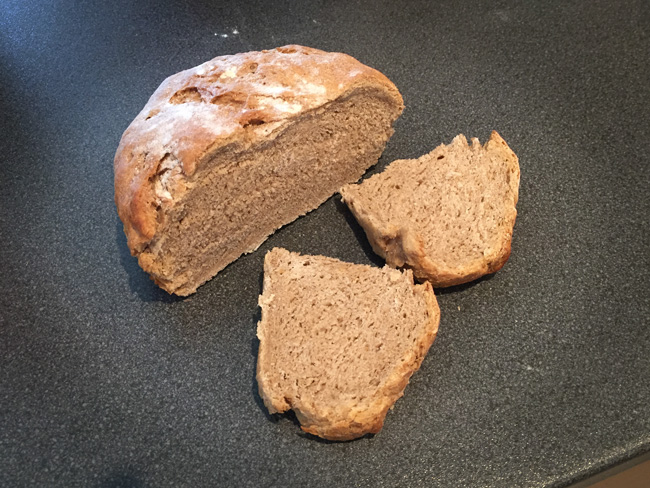
The barley bread turned out okay. This was just a standard bloomer recipe with half of the white flour substituted for bread flour. It came out well though I’m not a huge fan of the taste.

This was a mess. According to John’s recipe, you make it with boiling water. This makes it difficult to mix and never formed one cohesive ball. It is also made with baking powder rather than yeast. This made for a flat, flavourless bread.
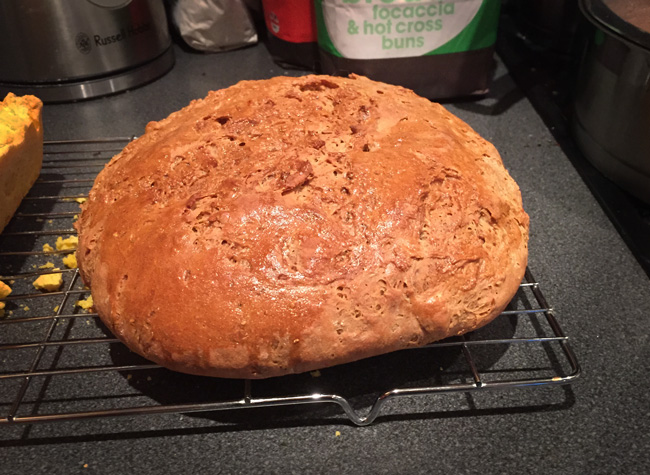
Another recipe where I swapped out half of the flour, this time for buckwheat. I also added one and a half eggs to see what happened. What happened was that the dough collapsed while proving. I probably added too much liquid.
Surprisingly tasty though. Quite a nutty flavour.
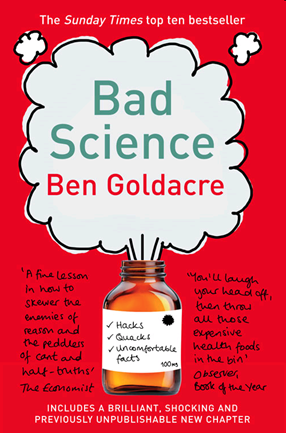
It’s ironic that after five years of running Leeds Skeptics, it is only now that I have stepped down that I have had time to sit down and read Ben Goldacre’s Bad Science. It is, after all, somewhat of a Skeptics bible.
I think I am a poor judge of how good this book is. Having spent so much time in skeptics, I knew everything in it. Literally almost everything. Not just the topics but a lot of the anecdotes and examples too.
It is a journey into what is wrong with medicine, science, the media and society’s inability to filter out the crap. Quite a big area to cover. Goldacre uses specific examples so show you what is wrong with the prevailing opinion generally.
He dedicates an entire chapter to rubbishing Brain Gym. He discusses how the media’s MRSA expert was working from a free-standing wooden structure with household-quality fittings. That would be a garden shed then. He goes into detail about how ageing creams. It’s a mixture of chemicals that actually work in trace amounts, vegetable matter that provides a short-term benefit only, and a bunch of other substances thrown in there on the off chance.
He also provides a reminder that we don’t really know how general anaesthetic works. Coupled with Dan Denett pointing out that anaesthetics also contain a memory eraser in case things go wrong, I felt rather uncomfortable with all that. Almost certainly better not to think about…
We also levies some criticism at the research behind antidepressants. This is similar to what Irving Kirsch said in The Emperor’s New Drugs. To be clear, I’m not saying Goldacre says SSRIs don’t work, but Kirsch doesn’t say that either, just that it is difficult to know given the data has not been made clearly available and thus may provide nothing more than an enhanced placebo.
Goldacre also discusses p values. Very important for science. A p value of 0.05 for example would mean that for every 100 times you do the test, you would get an anomalous result 5 times. He finishes up by discussing the MMR vaccine. He is quite kind to Andrew Wakefield and points the finger squarely at the media.
In summary, if you’re not familiar with how evidenced-based evidence works and why it is so important, this is definitely worth a read. If you’re already familiar with all this stuff, you probably won’t learn anything new.
Last year I argued that there is little difference between having and not having university tuition fees. The arguments placed against it were largely insubstantial and I have yet to have a decisive point against tuition fees.
However, in this article I will offer some arguments that could be used to defeat the idea.
Putting poorer students off
There has been a decline in university applications since the rise in tuition fees. According the BBC, the number of applicants dropped nearly 10%.
This is in itself not a problem. When people realise the full cost of university, perhaps people decide that it is not worth it. Which could legitimately be the case. Wages are market-driven thus the skills we need could continue to attract applicants while those we don’t could see a drop-off, and this would be the system working.
It would, however, be a problem if it turned out that there was a substantial drop in applicants from poorer backgrounds while wealthier backgrounds did not see such a drop as this would suggest we are creating a less egalitarian society.
However, this is not the case, and thus this argument falls down. According to the UCAS figure discussed in the previously mentioned BBC article, applicants from disadvantaged backgrounds dropped only 0.2%, while those from privileged backgrounds dropped 2.5%.
Supply and demand
In theory you might expect tuition fees to better match the demand for labour. This is because people might be more inclined to choose professions such as doctors, lawyers, engineers, etc, that give them a chance to pay off their loan. Whereas my guess (and it is a guess, I have no figures to back this up) is that people who study English or contemporary art, will be less likely to pay the loans off.
This does not necessarily follow though. If you are going to be a penniless artist you do not need to worry about paying your loan off because it is income dependent.
Also this assumes that people pick their courses both rationally and with financial ends in mind, neither of which may be true.
An alternative system that better match skills shortages to labour is a system such as Finland operate. In Finland, it’s free to go to university. You get like five years free, including a maintenance grant, which is enough time to do a bachelors and a masters. It’s open to all EU citizens for free too!
The catch is that there is a cap. They only take so many people, so if you want to go study sports science for example, there may be say 50 places per year and if you don’t make the cut, you don’t be doing that subject (or any subject).
This system means that people could potentially miss out on higher education. Though more likely they will just switch onto an under-subscribed course. However it does do a good job of making sure that the best people are fulfilling the countries labour needs.
Long term equality
In Capital in the Twenty-First Century Thomas Piketty suggests there is evidence that a more highly educated population leads to higher levels of equality in the long term, as shown by the Nordics.
Therefore we may decide that as tuition fees put people off attending university (this point is debatable, though applications have gone down in the short term), we may want to pay for as many people to go to university so that in the long term we create a better, more equal society.
Someone should definitely start this group.
That someone will not be me given the number of groups I already run, but I would definitely come along to some meetings out of curiosity.
In the final section of The New Complete Guide to Self-Sufficiency John Seymour talks about starting local groups to work on self-sufficiency projects. This could be doing small things like brewing beer or baking bread, or maybe a foraging club.
It sounds like he speaks from experience. Phrases along the lines of “doing all the organising” and “not being an instant success” sound to me like a fellow group organiser! And that is before the pendants have bemoaned being self-sufficient in a group.
Anyway, hopefully, you will have searched for a group, found my blog and been inspired to start such a group. If so, ignore that last paragraph and get going!
Fertility treatment can have a number of side effects. One of which is that it can work too well. This is what The Gosselins found out when they decided to add one more to their twin girls – and got an extra six!
Someone recommended it to me I watched the one hour special and a few of the 23-minute episodes out of morbid curiosity. They seem to cope very well. Their shopping is done at a wholesalers and they drive a full-size van but otherwise they live isn’t too crazy.
I imagine the family adapts. For example Kate sleeps in until 8am! Jon having already gone to work by this point. I didn’t think parents got to do that, let alone when you have eight kids. That is not to say it does not look like hard work – they pretty much have no other life, obviously.
They do totally cash in when they go to Shady Maple (a buffet restaurant). Under 4’s eat free!
Aside from the entertainment, the show might actually provide a useful purpose too. As Kate points out when they are invited onto a TV chat show, if they can cope with eight, it must give new and prospective parents hope that they can cope with one.