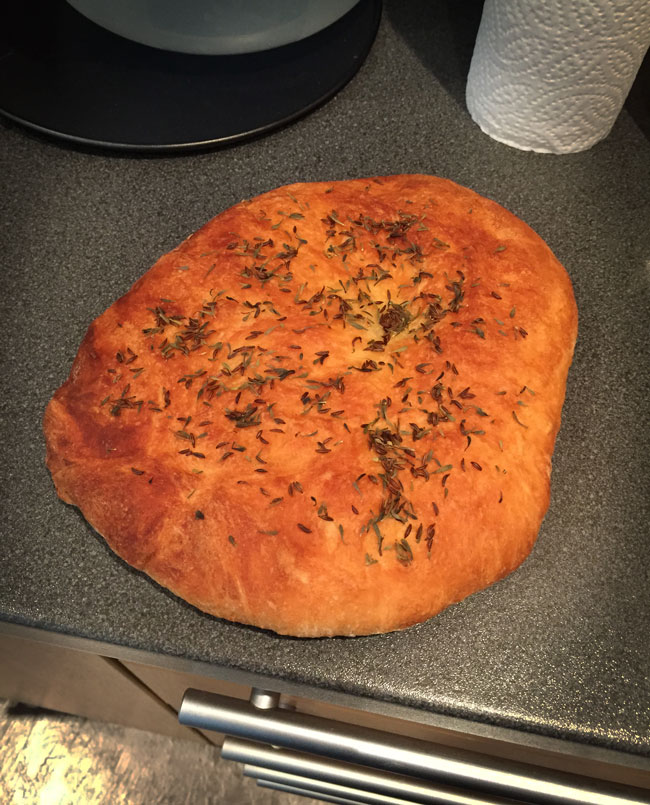
From Paul Hollywood’s Bread. This is a really nice flatbread recipe because the breads come out incredibly 3D. I like this. Regular flatbreads are nice but as you know, they only exist in two dimensions. These things are fat.
Of course I could just bake a bloomer. However, these are designed to be big and round. It is the surprisingly bonus of a light airy well-risen bread that makes these so tasty.
I did not have most of the ingredients he recommended for the topping so I combined thyme and caraway with olive oil. They did not stick well at all; they just fall off as soon as you pick the bread up sideways. However, they are tasty.
The Assembly Line is our new name for the in-house Sunday Assembly Leeds band. Our June event was on the theme of technology so we had some very vaguely related technology songs.
The Beatles – Drive My Car
This went pretty well, until the end, where I lost it. Listen out for Rich shredding the lead guitar.
Oasis – She’s Electric
Notable for my short guitar solo after the first chorus. It didn’t feel great at the time but on listening back it actually sounds pretty good.
R.E.M. – Man on the Moon
This also features a short guitar solo for myself. I also spent my Christmas vouchers on an analogue delay pedal which I used throughout the song, regardless of whether it was justifiable or not.
Sometimes I can make it quite a way into a novel before I can work out what it is actually about. Very occasionally, I get the whole way through. This is one of those times.
For the first chapter, I wouldn’t even work out who the characters work. I thought they might be anthropomorphised animals. It eventually turned out they were children. That is about all I got until I read through the Wikipedia article.
It reminds me a lot of Ulysses and indeed does use the stream of consciousness narrative employed by Joyce. However, unlike Joyce, who paints a beautiful and linguistically-inspiring picture which his rambles, William Faulkner failed to capture my imagination, leaving only the barely-intelligible plot.
From a literary perspective, it is certainly interesting. However, it ranks 6th on Modern Library’s list of 100 best novels. Is that justified on a list that puts The Grapes of Wrath at 10th and Nineteen Eighty-Four at 14th? No.
The Happiness Trap is a self-help book based on ACT (acceptance and commitment therapy).
It starts with a simple but profound message. Humans are not happy to be default. They are not designed to be happy. Happiness is not required to continue the species along. So if you’re not happy with your life, that might just make you completely normal.
It puts aside things like cognitive therapy, point out that we have a lot less control over our thoughts and feelings than we would like to think. Instead it focuses on accepting negative thoughts and feelings (indeed, it claims all feelings are just feelings, rather than good and bad ones).
The techniques it teaches including connecting with the world around you and accessing the observing self. Which is a fancy way of saying mindfulness, being in the moment rather than over-thinking life.
It gives you exercises to do, and tells you off if you do not do them! I stopped reading the book for maybe two months because it said I could not continue until I had done one the exercises and I did not want to go back and do it. When I did, it turned out it was really easy. As are almost all of the exercises – they are designed for busy people. This is kind of stupid really, how can I be too busy to look after my health? But I also suspect many of us all into this trap.
The end of the book is a little more strange. It has a section about how ACT is not a religion. I know that. But stating it puts up a red flag against the book’s version of ACT (Scientology isn’t a cult remember…).
Then it talks about connecting with your values, the things you think are genuinely important in life and pursuing those. This is a good thing to do, but not something I expected in a book about managing my feelings and anxieties.
Travels with Charley is a non-fiction book by John Steinbeck about his travels across America. Indeed it is titled “In search of America”.
He is not a man who messes around. When he decided to go travelling he wrote to the truck company and design him a special truck. They did. When his boat was in danger he jumped into the stormy water and swam out to it. It was a time when men were real men, women were real women, and everyone suffered because of gender inequality.
He does not go alone however. He takes his dog, Charley, who is as much a part of the story as Steinbeck himself. He begins by driving across the northern states (Steinbeck, not Charley, who does none of the driving) and then comes down the west coast and back across.
It is an interesting story. Steinbeck writes about his experiences in the colourful and descriptive way you would expect.
It is not, however, a description of Americana. Probably because, as Steinbeck points out, summing it up would be impossible. However, it is more a collection of anecdotes in sequence than a description of the areas he passes through.
It also all gets a bit horrible near the end when he visits the southern states and runs into a lot of racists. He quickly falls out with them. Thankfully he is then on the road again heading back to New York.
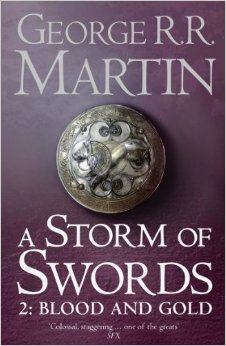
If you are a big reader you may well read A Storm of Swords as one book. However, if you are like me, reading a book longer than Anna Karenina is no small undertaking.
To make it easier I read Part 1 earlier. Even so, it is still a meaty novel, twice as long as your typical one. What a novel it is though. The more I got into it, the more I could not put it down.
I have only seen Game of Thrones up until the end of series 3 and A Storm of Swords goes beyond that so for the first time in the series I was breaking new ground.
There is a special circle of Hell in which George R. R. Martin will be subjected to all the things he has done to my favourite characters.
As with any instalment of A Song of Ice and Fire, lots of people died. Some of them I was pleased about, some I was annoyed about, some of which I was just surprised at.
HAVE YOU EVER WANTED TO CONVERT ALL YOUR BLOG CONTENT TO UPPERCASE? IF SO, I HAVE THE PLUGIN FOR YOU! I HAVE PUBLISHED A SHOUTCLOUD WORDPRESS PLUGIN THAT AUTOMATICALLY INTEGERGRATES YOUR BLOG WITH SHOUTCLOUD.
ADVANTAGES
AUTOMATICALLY CONVERTS ALL OF YOUR TITLES, CONTENT AND TAGS TO UPPERCASE
ZERO CONFIGURATION
ALL STRING MANIPULATION IS DONE IN THE CLOUD
INCREASES ANTIPCIPATION BY DRASTICALLY INCREASING LOAD TIME
DISADVANTAGES
NONE, EVERYTHING IS BETTER WHEN IT IS DONE IN THE CLOUD!
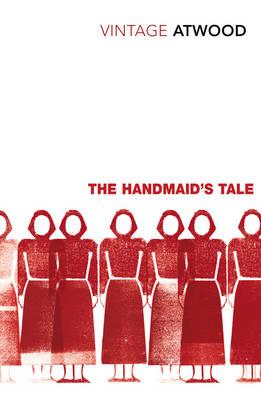
The Handmaid’s Tale is a novel Margaret Atwood. It describes a near-future dystopian world in which democracy has been replaced by a fundamentalist Christian military government and re-structured society.
In said society women are divided into functions for men. The protagonist, Offred, is a handmaid. She is used for breeding purposes only. Still, better than being a Martha, or shipped off to the colonies…