My mindfulness book has recommended that I do one thing a day and really concentrate on it. I decided to do my walk home. I usually listen to an audiobook on the walk to and from work, so I decided to skip one of those and ‘be mindful’. Evening made the most sense as there was more light.
Here is what I noticed:
Not thinking about things is really difficult
Like super-difficult. My mind has no off switch. It wants to think about things. They are loads of things to think about. It doesn’t even need to search for things: there are already a bunch of topics rolling around in there that need some CPU time. How is one supposed to banish it all? I suppose that is the exercise.
The world is really noisy
Cars, planes, trains, alarms. They all make loads of noise. And when you are not allowed to think about anything, you think about that. It occurs to me that train tracks properly run alongside rivers because rivers have the flattest and most consistent ascent. However, that means the one potential haven of peace and quiet in cities often has trains running alongside it. The mode of transport I passed most frequently was the canal boat: all of which were silent.
I miss my thinking time
My mind jumps from topic to topic, but I actually enjoy most of the thoughts. My walk is good imagination time. I don’t really want to experience the world. It’s Leeds. It’s cold, dark and full of ugly buildings.
I don’t feel like I usually miss anything
According to the books, people experience this great awakening about how much of life they have been missing out on. I did not experience any of that. I probably did notice things more, but nothing that was interesting or memorable. It was just the regular world that is always there.
I am currently working my way through The River Cottage Fish book. I will be writing about the book itself later, but here is a progress update. I started with the raw fish chapter. After much research, I have decided that I do not like raw fish.
Gravad max. If any of them were enjoyable, I think this leads the way. Based on the Swedish gravad lax it uses mackerel instead of salmon. You put it in a cure of salt, dill and a few other things and leave it in the fridge for a few days.
Salmon tartare is a take of steak tartare. Raw salmon chopped up with capers, gherkin, parsley and seasoning. If you’re going to try it, ask if your fishmonger if they have any sashimi-grade salmon. Mine had none on display, but when I asked, she had some in the back.
The fact that sashimi-grade fish existed is something I wish I had known before the first dish I made: home-made sushi. The recipe book never mentioned it. Lesson hopefully learned. It turns out that sushi made with hot mustard tastes mostly of raw fish and hot mustard. Who could have predicted that? Let it never be said I do not try things.
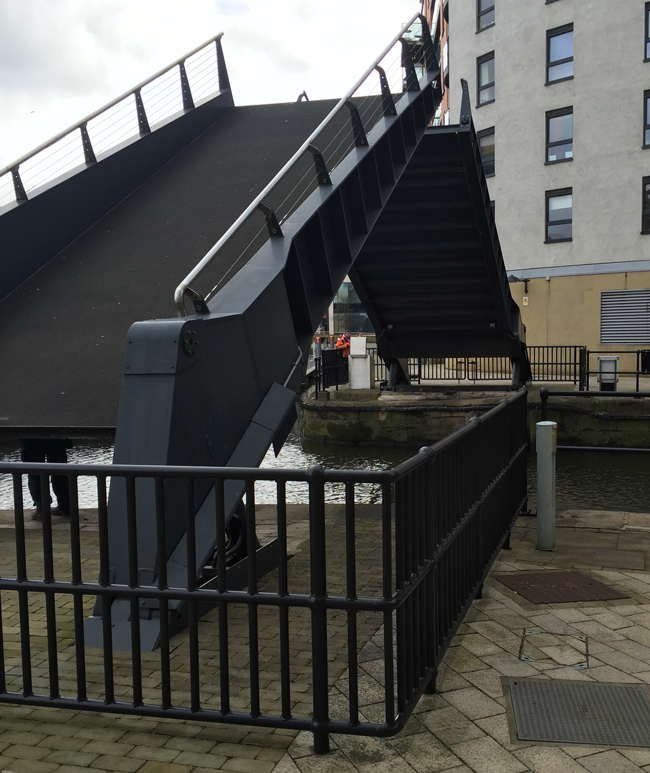
I was walking home recently when I noticed the two Leeds Dock water taxis, ee & Drie, tied up by the side of the canal. It gave me pause to think about the success of them.
Judging that depends on what you thought their purpose is/was. This in itself isn’t clear because I do not know whether the have been scrapped permanently, or whether they are just talking a very long holiday. As things stand though, they do not seem to have been running for over a month.
The new owners of Leeds Dock, Allied London (not a name that would endear yourself to Northerns), made a big slash about them. Pun intended of course. They put together videos of all the ways you could get from the city centre to the dock, including taking the water taxi.
Nobody did though. Unless you had guests visiting from Finland. This is not at all surprising. It is not any faster than walking. You would have to get to the station, then wait for the boat, then take a slow cruise down the canal.
This was not the fatal flaw though. The problem is inconsistently. They often didn’t run. How would you know if they were running or not? That is unclear. Certainly unclear enough that you wouldn’t make plans around them running. On one occasion I walked in the office to find an email telling me they were not running today. A bit late. People are put off by buses because they are sometimes late. But they run every day, to a timetable, and have done for decades. There is no such faith to be had in the water taxis.
Secondly, and here is the hilarious part, they don’t run when it is too wet. When there is ‘appalling weather’ such as a lot of rain (not flooding, which is perhaps more understandable – though it is a boat!) they stop running. Surely that is the one time you would want to use them in an attempt to stay dry?
I hedged at the start of this post by asking about the intent. It could be that the water taxis are designed as a promotional item. An attempt to provide the dock with some glamour and convince companies to move down there. If so, it has been successful. Sky are now down there with other companies likely to follow.
However, as a method of transportation, if it hasn’t already been scrapped, it seems only a matter of time. The only way I think they are likely to be a success is if at very least they run every day, come rain, come shine. With an emphasis on the rain, that does come most days.
When I was a child, I used to publish my own magazine. It was called The Tokyo Journal. I have no idea why. It is unrelated to another publication also named Tokyo Journal. I claim they ripped off my name, five years before I was born, but it is difficult to prove either way.
My gran was recently having a clear out and came across an envelope full of them. I have long since lost all of my copies so suspected they might be gone forever. It was quite a pleasant surprise to be reminded of my past.
A lot has changed in fifteen years. Back then I was not the flawless eloquent writer I am today. My sense of humour was less refined. A lot of the material in there makes me cringe a little today. Nevertheless though I think what this shows is that I am a younger far-less-successful version of Richard Branson. Who wouldn’t want that on their CV?
Zero to One: Notes on Startups, or How to Build the Future is a book by PayPal co-founder Peter Thiel. In it he talks about the challenges of producing real innovation to drive a start-up business.
He emphasises doing something new. You have to get a monopoly, with a broad scope. I could start a Finnish restaurant in Leeds for example but I wouldn’t have a monopoly. I would be the only Finnish restaurant in Leeds, but I would actually be competition with all the other restaurants in Leeds nonetheless.
In comparison the biggest tech start-ups typically have achieved near monopoly. Google handles more search traffic than all other search providers put together. The key is to start with a niche market that you can dominate and grow from there. Facebook started by only accepting students from Harvard for example. University by university it opened its doors one at a time and achieved domination. Similarly eBay started with only collectables, and PayPal started by online targeting eBay power sellers.
It also needs to be a business that can stick around. How sustainable is it in the long term? Decades from now? Zynga is a good example. The games company was worth a huge amount of money thanks to the success it had with FarmVille and Zynga Poker. At its peak, its shares were worth $10 a pop. Now they’re worth only a quarter of that because continuing to predict what social games will continue to captivate the world is an unreliable business model.
Thiel argues that you should have a small a board as possible. Ideally three people; a maximum of five. Everyone at the company should be full time: no consultants, no part time workers, no remote working. A start-up is a family and people need to be together every day to bond. Founders and CEOs should pay themselves a little as possible. This sets an example to the company, but also helps keep themselves motivated.
If you are thinking about doing a tech startup, or actually starting one, this is probably a worthwhile book to read. It is not very hands-on, but contains a lot of theory that seems useful. Given it is quite short, it seems like a sensible investment.
Our Leeds wedding was a fairly traditional sit-down affair, which included speeches by myself and my best man Norman. My brother-in-law Simon was good enough to capture it all on video.
I’m pretty pleased with my speech so I am now going to arrogantly offer advice to anyone who has such as speech to do. Perhaps it will even be useful for public speaking in general.
I opened with a few jokes. I think it set a good tone for the rest of the speech, which was mostly jokes. You have to go big or go home here. It’s scary yelling out “AH HA!” in front of a room of people who may or may not have seen Alan Partridge but you really have to go for it if you want the effect to work.
In terms of preparation, I started writing the speech as soon as I proposed. This gave me a year to work on it. I did not need all of that time. I wrote most of it mentally in the first few months, and metaphorically put ink to paper a few months before the big day. A month or two is ample time to write it but I recommend getting starting in advance for a number of reasons.
First, it is easier to do when you have plenty of time. Writing a speech to a deadline sucks. You are more likely to get writer’s block when you know you have to write, rather than when you can be relaxed about it. Also, doing it well in advance gives you plenty of time to go over it and nearer the day you will have other fires to fight. You can even write it, forget about it, then do a practice run a few weeks before.
In terms of practice, I didn’t do much. But then I was pretty relaxed about it (until I had to stand up and realised this was it!). Having written it mostly in my mind, I knew the lines pretty well anyway, and I did do some practice beforehand, so it wasn’t totally just freestyle.
I used notes, as you can see from the video. Always have notes to hand. They are a comfort blanket. When I am giving a competition speech, I do not have any notes. But when it is your wedding and you are already feeling the stress, the last thing you want is additional pressure. There is alcohol to factor in too. Best to have the notes there, just in case.
The Finnish bit was read word for word. I originally wrote it in English than had Elina translate it. Then I took that to my Finnish tutor and we worked on the pronunciation together. My script is actually annotated with pronunciation notes to remind myself.
Speaking of Finnish, try not to butcher the names of all your in-laws. It’s something that I, alas, was unable to achieve.
Emotion plays a key part in your delivery too. I choked up when I was telling the story about Elina’s dad. I was not expecting that. Looking back at the video it doesn’t look as bad as it felt, but it felt pretty bad. Worth factoring that in as something to be aware of.
I suspect the best bits are the most personal. Those are the most moving. And sometimes the most funny: the joke about my parents marrying for tax reasons got the biggest laugh of the speech.
Gestures, I still haven’t figured this one out. I need to find something else to do with my hands. However, I’m not sold on the idea of keeping them by myself the whole time. It looks and feels strange to me. This area needs more attention.
With the length, I came in at 22 minutes. This would have been too long had there been a third speech. However, given it was just myself and Norman, and we are both good speakers, I thought I could get away with it. Adding a bit of vocal variety (“20 years Leeds!”) seemed to help add some animation.
I sent my speech to Norman a week or two before the wedding. At which point he realised we were basically saying the same thing and quickly went on the re-write! He kept his notes on his phone which worked quite well. It’s small, like flashcards, so doesn’t get in the way.
Confidence is key. Norman’s strong and bold delivery sets a good base, and his appropriate timing and pauses around the jokes adds to the effect. You could take this even further: breaking out into song for the Tim Minchin lines for example. Not a tactic for the faint-hearted though!
Again, the personal stuff works the best. I loved the references to Stewart Lee, but it didn’t get the same laughs as the rest. Telling personal stories to your friends and family is being able to make an in-joke that everyone is included in.
The Everything Store is a biography of Amazon and Jeff Bezos. It is written by Brad Stone.
It discusses Walter Isaacson’s Steve Jobs biography and it is easy to make comparisons between the two. Both seem demanding people to work out. IN fact, Bezos more so. Life at Amazon is painted as relentless. Bezos speaks out against work-life balance and seems to work every employee into the ground. I think I have come away being put off by the idea of working for Amazon.
This is an interesting contrast to Netflix. They claim they don’t care how long employees are in he office for as long as they do good work. How true that is in practice I am not sure though it is true that they do not track the amount of holiday staff take (you can take as much as you want), which suggests they do have a relaxed policy. Netflix have of course been hugely successful as well.
It also makes me wonder whether you have to be a bad guy to succeed in business. Though successes such as Richard Branson would suggest there are alternatives.
Bezos is a man driven to build The Everything Store. He wants every product to be available immediately for customers. This is why Amazon sometimes drifts away from selling directly (Amazon auctions, Amazon marketplace) but often comes back to fulfilled by Amazon. They want to be able to control the whole customer experience, just like Apple.
Amazon itself appears in a mixed light. It is an innovative company. It did a great job of bringing together online retail. Look inside the book, search inside the book, super-saver delivery, prime, affiliates and recommendations were all developed or popularised by Amazon. It was the first to get e-books correct with the Kindle, and its purchase of Audible has helped audiobooks as well. KDP and CreateSpace allow you to publish directly onto Amazon. Not to mention Amazon Fire, Amazon Web Services (AWS), A9 and the many technology fronts Amazon has. In terms of market share, AWS is huge and probably under-appreciated on that list.
Amazon’s core retail business has always been about books. Bezos has a passion for books, which probably partly explains why they have been so successful. Compare this to music where Apple dominated. Stone correctly points out that Steve Jobs loved music, whereas Bezos had no interest in it. Even when you have a giant corporation behind you, it would seem you still need to do things with passion to succeed.
Bezos does embrace the same view as Jobs in disrupting your own company. I love the Jobs quote, if you don’t cannibalise your own company, somebody else will. This is exactly what Bezos wanted with the Kindle: he told his team to destroy Amazon’s core market of paper book sales. This had worked out as one of Amazon’s biggest successes.
They are also a relentless competitor. Like Walmart they are willing to stomach major loses to drive competitors out of business. They don’t treat their suppliers well either. Something I experienced first hand when publishing the Leeds Restaurant Guide. Amazon give me only around 30% of the sales price, whereas Apple give me 70%.
Getting an insight into Amazon’s logistics was fascinating. For example, super-saver delivery. I had lazily assumed it was that they used some kind of cheaper, slower delivery. Not necessarily so. The idea behind it is that they don’t even get it out of the warehouse until they have spare capacity. You might get lucky and they will have capacity straight away. Or you might not.
There is also the complexity of delivery. How often have you bought a USB stick and it turned up in box the size of a microwave? It’s amusing for the customer (ignoring the environmental effect, which we should not). However, for the business, putting the right products into the smallest possible packaging is actually an important part of cost-saving efficiency.
In some ways, Amazon could be seen as a bit of a mess. In the conclusion, Stone talks about how Amazon often has poor communication between departments and effort is also often duplicated. However, the company uses these things to their advantage. Different projects compete with each other on their own internal market, like their search routines did, with the best one surviving. Often companies are desperate to avoid duplication, but maybe it is not always that bad.
This is based on a recipe from The River Cottage Fish Book.
Flat fish are fairly easy to clean. They have all their guts in a little pocket at the front below the face. This is the only preparation I did for the flat fish. It was roasted hole with the skin on.
I replaced half of the original cherry tomatoes with sweet potato. Elina is not a tomato fan, but loves sweet potato. I cut it into chunks and boiled it for 15 minutes before adding it to the tray with the tomatoes. This produced a slightly mushy result, but with a firmed-up skin. I also rubbed olive oil and stashed a bit of butter around the fish.
Finally it all went into the oven for 15 minutes before being served on the tray.
For New Year’s Eve we threw a murder mystery dinner party. I’ve previously written about the event and the food I served. Today, I want to talk about the murder mystery and make it available for anyone who is interested.
The script was based around The Brilliant Batsby, a parody on the F. Scott Fitzgerald novel The Great Gatsby. Set in the Roaring Twenties, the plot involves a dozen characters at one of Batsby’s famous parties. A time traveller, Baron von Brown, turns up with proof that Batbsy will be murdered in the future. But which of the guests did it?
Ready for commercial sale it certainly is not. A good boxed murder mystery allows you to work with any number of characters (or without any) and have a different murderer every time. In my script most of the characters are required and the murder is predetermined. All of this is in the dialogue and difficult to change.
Indeed this almost caused me to come unstuck. Originally The Baron was going to turn up with a motion picture device showing a video of Batsby’s murder. However, my original Batsby was ill and so I had to switch the characters around and switch the video to a letter. This resulted in some clumsy dialogue that doesn’t make a lot of sense. However, it is a parody, so best just to go with it.
The characters are:
The Brilliant Batsby, party host
Bellina Morgan, wealthy heiress and noted beauty
Inspector Watt, a police detective
Baron von Brown, a time traveller from the future
Mona Moonshine, infamous bootlegger
Murderous Joe, a convicted criminal
Chef Gusteau, a chef hired to cater the party
Professor Laura Craft, archeologist and raider of tombs
Timothy Timson, Professor Craft’s assistant
Dr Victor Zoidberg, an Austrian psychologist
Any number of additional characters
There are a series of 11 dialogues. Each one can be read between courses. However, if by some chance you do not have 11 courses, you could batch them. This makes sense as they are not very long, and sometimes left a conversation gap after they had finished.
If you are interested in having a look, I’ve shared the files: download them here.
River Cottage: Gone Fishing is a series of three 45-minute long episodes of Hugh sailing round trying to eat unusual fish. It follows the usual River Cottage format. There is some footage of Hugh doing something, and then cooking the bi-product of whatever he has been doing. There are no formal recipes as such, it is just him and his friends catching and cooking various fish.
In episode one they tour the Channel Islands on a boat, spending some time on Guernsey. In episode two he visits the Scottish Highlands to see some of the remote islands and fish farms in the Hebrides. Finally, in episode three, he visits local fishing around Devon and Dorset.
I am not really sure if I learnt anything. That is pretty useful with River Cottage: you come alway having been entertained and maybe an action point to see what your local fishmonger has. However, you don’t come away with “I’m going to buy a garfish and make a special kind of soup” because where would you buy a garfish? As a piece of entertainment though, it does its job well.