Archive for the ‘Religion & Politics’ Category

On your bike

Friday, April 13th, 2012 | Religion & Politics, Thoughts

Cyclists on the road have long been a contentious issue for drivers. Many drivers argue that they slow down traffic and don’t pay any road tax. Meanwhile, cyclists argue that not enough care is taken by drivers to maintain safe roads and that they are often the victims of accidents in which they come off much worse.

The issue seems to be that they are very much in limbo. They are road users in many aspects, but then they are also similar to pedestrians in many ways (so in some aspects, pedestrians are road users also).

Traffic lights are a very good example of this. I would say the majority of cyclists I see on the roads, that is to say at least over 50% of them, do not pay attention to traffic lights. They ride straight through them or sometimes mount the pavement in order to avoid them if you would go as far as to describing it as that.

My problem with this is that you can’t expect to be treated as a valid road user, if you’re going to jump red lights.

First of all, it isn’t safe. You can make the argument that it is safe because obviously a cyclist wouldn’t jump a red light when there was someone crossing but if you’re going to make this argument there is no reason why cars should still be restricted to stopping for red lights – after all, we promise to check if there are people on the crossing. Obviously, this would end badly. Why? Because it’s just not safe to let people jump red lights, whoever they are (including emergency vehicles, but there are greater risk of not stopping).

Secondly, it creates a separation between cars and bikes. If we’re going to maintain that cyclists are full road users who deserve just as much respect as drivers, then they need to be held to the same standards as cars and motorbikes – if you say “the law doesn’t apply to me because I don’t have an engine”, you’re unlikely to be granted the respect you are looking for either.

As a society, we need to make the roads safer for cyclists – and that is only going to happen when drivers change their attitude towards cyclists. But, when the majority of cyclists don’t follow the rules of the road, can we really blame drivers for not giving them that respect?

God’s Way or the Highway

Monday, April 9th, 2012 | Religion & Politics

I’ve just started watching Diarmaid MacCulloch’s documentary series, “How God Made The English.” The premise of the series is that the one common identifier over the past thousand years in Britain has been religion. I’ve heard good and bad things about it, so I decided to give it a watch.

One of the points he discusses in the first episode is the idea that once we had abolished the slave trade in our own country, we then set about forcing this on the rest of the world. In MacCulloch’s words, we became God’s policemen.

An interesting parellel could be drawn between this and today when the United States, an anomaly in being the only major developed world to contain such high levels of piety, now takes on a similar role perhaps best illustrated in Parker & Stone’s Team America: World Police.

Is there then, a connection between religious devotion and a feeling that you can tell the rest of the world what to do?

Almost certainly. As luck would have it, we didn’t have to work out whether it was wrong or right to go into Iraq and kill a lot of civilians based on some fictional weapons of mass destruction. Why? Because both George Bush and Tony Blair both spoke to God, and he confirmed that that was exactly what he wanted.

That isn’t to say that political positions didn’t play a part in this too. In both cases, we and America not only had the will to enforce our view on the rest of the world, but the power to as well. As the saying goes, power corrupts.

But it is this power, combined with divine right – the knowledge that you are unquestionability doing the right thing because you have God on your side and God can never be wrong, that seems to lead to such totalitarian attitudes towards the rest of the world.

Not that I’m all together against interventionism.

Sexism and domestic violence

Saturday, April 7th, 2012 | Religion & Politics, Thoughts

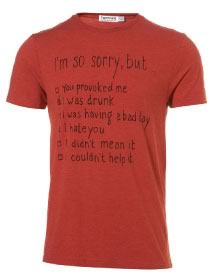
You may have heard the campaign that kicked off regarding a t-shirt on sale by Topman.

It seems pretty justified to kick off a campaign about it – the t-shirt itself is a list of “excuses” for domestic violence. That’s in incredibly poor taste and how anyone could think that was a good idea to put it on a t-shirt is beyond me. Only a complete moron would read that copy and think “yes, it would be clever to put that on a t-shirt.”

The t-shirt in question is:

Topman t-shirt

However, the campaign itself doesn’t actually seem to go after the idea that the t-shirt is in poor taste, but rather makes the claim that it is sexist.

This I have to take exception to. Nothing on that t-shirt suggests that it was a man that perpetrated the violence or that a woman was the victim. It could be a quote from a woman who has just beaten up her husband. Or one partner from a same sex relationship. It is in itself sexist to presume it’s male on female violence.

This is one of the biggest areas for Men’s Issues. Research shows that women are just as violent as men but thanks to the social stigma, domestic violence in which men are the victims goes significantly underreported.

So, while we’re boycotting Topman for selling this crap, lets remember why such items are so offensive. Domestic violence is unpalatable, regardless of who is the perpetrator and who is the victim.

Is privacy a lost cause?

Friday, April 6th, 2012 | Religion & Politics, Thoughts

Two years on from The Zuck officially announcing that the age of privacy was over, the government are once again on a beeline for another giant step in privacy invasion. The question is though, who is going to stop them?

Probably nobody. In fact, it’s already too late for that. They already track who we send emails and text messages to. They might not have the content of them yet, but they can already see what is going on. So despite the fact that we have freedom of association, and therefore I have every right to be friends with terrorists if I wanted to, chances are none of us would because our the government would then be watching everything we do and our telecommunications providers would have no option but to hand the records over.

So the downward spiral into Nineteen Eighty-Four seems to be well underway. In fact, Cameron doesn’t even need to install telescreens into our homes because as CIA director David Petraeus pointed out last month, we’re installing the gadgets for them.

But even if we did recognise that our freedoms are quickly being eroded, who is actually going to stand up against it? The answer is probably very few of us. Because ultimately, privacy is something that you can live your life without.

Of course, nobody wants to, and the visions from Nineteen Eighty-Four are horrific, but a slow, gradual erosion of our liberties isn’t going to affect our lives too much and unless we’re going to look at the bigger picture, it will be reasonably easy to swallow. I mean, the government already tracks all the messages we send and receive and watches us on CCTV on all the roads and city centres already. But we all accept that now.

Motiving yourself to get and there and do something about the bigger picture is never easy because there is little motivation to take care of it now. Not to mention that the government has got us so scared of terrorism that we openly invite many of the security measures put in place – just look at what Bush managed to push out in the Patriot Act.

Day to day, the invasion of privacy is just a purely intellectual exercise – we have nothing illegal to hide, it’s only the terrorists who need to be worried. Of course, we would prefer to have privacy, but it isn’t like we need it to go about our lawful lives.

Furthermore, what can you really do about it anyway? Chances are it will never feel like we’re now at the line that we must draw and go no further – it will continue slowly and gradually. Much like the slow ticking of the evolution clock, there is no definitive cut-off between here and Nazi Germany.

Indeed, we have many of the tools to do it now. You can route all your internet traffic via an anonymous proxy. But almost nobody does. It’s just too much effort. That’s the problem – it will simply be easier to just swallow the erosion of our civil liberties than it will to fight the fight. So where do we go from here?

Panic and buy more petrol!

Thursday, April 5th, 2012 | Religion & Politics, Thoughts

It’s a hard life being a petrol tanker driver. Having to struggle by on an average salary of £45,000 a year. How do they cope?

Actually, as a result of finding out how much they rake in, I’m thinking about suggesting to Elina that she retrains in HGV driving as there seems to be far more money in it than translating, not to mention an ever widening variety of role models such as Lisa Kelly.

Anyway, onto the real topic. It’s easy to say that the mini-crisis we recently experienced was caused by politicians. It is easy to say this, because it mainly was. What is a ridiculous thing to say, everyone should panic and start storing fuel in jerry cans.

But to let the media off would be short sighted. Even the BBC for example where jumping on the bandwagon (or should I say tanker) with a count of how much extra money the petrol companies were making out of the increase in petrol sales.

That doesn’t make any sense. Why would people by more petrol overall? Surely they would just ensure their cars are filed up, but they wouldn’t burn more petrol, so they wouldn’t buy more in the long run. If anything they will look to conserve fuel, and therefore will actually cost petrol companies money.

Leeds – Second biggest city in the UK

Monday, March 26th, 2012 | Distractions, Religion & Politics

One topic that often comes up in discussions is regarding how big Leeds is. So I thought I would clarify the situation, by pointing out that we are in fact the second biggest city in the UK.

Leeds now has a population of 810,200. That isn’t the West Yorkshire Urban Area which includes all the surrounding towns, of which the population is 1,499,465. So we’re not talking about Greater Leeds if you will, just Leeds.

Compare this to Glasgow, which has a population of 629,501, or Manchester, which has a population of 394,269. Of course, Greater Manchester has over two million people, but as we’ve already discussed, we’re not including surrounding towns.

Only one city can out-match us for population – and that is Birmingham, with a population of 970,892.

What of that London place you say? Why the City of London is only a square mile, and has a population of 11,700.

Public sector pay

Sunday, March 25th, 2012 | Religion & Politics, Thoughts

A proposal by the government to introduce regional variation in public sector pay has been greatly discussed in recent times. The idea is that because the cost of living is more expensive in one place and less expensive in others, pay should variety to reflect that.

Having listened to the arguments on Question Time last Thursday, one of the suggestions was that, taking teachers as an example, the areas which have higher pay would then become magnets for the best teachers and other areas would be left with lower standards.

This completely misses the argument that the cost of living is different and therefore the pay would simply reflect this – in actual fact, it is the lack of regional variation should cause such a problem – if you get paid the same but your cost of living is cheaper, your effective pay is currently higher in the North East than it is in London.

However, I don’t support regional pay variation for that reason.

I’m going to use London as an example here, but in reality London could be replaced by any other big city. Indeed, London is perhaps not the best example given a divide in pay already exists in the form of London weighting. But given its relative size to other places in the UK, I’m going to proceed none the less.

Whether you truly believe there is a strong North South divide or not, it is hard to deny that as a country, we are very London centric. Not to the extent of other countries (Helsinki in Finland for example), but the best jobs, the biggest companies, museums, theaters, events, etc, etc are almost always bigger and better in London.

It then becomes self propelled – the big cities become more attractive places to live as they grow and grow, adding more exciting attractions, therefore attracting more people, and the cycle goes on.

London in itself is attractive enough to bring in talent in the public sector, and therefore we don’t need to offer people a pay packet which is effectively equivalent to those in other areas. To maintain a balance between the biggest cities and the rest of the country, we actually want to pay people more for not living in these places, which are attractive enough already.

The Budget

Saturday, March 24th, 2012 | Religion & Politics, Thoughts

This week, George Osbourne rolled out The Budget. Norm described it as a budget he found “impossible to get angry about.” But I disagree.

The increase in the personal tax allowance is great, thumbs up there, well, on the most part. I’m not too bothered by the granny tax either, as state pensions have in fact gone up quite considerably in a time when many working people’s pay have been frozen despite the ever marching climb of inflation. Not to mention is that all that is happening is that their personal allowance is being lowered to match that of working people.

However, when it comes to the top tax bracket, it is nothing moe than a traditional Tory budget. There is little justification for giving 14,000 millionaires a tax break given the financial crisis we are in.

One of the clearest messages we have received from this government is that the previous one has left them with a huge hole in the budget and that strong austerity measures would need to be put in place. So, if it so important to plug the hole in the budget and pay back some of our borrowing, how can we afford to give tax breaks to the rich?

Street fundraising

Thursday, March 22nd, 2012 | Religion & Politics

While listening to the radio this morning, I heard that some councils are planning to place restrictions on fundraisers. I’m very much in favour of this, so I write to my local councillor to voice my support.

Dear Elizabeth,

I am a resident living in your ward. As you may have heard, several city councils have proposed restrictions on “chuggers” raising money for charities on the street. I am writing to you to voice my support for similar restrictions in Leeds.

I walk though town on a regular basis and often feel like I am “running the gauntlet” as I walk up and down Briggate or Lands Lane only to have people madly waving their arms at me and block my path.

Worse still, as a trustee of a local charity based here in Leeds, I am familiar with the industry and know that these people are almost always professional fund raisers that are primarily funding their own salaries, and taking money away from local charitable causes. This to me seems dishonest, as when people give to charity, they expect that money to actually end up in the charities pocket.

Therefore, given they provide benefit to neither charities nor residents, I would strongly support any move to reduce this nuisance.

Yours sincerely,
Chris Worfolk

I would encourage you all to do the same.

Adoption

Saturday, March 10th, 2012 | Religion & Politics

Recently, there has been quite a lot of discussion around the subject of adoption. People stand in horror that the adoption process is being sped up so that we can match children to adoptive parents in a quicker amount of time.

The phrase you hear most often is that “we need to make sure that perspective parents are suitable.”

But is that really true? I’m going to suggest not.

The reason is, we don’t actually need adoptive parents to be that suitable. Of course if they are brilliant perspective parents then that is fantastic news, but I think we need to take a more pragmatic approach to the whole situation.

After all, these are kids who are usually in care homes. So the question isn’t are we placing them with suitable people, it’s whether we are placing them we a couple who would be at minimum more suitable than living in a care home.

We know that a care home isn’t a good environment to bring a child up in, we’ve done the research and statically it doesn’t end as well. So the question then becomes, what exactly would be the harm in having a more relaxed attitude to adoption?