Archive for the ‘Religion & Politics’ Category

Kicking straw men in the balls

Monday, August 13th, 2012 | Religion & Politics

As many of you will know, we’ve recently spent a great time of time bickering with each other over whose attitude towards equal rights for women is the most equal. Meanwhile, Saudi Arabia continues to cut out the genitals of their women before forcing them to walk behind the men.

At Leeds Skeptics we wanted everyone to have their say, so we held a debate “How should Skeptics deal with controversy?” Tom Williamson summed up his thoughts on his blog. Ophelia then wrote a piece about the blog post.

The original talk was entitled “Why aren’t their more women in the boardroom?” Seems like a sensible topic title, and one that fits very well into Ophelia’s suggestion that topics should be specific and useful. However, some of her commentors decided to suggest alternative titles.

“Precisely how stupid and misogynistic are male skeptics?” would make a good discussion. I look forward to Leeds Skeptics discussing this.

What?

The answer is a million. So, that’s settled.

Well, I have a question:

Are Tom Williamson and Steven Moxon REALLY equal to a pile of hog shit?

What? I’m just being skeptical!

I’m not sure they’re quite the same…

Ladies night

Friday, August 10th, 2012 | Photos, Religion & Politics

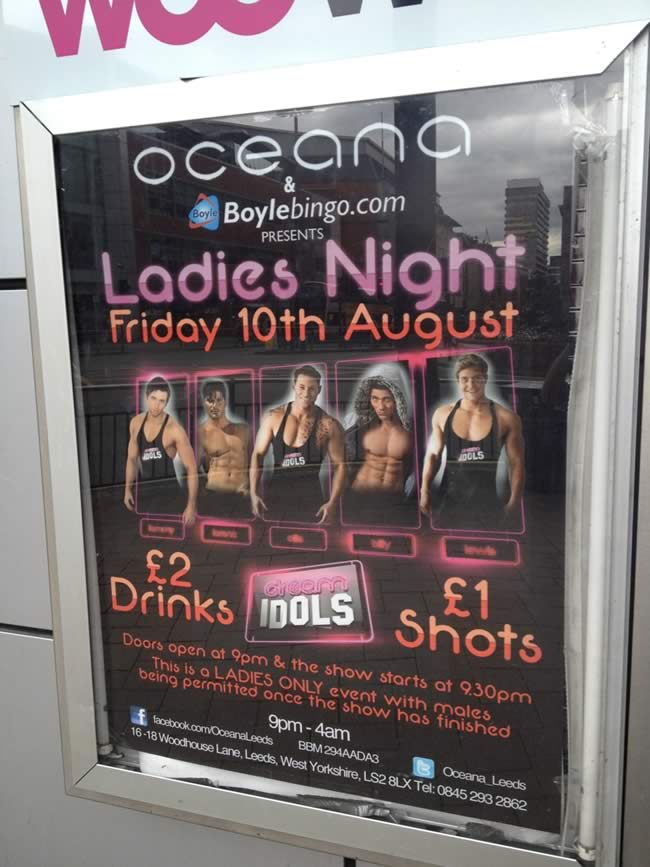
Ladies night poster

Tonight is “Ladies Night” at Oceana. You’ll notice the sexualised images of some young “buff” men in the posters, collectively known as the “Dream Idols” apparently.

This caught my eye because it’s easier to stand behind a claim such as “people should have the right to use their bodies for whatever purposes they wish”, when you’re not the victim. But take this example, it is my gender that is being used in sexual imagery to sell a product (in this case, entry to a night club).

Yet, I’m still entirely behind it. True empowerment and equality come from granting people the freedom to do as they wish. If they want to appear on a poster without a shirt on, who am I to tell them otherwise?

The Wikipedian gender gap

Friday, August 10th, 2012 | Religion & Politics

According to Wikipedia’s own figures, 91% of editors are male. According to another set of their figures, it’s 90%, with 9% women and 1% transgender.

Why is there such a bias towards males?

Stereotype threat doesn’t seem a very good fit for explaining – it’s a fairly anonymous system on the internet, and they only know what gender you are based on the answer you choose to give in the editor’s survey. Not to mention that the Foundation itself is dominated by women – Sue Gardner is Executive Director of the Wikipedia Foundation and Kat Walsh is the Chair of the Board.

The New York Times caused quite a stir when they wrote about it, quoting Jane Margolis who suggests “women are less willing to assert their opinions in public”. Meanwhile Pascal-Emmanuel Gobry, writing in Business Insider, suggests that would upset many existing editors if they were discriminated against by pro-female initiatives.

Many people have weighed in on the debate too and Sue Gardner has done an excellent job of rounding up the opinions on her blog.

Indeed, opinions are so varied, that perhaps the message we can take from it is that more research needs to be done on the subject. It’s interesting to note that while women are very unrepresented, transgender people are actually over represented (1% of Wikipedia compared to 0.3% in the general population), so suggestions of it being a patriarchal problem wouldn’t seem to stand up.

In the meantime, you can always take some positive action and begin contributing to Wikipedia.

Gambling legislation

Tuesday, August 7th, 2012 | Religion & Politics, Thoughts

Last month, a report by the Commons Culture Committee concluded that our gambling legislation was “outdated” and “ill-equipped” to deal with globalisation.

I strongly agree. Having worked in the industry for years, I know first hand that our legislation is lagging behind.

For example, you can only have four FOBTs (fixed odds betting terminals) in a bookies. But over the last ten years, traditional betting has been almost entirely replaced by the use of FOBTs, and without them high street bookies would close. You could argue this is a good thing, but with millions out of work do we really want to go slashing many more jobs?

Secondly, we simply don’t have the legislation to deal with new technology. At Buzz, we developed a bespoke wireless terminal for our games. But what does this count as? A FOBT? It’s just a tablet computer in a case. Does that mean we can put them in pubs? Probably not. But if you took your own tablet into a pub, you could then gamble online. The Gambling Commission simply didn’t know what to do.

Thirdly, because of the online nature and high taxes in the UK, bookmakers can just move abroad – and most of them have. Running a website is the kind of thing you can do from Gibraltar, so they do. Not that it’s cheap – you have to pay staff a lot more money to go work out on some god-forsaken rock, but the tax difference is so great that is still works out cheaper. If we lowered taxes, we would bring that income back to the UK.

This is becoming more and more apparent, as services continue to move online. For example poker tournaments and live dealer casino games, once exclusively the preserve of the real world have now moved onto the internet. You can sit, at a table, with a live dealer, on the internet. When the technology is this good, we need to ensure that our legislation can keep pace with it, or we’re only hurting ourselves.

The problem with FGM

Sunday, August 5th, 2012 | Religion & Politics

Over the past decade, the term female circumcision has been replaced by the term FGM – female genital mutilation.

It’s almost certainly a more accurate term. FGM is entirely unpalatable, the cutting out of a young girl’s genitals (you could say “before she is too young to consent” but that would be meaningless as almost nobody would ever give their consent for such an act, certainly nobody in the right state of mind) no for no reason than depriving her of one of the most basic human pleasures is a beyond-abominable act.

But such a change, without it’s male counterpart, has one drawback.

At the launch of Pro Life Through Pro Choice campaign, a pro choice group which advocated such a stance was also pro life, Norm innocently used the term “female circumcision”, only to be hounded for the rest of the meeting for having the nerve to accidentally use what some people in the room considered the wrong term.

But, when we used the term male circumcision, no such outcry was heard. Even though we now know such a procedure is just as unjustified as its female equivalent, the voices remain oddly silent.

This is a real problem because it creates a double standard – female circumcision gets upgraded to FGM because it’s so heinous, yet male circumcision is allowed to keep its name because it isn’t as wrong. That, as far as I can see, is the only message you can take away from such a change.

It creates at atmosphere where circumcision remains an acceptable term because we have a whole different term of something that is wrong. This gives the term circumcision a free pass – and it shouldn’t have one. It’s a betrayal of the young boys in our society to grant it one.

That isn’t to say that we should rename FGM back – we could simply rename its male equivalent to male gentile mutilation. But either way, we shouldn’t grant any more credence to the idea that it is more acceptable to mutilate a boy’s genitals, than it is a girls.

EDIT: Since originally penning this article, a friend pointed me to a news story on The Guardian in which some campaigners were quite open about the fact that thought millions of males should suffer in case it jeopardised their own position in some unknown way.

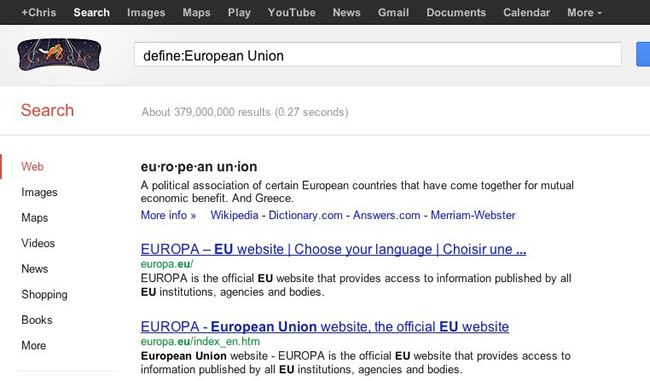
Defining the EU

Saturday, August 4th, 2012 | Religion & Politics

EU definition

Surviving Identity

Thursday, August 2nd, 2012 | Events, Religion & Politics

Recently, Leeds Salon hosted Ken McLaughlin, author of Surviving Identity: Vulnerability and the Psychology of Recognition.

The book itself is a good read. I found the first chapter or so, which discusses the transition from the old social movements (such as traditional labour and trade union movements) so the new social movements that we say today, went over my head somewhat. Not that it wasn’t well written or easy to follow, but I won’t claim to understand the nuances of the historical development of sociology. But beyond that, I settled into an enjoyable read.

Ken’s thesis looks at the increasing prevalence of the “survivor mentality” – once a term used for people who survived the Holocaust, now an increasing number of groups describe themselves as survivor groups, even though the category of things you can die from had been left long behind.

He also commented on the increase of people classified as “vulnerable adults”, which only 40 years ago was restricted to those with mental health issues that explicitly put them at risk of serious abuse, to today’s standard where simply being old can qualify you as a vulnerable adult, in which everyone who comes near you must be rigorously CRB checked, of which the extended CRB checks can include information like accusations – even if you are found innocent. Such restrictions don’t help the field of social care, but more importantly, they don’t help the people they are designed to protect.

If interested, you can find the book on Amazon.

State of the job market

Wednesday, August 1st, 2012 | Religion & Politics, Thoughts

The recent global recession has been a real boom time for me. I’ve switched jobs several times and now gone self employed. When I was lead developer over at Buzz we couldn’t hire people fast enough, and even when we could, the often ended up going elsewhere as other companies desperately tried to attract them with ever spiraling pay increases. Kick backs for referrals started reaching four figures.

Never the less, I heard a lot in the media, and from other people, about how hard it was to get a job and about the record levels of unemployment. The news is full of headlines about how bad things are.

I put it down to the industry I was in. We must be an island, resilient to the global economic downturn, ever-expanding while the rest of the world was reseeding. Sure it was easy to get a job if you worked in software development, but everyone else must be struggling.

Then, in April, Elina moved over to the UK. She had just graduated and had no real work experience. But together we wrote her a CV, put together a “job hunting action plan” and did some interview practice. Within two weeks she had a series of interviews lined up and was offered two of the first three she went to.

In fact, they wanted to start her so quickly that she had already done two days work for one company before receiving a better offer and leaving to go another one.

This once again made me question as to whether there really were no jobs available out there. We certainly didn’t find a lack of them when looking for Elina – just trawling through Gumtree threw up dozens of local vacancies each day.

Having spent three years working at McDonald’s, I have quite a few friends still working in McManagement. Conversations with them tell a similar story to the IT industry – they’ve been pretty much continually recruiting throughout the entire recession.

Last weekend, I also spoke to my auntie who works for a charity shop. While she took the job part-time to give her something to do in her retirement, she is currently working full time because they can’t fill the two paid vacancies they have at the moment.

So if the industry I work in has plenty of jobs, the industry my friends work in has plenty of jobs, the industry my relatives work in has plenty of jobs and Elina can get a job without any real work experience in only a matter of weeks, how then can you make the case that there are no jobs available?

The answer is, I’m not sure you can. The last resort of an answer I could pull up was perhaps due to age barriers as most of my friends are young – but as I’ve already said, my auntie has retired once!

That then opens the question up as to why there is so much unemployment.

Two answers spring to mind.

First off, people just won’t take the jobs available. It’s almost certainly no coincidence that the biggest constant in recruitment are companies like McDonald’s – nobody wants to work there. Many people consider themselves too good to work there. You can argue that it is demeaning for people with a degree to go work in fast food, but I think that is a real insult to people like myself and Norman who did go work there – and we’ll both tell you that we learnt loads!

Not to mention the fact that a bachelor’s degree is far from anything special anymore. But more to the point, it’s totally reasonable for employers to want to hire well rounded people, who have some knowledge of the real world outside of academic the academic environment.

Secondly, I think there is a failure of our education system to prepare people to job hunt. When I finished school, I will put my hand up and admit that I didn’t know how to job hunt. We had gone over writing a CV at school but that is about where it ends.

Job hunting is a lot of work! Loads! I actually much prefer being in a job (although being self-employed is even better) than looking for one because it’s LESS work. When you’re job hunting you need to be putting in a full 40 hour week, you need to be up first thing in a morning, looking presentable to go round speaking to people. When I’m working I can role out of bed any time up until 10am (I like to be in the office by 7:30, but the point is I could go in at 10), and turn up in “whatever you wake up in” – that’s a quote from one of my manager’s.

But I didn’t realise how much effort was required. Nobody at school ever said to me, “it should be a 40 hour week and you need to make sure you have an action plan and a spreadsheet of who you have contacted and when you’re chasing them up.” School should be teaching that because otherwise, it is no wonder that people are unable to find themselves one of the many jobs that are out there.

The nerve

Wednesday, July 25th, 2012 | Religion & Politics

I wasn’t going to write about this, but so many people have now mentioned it to me that I’ve decided it is worth while commenting after all…

It’s now been six months since Lloyds TSB started the processing of correcting the account they had incorrectly set up and then started billing our charity for. They’re still working on it. After all this time, you really have to wonder if they ever will get it done.

This is a bank of truly incompetent scale – no wonder they had to sell 77% of it to the government as part of a £37,000,000,000 bailout from public funds to the major banks. That’s about £800 each btw.

So what did such a bank do with all it’s ill-gotten gains from hard-working taxpayers?

They spent £40,000,000 sponsoring London 2012. As if the tax payer hadn’t paid enough for the Olympics already, Lloyds TSB are now taking our emergency bailout money and spending it on making itself a sponsor of London 2012!

Not only that, but this is only the money paid for the sponsorship deal – and one imagines that the expenses of having a party bus follow the Olympic torch around and anything else rack up to quite a bit. In fact, they’ve even made a website about everything their blowing money on this summer.

It’s absolutely unbelievable.

Footing the bill

Tuesday, July 24th, 2012 | Religion & Politics

Hosting the Olympics has been a harsh affair. We’ve had to temporarily (hopefully!) transformed into a semi-totalitarian state.

But on the flip side, we get to go to the Olympics. Or do we?

The Olympic Stadium holds 80,000 people. So even if you allocate a rather large amount of 800 tickets to sponsors and other interests in the private sector, that still means we can sell 99% of tickets to the generic public. But apparently not. Only 75% of the tickets have gone on sale to the general public. When it comes to the high profile events, that already rather low number of 75% drops to 35%!

But, of course, you have to give some to the private sector. They’re paying for the games after all. Otherwise, the tax payer would have to foot the bill. But, as it turns out, and we all knew already, we are footing the bill.

According to the Guardian, sponsors have contributed £1 billion of funding. They’ve made the data available for free too. The Guardian is actually being generous here – a report by Parliament puts the figure even lower.

Meanwhile, the total cost was reported to the House of Parliament as being around £12 billion. Jules Boykoff points out this isn’t entirely accurate though and, indeed, according to Sky Sports, the figure is actually around the £24 billion mark.

So do the maths on that one. We’re footing 92% to 96% of the cost, yet we’re getting 35% – 75% of the tickets.