The Inner Level
Monday, September 8th, 2025 | Books
The Inner Level: How More Equal Societies Reduce Stress, Restore Sanity and Improve Everyone’s Well-being is a book by Richard Wilkinson and Kate Pickett.
In the book, the authors make the case that inequality is both bad, and currently rising. It is bad because it degrades our mental and physical health, and increases a whole host of related issues such as addiction, crime, and social isolation.
Importantly, they present evidence to show that it is causative. That is to say that rising inequality is the cause of poorer well-being, and not the other way around. We know it is causative from a host of factors including a dose-response relationship, a plausible theoretical basis, poorer well-being following inquality, and being able to see this both across countries (Denmark is happier than the UK) and longitudinally (people in the UK were happier when equality was higher).
Status anxiety and its problems
Humans, like many animals, are sensitive to status. Many animals live in hierarchies and are constantly anxious about where they are in the pecking order. When equality is high, we all feel on the same level. When equality is low, those at the bottom feel depressed, and those everywhere else experience status anxiety. As a result, everyone’s wellbeing gets worse.
You might think that because it impacts so many animals, hierarchies are natural. But that is not the cause with humans. For most of human history, we lived in egalitarian societies where humans worked together and shared things, particularly big game kills. Hierarchies only came into fashion with the agricultural revolution: a relatively short time period in the course of human history.
In summary, the reason there is so much misery at the moment is that we have so much inequality.
What about meritocracy?
Some might argue that this is a good thing because it motivates people to work hard and that those who are successful are rewarded. The problem with this idea is that it is wrong. As inequality rises, the strongest predictor of where you will end up is your starting point. Class at birth is a better predictor of where you will end up than ability or hard work.
In fact, the causative relationship works the other way around. Rather than ability leading to a higher social class, the privilege of being born into a higher class (and its associated benefits such as private schools, more free time, more money) means people end up with more developed abilities than those born into poverty.
As a result, the greater the inequality, the less motivation there is to work hard and “improve your station” because it simply does not work.
Impact on climate breakdown
Another problem with inequality is that it drives a lot of climate change.
When we experience status anxiety, we are consume more. We buy more things to demonstrate to our peers that we belong in a certain social class. For example, designer clothes, gym membrships andyoga classes, prestige cars, bigger houses, etc.
If we built a more equality society, individuals would experience less status anxiety, and therefore be less concerned with consumption. We would value time with each other more having physical possessions.
Similarly, the need for consumption drives long working hours to earn money. This leads us with little time: our free time is valuable, which makes it more time-expensive to look after the environment. If he we consumed less and worked less, we would worry less about the extra time it takes to walk to work, rather than taking the car.
What do we need to do?
If you are with me so far, you will hopefully now agree we should make a more equality society. If you don’t agree with me, go read the book, which makes a much more convincing case than I can do in a short blog post. But what do we need to do to make such a change?
The authors argue we need economic democracy.
In the west, we often view democracy as one person, one vote. But that ignores the fact that some people spend hundreds of millions changing election results. Or that most of the media is owned by billionaires who can use this to control the narrative. Or that corporations often have more power than governments do.
A clear example of this is trade unions. If a company mistreats you, you can complain, or even sue them. But realistically, what can you do when you are just one person and they are a multinational corporation with a team of lawyers and enough money that all they need to do is stall you in court until you go bankrupt? Trade unions restore this power imbalance and make the situation fairer.
But the authors argue we need to go much further. Companies regularly say they have to focus on generating returns for shareholders. This is a misconception. But speaks to how they act. Anything for a quick profit.
One of the reasons for this is the changing way in which companies are owned. Shares used to be owned by individuals who would hold them for an average of seven years. Now most shares are owned by institutional investors, often engaged in high-frequency trading where they hold shares for minutes at a time. When a shareholder only cares about the performance in the next 10 minutes, and not the next 10 years, it is easy to see why companies struggle to maintain a long-term outlook. This system is shares is not suitable for the 21st century.
The authors propose that all companies could be mandated to have employee representation on company boards. This is already the case in many countries, including Germany. They also suggest that, as a society, we could do more to promote, facilitate and encourage employee-owned companies.
Critically, all of this points to inequality not being an inevitable product of society, but a political choice made by pursuing neoliberalism. We can choose something else, such as the social democracy that brought such improvements to wellbeing in the 20th century.
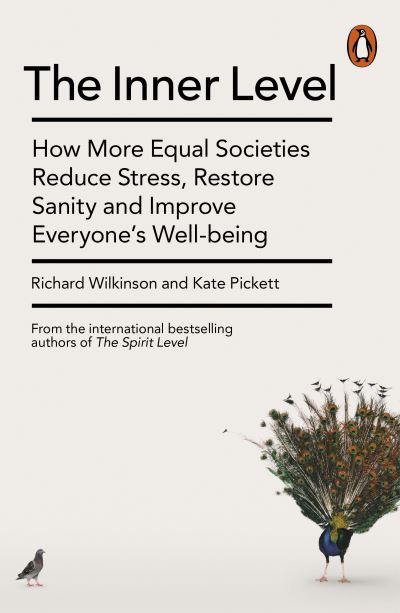
The Inner Level: How More Equal Societies Reduce Stress, Restore Sanity and Improve Everyone’s Well-being is a book by Richard Wilkinson and Kate Pickett.
In the book, the authors make the case that inequality is both bad, and currently rising. It is bad because it degrades our mental and physical health, and increases a whole host of related issues such as addiction, crime, and social isolation.
Importantly, they present evidence to show that it is causative. That is to say that rising inequality is the cause of poorer well-being, and not the other way around. We know it is causative from a host of factors including a dose-response relationship, a plausible theoretical basis, poorer well-being following inquality, and being able to see this both across countries (Denmark is happier than the UK) and longitudinally (people in the UK were happier when equality was higher).
Status anxiety and its problems
Humans, like many animals, are sensitive to status. Many animals live in hierarchies and are constantly anxious about where they are in the pecking order. When equality is high, we all feel on the same level. When equality is low, those at the bottom feel depressed, and those everywhere else experience status anxiety. As a result, everyone’s wellbeing gets worse.
You might think that because it impacts so many animals, hierarchies are natural. But that is not the cause with humans. For most of human history, we lived in egalitarian societies where humans worked together and shared things, particularly big game kills. Hierarchies only came into fashion with the agricultural revolution: a relatively short time period in the course of human history.
In summary, the reason there is so much misery at the moment is that we have so much inequality.
What about meritocracy?
Some might argue that this is a good thing because it motivates people to work hard and that those who are successful are rewarded. The problem with this idea is that it is wrong. As inequality rises, the strongest predictor of where you will end up is your starting point. Class at birth is a better predictor of where you will end up than ability or hard work.
In fact, the causative relationship works the other way around. Rather than ability leading to a higher social class, the privilege of being born into a higher class (and its associated benefits such as private schools, more free time, more money) means people end up with more developed abilities than those born into poverty.
As a result, the greater the inequality, the less motivation there is to work hard and “improve your station” because it simply does not work.
Impact on climate breakdown
Another problem with inequality is that it drives a lot of climate change.
When we experience status anxiety, we are consume more. We buy more things to demonstrate to our peers that we belong in a certain social class. For example, designer clothes, gym membrships andyoga classes, prestige cars, bigger houses, etc.
If we built a more equality society, individuals would experience less status anxiety, and therefore be less concerned with consumption. We would value time with each other more having physical possessions.
Similarly, the need for consumption drives long working hours to earn money. This leads us with little time: our free time is valuable, which makes it more time-expensive to look after the environment. If he we consumed less and worked less, we would worry less about the extra time it takes to walk to work, rather than taking the car.
What do we need to do?
If you are with me so far, you will hopefully now agree we should make a more equality society. If you don’t agree with me, go read the book, which makes a much more convincing case than I can do in a short blog post. But what do we need to do to make such a change?
The authors argue we need economic democracy.
In the west, we often view democracy as one person, one vote. But that ignores the fact that some people spend hundreds of millions changing election results. Or that most of the media is owned by billionaires who can use this to control the narrative. Or that corporations often have more power than governments do.
A clear example of this is trade unions. If a company mistreats you, you can complain, or even sue them. But realistically, what can you do when you are just one person and they are a multinational corporation with a team of lawyers and enough money that all they need to do is stall you in court until you go bankrupt? Trade unions restore this power imbalance and make the situation fairer.
But the authors argue we need to go much further. Companies regularly say they have to focus on generating returns for shareholders. This is a misconception. But speaks to how they act. Anything for a quick profit.
One of the reasons for this is the changing way in which companies are owned. Shares used to be owned by individuals who would hold them for an average of seven years. Now most shares are owned by institutional investors, often engaged in high-frequency trading where they hold shares for minutes at a time. When a shareholder only cares about the performance in the next 10 minutes, and not the next 10 years, it is easy to see why companies struggle to maintain a long-term outlook. This system is shares is not suitable for the 21st century.
The authors propose that all companies could be mandated to have employee representation on company boards. This is already the case in many countries, including Germany. They also suggest that, as a society, we could do more to promote, facilitate and encourage employee-owned companies.
Critically, all of this points to inequality not being an inevitable product of society, but a political choice made by pursuing neoliberalism. We can choose something else, such as the social democracy that brought such improvements to wellbeing in the 20th century.