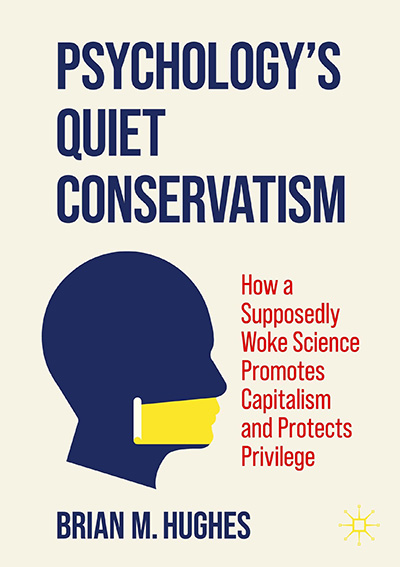
Psychology’s Quiet Conservatism: How a Supposedly Woke Science Promotes Capitalism and Protects Privilege is a book by Brian M. Hughes, Professor of Psychology at the University of Galway. Which I’ve been to, to do the parkrun, of course.
Psychology has been accused by some of having a liberal bias. Hughes opens the book by looking at the evidence, or rather lack of evidence, for this.
He then goes on to talk about how psychology is traditionally highly individualistic. It is the science of individual behaviour. Anything from psychological distress (mental illness) to police violence is looked at in terms of individual actions rather than as systemic issues. Entire branches, like positive psychology, are built around what can the individual do to be happy, rather than what can we do as a society to ensure everyone is happy.
This leads into a capitalist mindset. Mental health is often measured in terms of economic productivity: depression is costing the economy X amount of money and if we spend Y amount of money on mental health services we can get people back into work. This was the specific aim when setting up IAPT (now NHS Talking Therapies) and is a common discussion point, while completely missing the human side of psychological distress.
He also draws attention to the cigarette industry which spent millions funding psychological research by Hans Eysenck claiming that stress causes cancer, not cigarettes. This is the same industry that spent a huge amount of money trying to undermine government science and helped make climate denial mainstream. This latter point isn’t discussed in the book, but it’s shocking just how much damage the cigarette industry has done across a range of fields.
Hughes also points out that we’re still a very white profession and one that seems obsessed with gender differences, despite so many of us individually seeing gender as a social construct. This leads us into racism without necessarily meaning to: so much of psychology assumes a western approach to solving problems is applicable to every other culture in the world.
It also made me think about the peer review process. Anyone who has written a journal article knows how brutal this process is. And this is regarded as good: we don’t care about people’s feelings, we just want the science. While the intention is good, it means that authors have to have enough self-esteem and enough social capital to endure the process. This inevitably punishes minorities harder, leading to a reduction in submissions. Which reinforces the WEIRD (Western, educated, industrialised, rich, democratic) bias we already have. If our objective is to get as much truth as possible, we may want to re-examine this balance.
Psychology might be more popular than sociology, anthropology, political science, or critical theory. But this might be because it conceals real problems rather than revealing them, drawing attention away from structural issues and pointing the blame toward individuals. Psychology research is often done in an American white capitalist echo chamber. It supports existing structures of power, rather than challenging them. Hence, far from having a liberal bias, psychology is deeply entrenched in conservatism and we desperately need to redress this balance.
Hughes starts in quite an academic style. He is rigorous in his referencing but some might find it a little dry. As the book goes on, though, I felt that more of his personality came out without compromising the academic standard. He also writes in very short chapters, which I loved.
Don't have time to check my blog? Get a weekly email with all the new posts. This is my personal blog, so obviously it is 100% spam free.
Tags: psychology
This entry was posted on Wednesday, August 5th, 2026 at 11:00 am and is filed under Books, Religion & Politics. You can follow any responses to this entry through the RSS 2.0 feed. You can leave a response, or trackback from your own site.