Although I really love my Canon EOS 450D, one thing I have noticed recently is that I’m not taking as many photos as I would like to because it’s particularly convenient to take my camera clubbing or to gigs where they search your bags using ambiguous policies.
To counter this I decided to get my self a cheap camera which could serve such a purpose. I finally settled on the Sony DSC-W350 which for under £100 gets you 14 megapixels (two more than my 450D as it happens) and easy point and click operation in something that will easy fit into my pocket.




Size was really my primary concern when making the decision and the W350 holds up well. It’s about the same size as a credit card so if you’re thinking “wow, it’s only slightly better than a paperclip” I should point out that that is a very big paperclip lol.
It comes in at a depth of 17mm, just slightly shy of being twice that of my iPhone 4 at 9.3mm. That seems a little bulky in comparison but it is perhaps an unfair test to compare it to the world’s thinnest smartphone, and it manages to come in thinner than most of the competition I looked at with most of the slim cameras in it’s price range coming in at around 23mm.
Picture quality is mediocre. It is significantly better than my iPhone 4 but having shot with nothing but a DSLR for two and a half years now, my quality expectations have come to rest somewhat high. Just viewing the photos on my 23″ monitor you can see the photos aren’t quite perfect but then for a compact under a £100, you would have to be very demanding to expect them to be – if I need print publication-quality photos, I’ll take my real camera.
What I do like is that the wide-angle lens produces usually warm images in comparison to my DSLR and as the camera’s main use will be taking shots of my friends while we’re out, this actually makes for more than adequate results for what I need it to do.



Work having shat all over my Friday night plans where I was supposed to be delivering a session of the Answers course at Atheist Society and then spending some time with Elina, I eventually made it home around 9pm, still in need of grabbing some dinner.
So, having rescheduled Elina to tomorrow, myself and George headed out to grab some much needed food. While I had heard some mixed reviews since the last time I went, they consistently delivered again with some amazing food. My Weeping Tiger actually tasted more of beef than tiger, but then I’ve never actually had tiger, so maybe it tastes the same.
The May meeting of the Humanist Society of West Yorkshire was a talk by a representative from the animal rights group Uncaged on the subject of animal experimentation. Unfortunately the speaker didn’t actually show up, but we had a fantastic debate on the subject anyway, with opinions being very much divided.
I’m not sure what side of the line I fall, though on the strength of the arguments I think Gijsbert delivered a powerful argument in favour of animal experimentation. It could have been different if someone as eloquent had been there to argue against it, unfortunately most of the arguments but forward by that side were just rubbish.
The biggest problem was that the anti-animal experimentation side used an endless amount of bad arguments and logical fallacies, of which Gijsbert quickly called them on. These included:
- The slippery slope argument and constantly envoking Godwin’s Law.
- Claims that we shouldn’t care if humans die, “so what,” which is fine, but you then can’t argue that we should care about animals. If you say it’s just natural for humans to die, you can also argue that it’s natural for one species to use another for it’s own ends.
- Some people abuse animals and do horrible things to them, so all animal experimentation is bad. It’s true that some animals are treated horrifically, but of course, it doesn’t follow that this makes all animal treatment inherently bad.
- “We’re against ALL animal experimentation. Except humans.”
- Uninformed opinions about the regulations surrounding the issues.
- “You shouldn’t take into consideration how intelligent an animal is. Pain is pain, no matter how intelligent a creature is. Except for insects, it’s fine to kill them.”
- “I saw this on a video many years ago.”
- “If you carry out Kosher slaughter correctly the animal feels no pain, whereas if you don’t pre-stun the animal correctly it suffers horribly.”
There are some great arguments against animal experimentation and it’s a shame that certain voices making comments such as those above, drowned out the few logical arguments that were put forward against animal experimentation.
Last week we headed over to Elbow Room to shoot some pool.
It’s a great place to play as they have plenty of room (as Norm pointed out – the name is probably derived from the fact you have enough elbow room to play) though they are American pool tables which means the pockets are massive and so the chance of you potting the white quickly becomes more of a when than an if, even if you put some thought into it.
In the end myself, Norm and George all came out three wins to two defeats, most of which were won or lost on the white following the black into the pocket lol. Fonze played well also, beating George in the last game, though he did have the advantage that he wasn’t drinking.
At Atheist Society last week, they screened a Dan Dennett lecture given at Conway Hall. During the talk he made some excellent points including a new quote to go on my favourite quotes list: fairies are invisible – so how come everyone knows what they look like?
In the lecture he also answers the question often asked – if religion was just total rubbish, why is it still around? Surely it must be good for something? Dennett’s response was to give an analogy – think of the common cold. What is it good for? It’s good for itself. Similarly, what keeps religion alive is not because it’s good for society, or humanity – it’s just good at keeping itself around.
I headed up to York last week to the North Yorkshire Humanist Group’s meeting as they had a talk on the role of faith based representatives in nursing. The talk was interesting and proved some great debate afterward. It’s interesting to see the variance of opinions on the subject, though most humanists seem overall in favour of the idea of humanist chaplaincy.
After the meeting we headed to a local pub which got a very impressive attendance – probably over 50% of people who went to the meeting joined us at the pub, a retention rate which I’m sure West Yorkshire would love to emulate.
Earlier this year, when Oli and Jess got together, Norm made a start on the usual paperwork for a possible new application to The Circle. This resulted in us having to schedule a house party for some induction training – it’s a hard life, but you just have to get on and do it I guess.
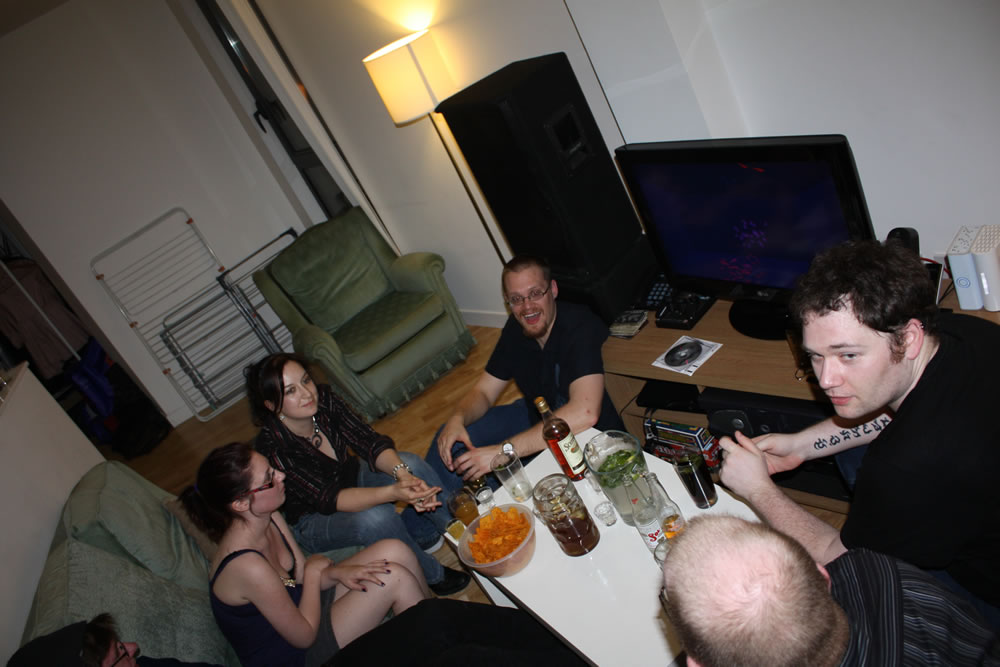
While unfortunately neither Oli nor Jess actually made it to the party, it was a great night none the less with the party raging until around 4am and a strange hour in which everyone decided to try and pick everyone else up.
Indeed, the night ended up so heavy that Norm was unable to eat his recovery steak at the next day and I just collapsed out in front of the TV for most of the afternoon.




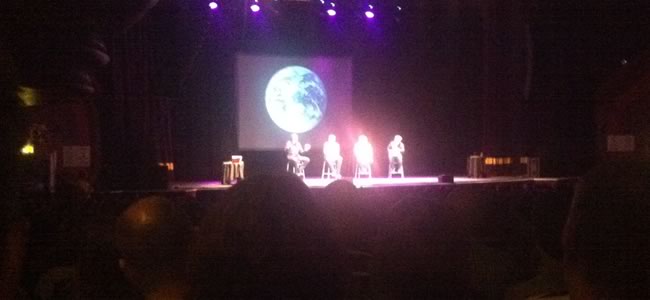
Myself and Norm recently headed over to Manchester to see Uncaged Monkeys – a popular science stage show based on the radio show Infinite Monkey Cage. The show featured Brian Cox, Ben Goldacre, Simon Singh, Matt Parker and a host of other sceptical faces, all anchored by the always entertaining Robin Ince.
Not only was the show entertaining, but it was also great to go to a gig where we actually felt far younger than the average audience member, rather than far older (such as here or here for example).
Earlier this month, the Atheist Society held it’s 2011 AGM. This was an important event, as it marked the end of my involvement with the group. This year has very much been consultative anyway, as fresh blood takes over, and it’s great to see the society is returning to its great shape.
This December will mark five years since the society was founded, though it seems like forever ago that we were first starting things up. As such, I would like to say a big thank you to everyone who helped make the society what it is.
Without a doubt Norm is due the biggest amount of credit, having signed up on day one and being easily the most influential person also to be involved in the society. I would also like to say a big thank you to Matt and Claire for helping the society to get started and Nicola and Paul for their tireless work over the years. And of course, all of those who have served on the committee and helped out at events have all made valuable contributions which I’m grateful for.
The recent elections saw James, Elettra, Will and Michael form the new committee and I’m sure with such excellent leadership, the society will continue to prosper and grow.
We often joke about Godwin’s law so it’s easy to forget that sometimes, people are actually silly enough to try and use it as a legitimate argument.
A few months ago, 4Thoughts, a series of short commentaries by Channel 4, did a week on religious slaughter, a topic which I wrote about a few days ago. The first of which was by a man named Chanoch Kesselman who literally said, the first thing the Nazi’s did was to ban ritual slaughter, and then they killed six million Jews. You can watch the video here.
In total there were seven videos on the subject, though they didn’t prevent a very balanced argument. Only one of the videos was by a non-religious person, the rest were from believers. Two of which were Christians, but you really can’t call what they said being supportive to either side. Only Helen Rossiter made the case that animal welfare considerations might want to play a part in a decision about animal welfare.