Chris Worfolk's Blog


Google’s great car crash

August 25th, 2011 | Tech

Recently, Google merged their regular accounts with their Google Apps accounts. Unfortunately, they didn’t do it very well.

The problem is that people often had both accounts using the same email address. For example, chrisworfolkfoundation.org is managed by Google Apps and so we have an info@ email address. But because you only get mail, calendar and docs with Google Apps, in order to use services like YouTube and Google Checkout, Google made us set up a separate account with the same email address.

Now they have merged them all together, obviously they have found that they have a lot of conflicts.

Indeed, we noticed then when I recently tried to sign into the Foundation’s Checkout sellers account and found that it wouldn’t accept the right password. It would accept the other password, but that account was empty. When I contacted Google Support – a rarity they let you do I will tell you!, they said they had created a temporary account for me and I would have to sign in to that one and use the migration tool.

I signed in, there was no migration tool.

I then started to worry about my other accounts with Google and signed into one of their other services, at which point I finally made it onto the migration.

This would seem OK, I could migrate a lot of my data over to the new account. However it wasn’t as simple as this. First of all, a lot of the data is sensitive and doesn’t want to be accessed by everyone who has access to the email account. But you don’t seem to be able to migrate to any account other than the conflicting one. The only other option is to create a whole new account @gmail.com.

Secondly, none of it works. We use about 12 different Google services – 9 of which aren’t supported by the migration wizard, two of which are supported but weren’t available for us because there were complications. In fact, the wizard only actually allowed us to migrate one of our services – Picasa Web Albums over to the new system.

This left me with having to create a brand new @gmail.com account for the Foundation which many of our services are now using including YouTube, reCAPTCHA, Google Checkout, AdWords and many others. All of which now looses significant user confidence because what organisation uses an @gmail.com account?

After all this, many of the manual migration that Google suggests you do as a last resort doesn’t exist either. reCAPTCHA for example offers no way to transfer the domains/keys you hold to a different account and of course, because it’s now a just a small wing of the Google Corporation, you can’t contact support about it because Google don’t do customer support.

I actually mourn for the days of Microsoft, they weren’t perfect but at least they do backward compatibility and customer support.

HSoWY Summer Social

August 24th, 2011 | Humanism

I hadn’t been able to make the last Humanist Society summer social because I was meeting the parent, but August provided a good opportunity to take in a few drinks at The Adelphi over some good conversation.

It turned out to be a really good night – almost half the people who turned up were new members, or at least hadn’t been in so long that I didn’t know them – one guy said he had first joined in 1984 – two years before I was born! It’s great to belong to a group which has such a long and rich history.

The food was quite nice if a little overpriced, but the drinks weren’t too bad – at least once the barman realised he had meant to say £7.10 rather than £17.10!

August Humanist Community

August 23rd, 2011 | Foundation, Humanism

Despite many of our members being unable to attend because they were at Leeds Pride, the August meeting of Humanist Community was both well attended and a fascinating evening.

The topic of conversation covered social justice, balancing freedom of expression with protection of people’s safety, world languages, equality and whether the sausages Gijsbert had been given were actually vegetarian or not – turns out they weren’t, so it was a good job we had such a good discussion about it and checked before he started eating!

Facebook Freeroll

August 22nd, 2011 | Distractions

Recently, myself and Norm headed up to the Grosvenor casino for their “Facebook Freeroll” tournament – a £500 guaranteed free roll that I figured was worth a punt. I managed to double up in the buy in period so didn’t need to re-buy, though I wasn’t impressed by the £2 for my coke, even if it was unlimited refills and a no registration fee evening.

I managed to keep going until 2am, at which point I still had 60,000 chips (with an average of 37,000), but I was so tired by this point I started making silly calls and was eventually knocked out after going all in on trip eights, which lost to a flush on the river. Could have been worse though, 21st out of 129 with no re-buy.

Riot!

August 21st, 2011 | Religion & Politics, Thoughts

As you may have noticed, we recently experienced some riots in the UK.

Everything was fine here in Leeds. Someone got shot in Chapeltown, but that is just a normal evening in Chapeltown. In fact, rather than a riot, we had a march of peace while other cities were kicking off. Good old Yorkshire values present such destruction, as we just stick kettle on instead (and it’s important to note I didn’t say stick the kettle on.

Two things I found interesting though.

Firstly, the amount of people who turn out to be rather right wing when it affects their lives. We should lock them up, evict them, beat school children with a cane and possibly bring back the death penalty should Facebook comments and tweets be believed.

Obviously we shouldn’t do this, we want to live in a fear-free progressive society, not a police state.

The second is that, the remaining people, though relatively few in number, seemed to think that those who were behind the riots, shouldn’t take much responsibility at all. It’s due to underlying social issues and the forgotten generation, so it isn’t their fault.

Of course this is equally nonsense. Even if there are underlying social causes, which there are, but rather contributing factors than absolute causes, people need to take some responsibility for their actions and nothing that took place in the past week is justified – stealing a loaf of bread for your starving family is justified, looting a shop isn’t.

So basically, if you expressed an opinion on the riots, you were probably wrong about it ;). But I look forward to blog posts from other people explaining to me why my middle of the road approach is nonsense as well… :D.

2011 AGM

August 20th, 2011 | Foundation

Last week we held the 2011 AGM. It was an exciting room to be in, as we discussed the work which has been done over the previous year and some very exciting projects which are up and coming. Don’t worry if you missed it – our 2011 Annual Report is now available to download from our website.

Are exams getting easier?

August 19th, 2011 | Religion & Politics, Thoughts

It’s everyone’s favourite time of year again – the debate as to whether exams are getting easier.

Yet again of course, exam results have gone up and everyone is asking “have exams gotten easier?” The answer, of course, is yes. Clearly if such a large sample size as the whole of the United Kingdom, probably going on a million children, have consistently achieved higher grades than last year, the exams are getting easier.

The educational community will quickly argue that it is in fact teaching methods getting better, but this to me, seems irrelevant. Even if it is teaching methods getting better, which I’m not disputing – I’m sure they are, if the exams stay the same and don’t get more challenging in proportion to teaching methods getting better, then from the perspective of the child, the exam has got easier – with the same amount of effort and intelligent on their part, they are able to achieve a higher grade.

You can then argue that, given they have done better in the exam, they deserve that higher grade, but I disagree. Firstly, just because teaching methods have improved to allow them to do better, doesn’t mean that they have actually learnt more – maybe teaching methods have just improved in terms of teaching kids to pass exams and not actually learn more, which seems a very plausible scenario.

Secondly, even if they are more knowledgeable about a specific subject, doesn’t mean they necessarily deserve a higher grade. That sounds counter-intuitive at first, but in reality the main purpose of exams is to test how intelligent someone is and just because schools have found a way to better put knowledge into their head in order to pass an exam doesn’t really help that purpose. On that basis, the only reason that exam results should go up is if children are genuinely getting more intelligent – this could be the case but I haven’t seen any evidence to show it’s happening, at least at the same rate as exam results are improving.

Therefore, I would argue that the constant year on year improvement in exam performance, is a problem.

The solution, I would put forward is percentile banding of exam results. Rather than setting specific levels which a candidate has to reach, you put all the results together and give a certain percentile each grade – for example the top ten percent get A*, the next ten percent get an A, the next ten percent get a B and so on.

I’m not arguing this is a perfect system, and you probably need to have something in place where there isn’t a “fail” percentile, if possible, but below I will outline why I think it would arguably be a fairer system than the current one.

Primarily, it ends the debate on whether exams are getting easier. Every year exam results would stay the same, because the same percentage of people will get each grade, and it doesn’t matter if exams get easier or harder because the system sorts itself out. It is impossible to make exams the exact same difficulty every year because you have to change them and under the current system, children are unfairly punished if they happen to get a slightly harder exam and unfairly rewarded if they happen to get a slightly easier exam. This eliminates that.

Secondly, it stops the grade creep which leads to everyone getting grades closer and closer to the top and therefore makes it harder for universities and employers to distinguish between the top candidates.

There are criticisms of such a system, and I will deal with these now.

Firstly, it means that a child could lose a grade just because they end up in a year where everyone does well. This doesn’t really stand up because, because of the sample size involved, if everyone else does well it is more likely to be because the exam is slightly easier this year and therefore they haven’t lost a grade, they simply weren’t good enough to achieve it.

Indeed, sample size is important. When dealing with an entire year group, which as I previously stated I would imagine is heading towards a million children, the probability that an entire generation happened to suddenly be more intelligent than the year before, is far less likely than this year’s exams simply being a little easier.

You could also argue that everyone deserves the change to get an A* if they achieve the required level. There are two parts to this answer, first of all, they have target just like the current system – except, instead of a specific number of marks, their target is to reach the top ten percentile, but either way they have a set, fixed target to reach. Secondly, you could argue that if everyone in the country all worked really, really hard, they should all deserve to get A*.

This is true, but this has never, ever happened. Indeed, what is the probability that this would ever happen? The answer of course is negligable, when you are dealing with such a big sample size, it evens out and you don’t get disadvantaged by statistical anomlies as you do under the current system.

So…

You could replace the current system with a banded percentile system and ensure that the grades accurately reflect a candidates performance, irrelevant of how accurate the difficulty level of the exam was and without worry that they were disadvantaged due to circumstance because of the sample sizes involved. This will then allow employers and universities to accurately select the best candidates, which is the whole point of standardised testing after all. It’s not a perfect system, but it’s arguably fairer than the current one.

Unfortunately, there would be very little incentive to change because the current system plays into the favour of schools and governments, because it makes them look like they have done better every year. This is probably true, but at the disadvantage that it makes the achievement far less meaningful.


Leeds Pride 2011

August 18th, 2011 | Events, Photos

The first Sunday of August saw Leeds Pride 2011. Everyone likes to see a parade, particularly when it comes right past your house, so as with last year I took plenty of photos. I was a little disappointed by the floats this year, but it was an enjoyable day nonetheless.

You can see more photos from the event on Atheist Stock.

Live poker

August 17th, 2011 | Distractions

Yesterday, I blogged about Poker Stats Library, a couple of scripts I wrote which I’ve now published on Github. On Saturday, it was time to try them out.

I headed down to Grosvenor to take part in their freeroll tournament. I say freeroll, it was a £10 rebuy tournament, which gets you twice the number of chips, so almost everyone buys in again. As I sat down at the table I found myself sitting opposite a guy named Christopher Norfolk – while I’m aware of the laws of probability, it’s still an amusing coincidence.

I ended up placing 11th, out of the 79 that entered. I was doing quite well but having started at 2pm, I had arranged to meet Elina at 6pm and by this time it was 7pm, so I went all in on an ace high for boom or bust and lost. Still, an enjoyable evening none the less.

Poker Stats Library

August 16th, 2011 | Tech

A few weeks ago, I wrote some tools which would help me out in getting to grips with poker, which in general I fail at.

It annoyed me because it should be fairly simple for someone like myself to get my head around the poker maths (well, it is, pot odds are easy), so even despite the lack of social understanding the life of a computer scientist brings, I should at least be able to achieve a level of averageness in the game. I clearly have failed to do this, and so I decided a bit of work on my basic strategy was needed.

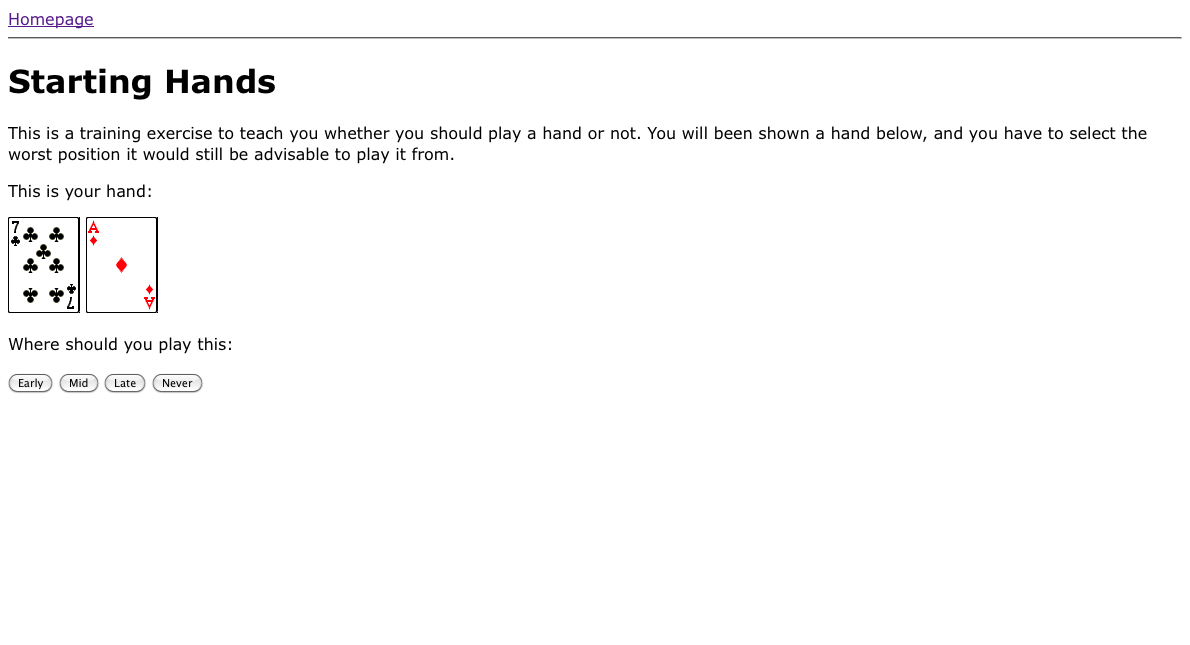
As a result, I built an interactive tool which would teach me what starting hands I should play, similar to the concept of Basic Strategy in blackjack. It presents you with two cards and you have to say what position you can play them from, if any. It will then tell you if you are correct or not, if not it will ask you to try again and if so, it will move on to the next hand.

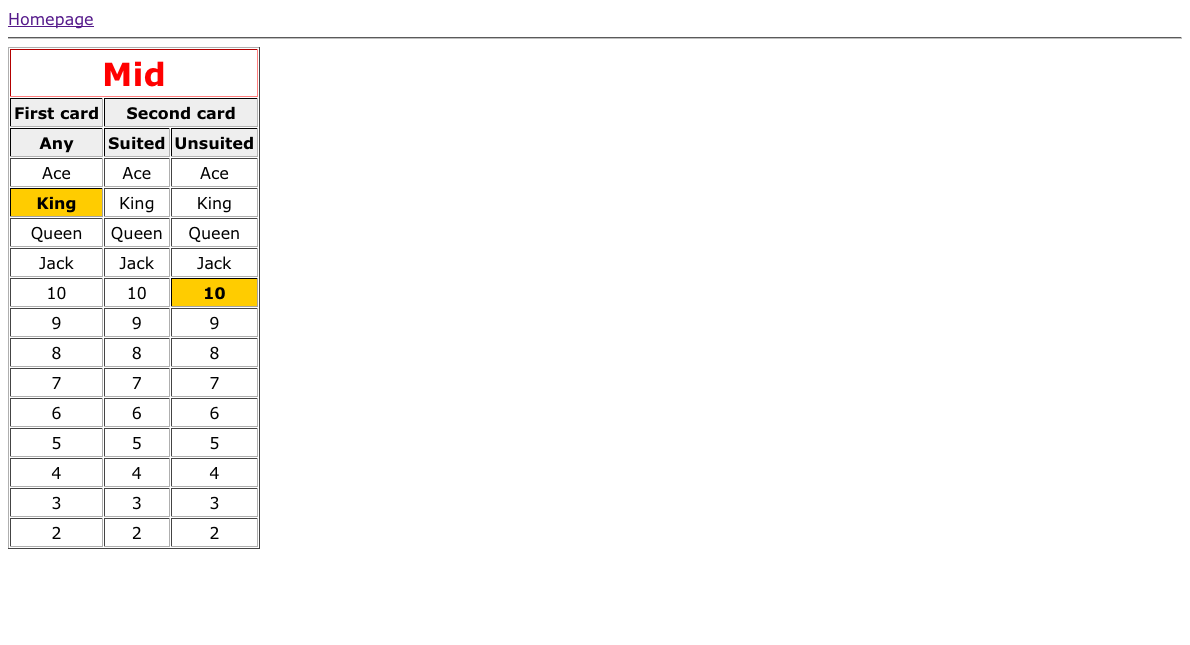
I also wrote a tool which allows you to select the cards you have, and using the same formulas it will tell you what position that hand is worth playing from. I’ve thrown in a few other simple odds calculations in there as well.

Of course, these won’t make you a great poker play by themselves, but it should provide a good basis to learn from.

Given the tools would otherwise just disappear into the depths of my hard drive somewhere, I’ve decided to publish the code on Github. Should you have any interest, you can download the source from the Github repository. It’s all written in PHP and should run out of the box.

Btw, the images below are screenshots, but the way they have been scaled down looks rubbish. They make more sense when you open them…