Chris Worfolk's Blog


A Random Walk Down Wall Street

May 4th, 2014 | Books

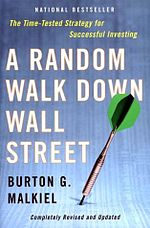
Two of the books I have read recently, Everything Is Obvious and The Signal and the Noise, made references to Burton Malkiel’s book “A Random Walk Down Wall Street”. They pointed out that the stock market is entirely unpredictable and therefore investment bankers are just guessing. I was curious to read more, so I picked up the book itself.

An index tracks stock market movements. For example the FTSE 100 tracks 100 companies on the London Stock Exchange, while the Standard & Poors (S&P) 500 or Russell 3000 track a far more broad range of stock prices. These therefore provide a good indication of whether the stock market moves up or down.

Now take a mutual fund – these are professionally managed funds that the general public put their money in for someone to manage on their behalf. The benchmark here is not whether they can grow their investment, but whether they can grow their investment at a better rate than the index (because the stock market generally moves up anyway). If they were just guessing, you would expect 50% of mutual funds to beat the index, and the other 50% to fail, in both cases just due to chance.

However, the research, as discussed at length in A Random Walk Down Wall Street, shows that only 40% of mutual funds can beat the index! This is not just guessing – this is worse than guessing. Professional investment managers not only do not add any value to the funds they are managing, they actually subtract value.

You could make the case that there are just a lot of bad fund managers. However, the research refutes this too. As Malkiel describes, if you take the top performing funds over a five year period they almost invariably fail to beat the index over the next five year period.

This should not actually be that surprising. The Wall Street Journal has long shown that throwing darts at the stock listings produces a better return than the experts; a noticeably better return once you adjust for risk. To see it in practice (I include this as an anecdote to make the facts more believable) just watch the BBC documentary Million Dollar Traders in which eight complete notices only lose 2.5% in a period where their multi-millionaire master-of-trading coach loses 5%.

Of course it is hard to believe. Why are all these people employed if they add no value? That is a fact I find hard to reconcile. Surely if we are talking about efficient markets, at least one bank would have realised they could fire all these traders and replace them with monkeys? Counter arguments to this suggest that the average trader actually earns a pittance, and that because it is in the interest of traders (justifying their own job) and brokers (getting rich of the transaction fees from all this needless trainers) to maintain the illusion that they actually do something, the industry keeps selling these products to the general public who simply don’t realise.

The evidence, at least if Malkiel is to be believed, is clear. You should invest all your money in an index tracker with the lowest fee you can find. That produces the most consistent returns compared with a mutual fund that charges you higher fees to produce a lower return. Nate Silver says the same thing.

In the final part of the book, Malkiel goes on offer some investment advice for those who do not want to use an index fund. He also hints that he picks individual stocks too. This is odd as it goes against a lot of what the evidence he has presented says, but is consistent with what the psychology says – that we have a really hard time accepting what the scientific evidence says when it contradicts our own pet theories, achievements and so called “common sense”.
A Random Walk Down Wall Street

The Truth

April 27th, 2014 | Books

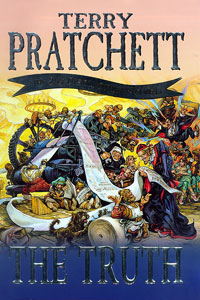
The Truth is the 25th novel in Terry Pratchett’s Discworld series. It follows the adventures of William de Worde as he accidentally starts the first newspaper, The Ankh-Morpork Times.

Without a doubt, it has been my favourite novel so far. The pioneering spirit of free enterprise, the passion for reporting the news to the public and the almost-tangible smell of Ankh-Morpock that emanates from the pages makes for a powerful, if odorous, combination.

I do wonder as to what the sitcom element comes into play in making the stories enjoyable. In a sitcom, you get to know the characters and that is what makes the situations so funny (not because the situation itself is inherently hilarious on its own). Similarly, it could be that the earlier novels are just as good as the later ones, and if you read them the other way round, you would enjoy the earlier ones more. Or maybe not. Or maybe it is a combination of both.

The-Truth

Everything is Obvious: Why Common Sense is Nonsense

April 26th, 2014 | Books

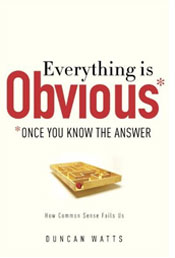
Everything is obvious – once you know the answer. That is the suggestion put forward by Duncan J Watts in his book. Is is not available as an ebook, which is very annoying, so I had to read this one using paper. Like I am living in the nineties…

It was a phenomenal read. Watts first puts forward the case against common sense. Within the first twenty pages I felt like I could never trust myself to make a decision again. Luckily common sense is not the kind of thing that lets logic get in the way, as Watts explains.

He points out that common sense is not that common. If it was, we could all just think about a problem, and come to the same conclusion. But we do not. Common sense is built up from our experiences to explain how to deal with every day situations. That means that each of us has different common sense. Not to mention that many of our common sense rules are contradictory to each other.

This is a problem because when we try and solve a problem, we often use common sense. These are built on our experiences, which are different from other people’s experiences, hence are not directly translatable. One of the most extreme cases of this is that what is the obvious solution to a politician from a rich Western country is not the actual solution that impoverished third world countries actually need.

He then goes on to point out that when you realise you cannot trust your own common sense and go looking at lessons from history, these are useless too. History only plays out once, which as any statistician will tell you, is a pretty poor sample size. The iPod may have been a huge success while MiniDisc floundered, but was it due to Apple having a better strategy than Sony, or where they simply the victims of circumstances? The honest answer is, we will probably never know.

Finally he presents some solutions to the problems put forward. We need to be aware of our biases. We need to do things that we can test and measure scientifically. Sometimes however, this simply is not possible. In those situations, we are basically screwed…

Still, at least we know that now.

everything-is-obvious

Area speech contest

April 25th, 2014 | Public Speaking

Last week I had the pleasure of going to Sheffield for the Toastmasters Area 15 International Speech & Evaluation contest. At said meeting I was elected as next years Area Governor. It remains to be seen whether that counts as winning or not ;). Congratulations to Billal, Jane, Gail and Pauline who proceed on to Division.

Restaurant closures

April 24th, 2014 | Thoughts

Since August last year, we have lost 18 restaurants in Leeds. That would not be so bad if it was the rubbish restaurants that had closed. But it never is. Quality has basically nothing to do with the success of a restaurant and marketing has everything to do with it.

Recently we have lost Curry Leaf (my favourite Indian), La Grillade (my favourite French), Cafe Italia (my favourite Italian) as well as many other great kitchens including Saengarun and Norman’s.

Meanwhile so many low quality chain restaurants continue to churn out their mush. It makes me sad.

Casting Light on Evidence

April 23rd, 2014 | Foundation, Humanism

For the April meeting of Leeds Skeptics, Dr Paul Marchant presented a talk entitled “Casting Light on Evidence … & Evidence on Light”. The talk looked at how data is used on public policy making, to varying degrees of success.

IMG_4036 IMG_4038 IMG_4039

Sunday Assembly March

April 22nd, 2014 | Humanism

I hosted the March event of Sunday Assembly Leeds. The theme was Spring. We had readings from Dermot and Andrew, a talk on laughter from Hugh, Hal is trying his best and Michelle announced the first community action day.

IMG_3997 IMG_4010 IMG_4019 IMG_4032 IMG_4033 IMG_4034 IMG_4035

Rainbow

April 21st, 2014 | Photos

rainbow

I tried to capture the rainbow I could see from my balcony, to a certain degree of success.

Louis Theroux’s LA Stories

April 20th, 2014 | Distractions, Thoughts

Louis Theroux is my favourite documentary maker. When I read in the BBC Magazine that he had moved to LA and was planning on making some documentaries on his experiences there, I awaited them with much anticipation.

They were not my favourite documentaries he has ever done, but still enjoyable. The dogs one was fairly predictable. It also puts in perspective the destruction of a giraffe in Denmark. One pound in South LA is killing dogs by the dozen on a regular basis. Why are people not up in arms about that? Not to mention all the animals we eat…

End-of-life care helped explain how the United States manages to blow quite so much money on healthcare. Some of the people in there were correct – why not try everything to fight for life if you have the choice? But on a societal level, you do have to wonder whether those resources could be better spent elsewhere. It must be a tough decision for the people who make those kind of budget calls.

The most thought provoking I found was the sex offenders episode. It was pretty clear that nobody thinks these people deserve a second chance. However, if you are going to adopt that kind of attitude, why let them out of prison in the first place? Or put them to death. That is something the US still does of course.

I do not know how this compares to the UK system. I can, for example, get a list of all the sex offenders in my area from a handy site called “UK Paedos Exposed”. However, this seems to be built from user submissions, rather than state-published data. That is a pretty sick website, but not on the same level as the state-run database you can find in the US.

This is available from the UK government, but only if you are a parent or carer and want to check a specific individual. However, The Sun newspaper claim to have plotted every convicted sex offender on a map.

Meanwhile the open access in the US, as Theroux points out, leads to apps like “Offender Locator” that allow you to find them.

offender-locator

Fonze’s birthday

April 19th, 2014 | Friends

With Fonze getting another year older earlier this month, we planned a three part celebration.

First, I made him to go flag football training. What more could you ask for on your birthday? Actually, he wanted to come, but it all worked out for everyone 😀 . For lunch, we went to his parents. His mum does a good Sunday lunch.

Finally, we finished up going to Chaophraya for dinner. I had wanted to go to Saengarun but unfortunately it had closed down. The advantage of Chaophraya though is that you can order the birthday cake where they come with the drums and all the staff sing happy birthday. Despite his accusatory and threatening tone, I think that was his favourite part of the day.