Chris Worfolk's Blog


Breathing space

July 18th, 2015 | Life

This time last year I was running eight community groups. Anxiety Leeds, Leeds Tornadoes, Leeds City Toastmasters, White Rose Speakers, Humanist Action Group, Sunday Assembly Leeds, West Yorkshire Humanists and Leeds Skeptics.

I have been gradually cutting that down over the past year. I moved on to being a Toastmasters area governor (so looking after five clubs rather than two) and that too has now come to an end. Leeds Skeptics is now in the capable hands of Trevor and I’ve moved to Leeds Samurai, so I can train without the organisational hassle.

All in all then I am a now mere civilian in four of those groups and can attend as and when I have time.

I’ve cut down on my personal commitments too. Last year I was having regular lessons for guitar, singing and Finnish. Now I am down to Finnish and piano.

It’s an interesting experiment, not cramming far too much into my life and hoping it all gets through the doorway. So far, it’s working out okay. It’s still a lot of groups, and I won’t say I have much unscheduled time, but I am now finding more time to revise, and even a bit of timing to garden (luckily this only requires limited attention when all you have is a balcony). Besides which wedding planning quickly turns into a full time job…

Who are the middle class?

July 17th, 2015 | Religion & Politics

When I was a kid, working out what class you were was simple. If you brought TV Times you were working class, if you bought Radio Times you were middle class and if you had a man to read the TV listings to you, you were upper class.

As I have grown older though, I have begin to wonder whether it might be slightly more nuanced than that.

A traditional British view might divide people into the aristocracy, the lords and ladies, the middle or ownership class, who own factories and businesses, and the working class, who work in them. I use traditional in a loose sense here because that has only been the case since the industrial revolution. This view fits with the wider social description of the class “between” the peasants and the nobility.

In more recent times, many new definitions have been brought forward. Some of which may have been promoted by governments in an attempt to create an aspiration. The advantage of this being that people will make sacrifices in order to achieve it, thus suppressing criticism of their policies.

Further education being a good example. Did you parents go to university? Or enjoy a high-prestige job such as a doctor or lawyer? Under some definitions this would categorise you as middle class.

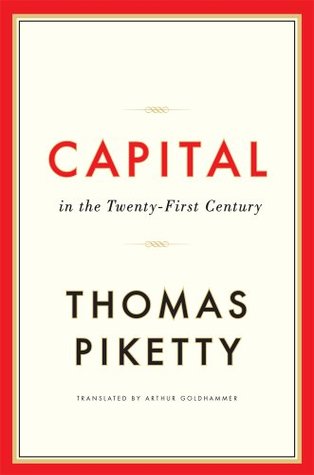
In Capital in the Twenty-First Century Thomas Piketty divides society up into the top 10%, the middle 40% and the bottom 50%. Though he does this with the explicit statement that these are arbitary boundaries that are useful for statistical comparisons across states and not meant to be taken as definitions.

He does note however that one of the major changes of the last century was a shift away from a 10% owning everything, to 10% owning most things, while the 40% managed to gain a house (the bottom 50% still owning nothing). Home ownership could therefore be considered the qualification for middle class.

Ultimately then it would seem there is no agreed definition of what the middle class actually is. It would therefore seem wise to define it in the context of any debate being had.

Capital in the Twenty-First Century

July 16th, 2015 | Books

How has wealth inequality changed over the previous few centuries and what does that tell us about the present? That is the rather large question that French economist Thomas Piketty attempts to answer in this book.

No doubt his writing is in a far more coherant and structured format than my description of it, but here goes.

H begins with a global outlook. Poor countries are gradually catching up with rich countries, and he notes that wealth inequality is primarily within a country. China is making rapid progress in catching up with Europe for example, while the working class of Europe are not making the same gains on the upper class.

Nevertheless, it is a long and hard struggle. Once one country has an advantage, it can essentially own another. This is how European nations managed to maintain colonial domination while running a trade deficit. We could simply put our colonies into debt and then force them to work for us to pay it off.

Once they do grow, they are unlikely to overtake us because as they become a first world country the growth levels off. They are also a long way behind. Europe has 2000% the wealth of China for example, so even growing at 8% a year, once you factor in that Europe is also growing, that is a long way to catch up.

The oil countries could see huge growth though because of their sovereign wealth funds.

Europe itself remains incredibly rich. Richer than anyone else in the world. Though admittedly the United States are the only real competition. However this wealth is all in private hands. European governments themselves are heavily in debt, mostly to their own citizens, and typically have a capital of 0, because their public assets only just cover said debts.

It is traditionally highly unequal wealth. Far from being the land of the financially free, it was the United States that pioneered high tax of the wealthiest and it is only in recent decades that America’s wealth inequality has become greater than Europe’s.

This wealth is very concentrated. One way is labour inequality. Some people are paid far more than others. Though this is not always the close. In 1970s Scandinavia the top 10% of earners claimed 20% of the earnings. This seems a reasonable level of inequality to me.

A much more pressing issue though is capital inequality. Even in the most equal societies the bottom 50% will typically own nothing. Before the World Wars 1% typically owned 50% and 10% owned another 40%. The Wars changed this, but only as far as to allow the next 40% to buy their own home, which is not much by comparison, and still leaving 50% without assets.

Capital inequality is typically inherited. Thus it is not a useful form of inequality because it does not provide motivation for people to earn money. The point of inequality is to motivate people to work hard and earn money, but there is no utility in allowing people to merely inherit large amounts of capital – in fact this encourages them to do nothing.

It is also worth noting that labour inequality does not necessarily provide this motivation either. This is because the differences in “super manager” compensation cannot be directly related to a persons output but rather by industry and non-talent based conditions (luck).

Once people are rich the problem of wealth inequality perpetuates itself. Inflation, which many assume would reduce wealth, actually makes the situation worse. This is because poor people see their savings eroded by inflation while large amounts of capital is able to better protect itself.

It does this in a number of ways. By being larger, the capital of American university endowments when compared to individual savers for example, can afford to spend far more on management. Harvard has around $30 billion, so can spend $100 million a year on management with that only being 0.3% of their capital, which will be more than made up for in growth.

Secondly, with a bigger fund you can diversity into more risky assets. This produces a less predictable short term but a more profitable long term. Thirdly, many options that Harvard invest in may simply be entirely unavailable to small amounts of capital, such as products which require a large minimum investment.

Thus the rich get richer and the poor get poorer with no relation to the work, productivity or utility of the individual. There is no self-correcting mechanism for this.

What can we do about this?

Free university could be one way. It seems to have reduced inequality in the Nordics, though this has not been entirely proven. Picketty also suggests minimum wage will not help in the long run.

He suggests a global tax on capital. This would be low, initially at 0.1% of total capital, progressively rising to 0.5% for the largest fortunes.

This would have to be done in a global level, or at least a European level and require cooperation from banks. Otherwise people would just hide their assets. Indeed, it should be noted that the balance of payments for Earth is currently negative! More wealth flows out that comes in. This is of course theoretically impossible, but could be accounted for by tax heavens not being transparent.

A global tax on capital would encourage people to generate money and become rich, which ensuring that these fortunes cannot be used by future generations to unfairly dominate the economic landscape.

In summary, the following points:

  • Capital inequality is the biggest form of inequality
  • The twentieth century saw some reduction in the importance of inheritance, but this is now returning
  • Large inherited fortunes serve no utility to society
  • Large fortunes are able to perpetuate themselves and thus the rich get richer and the poor get poorer
  • There is no natural self-correcting mechanism for this
  • The best way to tackle this would be with a global tax on capital

Capital in the 21st century

Is privilege profitable?

July 15th, 2015 | Religion & Politics, Thoughts

Why do people maintain their bigoted beliefs even when it works against their own immediate interests? Bakers and hotel owners not selling to gay people or atheists for example.

In a recent blog post entitled “Why Are People Bigoted, Even When It Costs Them Money?” Greta Christina proposes that people act this way because it is of overall benefit to maintain their white/straight/male privilege than it is to reap the immediate benefit.

According to the theory, maintaining privilege is profitable, even when factoring in the short-term loses.

Unfortunately, I believe the blog post is short on both evidence or further explanation.

Presumably, a secret cabal designed to maintain each privilege is not being suggested. Especially as she herself would presumably be included in the while cabal, but not the male cabal, and therefore be able to see both sides of the situation. If that is not the case though, it is difficult to explain why such a system does not fall foul of the tragedy of the commons.

More importantly, though, there is a lack of evidence for the hypothesis while far simpler explanations can easily fill the gap. Occam’s razor must come slicing in.

Firstly, there is an assumption that people do things for rational reasons. We know that people don’t. Arguably, people never do.

Why won’t a baker sell a wedding cake to a gay people? Because he irrationally believes that there is a giant man in the sky who hates gay people.

When it comes to perpetuating male privilege, perhaps it is because we subconsciously favour people similar to ourselves, as Steven Pinker and Noreena Hurtz both point out. In the hunter-gather tribe environment that our brains evolved in, it probably did pay to be a racist. Even if things have changed, and I think they have, evolution has not had time to catch up.

That is not to say that these things are good things of course. That would be the naturalistic fallacy. But if we want to address issues such as gender discrimination in academia, we need to be able to tackle the root cause of the issue and for that we need evidence-based solutions.

The Psychopath Test

July 14th, 2015 | Books

Jon Ronson is a journalist who writes books the same way Louis Theroux makes documentaries. He goes and interviews odd people and pokes them gently but persistently until interesting stories fall out.

In his book The Psychopath Test: A Journey Through the Madness Industry he looks at what psychopathy is, how it is diagnosed (there is a checklist), what can be done about it (very little) and where you might find psychopaths. The answer to the last question is apparently prisons and CEOs.

He starts off by narcissistically whining about his own problems and anxieties. I find this annoying at first as he sounds too similar to myself for comfort, but gradually come round to it as the book goes on. He is very much a character in the story. Given a preference, I think I would opt-out of that, but it doesn’t ruin the book.

If you ever worry that you are a psychopath, then good news, that probably means you are not one. Psychopaths typically do not suffer from anxiety. However, if you want to double check, you could use the PCL-R, a checklist developed by Robert Hare.

Ronson also provides advice for psychopaths looking to avoid the media spotlight – be as boring as possible because then no journalist will want to write about you. Statically, that should be useful to just under 1% of my visitors…

The-Psychopath-Test

How the Mind Works

July 13th, 2015 | Books

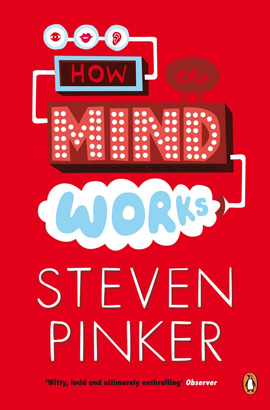
Explaining how the mind works is a big topic to take on. However, if anyone is up to the challenge, I imagine Steven Pinker has to be on the shortlist.

His central premise is that the brain is a series of specialised systems. Rather than being one general problem solver, it is a collection of machines designed to do different things.

For example, we have a language module and a facial recognition module. We know this because one system can be damaged. In a condition called prosopagnosia people are unable to recognise faces. They can recognise every day objects and show no cognitive impairment, except when it comes to recognising faces, when even their own family are a mystery to them.

This is perhaps why we have been unable to recreate human intelligence with computers (though why would we, artificial intelligence is just a different kind of intelligence). It’s not that computers are too specific, following their specific code – it is that they are general problem solvers and the brain is not!

That does not mean of course that the brain cannot adapt and repurpose. If you lose the sight of an eye, for example, that part of the brain will be used up processing imagery from the other eye. However, there is design (albeit naturally guided by evolution) and purpose behind the modules of the brain.

The brain does some things really well. Colour for example. How do we know what colour snow is? It sounds easy, but it isn’t! In direct sunlight, snow reflects lots of light. Indoors, it reflects less. But it is the same thing. A camera struggles to tell. That is why you often need to set the white balance, to tell it is looking at white snow in poor light rather than grey snow in good light. The brain does all this for us though.

It takes our sensory input and presents us with the world. Tilt your head, and notice the world doesn’t move. Again, if you did this on a camera it would list. Your brain, however, keeps things steady.

Other things it is less good at though. We are not great at recognising left from right. Why? Because any rule regarding left or right had to be generalised to both sides in our hunter-gatherer evolved brain. Hence we have no problems with up and down, but often struggle with left and right.

This is all a result of the environment in which we evolved. Phobias, for example, are all things we used to be scared of. Snakes and spiders for example. You do not need to teach a monkey, or a human for that matter, to be scared of a snake – they are innate. Yet similarly, we never develop of a phobia of electricity, even though that kills far more people.

We also calibrate our happiness based on other people. Pinker claims that there is no objective measure, we just use society to gauge what can be reasonably expected and set our levels based on that. Again, it makes sense from an evolutionary perspective, that we would balance our pursuit of happiness.

This makes a case for reducing income inequality. If one person makes £50 and someone else makes £500 it is not an everybody wins situation. Of course, you have to balance that with fairness and freedom, which is difficult.

He then talks about reproduction, which is quite a depressing section. Like most animals, we use sexual reproduction. The advantage of this is that you swap half of your DNA out every generation, thus making it harder for pathogens to crack the safe as it were. Good stuff there, we all enjoy sex. However, then he talks about babies and children.

It’s a war. The baby wants as much from its mother as it can, fighting her body to draw all the nutrients into the womb. Then once it is born it fights for all the attention, trying to stop the mother from having further children as this would reduce its own attention. To an extent anyway – eventually the chance of 50% of its DNA being in a sibling becomes worth it and it gives up screaming.

Pinker also discusses the sexes in nature. Most species operate with the female bearing the offspring and therefore having the most investment in it. Therefore females tend to be most picky about selecting mates of which there are plenty of options, whereas males want to spread their DNA as far and wide as possible, and compete with each other to do so.

This has interesting social implications. For example, the idea of men being “players” and women being “sluts” is, dare I say it, natural. This does not make it moral or right of course! However, these are not social constructs, but in fact the very opposite! These are naturally occurring tendencies that we are now overcoming thanks to society.

Indeed if people could be conformed to socially constructed gender roles this would soon be selected out because the powerful men in society would force them all to be celibate and cuckolded.

He also offers an explanation for the irrationally of love. Irrationally is actually a good way to fall in love. If you did it for rational reasons, you would just leave when you found someone better, which statically speaking if you get together in the first 30 years of your life, you probably would. Therefore falling in love for irrational reasons helps nature maintain monogamous relationships.

All interesting stuff. It felt a bit disjointed at times. It wasn’t one cohesive story but then that is the point of the book. The mind is not one unified general problem solver but a series of systems.

To me, this is Pinker’s “how it works” manual while The Blank Slate is the “what the consequences of that are” book, both of them together forming the full story. It has not changed my thinking is the radical way The Blank Slate did, but it s certainly is fascinating.

If you enjoy this, you will almost certainly enjoy Dan Dennett’s Consciousness Explained too.
how-the-mind-works

FIFA Women’s World Cup 2015

July 12th, 2015 | Sport

I really enjoy international women’s football because it punishes countries with high gender inequality more than anything the UN could ever do.

The Ivory Coast’s 10-0 drubbing at the hands of Germany is a classic example.

It is interesting though that whenever I asked anyone whether they had “seen the world cup?” the response was usually “oh the women’s football?”. In fairness, most of them had seen it. And why not? England did brilliantly! We should really look at this as our best opportunity to win a trophy.

We were (as an Englishman, and a supporter, I’m part of the team of course) unlucky to have lost to Japan and could easily have been in the final. That showed with our first ever victory over Germany – 21st time lucky!

FinnStore Self Storage

July 11th, 2015 | News

finnstore

Now that I will soon be marrying into a large estate, I’m pleased to announce my new business venture, FinnStore Self Storage.

Why pay Leeds city centre prices for self storage? We will beat their quotes and provide an even better experience. Self storage solutions for all sizes available at our site in Laitila.

Top features:

  • Unlimited room – the sky is the limit when there is no roof!
  • 24-7 access – simply fly to Finland, take the three hour drive to Laitila and access your stuff anytime
  • Theft-proof – nobody is going to make the 18 hour round trip to steal your worthless possessions
  • During the winter your items will be protected by a thick covering of ice and snow
  • Tough security – the area is regularly patrolled by bears and wolverines
  • Minimal chance of your documents being eaten by an elk thanks to our newly installed “no elk” signs

Contact us now to get a 80% introductory discount on your first 6 hours of storage!

Should you read the news?

July 10th, 2015 | Thoughts

An email went round work last week announcing that we were going to be having a minute’s silence for the victims of the Tunisian beach attack. As it happens everyone forgot when the time came but it brought up an interesting point.

I didn’t really know about it.

People were shocked, but it just had not entered my radar. I hadn’t seen the news and while there were probably some references to it, perhaps in conversation or on Facebook, I had just filtered them out.

I have gone through periods of my life where I thought it was really important to read the news. I would diligently check BBC News every day to find out what was going on in the world.

I have also gone through periods, such as now, where I just do not read the news. Why? Because it is generally full of unfortunate things happening to people. In fact, it is almost exclusively full of that.

It is extremely sad that those people died in Tunisia. In some ways it is an odd story to focus on. 50,000 people died of a preventable cause yesterday. That is 30 just during the minute’s silence. That isn’t in the news.

Similarly a story such as this might put people off from travelling to Tunisia. However, statistically the most likely way for me to die if I was to go there for a holiday, would be as it always is – in a car crash travelling to or from the airport.

It feels an odd thing to admit to being not just ignorant of something, but wilfully ignorant of it. However, my life does not seem to be much affected by my screening out of the non-stop string of mongering and negative news reporting that the media engages in, so it is hard to see how I am not better off without it.

Caught in the Pulpit

July 9th, 2015 | Books

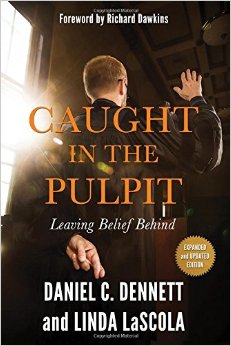
Not only does the audiobook of Caught in the Pulpit: Leaving Belief Behind feature Daniel Dennett and Linda LaScola reading their work, but it also includes a foreword by Richard Dawkins, also read by the man himself. I was hard before it had even finished downloading.

The book itself is about a study by Dennett and LaScola on ministers who have stopped believing. Most of them are trapped in this difficult situation – their family, friends, and livelihoods are tied up in church ministry, so admitting their non-belief is typically not an option.

Yet it is apparently widespread. Many of the people they interviewed share a common desire to help people, but think that the stories contained within their holy texts are nonsense.

Caught-in-the-Pulpit