Chris Worfolk's Blog


Viddyoze review

April 9th, 2017 | Reviews, Tech

Viddyoze is a cloud-based service that allows you to create intros and outros for your videos.

If you are not familiar with what they offer, here is one of the promotional videos from their YouTube channel:

This is my review. There is no promo code at the end: I know a lot of the “reviews” end with here is an affiliate link, but I don’t have anything like that. It’s just my perspective.

Pricing

It is priced at a one-time fee of $47 for the personal licence (30 renders per month) and $67 for the commercial licence (unlimited renders per month and the right to resell the renders).

It is advertised as being discounted down from $97 per month and $197 per month. However, it is not clear where these figures come from. As far as I know, these prices have never been used. I first saw Viddyoze months ago and the prices haven’t changed, so this isn’t a short-term discount, either.

However, it is also an additional $37 per month for access to the “template club”. I will talk more about this below.

What do I think of it?

I signed up and got access within a few minutes.

However, The first thing I was presented with was an upsell for the template club. This was an additional monthly subscription that gives you access to most of the templates. So, for example, if you wanted their promotional video, you will have noticed there are loads of cool intros and outros. However, these are only available if you pay for the template club.

With my standard access, you do get a bunch of templates (I think it is about 85). However, that is spread across all of the categories. This includes intros, outros, titles, lower thirds, etc. In terms of the number of intros you get, I think there were about a dozen in there. Which sucks. There were only a few I would actually want to use.

Using the software was okay. It is pretty fast. However, there is no preview. So if you have to do it and see what the result is. Then, if you don’t like something, such as the logo or colours, you have to do it all again. This is a little frustrating on the unlimited plan. On the 30 renders per month plan, that would be very frustrating.

Is it worth it?

It depends on how much you will use it. But, for me, no.

Because there are only a handful of intros on the basic package, I don’t think I would get much use out of it.

The other option is to pay for the template club. But this means you are paying $67 up front plus $37 per month, which is approximately $42 per month. As they point out in their video, there are people on Fiverr reselling their stuff. For $5 each. So, you need to be doing at least nine unique videos per month before it becomes cheaper to use Viddyoze rather than just hiring someone on Fiverr each time.

Is there a money-back guarantee?

Yep, 30 days. When I requested my refund they sent me a form to fill out with various transaction IDs I had to dig out of my emails. After that, they refunded me two later, which all seems reasonable.


How the budget shakes up for small businesses

April 8th, 2017 | Religion & Politics

It’s the start of a new tax year. That means another year of people trying to sell me their self-assessment services long after I have already filed mine. What joy.

Last year was a kick in the balls for small business owners. The government introduced a new tax on dividends, which is how small business owners typically pay themselves.

This year it looked like we were going to hit with the double whammy. First, that £5,000 limit was set to be decreased to £2,000, resulting in me paying tax on an additional £3,000 of income.

Second, the flat VAT rate for my industry was set to be increased by 2%. If you are not familiar with flat VAT, it is a scheme that allows small businesses to pay a set rate of VAT and not claim anything back on purchases, meaning you can avoid doing all the complex VAT accounting. It’s terrific.

This year hasn’t been a complete disaster. The VAT increase has happened, but the reduction of the tax threshold will not take place until next year. Add to that that the corporation tax rate had been reduced by 1% and the additional tax being placed on small business owners is irritating, but not crippling.

One thing remains clear, however. This Conservative government is no friend to small businesses. For a second year running, they have increased taxes in favour of cutting those for big businesses.

I’m on Udemy

April 5th, 2017 | News

Last month, I launched the IT Career Acceleration course for IT professionals looking to take the next step in their career.

Advancing your career is like being an athlete. Even the best athletes in the world have a coach to help them improve. It’s the same thing when you are writing your CV, winning interviews or creating a promotion plan: you need a coach. The course provides that.

That’s all super, except that not everyone wants to have to set up a new account or put their credit card details into an unknown site.

At the same time, there are great education platforms, like Udemy, already out there.

This made a natural fit for the ITCMC content. Which is what I have done. You can now find the Career Acceleration course on Udemy. It includes all of the video lectures and workbooks you get from us direct. The only thing missing is the checklists.

It’s all backed up by Udemy’s 30-day refund policy. Not quite as good as the 60-day one you get direct, but it still makes the purchase risk-free.

Introducing the Human Baby Cookbook

April 1st, 2017 | Books, News

Unlock the secrets to cooking human baby with this beautifully presented new cookbook.

Been tempted to try the other other white meat, but been confused by unclear instructions, endless barbeque sauce choices and the law? Never fear: let us take you by the hand. Learn how to buy, prepare and cook a meat that is abundant, sustainable and environmentally friendly.

This no-expense-spared hardback edition contains 31 delicious recipes, each illustrated with a full-page full-colour edge-to-edge photograph.

For anyone who considers themselves a foodie, this is a must by. Nobody could possibly walk past your bookshelf without commenting!

Order your copy now for £29.99 (plus shipping).

WAM anxiety challenge launches

March 31st, 2017 | News

Over at Worfolk Anxiety, we’ve just launched our 30-day challenge to help people reduce anxiety. It’s a free month of coaching where people get a different challenge to complete every day and a private support community to share experiences and access encouragement.

Pretty cool. But will it work?

The science says it will. The challenges are based on the lifestyle changes that drive improvements to mental health. I wrote about these in my book Technical Anxiety and look at them in far more detail in my upcoming book Do More, Worry Less.

But, of course, the science can say one thing: whether you can translate into success for people in real life is another. We’re working on a small scale: a few hundred people have signed up for the challenge. That is still enough to make me nervous, though. It needs to deliver.

We’re measuring the success as best we can so I will be able to write about the results next month. Until then, wish me luck!

Family parking

March 27th, 2017 | Family & Parenting

Family parking spots always seemed like an unnecessary thing to me. Sure, the extra space is nice. But that would be nice for everybody. Adults need to be able to get out of the car, too. It is not like families are disabled: why should they get preferential parking right next to the shop?

Now that I have a family, they still seem silly. I’m not going to unilaterally disarm by not using them, of course. That would be stupid. But I’m not convinced that any of us really need the parking spots to be there.

Indeed, they are not there in many car parks, and somehow we manage to survive.

Another oddity is that Homebase have family parking, but no changing facilities. That would have been a much welcome addition when Venla decided that mid-trip was the appropriate time to start screaming.

How to install Composer inside WordPress

March 26th, 2017 | Programming

WordPress has an ancient and ugly codebase. When you are writing plugins, you often want to make your code less horrible and use Composer to bring in dependencies as normal. How do these things fit together?

The first thing I tried was to create plugin-specific dependencies list. Inside the plugin directory, I created a composer.json> file, then ran the install and uploaded it.

This approach works fines when you only use a dependency once and no other plugin uses the same dependency. However, when I wanted to re-use a library in another plugin I had a problem. If I included it twice it would crash.

Installing Composer globally

The solution I came to was to do a global install of Composer. I created a composer.json file in the root and listed all of the dependencies I needed for my plugins in there.

Then, in each plugin, I checked for the file and included it.

if (file_exists(sprintf('%s/vendor/autoload.php', ABSPATH))) {
    require_once sprintf('%s/vendor/autoload.php', ABSPATH);
    add_filter('the_content', 'simple_related_posts', 30);
} else {
    add_action('admin_notices', function() {
        echo '<div class="notice notice-warning is-dismissible"><p><em>Simple Related Posts</em> plugin requires <strong>Composer</strong>.</p></div>';
    });
}

Drawbacks to this approach

This means plugins are no longer self-contained. You have to install the plugin and add the dependencies to your central composer.json file. That is messy.

With the code above, it does not check if the _correct_ dependencies are there. This is something you could add in. However, given the problem above, it seems like it would require so much manual management anyway that I would know what was going on.

Optimise for performance

If you are using Composer on production, do not forget to optimise the autoloader before uploading your files.

composer dumpautoload -o

Conclusion

Personally, I would rather lose plugins being entirely self-contained and benefit from Composer libraries. This approach works well for me because they are purpose-written plugins for my blog.

However, this approach would not work well if you were publishing your plugins as most WordPress users would not know what was going on.

5 reasons your community group should NOT use Facebook ads

March 25th, 2017 | Thoughts

You’re on the committee for a community group and you have a big event coming up. Someone suggests you should do some advertising as it would be a great chance to get some new people in. Someone else suggests “let’s do some Facebook ads”.

It is understandable why this suggestion would be made. Flyers are a massive waste of money. Plus, everyone is doing Facebook ads now. It seems like a great way to go.

It isn’t. Stop right now and make sure you can answer all of these objections before proceeding.

Your copy sucks

The art of writing sales material, known as copywriting, really is an art. It takes years to become good at copywriting. I’ve spent the last three months working on it, including buying expensive courses from some of the best copywriters around and my copy still sucks. Not just a little bit: it’s rubbish. It doesn’t convert.

And whether you are a business selling a product, or a community group selling an event, you need to convert some people into customers, even if that is only showing up to your event. Saying “oh we have this amazing event” is not enough. You need to write compelling stuff. That takes a professional.

Who are you going to target?

Facebook ads work because you can target specific people. But how will that work for your community group? The best marketers spend ages zoning in on their ideal customer, then market to them, then retarget them after they have visited their website.

Nobody has visited your website because you’re a community group, and even if they did, you don’t have a retargeting pixel on there.

So you target “people in my city”. Which is the equivalent of sending a blanket mailshot out via the Royal Mail. Most targetted direct mail gets a 1% response rate. Untargeted mail can only dream of that.

Facebook takes time to work

Facebook is very good at working out who your ads should be shown to. But this takes time. You have to spend money before it works. When I started advertising for the WAM 30-day challenge, we were paying £0.60 per click. Thre weeks later we were paying £0.15 per click. Facebook worked out who my ads should be shown to.

But that only happened after several weeks and several hundred pounds spent on ads. The first £100-200 is basically a fee you pay to Facebook so they can work out who to show the ads to. Then you start seeing results. How big is your budget? Probably less than that, right?

People don’t trust you

People are suspicious of paid advertising. They should be: a company is trying to influence them. You might think that you avoid this being a community group. But you’re wrong. You’re in a worse position.

Why? Because it is even more suspicious. ProCook follow me round the internet with adverts for their latest cookware. They know I have been on their website so they target me on Google and Facebook (and all the websites who use their ads, which is everyone). There are ProCook ads everywhere.

But at least I know what is going on here. ProCook is relentlessly targeting me because they are trying to sell me a pan. That’s the deal.

With a community group, it is a whole different ball game. What are they selling? How are they funding these ads? Is it a cult? What is their business model that allows them to run Facebook ads?

People want to discover community groups organically, either by searching for something they are interested in or because a friend told them about it. Seeing paid advertising makes it look like a religious cult or government-sponsored initiative to shift state-provided services off their books and into the hands of private individuals.

There are better things to spend the money on

Like making your events even more awesome. So that people come back. Most groups do not have a promotion problem. They have a retention problem. You only need one new person to come along each week and you have one hundred members after two years of running. But most groups are five years down the line with 20 members.

Do people read long-form content?

March 24th, 2017 | Success & Productivity

We are told that everyone on the internet has the attention span of a gnat. You have to write short copy and get to the point immediately or people will leave.

This is not true.

What is going on here, and why do we have this misconception?

How do we know it is false?

Website spy on you.

Not in a freaky “we’re watching you through a camera” CIA way. But they are watching.

They use session recordings. Services like Hotjar, CrazyEgg and Inspectlet track what visitors do. Every click, every scroll, every interaction with the page is sent back to their servers so that the website owner can watch it later.

Everyone is doing this. Well, not everyone. I am not doing it on this blog, for example. But for big companies, e-commerce websites or anyone with an analytics team, they probably have it installed.

This should not freak you out. It is all anonymous: you haven’t told them who you are. The session recording they watch could be anyone.

Unless you are on Facebook. Then they know exactly who you are. Every time you hover over that pro-Trump article or dietary video ad, for example, Facebook makes a record of it. But then, you’ve already told them all of your secrets and uploaded all of those private photos…

Anyway, I do have the software on Worfolk Anxiety. Specifically, I use it to see what people do on my landing pages. When I pay for an advert, I want to see how effective it is.

What do people do? Find out below…

What does turn people off?

First, let’s look at what _does_ turn people off.

It is true that people do get bored easily online. It is not necessarily because we have a reduced attention span. But there is a lot of competition.

Back in the day, you bought a newspaper and took it home. If you got bored, you would probably keep reading anyway. The alternative was to put your shoes back in, walk back to the corner shop and buy another newspaper.

Not so with the online world. If you are bored of that Guardian article, the Telegraph is two clicks away. Or dog videos. Lots and lots of dog videos.

With all this competition, people have upped their game. They make content easier to read. They use short sentences. Regular sub-heads. They get right to the point and keep the content interesting.

All of these things should be done in any piece of writing. But with the online world being so cut-throat, online writers have been forced to do it much faster.

So what do people do?

When you do get down to practising all of these good writing habits, people read your content.

The sales letter for our free 30-day anxiety challenge is over 1,000 words long. That is longer than 95% of the blog posts I write. It is two pages of A4. But people read it.

There are two types of visitors that hit that landing page. The first reads the headline and then leaves immediately. The second slowly scrolls down the page reading everything.

And almost nothing in between. Once people start reading, they read it all.

The pros get much better results

I have spent a lot of time working on my writing. But, not being a naturally gifted one, I still have a LONG way to go. I am not under any illusion that it is otherwise.

So I highly doubt my content is some magical exception to the rule because of how good it is. People just have longer attention spans than we think.

Better writers know this. And use it.

Sean D’Souza’s sales page for his article writing course is over 7,000 words, for example. Someone was telling me about a Ramit Sethi sales letter that was 47 pages long: and didn’t even have a call-to-action until 75% of the way through.

Conclusion

Whether you are blog posts, articles or sales copy, one thing is clear: people will read well-written stuff. If they are interested in the subject matter, they are willing to invest the time in consuming it.

If you are losing readers, then it is not internet attention spans that are at fault: it is your writing. Make it more readable, and you will hold people’s attention to the end.

I’m sorry YOU feel that way (about OUR toilets)

March 23rd, 2017 | Thoughts

Earlier this month, we celebrated Elina’s birthday. We went big: giving Venla to my parents to look after while we went on a food crawl around Leeds. By the end of the night, I was taking pictures of toilet signs. Why was this?

First up: what exactly is a restaurant crawl? It’s what you imagine it to be: a pub crawl, but with food, as well as drink.

We started at Yo Sushi. Who charge £1.30 for tap water! I had the soft shell crab tempura, which was good, but not as good as Chaophraya’s version. We moved on to The Alchemist for a round of cocktails, before hitting up Yoko’s Teppanyaki who kindly squeezed us in, before finishing up with dessert at TGI Friday’s.

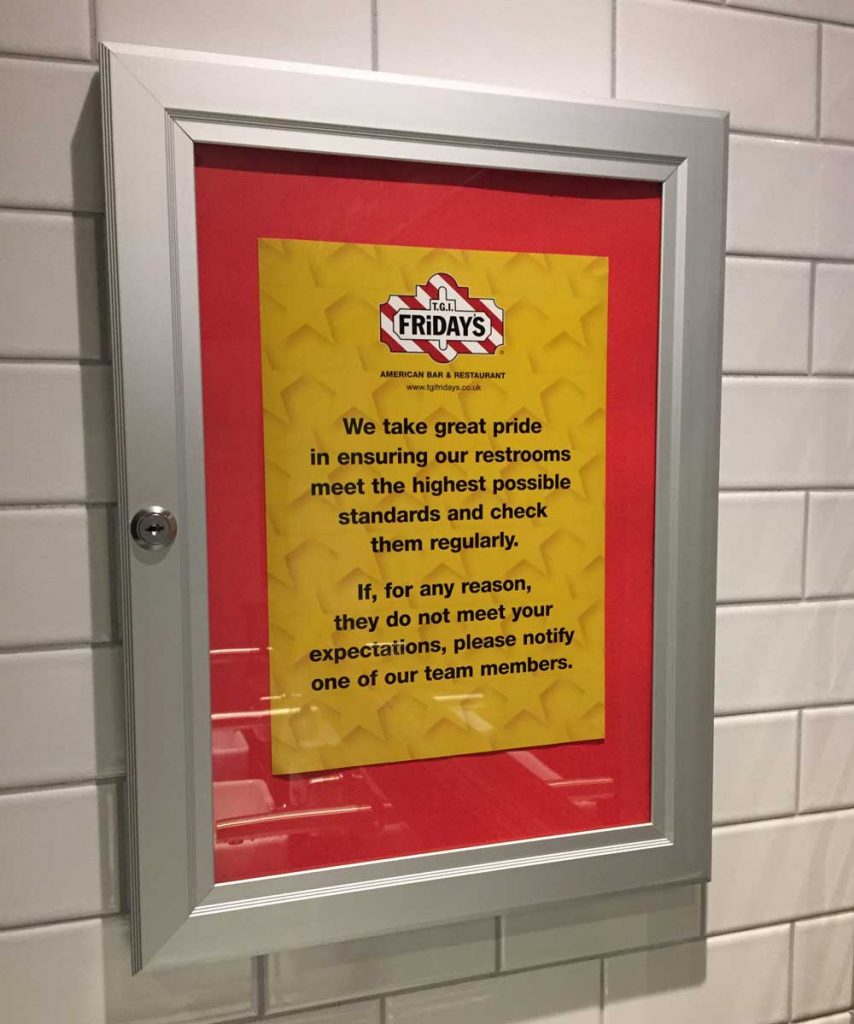
It was at this point, that I spotted the sign above.

If, for any reason, they do not meet your expectations, please notify one of our team members.

If the toilets were dirty, I think this would put me off speaking to anyone. Why? Because it implies that it is my fault. It is like when you say to someone “I am sorry you feel that way”. That is not an apology: it is making it clear that it is their problem and not yours.

Maybe they want to put people off. However, TGI seems to have a responsible focus on customer service so I will take it as an honest attempt to speak up.

A better way to word it would be to say “if the toilets are dirty”. It is pretty objective, right? The toilets are clean or they are not. People can then make a subjective choice about it. What they do not have to worry about is whether their expectations ae reasonable or not.