Posts Tagged ‘running’

May races

Friday, May 1st, 2020 | Sport

Tomorrow would have been Tour de Yorkshire. Instead, we’ve got an email confirming at World Triathlon Leeds has been upgraded from postponed to cancel. But not all is lost.

Everymayday 10k

As a fundraiser for the WHO COVID-19 Solidarity Relief Fund, we’re running 10km every day throughout May. That adds up to 310km in total, which is 7.3 marathons. I don’t feel super-prepared as it’s a higher weekly mileage than I usually do. But might be doable with plenty of easy runs and some run-walks, or just plain walks.

Find out more on the JustGiving page.

The Great Virtual Race Across Tennessee

From the mind of Gary Cantrell, creator of the Barkley Marathons, comes this virtual race. 1,021 kilometres from one corner of Tennessee to the other. Still, you have four months to complete it, which means you need to average 8.3km per day.

My original target was to do half of the distance. I think 500km is still a good crack at it. But, if I get through the #everymayday challenge, who knows. The important thing is that you get the t-shirt just for starting.

You still have time to sign up if you fancy the challenge.

Garmin activities not uploading

Wednesday, April 29th, 2020 | Tech

If you watch is syncing with Garmin Connect or Garmin Express, but not appearing in Garmin Connect, it could be that the activity has corrupted.

You can fix this by plugging your Garmin watch into your computer, browsing to Device/Garmin/ACTIVITY and finally finding the .FIT file. Try uploading this to Garmin Connect manually. If it says unsupported file type, you know you have a corrupt file.

Take it to Fit File Tools and run it through their fit file fixer. Download the result and try re-uploading it to Garmin Connect. Hopefully, it should be accepted this time.

Endure: Mind, Body and the Curiously Elastic Limits of Human Performance

Tuesday, April 28th, 2020 | Books

Endure: Mind, Body and the Curiously Elastic Limits of Human Performance is a book by Alex Hutchinson.

It’s an interesting book for understanding the limits of human performance from both a physical and psychological point of view. Not that all questions are resolved. But there is plenty of discussion.

Below, I have picked out a few points.

Typically, you don’t run yourself to exhaustion. Your brain stops you before you reach that point. And that starts from the minute you start exercising. For example, cyclists set off slower from the start on a hot day.

But when you get in sight of the finish, you know the danger is over and you can sprint. Hence we can be hurting so much until the final straight, at which point we find that last bit of energy to push across the line.

How does this work? Is there some kind of internal regulation in the brain that we are not consciously aware of? Or is there another explanation? For example, could we be tapping into anaerobic energy?

It seems likely that the brain does have some control. For example, everyone finishes a marathon in just under 3, 4, 5 hours. Only the brain can respond to these abstract concepts. So why do so many more people finish a marathon in 3:59 than 3:47?

Similarly, how is it that the limit that climbing a mountain without oxygen turns out to be almost exactly the high of Everest? If Everest was a little smaller, or a little larger, would it turn out that the limits of climbing without oxygen were different also? It seems likely given that it was thought to be impossible until Reinhold Messner and Peter Habeler did it. Then they changed the sums to show it was just possible.

Finally, a note on hydration. We often hear the idea that if you wait until you are thirsty, it is too late. But voluntary dehydration seems to be fine in the short term. Top marathon runners sweat more than 3.5 litres per hour. They replace nowhere near this much. If our performance drastically drops when we lose 2% of our body weight, how did Gebrselassie become an Olympic champion when losing 10% of his body weight? That is not to say drinking to thirst is the perfect strategy for running a marathon: but it does seem to be fine for everyday life.

Virtual parkrun PB attempt

Saturday, April 25th, 2020 | Sport

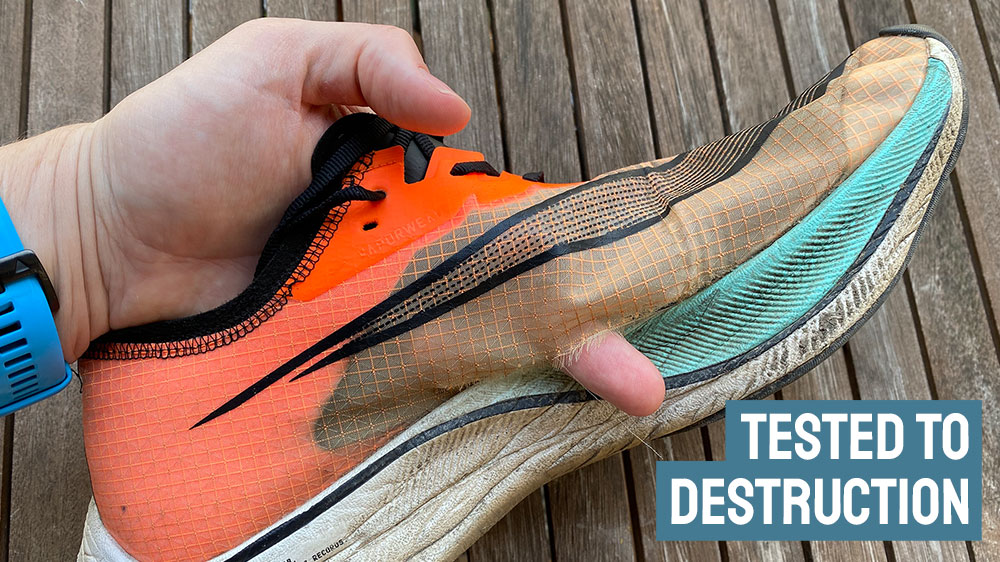
The lockdown seems like a good excuse to do some fast running. And, now that I have decided that I can live with the Nike Next%, I was eager to see if they really could reduce my 5km PB time. So, I decided to go out early Tuesday morning while it was still cool.

I felt crap when I got up. I didn’t think about abandoning, but I did think “remember this feeling for the next time you’re feeling crap, in case you ace it”. The weather was pretty good: nice and cool but there was also a strong headwind on the finishing straight.

I jogged up there but had to come down to a walk on Clarendon Road because the shoes were really digging into my feet. As I reached the top, it eased off a bit, and I figured it was going to hurt a lot anyway, so I might as well give it a go. After a few minutes sit down in the park, I counted down from 10 and set off.

My first kilometre came in at 4:08. After that, I had to back off a little as my chest started to burn. My previous PB was 22:06, so even on a great day, sub-21 was unlikely. Therefore, anything near 4:12 was acceptable. I settled in around the 4:20s, which I was fine with as even a 22:30 would show I could still run at around my best.

As each kilometre went by, where my watch said I was and where I knew the parkrun markers would be, drifted apart. I had specifically turned GLONASS on, as well as GPS, to get a more accurate reading but it was to no avail.

As I fit the final straight I smashed into the wind and felt like I was sprinting while simultaneously feeling like I was slowing down. I crossed roughly where the parkrun finish line is at 21:06, although I had to keep running to 21:29 until my watch registered 5km.

21:06

Which was one was correct? I’m going with the official parkrun course, which I assume they have carefully measured. It was a clear day, though, so there should have been a good satellite signal.

After the run, I collapsed on the grass and took 5-10 minutes before I could get up and walk again. Based on the parkrun line time, I was exactly 60 seconds faster than my previous PB. At 4%, the shoes would give me 53 seconds. That means I was the other 7 seconds of improvement. Or at 5%, 67 seconds, in which case I lost 7 seconds. But either way, my fast running is still in good shape. Of course, it is easier without the crowds, too.

And that’s the story of how I got up before 9am for the first time since the lockdown started.

Irongran

Friday, March 20th, 2020 | Books

Irongran: How Keeping Fit Taught Me that Growing Older Needn’t Mean Slowing Down is a book by Eddie Brocklesby. She started running in her 50s, took up triathlon in her 60s, and holds the record of the oldest British woman to finish an Ironman, aged 74.

In her biography, she shares her story of how she got involved in endurance sports, went on to found the charity Silverfit, an organisation dedicated to getting older people active, and the many Ironmans she has done. I lost count but I am pretty sure she has finished at least five: Lanzarote twice, Kona, Vichy and Cozumel.

It’s not a rags-to-riches story. She starts by talking about her grandmother who was Winston Churchill’s private cook. But throughout the book, she shows a high level of self-awareness about her opportunities and ability to afford what all of us in triathlon must surely admit is an expensive sport.

Some of the story seems like a sharp contrast. For example, she says she is not well organised. And yet managed to maintain a career, running Silverfit and Ironman training: all things which sound like they need a lot of organisation. Similarly, it’s not like she never got off the couch before 50 as she did play netball competitively, although it is true that she never tried endurance sport until later in life.

Overall, it is a fun and inspiring read.

Leeds Dock social run

Tuesday, March 10th, 2020 | Sport

Back in August, my friend Jenny and I set up a social “run and chat” type group for people working at Leeds Dock to encourage them to get out from behind the desk each Wednesday lunchtime.

Seven months later and we’re still running. We run for around 30 minutes, heading down the navigation towpath for 15 minutes, turning around and running back. It’s been lovely to chat to different people and see people go from strength to strength as their running improves week on week.

Sadly, the COVID-19 crisis looks like it will put the club on pause for a while, and I’ll be finishing with my client down at Leeds Dock, so that’s probably it for me. But it’s been a blast and I wish them many happy runs in the future.

Karhu Synchron running shoe review

Monday, February 10th, 2020 | Reviews, Video

Karhu is a Finnish running shoe brand and the Synchron is their support shoe. I wanted to love it but I don’t.

The shoe pinches my midfoot and digs into my plantar fascia underneath. It’s not as bad as the Karhu Fusion, but it is still uncomfortable. It’s not as tall as the Fusion, which makes it difficult for me to get my foot into it. The toe box suggests I am wearing the right size; the shoes are simply not tall enough.

It feels like quite a heavy shoe and after any period of time running, my toes start to get hot. They have a chunky sole but it does not give much back. Hoka have an annoying large sole but at least it gives something back; the Karhus not so much.

It is a shame because they look nice, albeit not quite as nice as the Karhu Fusion. But, alas, the Synchron is not the running shoe for me.

Karhu Fusion running shoe review

Sunday, February 9th, 2020 | Reviews, Video

The Karhu Fusion running shoe is a story of heartbreak. Visiting Finland regularly and speaking some Finnish, the minute I saw the word karhu, I wondered if it was a Finnish brand. And it was. A legendary Finnish brand with over a hundred years of running heritage.

The shoes look great and the Fusion is tall enough to fit my foot in.

However, it is also uncomfortable. The mid-foot rocker digs into my plantar fascia and I came off a treadmill run in some discomfort. They feel heavy without providing much cushioning, so it is like running in a big shoe without the benefits you usually get from them. In fact, they pinch my midfoot the whole way around, from the bottom to across the top as well.

So, unfortunately, these are not my new running shoes of choice.

Abbey Dash 2019

Thursday, December 26th, 2019 | Sport

I love the Abbey Dash as it is a great chance to get together with the running club over a few beers. It’s almost a shame there has to be a run before it.

My 10km run PB was in a strange place. Officially, it was 49:47, set at the 2017 dash. But in 2018 I ran 47:36 at Wetherby Triathlon and 47:12 at World Triathlon Leeds this year. Where they short? Too down hill? Or just my best runs?

I wanted to put that question to rest and so resolved to go out at 47-minute pace. The 22:30 ai ran at parkrun the week before suggested I should be able to run a 47:04 but I was worried that a year of Ironman had eroded my top-end speed.

The weather is always cold so this year I came prepared. The day before I popped down to a charity shop and bought a hoodie to wear before the race. There was a little rain before the race, but otherwise cold and sunny: PN conditions.

This year, the start moved from Wellington Street to The Headrow. Julie says this is the way it used to be. This meant cutting out the congestion point around Cardigan Fields. No speed bumps to jump this year.

My target pace was 4:42 per kilometre. My first km was downhill and came in at 4:32 but I then slowed down to 4:49 for the second. I tried to pick the pace up but couldn’t and slipped a few more seconds behind all of the way to the abbey.

I went around the turn at 23:40, ten seconds behind target pace. I was hurting and wanted to give up, but convinced myself that it might get easier, and even if it didn’t, I wanted to get as close to those triathlon times as possible: 47:10 would still be a PB after all.

The return journey starts with a downhill and I put in a 4:30 kilometre. After that, I didn’t slow down. Harriers kept screaming my name. I was head down racing, it thank you to everyone who did: I did hear you!

By kilometre seven and eight ai had realised that I was slightly ahead and just needed to keep it going. That was a scary prospect given there was a slight climb to The Headrow but I hoped I could rely on the adrenaline of being so close to keep me going.

I kept checking my watch to try and hit the perfect pace. I did not want to go too hard and blow up. I turned on the Galileo tracking (Europe’s GPS satellites) and my watch was pretty spot on with the distances.

As I crossed the line, I stopped my watch and looked down. It read 46:12. I couldn’t believe it. I have no idea where I found that minute. My official time came through via text 30 minutes later.

46:11

I am happy with that. It represents the fastest 10km I could run right now. I paced myself the whole way, pushed hard and kept a consistent heart rate of around 190 bpm.

Thank you to everyone on the route that was cheering us along.

Since the event, it has turned out that the course was 23 metres short. Even with an additional 23 metres, it would still be a PB, so I’m counting it.

Chicago Marathon 2019

Thursday, October 17th, 2019 | Sport

Chicago is one of the six marathon majors in the world, along with London, Berlin, Tokyo, New York and Boston. Why this is, is unclear. Nobody turns up to Chicago. The London route is lined with supporters the entire route. In Chicago, you can hear the footsteps of the athletes on the TV camera because there is no other sound.

That did not stop Brigid Kosgei, however. The London marathon winner shot out of the gate and refused to slow down, coming home in a new world record time of 2:14:04. This smashed the previous record of 2:15:25 that has been held by Paula Radcliffe since 2003 by 1:21.

On the finish line, Radcliffe congratulated Kosgei and said she always knew this day would come. I think collectively, as white people, we all knew this day would come, too. Radcliffe’s previous record was itself phenomenal, being over 3 minutes ahead of Catherine Ndereba’s 2001 world record time. It had stood for 16 years. The nearest anyone has got to it until now was Mary Keitany with 2:17:01.

Notably, of the 10 fastest marathon times ever for both men and women. Radcliffe’s time was the only one not set by a Kenyan or Ethiopian. Whatever genetic or cultural factors allow Africa to produce the world’s best distance runners, Radcliffe has been the only person in the world who was able to keep up with them. On the men’s side, you have to go back to before I was born to find a non-African world record holder.

But all records fall eventually (except Jerry Rice, obvs), and Brigid Kosgei’s incredible performance puts her nearly three minutes ahead of any time other the Radcliffe. That’s a huge gap. Will it too stand for decades, or give other runners the self-belief that they can run faster, too? I’m excited to find out.