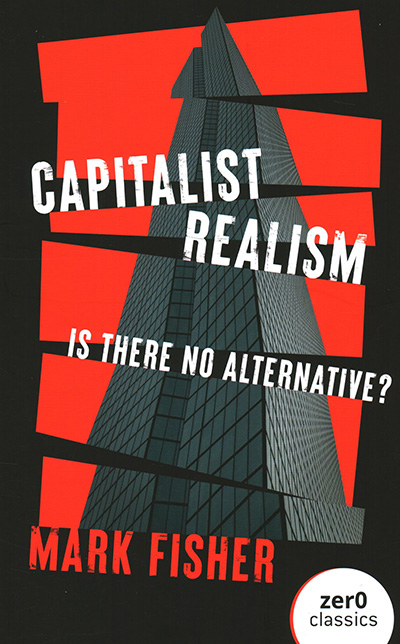
Capitalist Realism: Is There No Alternative? is a 2009 book by Mark Fisher.
It explores the idea that capitalism has become so all-consuming, that we can no longer imagine an alternative even as we watch neoliberalism burn the planet to the ground. As captured in the phrase, “it is easier to imagine an end to the world than an end to capitalism.” This, like so much of the book, has been prophetic, as we watch climate breakdown occur before our eyes.
Capitalism no longer tries to justify itself, or hide its flaws, but simply says that it is the only viable system and therefore we have to accept it. It even appropriates those who challenge it: we can buy Fair Trade or Product Red and feel we are doing our bit to mitigate the damage while consuming.
Similarly, Netflix is now awash with documentaries about the problems of everything from fast fashion to climate change, all while being streamed to us from huge data centres. We can then go on social media and be angry about it. But far from opposing the situation, this action provides big tech with free content that they can then monetise for ads.
But maybe it is all worth it. Capitalism claims to offer us an efficient market. But does it fulfill this promise?
The answer is no. Anyone who has phoned a call centre experiences the endless bureaucracy of capitalism. You have to fight your way through a phone menu to speak to a human. But even then, the human can almost never help. They have to send it off to another team and make an empty promise to get back to you. There is no point being angry at them because they are just as much a victim of the system as you are. It’s the same problem the farmers faced in The Grapes of Wrath.
Under market based systems, endless targets are set. And the machinery of organisations is focused on achieving these targets rather than doing the thing itself. Universities become more interested in league tables and student satisfaction surveys than teaching students. This is what Fisher describes as Market Stalinism. The market model creates more bureaucracy, not less.
A good example of this might be marketing. Here is a whole profession that is entirely unnecessary under alternative economic systems. You might argue that people would still need to know about products. But because we can’t trust companies to be honest, we need independent reviews such as Which Magazine or Consumer Reports to give us reliable information. Under capitalism, this parallel system already exists and marketing largely exists to prevent the efficient delivery of high-quality products by manipulating us through branding.
Fisher also discussed the privatisation of stress. Anxiety and depression are a social problem, but neoliberalism has convinced us that the problem is us: that we are somehow defective, and then tries to sell us purely individual solutions in the form of anti-depressants or therapy. But, as discussed in The Inner Level, inequality is shown to be causative to higher rates of mental illness. Given the book was published in 2009, just as IAPT was rolling out, this is perhaps one of the most prophetic points of the book.
Fisher offers some suggestions for fighting back. He suggests we resist managerialism. Strikes, which worked well in an industrial era, may not be as effective today. When teachers strike, schools get to reduce the wage bill and targets are not affected. This is critical because managers exist to fulfil targets, not to teach students. A better approach might be to target the things managers care about: metrics, reputational damage, and paperwork strikes, as these things would target things managers are actually measured on.
Seventeen years on, this is still a highly relevant read. Indeed, it only becomes more relevant as time goes on.
Don't have time to check my blog? Get a weekly email with all the new posts. This is my personal blog, so obviously it is 100% spam free.
This entry was posted on Monday, April 20th, 2026 at 11:00 am and is filed under Books. You can follow any responses to this entry through the RSS 2.0 feed. Both comments and pings are currently closed.