Thinking, Fast and Slow
Friday, August 1st, 2014 | Books
Daniel Kahneman is a psychologist who won the 2002 Nobel Prize in Economics. His book “Thinking, Fast and Slow” summarises a lot of the research he has done and proves to be a fascinating reading.
As someone who isn’t a psychologist I found some of it heavy going, but very interesting. The book is arranged into sections and these are then broken down into short chapters, which made it more readable.
Some of it was shocking too. For example, when it comes to making parol decisions, one of the biggest factors is how recently the parol office has eaten! Just after a meal they are far likely to grand you parol than just before a meal.
His discussion on priming reminded me a lot of what Richard Wiseman talks about in his book Rip It Up. Behaviour can drive emotion, even though we always think of it as emotion that drives behaviour.
The question of how effective pure branding advertising is gains some support. “Familiarity is not easy to distinguish from truth”. The more you show something to people the more confident they feel about it. Other times a lack of clarity is helpful. For example, using a bad font makes exam scores go up, because people have to concentrate more than they normally would and so make less mistakes.
Much of the book discusses the differences between System 1 (that does the fast thinking) and System 2 (that does the slower, more considered thinking). Elina often reproaches me for not noticing snails on the path, suggesting that I need to notice things or one day I will be eaten by a lion (metaphorically, these days). I now maintain that my System 1 is keeping an eye on things and simply not bothering to engage my System 2 because there is no danger.
Kahneman also adds weight o Burton Malkiel’s book A Random Walk Down Wall Street, which both discuss how the stock market is almost entirely unpredictable and therefore stock market traders actually add no value to what they do. Indeed, as 60% of mutual funds do worse-than-guessing, they actually subtract value.
Ultimately, people are just really bad at making judgements. 90% of drivers rate themselves as above average. Similarly, the majority of new businesses fail, yet the people who start them almost always believe they are exempt from such rules.
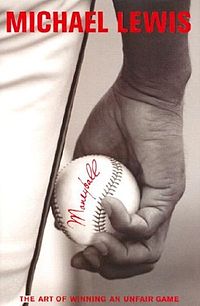
The answer to many of these issues is to replace judgement with a formula. This is essentially the entire point of Michael Lewis’s book Moneyball. Even a simple formula will do, according to Kahneman multiple regression does not even make it much more accurate.
One of the most useful points I took away from the book (almost certainly not the objectively most useful) is the idea of taking small gambles. In one chapter, Kahneman describes how people are unwilling to take profitable one-off gambles, such as a 50/50 chance of winning £20 or losing £10, but would be willing to take it if they knew they could take it 100 times in a row. The larger sample size means they are very likely to come out on top. However, they fear doing it once because there is a 50% chance they will lose and that will go down in their mental accounting.
Kahneman makes the point that we are “not on our death bed” and thus we will get chance to get even with the universe over time. Extended warranties are a great example of this. You pay a premium to insure your products, so it costs you money in the long term. A better strategy is not to buy the warranty and accept that sometimes you are going to have to replace a product – but over your lifetime you will almost certainly be up.
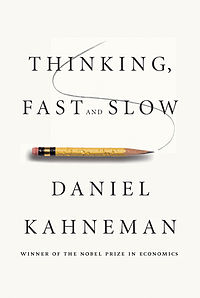
Daniel Kahneman is a psychologist who won the 2002 Nobel Prize in Economics. His book “Thinking, Fast and Slow” summarises a lot of the research he has done and proves to be a fascinating reading.
As someone who isn’t a psychologist I found some of it heavy going, but very interesting. The book is arranged into sections and these are then broken down into short chapters, which made it more readable.
Some of it was shocking too. For example, when it comes to making parol decisions, one of the biggest factors is how recently the parol office has eaten! Just after a meal they are far likely to grand you parol than just before a meal.
His discussion on priming reminded me a lot of what Richard Wiseman talks about in his book Rip It Up. Behaviour can drive emotion, even though we always think of it as emotion that drives behaviour.
The question of how effective pure branding advertising is gains some support. “Familiarity is not easy to distinguish from truth”. The more you show something to people the more confident they feel about it. Other times a lack of clarity is helpful. For example, using a bad font makes exam scores go up, because people have to concentrate more than they normally would and so make less mistakes.
Much of the book discusses the differences between System 1 (that does the fast thinking) and System 2 (that does the slower, more considered thinking). Elina often reproaches me for not noticing snails on the path, suggesting that I need to notice things or one day I will be eaten by a lion (metaphorically, these days). I now maintain that my System 1 is keeping an eye on things and simply not bothering to engage my System 2 because there is no danger.
Kahneman also adds weight o Burton Malkiel’s book A Random Walk Down Wall Street, which both discuss how the stock market is almost entirely unpredictable and therefore stock market traders actually add no value to what they do. Indeed, as 60% of mutual funds do worse-than-guessing, they actually subtract value.
Ultimately, people are just really bad at making judgements. 90% of drivers rate themselves as above average. Similarly, the majority of new businesses fail, yet the people who start them almost always believe they are exempt from such rules.
The answer to many of these issues is to replace judgement with a formula. This is essentially the entire point of Michael Lewis’s book Moneyball. Even a simple formula will do, according to Kahneman multiple regression does not even make it much more accurate.
One of the most useful points I took away from the book (almost certainly not the objectively most useful) is the idea of taking small gambles. In one chapter, Kahneman describes how people are unwilling to take profitable one-off gambles, such as a 50/50 chance of winning £20 or losing £10, but would be willing to take it if they knew they could take it 100 times in a row. The larger sample size means they are very likely to come out on top. However, they fear doing it once because there is a 50% chance they will lose and that will go down in their mental accounting.
Kahneman makes the point that we are “not on our death bed” and thus we will get chance to get even with the universe over time. Extended warranties are a great example of this. You pay a premium to insure your products, so it costs you money in the long term. A better strategy is not to buy the warranty and accept that sometimes you are going to have to replace a product – but over your lifetime you will almost certainly be up.