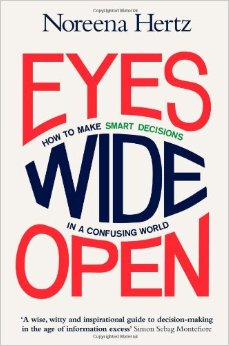
I recently read Noreena Hertz’s book “Eyes Wide Open: How to Make Smart Decisions in a Confusing World”. It’s quite a good read. In the book she puts forward some of the problems with decision making in the modern world and how can improve our own thinking.
I have picked out some of my favourite quotes and ideas.
“We need to be better decision makers, have decision making classes in schools”
This I would totally agree with. If people had a better understanding of decision making, scientific analysis and understanding statistics and information you would hope that we would at least some of the time have better decisions making, even if that doesn’t fix political bias.
However, I think some of the picture of the “modern world” being such a problem is unjustified.
“The average copy of the New York Times contains more information than you would have encountered 300 years ago.”
That I would suggest is nonsense. How do you measure information? I am sure the New York Times contains a lots of facts and figures, but if you think about the amount of information you pick up just by living your life, its a lot.
Take cooking for example. There is so much knowledge in preparing ingredients, putting it all together and cooking it, serving it, tasting it – tasting food alone has to be a huge amount of information. The human brain can store loads of information.
She probably means specific information in a context. However, it struck me as an add thing to say. She then goes on to say that this is a lot given we can only hold seven things in our memory. Though the latest research indicates this is only two or three things anyway.
“Our world is increasingly unstable and we cannot rely upon it anymore.”
Again, this to me seems like nonsense. Our world is the most stable it has ever been. On a global level, less people are being killed by war than ever before. However, it is on a personal level were we really have seen the chance.
Hundreds of years ago, if the crops failed, you were fucked. Totally fucked. There was a good chance you would die. Just ask the Irish. Today I can walk into Tesco and buy food 24 hours a day, 7 days a week. It will always be there. There is no time when Tesco do not have food.
So who cares if Leman Brothers might collapse overnight. I will still be able to find food, clean water, shelter and medical care tomorrow, and the day after, and the day after that.
In short, I think she paints a much bleaker picture than we actually find the world. However, there is plenty of room for improvement. Luckily there were some buzz words to the rescue – lets go about making some empowered decision making.
Intuitive thinking
One of the first things that I liked was that She then says that intuitive thinking is often wrong, in contradiction to Gladwell. She even says something like you can’t just blink and make a good decision. Perhaps as an intention reference to the nonsense Gladwell wrote in his book entitled “Blink”, or perhaps not.
Social media
Hurtz puts forward the idea that the constant ping of emails, phone calls and other distractions utterly ruins our train of thought. “Social media is distracting.” I have not seen the research on this, but it would be interesting to know if this is also true of the younger generation who have grown up with it.
Cult of the measurable
Hurtz laments the rejection of anything that cannot be measured. SHe claims that domestic violence is ignored because it is hard to measure. This is a big claim, so I would like to see some evidence on that before I believe it. Of course it could be the case, and if it is, that is something we should address.
Measurables are important though. Maybe not with wine, the example Hurtz uses, but they are with most things. How do you measure success without measurables? How do you make an evidence-based decision if you cannot measure the evidence? It provides the justification for your decisions.
Positivity bias
Most people have a positive bias. Ironically, it is depressed people see the world most clearly. Everyone else overlooks the negative stuff. This should be taken into account when making decisions. You should re-adjust your perceptions in case bad things happen.
I discussed this idea with my friends and family. They said, in my case, I was probably adjusting far too much already lol.
Recency bias
I am not sure what the actual name of it is. However, Hurtz tells the story of an ER doctor that had seen a lot of pneumonia cases recently. A patient came in with slightly odd symptoms that did not quite fit. However, the doctor diagnosed it as pneumonia. Another doctor, who had not seen all the cases, immediately correctly the diagnosis to aspirin poisoning.
This is something I could definitely do to be more aware of at work. Often I will be trying to trace down a bug, as it is the same thing I have seen before, but the usual fixes and debugging are getting me nowhere. Usually, it will turn out to be something totally different, but because I am zoned in on a particular problem, I miss it.
Challenger in Chief
Hurtz recommends you appoint someone to pay “Challenger in Chief”. Their job is to challenge your ideas in an attempt to overcome your optimism bias. They can play Devil’s Advocate and put your ideas to the test.
Pick your historical lessons carefully
Do not get hung up on past success and failures. Richard Zanuck, one of the producers of the Sound of Music, went on to commission several more musicals after the huge success of the first. They flopped. History is not always a good indicator.
This correlates with what Duncan J Watts writes. History only happens once, so is a sample size of one. His classic example is the Minidisk. Sony, hurt from losing the VHS Betamax wars, really did learn its lessons and make an excellent product in the Minidisk. But it still flopped, because of the entirely unpredictable rise of file sharing making MP3 devices popular. Do learn from your mistakes. But do not learn too much.
Thinking time
According to Eyes Wide Open, Barack Obama advised David Cameron to allocate large parts of his day to time where he does nothing but sits and thinks.
I cannot find any evidence to support the claim made in the book, but it is good advice anyway. At work, sometimes I just sit and think. That time is an investment, allowing me to work out the pros and cons of my ideas before I implement them, thus saving time in the long run.
It is also a good idea to not implement ideas straight away. When you first come up with an idea your a) probably quite excited about it and b) have not had time to think it through. Put it at the back of your mind and mull it over for a while before doing anything.
This is something I already practice at work and home. If I decided to take on a new project or get involved with a new charity, I will wait a few weeks and see if I am still as excited about it as I was when I first thought of the idea. Only after sustained interest in an idea will I pursue it.
Similarly, at work, if we need a new feature implementing, I will generally leave it to the next day so that my mind has time to process the pros and cons of my approach.
CV writing
Studies on CVs that suggest if you write it in the third person it is taken more seriously. So the next time you are updating your CV, replace “I lead a team and I implemented x” to “Leading a time and implementing x”.
Anchoring
Anchoring is a real problem, and something Kahneman writes a lot about in Thinking, Fast and Slow. If you are not familiar with the problem it is this. If you ask someone who much a house is worth, they will probably give you a reasonable estimate. However, if you tell them the house recently sold for a huge amount, they will subconsciously anchor on this, and give you a much higher estimate.
This is not always a problem, but is a massive problem when it comes to things like sentencing a convicted criminal to x number of years in prison. It is also one of the reasons why you can get a much better pay rise by switching companies.
Once you are aware of these potential anchors and biases, you can try and eliminate them. Hurtz recommends painting a blank canvas. If you are looking round a new house for example, and the current owner has baked some fresh bread to bias your senses, take the time to try and imagine it without it without the smell.
Colours affect our judgement. This is something we saw a lot at Sky Bet. Just changing the colour of a button for example could have a significant impact on whether people clicked it or not.
Narrowcasting
Do not be so hasty to block people with different opinions on Facebook and Twitter. It is important to expose yourself to different points of view, otherwise you find yourself in a bubble where all you ever get is people reinforcing your existing opinions, regardless of their validity.
I have Facebook friends who post material from the far left, and occasionally from the right. I have religious friends and foreign friends with cultural differences, and many of their opinions I do not agree with. However, I am glad they share them with me to challenge my own point of view.
Eli Pariser also has a great TED talk about this.
Summary
While I think the introductory chapter perhaps over-emphasises the problems with modern society, this book is filled with good ideas. Of course, I would think that as I already use a lot of them, but there was plenty of useful reminders and new ideas that for me, made this book an excellent read.